










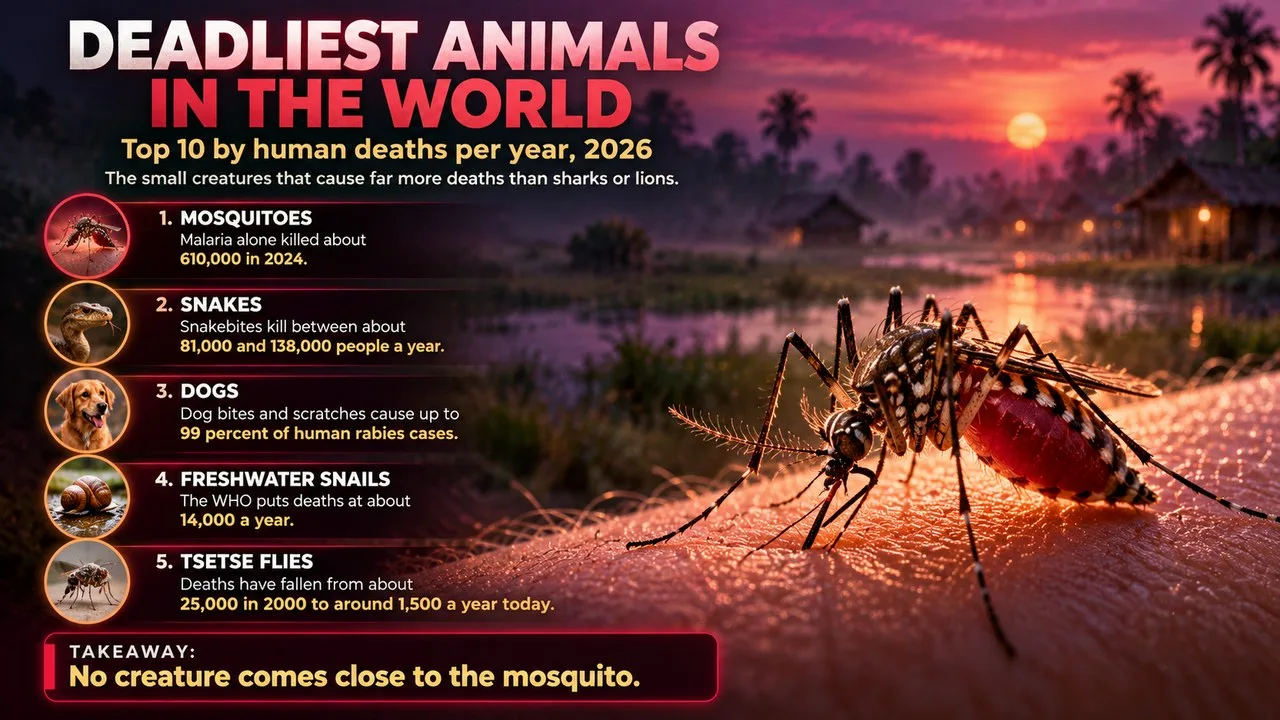
The deadliest animals in the world are led by the mosquito, whose diseases kill about 760,000 people a year, according to health estimates as of 2026.
This Finepedia guide, written in October 2026, ranks the ten animals that cause the most human deaths each year. Most of them are small: insects, worms and snails that pass on parasites and viruses, rather than the big predators that star in films. Sharks, for example, kill only about six people a year, while lions, crocodiles and hippos each account for a few dozen to a few hundred. For more on nature's hidden dangers, see the Finepedia guides Most Venomous Snakes in the World: Top 10 and Most Deadly Diseases in the World: Top 10.
How We Chose These
We ranked animals by the estimated number of people they kill in a typical year, either directly through bites, stings and attacks or indirectly through the diseases they carry. Our main source is the Our World in Data review of deadly animals, last updated in February 2026, which draws on figures from the World Health Organization (WHO) together with the Global Burden of Disease project run by IHME in Seattle. We checked each figure against WHO fact sheets. Humans themselves, who kill about 600,000 people a year through violence, are left out. All figures are rounded, and several are uncertain by thousands.
The 10 Deadliest Animals at a Glance
| Rank | Animal | Estimated deaths per year | Main cause of death |
|---|---|---|---|
| 1 | Mosquitoes | 760,000 | Malaria, dengue and other diseases |
| 2 | Snakes | 100,000 | Venomous bites |
| 3 | Dogs | 40,000 | Rabies |
| 4 | Freshwater snails | 14,000 | Schistosomiasis |
| 5 | Kissing bugs | 8,000 | Chagas disease |
| 6 | Sandflies | 5,000 | Leishmaniasis |
| 7 | Roundworms | 4,000 | Ascariasis |
| 8 | Scorpions | 3,000 | Venomous stings |
| 9 | Tapeworms | 2,000 | Cysticercosis |
| 10 | Tsetse flies | 1,500 | Sleeping sickness |
1. Mosquitoes Kill More People Than Any Other Animal
No creature comes close to the mosquito. Diseases spread by its bite kill an estimated 760,000 people a year, and malaria alone killed about 610,000 in 2024, according to the WHO's World Malaria Report 2025. That year saw an estimated 282 million malaria cases, almost all of them in Africa. Mosquitoes also carry dengue, yellow fever, Japanese encephalitis, chikungunya and Zika.
Key Facts
- Estimated deaths: about 760,000 a year
- Malaria deaths: about 610,000 in 2024 (WHO)
- Main malaria carrier: Anopheles mosquitoes
- Main dengue carrier: Aedes mosquitoes
Did You Know?
Only female mosquitoes bite, because they need a meal of blood to make their eggs. The WHO African Region accounted for about 95 percent of malaria deaths in 2024, and three in every four of those deaths were children under five.
2. Snakes Are the Deadliest Venomous Animals
Snakebites kill between about 81,000 and 138,000 people a year, according to the WHO, and Our World in Data uses a middle figure of 100,000. Most victims are farm workers and children in rural South Asia, Africa south of the Sahara and Latin America, often far from a clinic with antivenom. Many more survivors are left with amputations or lasting disability.
Key Facts
- Estimated deaths: about 100,000 a year
- WHO range: 81,410 to 137,880 deaths a year
- Most affected regions: South Asia, Africa and Latin America
- Main treatment: antivenom, given as soon as possible
Why It Matters
In 2017 the WHO added snakebite envenoming to its list of neglected tropical diseases, and in 2019 it launched a plan to halve deaths and disability from snakebite by 2030. Cheaper antivenom, better roads to clinics and simple first aid are central to that goal.
3. Dogs Spread Almost All Human Rabies
Dogs are humanity's oldest animal companions, yet they are the third deadliest animal because they spread rabies. The WHO estimates that rabies kills about 59,000 people a year, while other estimates are lower, so Our World in Data uses 40,000. Dog bites and scratches cause up to 99 percent of human rabies cases, and nearly all deaths are in Asia and Africa.
Key Facts
- Estimated deaths: about 40,000 a year (WHO figure: 59,000)
- Share of human rabies from dogs: up to 99 percent
- Most affected regions: Asia and Africa
- Global goal: zero dog-spread rabies deaths by 2030
Did You Know?
Once symptoms appear, rabies is almost always fatal, but it can be prevented with prompt vaccination after a bite. Louis Pasteur first used his rabies vaccine on a person in 1885, when he treated a boy named Joseph Meister.
4. Freshwater Snails Carry a Parasitic Worm
Freshwater snails do not bite, but they host the young stages of Schistosoma flatworms. The larvae leave the snails and burrow into the skin of people wading, washing or swimming in infected water, causing schistosomiasis. The WHO puts deaths at about 14,000 a year and warns that the true number is probably higher, since the disease often kills slowly through liver, kidney and bladder damage.
Key Facts
- Estimated deaths: about 14,000 a year
- Disease: schistosomiasis, also called bilharzia
- Cause: Schistosoma parasites released by snails
- Most affected region: sub-Saharan Africa
Why It Matters
Schistosomiasis disables far more people than it kills, causing anaemia, stunted growth and learning problems in children. The disease is named bilharzia after Theodor Bilharz, a German doctor who identified the worm in Cairo in 1851.
5. Kissing Bugs Spread Chagas Disease
Kissing bugs, or triatomine bugs, feed on blood at night and often bite near the mouth of a sleeping person. The bugs pass a parasite called Trypanosoma cruzi in their droppings, which can enter the body through the bite or the eyes. The resulting Chagas disease kills about 8,000 to 10,000 people a year, mostly in Latin America.
Key Facts
- Estimated deaths: about 8,000 a year (WHO figure: about 10,000)
- People infected: an estimated 6 to 8 million worldwide
- Main region: 21 countries of mainland Latin America
- Parasite: Trypanosoma cruzi
Did You Know?
The disease is named after Carlos Chagas, the Brazilian doctor who described it in 1909. Many infected people feel well for decades before heart or gut damage appears, which is why the WHO calls it a silent disease.
6. Sandflies Transmit Leishmaniasis
Sandflies are tiny, about 3 mm long, and their bite is often not felt. Females spread Leishmania parasites, which cause leishmaniasis. The most serious form, visceral leishmaniasis or kala-azar, attacks the liver, spleen and bone marrow and is fatal in most untreated cases. Recent estimates put deaths at about 5,000 a year.
Key Facts
- Estimated deaths: about 5,000 a year
- Disease: leishmaniasis, including kala-azar
- Main hot spots: East Africa, South Asia and Brazil
- Insect size: about 3 mm
Why It Matters
Deaths have fallen sharply as testing and treatment improve. In October 2023, Bangladesh became the first country to have the WHO confirm that it had eliminated kala-azar as a public health problem.
7. Roundworms Live Inside the Human Gut
The giant roundworm Ascaris lumbricoides ranks among the commonest parasites of people. People swallow its eggs in food, water or soil that has been contaminated by human waste, and the larvae travel through the lungs before settling in the intestine. Heavy infections can block the gut, and about 4,000 people die of ascariasis each year.
Key Facts
- Estimated deaths: about 4,000 a year
- Disease: ascariasis
- Length of an adult female worm: up to about 35 cm
- Most affected: children in places with poor sanitation
Did You Know?
Close to a billion people may carry the worm, but most have no symptoms. Clean water, toilets and regular deworming pills given at schools are the main ways to cut infections.
8. Scorpion Stings Kill Thousands Each Year
There are more than 2,500 kinds of scorpion, but only about 25 have venom strong enough to kill a person. Their stings kill an estimated 3,000 people a year, mainly children in North Africa, the Middle East, India and Mexico. Antivenom and fast medical care can save most victims.
Key Facts
- Estimated deaths: about 3,000 a year
- Known species: more than 2,500
- Species dangerous to people: about 25
- Hot spots: North Africa, the Middle East, India and Mexico
Why It Matters
Scorpion stings are not on the WHO list of neglected tropical diseases, so they receive less research money and reliable data is scarce. Experts think the real death toll may be higher than current estimates.
9. Tapeworms Can Infect the Brain
The pork tapeworm, Taenia solium, causes cysticercosis when people swallow its eggs in contaminated food or water. The larvae form cysts in muscles and sometimes in the brain, a form called neurocysticercosis. Estimates of deaths vary widely, from about 1,500 to almost 7,000 a year, and Our World in Data uses 2,000.
Key Facts
- Estimated deaths: about 2,000 a year
- Main species: the pork tapeworm, Taenia solium
- Most serious form: neurocysticercosis
- Spread: eggs swallowed in food or water
Did You Know?
Neurocysticercosis is one of the main preventable causes of epilepsy. In places where the tapeworm is common, it is thought to cause about 30 percent of epilepsy cases.
10. Tsetse Flies Cause Sleeping Sickness
Tsetse flies are large biting flies found across tropical Africa. They spread trypanosome parasites that cause sleeping sickness, which disturbs sleep and, without treatment, leads to death. Deaths have fallen from about 25,000 in 2000 to around 1,500 a year today, one of the great public health successes of recent decades.
Key Facts
- Estimated deaths: about 1,500 a year
- Disease: human African trypanosomiasis (sleeping sickness)
- Range: sub-Saharan Africa
- Deaths in 2000: about 25,000
Why It Matters
Better screening, new medicines and fly traps have cut reported cases to under 1,000 a year, and several African countries have been validated by the WHO for eliminating it as a public health problem. Just below the tsetse fly come elephants, which kill about 1,000 people a year, and bees, wasps and hornets, at more than 500.
Frequently Asked Questions
Which large animal kills the most people?
Elephants are the deadliest large wild animal, killing an estimated 1,000 people a year, including more than 600 in India alone. Big cats kill about 300 a year, crocodiles more than 150 and hippos around 50, far fewer than many older lists claim.
How many people do sharks kill each year?
Very few. Records show about 54 fatal shark attacks from 2010 to 2019, or around six a year worldwide. Bees, wasps and hornets kill far more people, mostly through severe allergic reactions.
Conclusion
The deadliest animals in the world are mostly small and easy to overlook, led by the mosquito, snakes and dogs, with snails, bugs, worms and flies close behind. Nearly all of these deaths are preventable through bed nets, vaccines, antivenom, clean water and better sanitation, and several diseases on this list are in steep decline. For more on the creatures and illnesses that threaten human health, read the Finepedia guides Most Venomous Snakes in the World: Top 10 and Most Deadly Diseases in the World: Top 10.
- Our World in Data, What are the world's deadliest animals? technical documentation by Hannah Ritchie and Fiona Spooner (last edited 16 February 2026), accessed October 2026.
- World Health Organization, World Malaria Report 2025, accessed October 2026.
- World Health Organization fact sheets: Snakebite envenoming, Rabies, Schistosomiasis, Chagas disease, Leishmaniasis, Taeniasis and cysticercosis, and Trypanosomiasis, human African (sleeping sickness), accessed October 2026.
- IHME (University of Washington), Global Burden of Disease estimates for 2023, accessed October 2026.
- Wikipedia (accessed October 2026): List of deadliest animals to humans, Mosquito, Snakebite, Rabies, Schistosomiasis, Chagas disease, Leishmaniasis, Ascariasis, Scorpion, Cysticercosis and Tsetse fly.
- 10 Most Today, 10 Most Dangerous Animals in the World, 10mosttoday.com (topic reference).


























Discussion
Log in with