




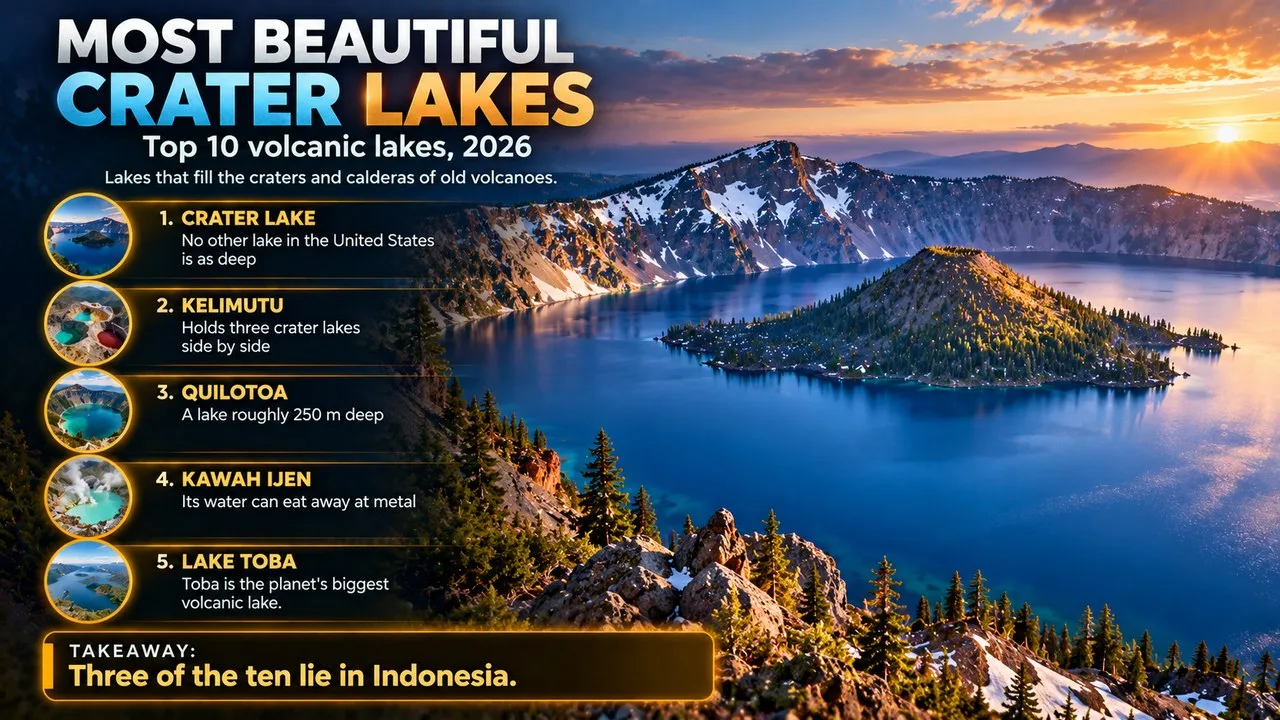
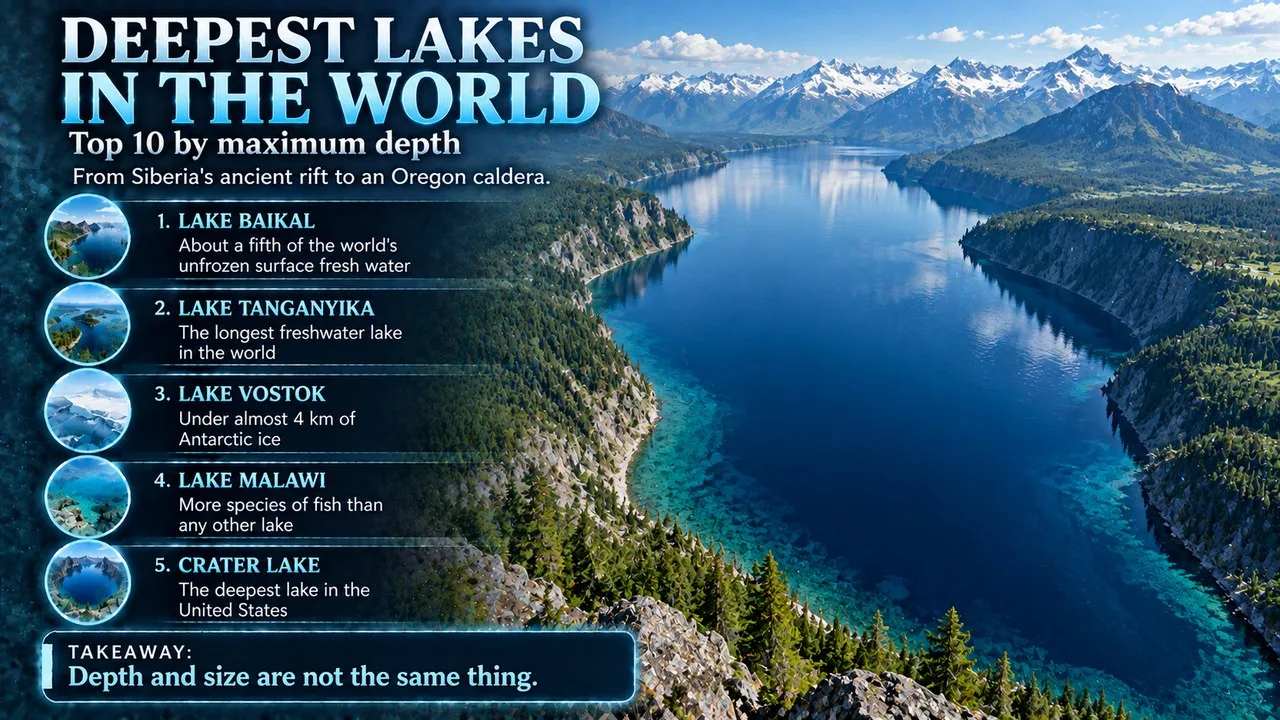
The world's most beautiful crater lakes fill the hollows of old volcanoes, led by Oregon's Crater Lake, which is 594 m deep and famed for its blue water.
This Finepedia guide, written in October 2026, ranks ten volcanic lakes that are worth a journey for their colour, their setting and the story of how they formed. Some lie in small craters at the top of a single peak, while others fill vast calderas left when a volcano collapsed after a huge eruption. Several are still linked to active volcanoes, so visitors should check local warnings. For more volcanic and watery wonders, see the Finepedia guides Most Stunning Volcanoes in the World: Top 10 and Top 10 Deepest Lakes in the World.
How We Chose These
We looked at lakes that formed inside volcanic craters or calderas, not those made by meteorite impacts. Each lake was scored on the colour and clarity of its water, the beauty of its setting and how easily visitors can see it. We checked depths, dates and eruption details against the Smithsonian's volcano database, national park services and Wikipedia, as of October 2026. Lake colours can change with the seasons and with volcanic activity, so a lake may look different on the day you visit. Three of the ten lie in Indonesia.
The 10 Most Beautiful Crater Lakes at a Glance
| Rank | Lake | Country | Formed | Known for |
|---|---|---|---|---|
| 1 | Crater Lake | United States | About 7,700 years ago | Deep blue colour |
| 2 | Kelimutu | Indonesia | Unknown | Three lakes of changing colours |
| 3 | Quilotoa | Ecuador | About 800 years ago | Green water in the Andes |
| 4 | Heaven Lake | China and North Korea | 946 CE | High mountain setting |
| 5 | Kawah Ijen | Indonesia | Unknown | Turquoise acid lake and blue fire |
| 6 | Lake Toba | Indonesia | About 74,000 years ago | Largest volcanic lake |
| 7 | Blue Lake | Australia | About 4,300 to 28,000 years ago | Turns bright blue each summer |
| 8 | Lake Pinatubo | Philippines | After 1991 | Lake born from a modern eruption |
| 9 | Lake Taupō | New Zealand | Mainly 232 CE and earlier | Largest lake in New Zealand |
| 10 | Katmai Crater Lake | United States | After 1912 | Remote Alaskan caldera |
1. Crater Lake Holds the Deepest Water in the US
Crater Lake in southern Oregon sits in a caldera made about 7,700 years ago, when the volcano Mount Mazama erupted and collapsed. At 594 m (1,949 ft), no other lake in the United States is as deep. No rivers flow in or out; rain and snow keep it full. The water is so pure that its colour is an intense, deep blue.
Key Facts
- Maximum depth: 594 m (1,949 ft)
- Formed: about 7,700 years ago
- Location: Crater Lake National Park, Oregon
- National park since: 1902
Did You Know?
Wizard Island, a small volcanic cone, rises from the western side of the lake. Divers and scientists regularly measure clear water to a depth of more than 30 m, among the best readings for any lake on Earth.
2. Kelimutu Has Three Lakes That Change Colour
Kelimutu, a volcano near the town of Moni on the Indonesian island of Flores, holds three crater lakes side by side. Each has its own colour, and the colours shift over the years between turquoise, green, red, brown and almost black. Scientists link the changes to volcanic gases and minerals such as iron and manganese in the water.
Key Facts
- Number of lakes: three
- Location: central Flores, East Nusa Tenggara, Indonesia
- Colours seen: blue, green, red, brown and black
- Protected area: Kelimutu National Park
Why It Matters
The local Lio people believe the lakes are resting places for the souls of the dead, with one lake each for the young, the old and the wicked. Sunrise visits from the viewpoint above the lakes are among the most popular trips on Flores.
3. Quilotoa Glows Green in the Andes
Quilotoa is the westernmost volcano of the Ecuadorian Andes, and its caldera, about 3 km wide, holds a lake roughly 250 m deep. The caldera formed after a huge eruption around 800 years ago, often dated to 1280. Minerals dissolved in the water give the lake a striking emerald to turquoise colour.
Key Facts
- Lake depth: about 250 m
- Caldera width: about 3 km
- Last major eruption: about 800 years ago
- Rim height: about 3,900 m above sea level
Did You Know?
Hikers can walk all the way around the rim in about five hours, or descend a steep trail to the shore and ride a mule back up. The lake is a stop on the popular Quilotoa Loop trek through Indigenous Andean villages.
4. Heaven Lake Straddles Two Countries
Heaven Lake sits in the caldera of Paektu Mountain, called Changbai Mountain in China, where China meets North Korea. The caldera formed in a massive eruption in 946 CE, among the most powerful blasts of the past five millennia. The lake is about 2,189 m above sea level and up to 384 m deep.
Key Facts
- Elevation: about 2,189 m
- Maximum depth: 384 m
- Formed: in the eruption of 946 CE
- Countries: China and North Korea
Why It Matters
The lake is the source of three major rivers, the Songhua, the Tumen and the Yalu, and it is frozen over for roughly eight months of each year. The mountain has a special place in the history and legends of both Korean and Manchu peoples.
5. Kawah Ijen Is a Turquoise Acid Lake
The Ijen volcano in East Java, Indonesia, holds a turquoise crater lake about 1 km wide. No other strongly acidic crater lake on the planet is bigger, and its water can eat away at metal. Miners haul heavy baskets of sulphur up from the bottom of the crater on foot, a hard and dangerous job.
Key Facts
- Lake width: about 1 km
- Location: East Java, Indonesia
- Record: biggest strongly acidic crater lake
- UNESCO status: part of the Ijen Global Geopark since 2023
Did You Know?
At night, sulphur gases escaping from cracks in the crater catch fire and burn with an eerie blue flame. Visitors often start the hike in the early hours to see this blue fire before sunrise.
6. Lake Toba Is the Largest Volcanic Lake
Lake Toba in North Sumatra fills the caldera of a supervolcano that blew apart about 74,000 years ago, in what scientists see as the biggest explosive blast of the past 25 million years. Measuring about 100 km by 30 km and up to 505 m deep, Toba is the planet's biggest volcanic lake and the largest lake in Indonesia.
Key Facts
- Length: about 100 km
- Maximum depth: about 505 m
- Formed: by an eruption about 74,000 years ago
- UNESCO status: Global Geopark since 2020
Why It Matters
Samosir, an island almost the size of Singapore, rises from the middle of the lake. It is the home of the Batak people, whose carved wooden houses with curved roofs are a major attraction for visitors.
7. Blue Lake Turns Bright Blue Each Summer
Blue Lake sits in a dormant volcanic crater on the edge of Mount Gambier, a city in South Australia. For most of the year it is a soft grey-blue, but each November it turns a vivid turquoise that lasts until about March. Scientists link the change to warmer water and tiny crystals that form in the lake in summer.
Key Facts
- Average depth: about 72 m
- Location: Mount Gambier, South Australia
- Colour change: from about November to March
- Last eruption: between about 4,300 and 28,000 years ago
Did You Know?
The lake is the main source of drinking water for Mount Gambier. Its traditional name in the language of the Boandik people is Warwar, and the city now uses both names.
8. Lake Pinatubo Was Born in 1991
Lake Pinatubo formed in the summit crater of Mount Pinatubo, in the Philippines, after the volcano's huge eruption on 15 June 1991. That was the second largest eruption of the 20th century on land. Rain filled the new crater, creating a warm green-blue lake about 90 km north-west of Manila.
Key Facts
- Formed: after the eruption of 15 June 1991
- Location: Zambales, Luzon, Philippines
- Depth: estimates vary, with recent studies suggesting about 100 m
- Distance from Manila: about 90 km
Why It Matters
Early warnings allowed tens of thousands of people to leave before the 1991 eruption, saving many lives. Today visitors reach the lake by four-wheel-drive vehicle across ash fields, followed by a short hike.
9. Lake Taupō Fills a Giant Caldera
Lake Taupō, in the centre of New Zealand's North Island, covers 616 square km, making it the largest lake in the country. It lies in the caldera of the Taupō Volcano, which produced the huge Oruanui eruption about 25,600 years ago and the Hatepe eruption around 232 CE. The lake is up to 186 m deep and feeds the Waikato, New Zealand's longest river.
Key Facts
- Area: 616 square km
- Maximum depth: 186 m
- Last major eruption: about 232 CE
- Outflow: the Waikato River
Did You Know?
Lake Taupō is famous for its trout fishing, and Māori rock carvings at Mine Bay can be seen only from the water. The town of Taupō on its shore is a base for skydiving and hiking in Tongariro National Park.
10. Katmai Crater Lake Formed in 1912
Mount Katmai on the Alaska Peninsula collapsed when nearby Novarupta erupted in 1912, the biggest eruption of the 20th century. The collapse left a caldera about 3 km by 5 km, which has since filled with a vivid blue-green lake. The lake sits inside Katmai National Park and Preserve and can be seen by few visitors because of its remote location.
Key Facts
- Formed: after the eruption of 1912
- Caldera size: about 3 km by 5 km
- Location: Katmai National Park and Preserve, Alaska
- Rim height: up to about 2,047 m
Why It Matters
The 1912 eruption also buried a nearby valley in hot ash that steamed for years, later named the Valley of 10,000 Smokes. Wind can still lift ash from that eruption into the air, so the Alaska Volcano Observatory issues warnings for aircraft.
Frequently Asked Questions
What is the difference between a crater lake and a caldera lake?
A crater lake fills the opening at the top of a volcano, while a caldera lake fills a much larger basin left when a volcano collapses after emptying its magma chamber. Crater Lake in Oregon is in fact a caldera lake, despite its name.
Is it safe to swim in crater lakes?
Some, such as Crater Lake and Lake Taupō, are open for swimming in summer. Others, like Kawah Ijen, are highly acidic and dangerous to touch, and lakes on active volcanoes can release harmful gases, so always follow local rules.
Conclusion
These ten volcanic lakes range from Oregon's deep blue Crater Lake and the three colourful lakes of Kelimutu to the acid waters of Ijen and the vast caldera of Lake Toba. Each one is a reminder of the enormous power of volcanoes and the beauty that can follow destruction. For more natural wonders shaped by fire and water, read the Finepedia guides Most Stunning Volcanoes in the World: Top 10 and Top 10 Deepest Lakes in the World.
- US National Park Service, Crater Lake National Park and Katmai National Park and Preserve pages, accessed October 2026.
- Smithsonian Institution, volcano records: Crater Lake (Mount Mazama), Kelimutu, Quilotoa, Changbaishan, Ijen, Toba, Pinatubo, Taupō and Katmai, accessed October 2026.
- UNESCO Global Geoparks Network, Toba Caldera and Ijen pages, accessed October 2026.
- SA Water and City of Mount Gambier, Blue Lake information, accessed October 2026.
- Wikipedia (accessed October 2026): Crater Lake, Mount Mazama, Kelimutu, Quilotoa, Heaven Lake, Paektu Mountain, Ijen, Lake Toba, Blue Lake (South Australia), Lake Pinatubo, Mount Pinatubo, Lake Taupō and Mount Katmai.
- 10 Most Today, 10 Most Beautiful Crater Lakes in the World, 10mosttoday.com (topic reference).























Discussion
Log in with