







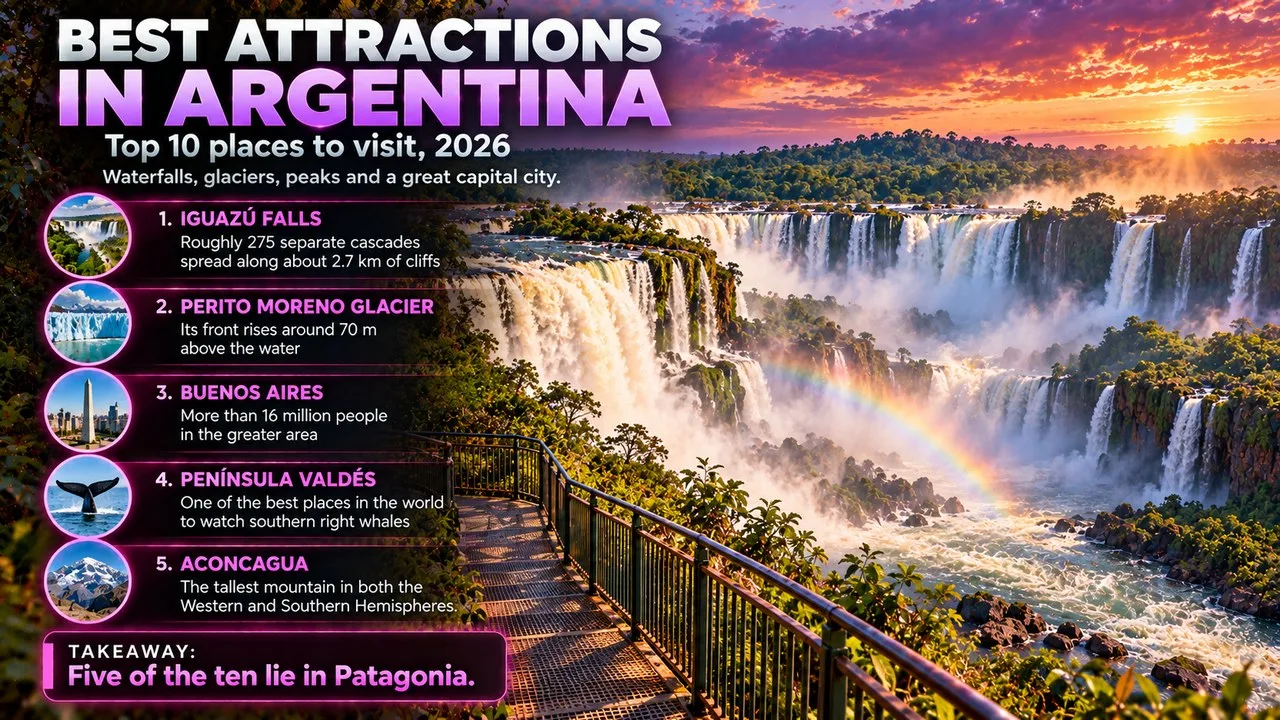
The best attractions in Argentina run from the roaring Iguazú Falls in the humid north to the Perito Moreno Glacier and the port of Ushuaia in the south.
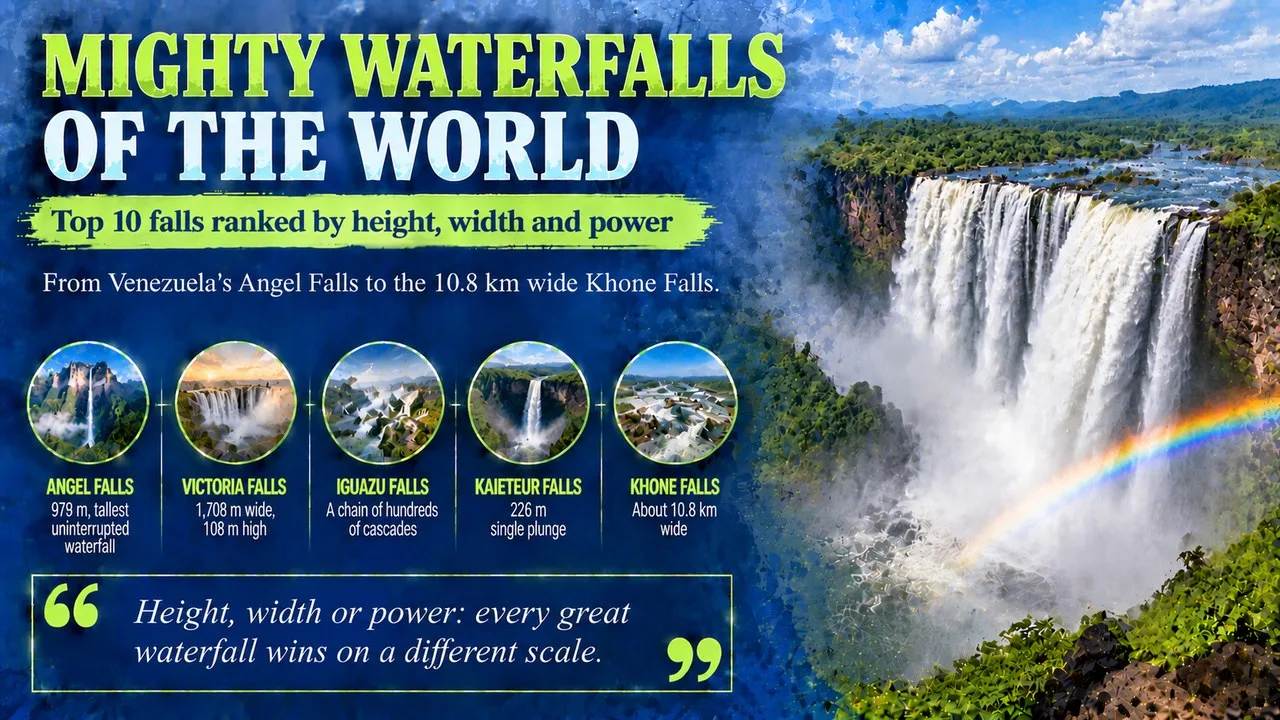
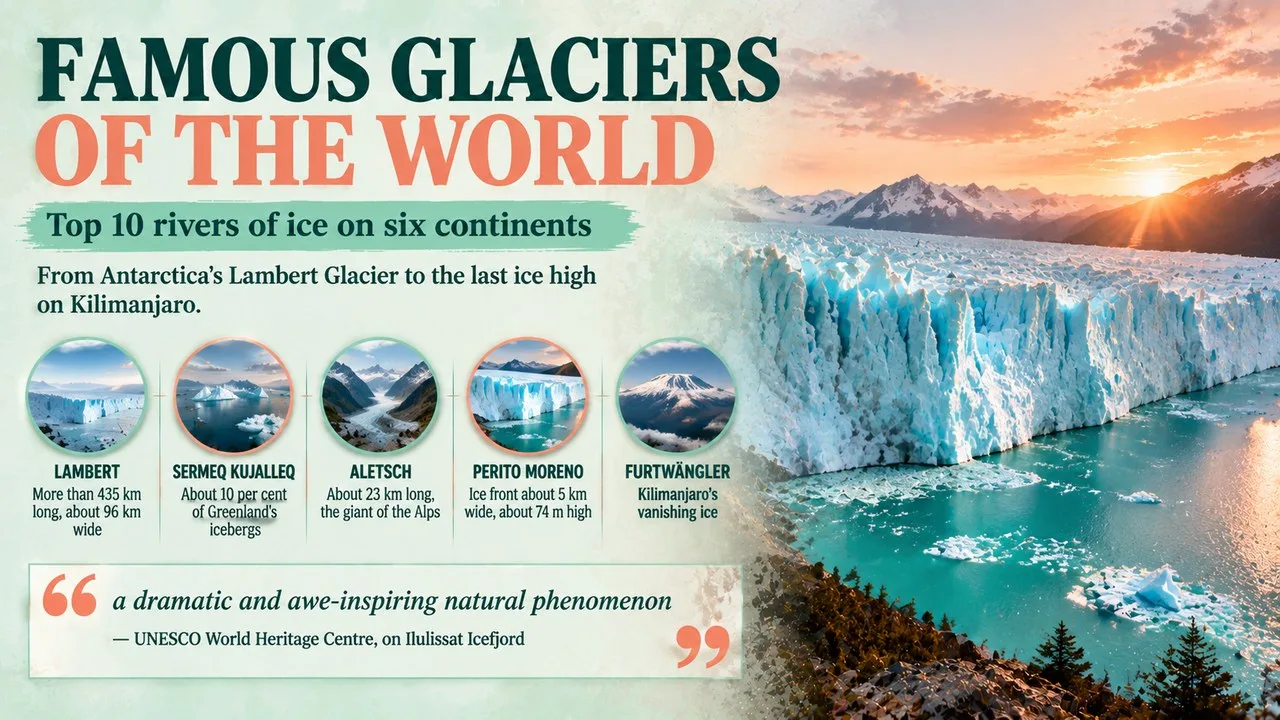
This Finepedia guide, written in October 2026, picks ten places that draw travellers to Argentina, the eighth-largest country in the world by area. The list mixes a great capital city with waterfalls, ice fields, desert canyons, wildlife coasts and the highest peak in the Americas. Most of the natural sites are protected as national or provincial parks, and several are UNESCO World Heritage Sites. For more on the natural wonders that feature here, see the Finepedia guides Mighty Waterfalls of the World: Top 10 and Famous Glaciers of the World: Top 10.
How We Chose These
We looked for places that are famous well beyond Argentina, easy enough for visitors to reach, and different from one another, so that the list covers the north, the centre, the Andes and Patagonia. We checked sizes, heights and dates against UNESCO, Argentina's national parks service (Parques Nacionales) and Wikipedia, as of October 2026. The order reflects how well known each place is and how strongly it shapes a trip to the country. Five of the ten lie in Patagonia.
The 10 Best Attractions in Argentina at a Glance
| Rank | Attraction | Province | Type | Best known for |
|---|---|---|---|---|
| 1 | Iguazú Falls | Misiones | Waterfalls | Hundreds of cascades in the rainforest |
| 2 | Perito Moreno Glacier | Santa Cruz | Glacier | Ice walls that crash into a lake |
| 3 | Buenos Aires | Capital city | City | Tango, cafés and grand avenues |
| 4 | Mount Fitz Roy | Santa Cruz | Mountain | Granite spires above El Chaltén |
| 5 | Península Valdés | Chubut | Wildlife coast | Southern right whales |
| 6 | Ushuaia | Tierra del Fuego | Port city | Southernmost city in the world |
| 7 | Quebrada de Humahuaca | Jujuy | Mountain valley | Many-coloured hills |
| 8 | Aconcagua | Mendoza | Mountain | Highest peak outside Asia |
| 9 | Ischigualasto and Talampaya | San Juan and La Rioja | Desert parks | Fossils and red cliffs |
| 10 | Nahuel Huapi and Bariloche | Río Negro and Neuquén | Lakes and mountains | Lake views, skiing and chocolate |
1. Iguazú Falls Are the Country's Greatest Sight
On the border with Brazil, the Iguazú River breaks into roughly 275 separate cascades spread along about 2.7 km of cliffs. Most of them sit on the Argentine side, inside Iguazú National Park. Walkways lead right to the edge of the Devil's Throat, a horseshoe-shaped chasm where roughly half the water of the river plunges more than 80 m.
Key Facts
- Province: Misiones, on the border with Brazil
- Width: about 2.7 km
- Number of cascades: around 275
- UNESCO World Heritage Site: since 1984
Did You Know?
The name comes from Guaraní words meaning "big water". The Spanish explorer Álvar Núñez Cabeza de Vaca was the first European to write about the falls, in 1541. Brazil protects its side in a park of its own, and many visitors see both.
2. Perito Moreno Glacier Breaks Apart Before Your Eyes
The Perito Moreno Glacier flows down from the Southern Patagonian Ice Field into Lake Argentino, inside Los Glaciares National Park. Its front rises around 70 m above the water, and huge blocks of ice regularly crash into the lake with a noise like thunder. Boardwalks on a peninsula facing the ice let visitors watch from close up.
Key Facts
- Length: about 30 km
- Area: about 250 square km
- Nearest town: El Calafate, about 78 km away
- Park: Los Glaciares, a World Heritage Site since 1981
Why It Matters
For decades the glacier stayed roughly stable while many others shrank, and it became a symbol of Patagonia. Since about 2020, scientists have recorded the front pulling back, and they now watch it closely as a sign of a changing climate.
3. Buenos Aires Is the Heart of Tango
Argentina's capital lies on the wide Río de la Plata and is one of the largest cities in the Americas, with more than 16 million people in the greater area. Visitors come for the colourful houses of La Boca, the Teatro Colón opera house, the Recoleta Cemetery, the Plaza de Mayo and long evenings of steak and tango.
Key Facts
- Population: about 3.1 million in the city, 16.7 million in the metro area
- River: Río de la Plata
- Famous street: Avenida 9 de Julio, one of the widest in the world
- Opera house: Teatro Colón, opened in 1908
Did You Know?
Tango was born in the working-class districts around the port of Buenos Aires and Montevideo in the late 1800s. In 2009 UNESCO added it to its list of the intangible cultural heritage of humanity.
4. Mount Fitz Roy Rules the Trekking Capital
The jagged granite tower of Mount Fitz Roy rises to about 3,405 m on the edge of the Southern Patagonian Ice Field. Below it sits El Chaltén, a small village founded in 1985 that calls itself Argentina's trekking capital. A day hike to Laguna de los Tres brings walkers face to face with the peak.
Key Facts
- Height: about 3,405 m
- Nearest village: El Chaltén, Santa Cruz
- First climbed: 1952, by Lionel Terray and Guido Magnone
- Park: Los Glaciares National Park
Why It Matters
The local Tehuelche people called the peak Chaltén, often translated as "smoking mountain", because clouds nearly always gather around its summit. Its steep walls are among the hardest big climbs on Earth, and its outline is one of the best-known views in South America.
5. Península Valdés Is a Whale Nursery
Jutting into the Atlantic in Chubut province, Península Valdés is one of the best places in the world to watch southern right whales, which arrive each winter to breed and raise their calves in its sheltered bays. Elephant seals, sea lions and Magellanic penguins also crowd its shores, and orcas sometimes hunt right on the beaches.
Key Facts
- Area: about 3,625 square km
- Nearest city: Puerto Madryn
- Whale season: roughly June to December
- UNESCO World Heritage Site: since 1999
Did You Know?
The orcas of Península Valdés are famous for a rare hunting trick: they surge out of the surf onto the sand to snatch young sea lions, then wriggle back into the water. Only a few groups of orcas in the world hunt this way.
6. Ushuaia Is the Southernmost City
Ushuaia, capital of the province of Tierra del Fuego, sits on the Beagle Channel below snowy peaks and claims to be the southernmost city on the planet. It is the main port for cruise ships heading to Antarctica, about 1,100 km away. Nearby, Tierra del Fuego National Park protects forests, lakes and peat bogs.
Key Facts
- Population: about 90,000
- Founded: 12 October 1884
- Waterway: the Beagle Channel
- Distance to the Antarctic Peninsula: about 1,100 km
Why It Matters
Ushuaia began as a prison town, and the old jail is now a museum. Today most of the world's tourist voyages to Antarctica leave from its harbour, which makes it a gateway to the coldest continent.
7. Quebrada de Humahuaca Glows With Colour
In Jujuy, the far north-west province, the Quebrada de Humahuaca forms a deep valley about 155 km long, framed by hills striped in red, purple, green and cream. The best-known view is the Hill of Seven Colours above the village of Purmamarca. Adobe churches and markets show the strong Andean culture of the region.
Key Facts
- Length: about 155 km
- Province: Jujuy
- Famous view: Cerro de los Siete Colores, Purmamarca
- UNESCO World Heritage Site: since 2003
Did You Know?
People have travelled along this valley for about 10,000 years. It formed part of a trade route linking the Andes with the lowlands, and the Inca road network passed through it in the 15th century.
8. Aconcagua Is the Roof of the Americas
Aconcagua, in Mendoza province near the Chilean border, stands almost 7,000 m high, making it the tallest mountain in both the Western and Southern Hemispheres. Climbers count it among the Seven Summits, the tallest peaks of the seven continents. Thousands of climbers attempt it each season, while day visitors view its south face from the park entrance.
Key Facts
- Height: almost 7,000 m
- Province: Mendoza
- First recorded ascent: 1897
- Status: one of the Seven Summits
Why It Matters
Aconcagua anchors a wider trip to Mendoza, Argentina's best-known wine region and home of most of its Malbec. Travellers often pair a visit to the mountain with tastings at vineyards in the foothills of the Andes.
9. Ischigualasto and Talampaya Reveal the Age of Dinosaurs
In the dry north-west, the neighbouring parks of Ischigualasto, nicknamed the Valley of the Moon, and Talampaya protect a striking desert of eroded rock, red canyon walls and strange stone shapes. The rocks date from the Triassic period and contain several of the earliest dinosaur fossils ever found, such as Eoraptor and Herrerasaurus.
Key Facts
- Provinces: San Juan and La Rioja
- Rock age: Triassic, about 230 million years old
- Ischigualasto area: about 603 square km
- UNESCO World Heritage Site: since 2000
Did You Know?
The name Ischigualasto is often explained as meaning "place where the moon alights". At night, rangers lead full-moon tours through the park, when the pale rock formations look even more like the surface of the Moon.
10. Nahuel Huapi and Bariloche Offer Lakes and Snow
Nahuel Huapi National Park, created in 1934 from a reserve set up in 1922, is the country's oldest national park. It wraps around the deep blue Nahuel Huapi Lake, where the Andes meet the steppe. On its shore, the town of San Carlos de Bariloche is known for alpine-style buildings, ski slopes on Cerro Catedral and its chocolate shops.
Key Facts
- Park area: about 7,050 square km
- Protected since: 1922, the first in the country
- Gateway town: San Carlos de Bariloche
- Ski area: Cerro Catedral
Why It Matters
Bariloche is one of the most visited places in the country, busy with skiers in winter and with hikers, anglers and families in summer. The scenic Seven Lakes Route links it with the nearby town of San Martín de los Andes.
Frequently Asked Questions
What is the most visited attraction in Argentina?
Buenos Aires receives the most visitors overall, while Iguazú Falls is usually the most visited natural site. Iguazú National Park welcomes well over a million people in a typical year.
When is the best time to visit Argentina?
It depends on the region. Patagonia is best from about October to April, when days are long and trails are open. The north and Buenos Aires are pleasant in spring and autumn, and the ski resorts of the Andes open from about June to September.
Conclusion
The best attractions in Argentina, from the roaring Iguazú Falls and busy Buenos Aires to the ice of Perito Moreno and the peaks of Fitz Roy and Aconcagua, show a country of huge contrasts. Distances are long, so many visitors combine a few regions in one trip and save the rest for another. For more on these natural wonders, read the Finepedia guides Mighty Waterfalls of the World: Top 10 and Famous Glaciers of the World: Top 10.
- UNESCO World Heritage Centre: Iguazu National Park, Los Glaciares National Park, Península Valdés, Quebrada de Humahuaca, and Ischigualasto / Talampaya Natural Parks, accessed October 2026.
- Administración de Parques Nacionales (Argentina), park information for Iguazú, Los Glaciares, Tierra del Fuego and Nahuel Huapi, accessed October 2026.
- UNESCO Intangible Cultural Heritage, Tango, 2009.
- Wikipedia (accessed October 2026): Iguazu Falls, Perito Moreno Glacier, Buenos Aires, Fitz Roy, Valdes Peninsula, Ushuaia, Quebrada de Humahuaca, Aconcagua, Ischigualasto Provincial Park, Talampaya National Park, Nahuel Huapi National Park and San Carlos de Bariloche.
- 10 Most Today, 10 Best Attractions in Argentina, 10mosttoday.com (topic reference).





























Discussion
Log in with