










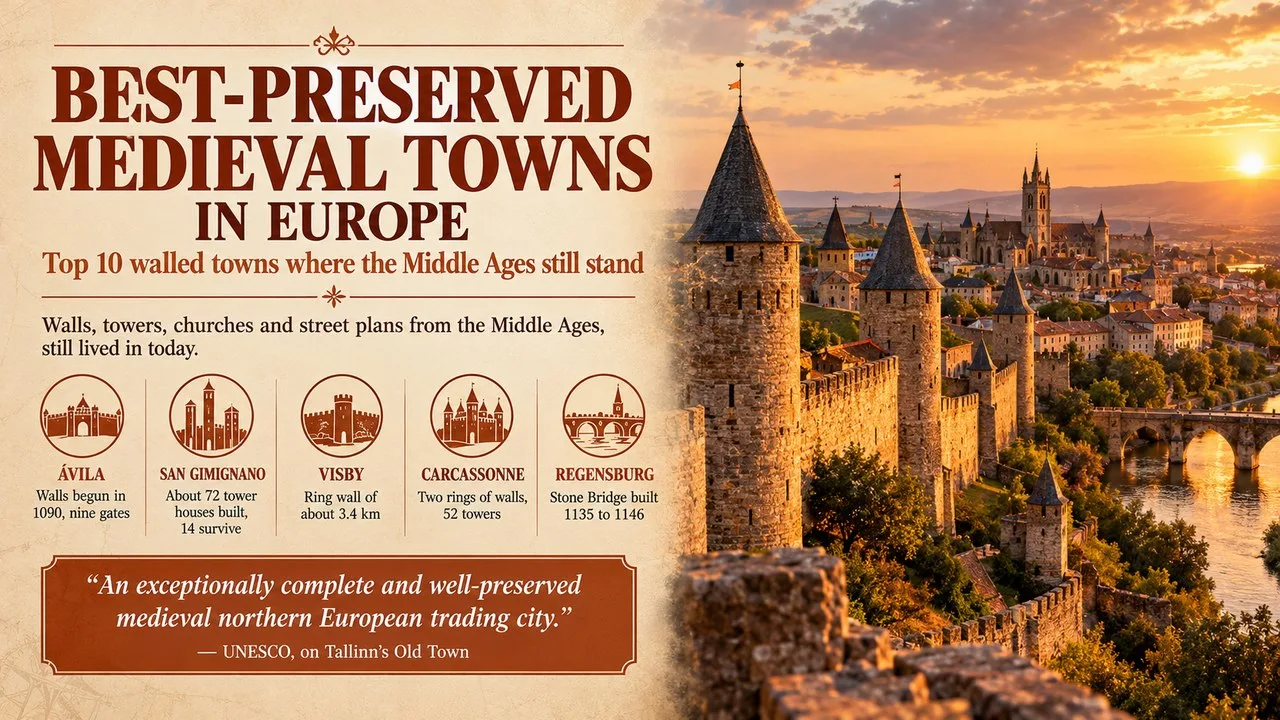
The best-preserved medieval towns in Europe still keep their walls, towers, churches and street plans from the Middle Ages, and people live in them today.
This Finepedia guide, written in October 2026, brings together 10 European towns where the medieval layout survives so well that a 14th-century merchant could still find the way to market. All ten are UNESCO World Heritage Sites, and the facts below come from UNESCO's official descriptions, encyclopaedias and town records; where a figure differs between sources we say so. If you like travel with a sense of history, you may also enjoy Finepedia's guides to the most walkable cities in the world and the history of human civilisations from ancient to modern.
How We Chose These
We looked for towns, not single castles, where three things have survived together: a large part of the defensive walls or gates, a medieval street plan, and a working town living inside it. To keep the choice objective, every town here has been recognised by UNESCO for its medieval fabric. The list runs in the order UNESCO inscribed them, from 1985 to 2006, rather than ranking one beautiful town above another.
The 10 Medieval Towns at a Glance
| No. | Town | Country | UNESCO listing | Best-known feature |
|---|---|---|---|---|
| 1 | Ávila | Spain | 1985 | Complete stone walls with nine gates |
| 2 | Rhodes | Greece | 1988 | Street of the Knights |
| 3 | San Gimignano | Italy | 1990 | Surviving tower houses |
| 4 | Český Krumlov | Czech Republic | 1992 | Castle above a river bend |
| 5 | Visby | Sweden | 1995 | Ring wall of about 3.4 km |
| 6 | Carcassonne | France | 1997 | Double ring of ramparts |
| 7 | Tallinn | Estonia | 1997 | Hanseatic old town and Toompea hill |
| 8 | Sighișoara | Romania | 1999 | Inhabited hilltop citadel |
| 9 | Bruges | Belgium | 2000 | Medieval canals and squares |
| 10 | Regensburg | Germany | 2006 | 12th-century Stone Bridge |
1. Ávila Has the Most Complete Walls in Spain
Ávila sits on a high plateau in Castile and León, more than 1,130 metres above sea level, higher than any other Spanish provincial capital. Its walls were begun in 1090, after the Christian capture of Toledo, and much of the circuit was rebuilt in the 12th century. They still run unbroken for about 2.5 kilometres around the old town, with nine gates and close to 90 rounded towers; UNESCO counts 87, other sources 88. Ávila is also the birthplace of Saint Teresa, the 16th-century mystic, and has kept a stern, stone-built look that earned it the nickname "City of Saints and Stones".
Key Facts
- Walls begun: 1090
- Circuit: about 2,516 metres
- Gates: nine
- UNESCO: Old Town of Ávila, listed 1985
Did You Know?
The apse of Ávila Cathedral is built into the wall itself and works as one of the defensive towers, a sign of how closely church and fortress were linked on the Christian frontier. Visitors can walk long sections of the wall-top walkway today.
2. Rhodes Was the Fortress of the Knights of St John
From 1309 to 1523 the Greek island of Rhodes was ruled by the Knights of St John, a crusading order that had lost its last base in the Holy Land at Acre in 1291. They turned the island's capital into one of the strongest fortresses of the age, protected by walls about 4 kilometres long, and it held out against sieges in 1444 and 1480. In 1522 the city finally fell to the Ottoman sultan Suleiman the Magnificent after a siege of about six months.
Key Facts
- Rulers: Knights of St John, 1309 to 1523
- Walls: about 4 km long
- Final siege: 1522, about six months
- UNESCO: Medieval City of Rhodes, listed 1988
The Street of the Knights
The Knights were organised into national groups called "tongues", each with its own inn. The inns of the French, Italian, Provençal and Spanish knights still line the Street of the Knights, which UNESCO describes as one of the finest examples of Gothic town planning. The Knights' Great Hospital, completed in 1489 after almost 50 years of work, now houses an archaeological museum.
3. San Gimignano Is the Town of Medieval Towers
San Gimignano stands on a hill in Tuscany, about 56 kilometres south of Florence, on the old pilgrim route to Rome known as the Via Francigena. It became a free town in 1199, and over the next century its rival noble and merchant families built tall stone tower houses to show off their wealth, probably around 72 of them. Only 14 survive, but they still give the town a skyline that looks like nowhere else in Italy.
Key Facts
- Location: Tuscany, about 56 km south of Florence
- Independent town: from 1199
- Tower houses: about 72 built, 14 survive
- UNESCO: Historic Centre, listed 1990
Why It Matters
San Gimignano owes its survival partly to bad luck. Famine and plague after the mid-14th century emptied the town, and it fell under the control of Florence. With little money for rebuilding, its old streets and towers were left largely alone while richer cities modernised.
4. Český Krumlov Curls Around a River Bend
Český Krumlov lies in South Bohemia, on both banks of a tight loop of the Vltava river, beneath a castle whose story begins in the 1200s. From 1302 the estate belonged to the Rosenberg family, one of the most powerful noble houses in Bohemia, and the town grew rich under their rule. Its medieval street plan survived later Renaissance and Baroque rebuilding, and UNESCO singles it out as a model of the small medieval towns of Central Europe.
Key Facts
- River: Vltava
- Castle founded: 13th century
- Ruling family: Rosenbergs, from 1302
- UNESCO: Historic Centre, listed 1992
Did You Know?
The castle still has a working Baroque theatre, built in 1680 to 1682 and given new stage machinery in the 1760s, one of the best-preserved of its kind in Europe. Because the town developed peacefully for centuries, many houses keep their original roof shapes, vaulted rooms and painted facades.
5. Visby Kept Almost Its Entire Ring Wall
Visby, on the Swedish island of Gotland in the Baltic Sea, grew from a Viking Age harbour into a leading trading town of the Hanseatic League, the network of merchant towns that dominated northern European trade. In the 13th century its citizens surrounded it with a stone wall, and that wall still stands for about 3.4 kilometres. Most of its towers survive too, 36 of an original 51 or so, so few town walls in northern Europe can match it.
Key Facts
- Island: Gotland, Sweden
- Wall: built in the 13th and 14th centuries
- Length: about 3.44 km
- UNESCO: Hanseatic Town of Visby, listed 1995
Why It Matters
The wall did not only face outward. By shutting the town off from the countryside, it sharpened a quarrel between Visby's merchants and the farmers of rural Gotland, which turned into a civil war in 1288. Inside, the ruins of many medieval churches still stand among later houses.
6. Carcassonne Is Europe's Classic Fortified City
Carcassonne rises on a rocky hill above the River Aude in southern France, on an ancient route between the Atlantic and the Mediterranean. People had fortified the site before the Romans, but most of what visitors see today is a 13th-century defensive circuit: two rings of walls, about 3 kilometres long in total, with 52 towers, plus a count's castle and a Gothic basilica inside.
Key Facts
- Location: Aude, Occitanie, France
- Defences: two rings of walls, 52 towers
- Restored: Eugène Viollet-le-Duc, from 1853
- UNESCO: Historic Fortified City, listed 1997
The Restoration Debate
By the 19th century the walls were crumbling, and the architect Eugène Viollet-le-Duc led a long restoration. His work saved the site but drew criticism even in his own lifetime, mainly for giving the towers pointed slate roofs, a northern French style, instead of the local terracotta tiles. UNESCO counts this restoration as part of the site's importance in the history of conservation.
7. Tallinn Is a Complete Hanseatic Trading City
Tallinn, the capital of Estonia, grew into a major Hanseatic trading port between the 13th and 16th centuries. Its old town has two parts: Toompea, the upper town on a limestone hill with the castle and cathedral, and the lower town of merchants and craftsmen at its foot. The plots of land in the lower town have barely changed since the 13th and 14th centuries, and in the Middle Ages the city was guarded by walls with 66 towers.
Key Facts
- Upper town: Toompea, where the castle now houses Estonia's parliament
- Main period: 13th to 16th centuries
- Medieval towers: 66, many still standing
- UNESCO: Historic Centre (Old Town), listed 1997
Did You Know?
A weather vane in the shape of an old soldier, known as Old Thomas, was placed on the spire of Tallinn Town Hall in 1530 and has become a symbol of the city. Many narrow streets in the lower town still carry their medieval names.
8. Sighișoara Is a Citadel People Still Live In
Sighișoara, in the Transylvania region of Romania, was founded by German settlers known as the Transylvanian Saxons, who were invited to the area by the King of Hungary in the 12th century. A Saxon settlement is recorded there by 1191. Its hilltop citadel, strengthened over some three centuries, from the 1300s to the 1600s, against Ottoman raids, is still a lived-in neighbourhood, not a museum.
Key Facts
- Founded by: Transylvanian Saxons
- Landmark: Clock Tower, about 64 metres tall
- Towers: 9 of the original 14 survive
- UNESCO: Historic Centre, listed 1999
Guild Towers
Each of Sighișoara's defensive towers was looked after by a craft guild, which is why they still have names such as the Tailors' Tower and the Butchers' Tower. The town is also traditionally said to be the birthplace of Vlad III, the Wallachian prince remembered as Vlad the Impaler.
9. Bruges Is a Medieval Trading Capital on Canals
Bruges, in the Flanders region of Belgium, was granted a city charter in 1128 and became one of the busiest commercial centres of medieval Europe. A sea inlet called the Zwin linked it to the North Sea, and merchants from across the continent traded there. In the 15th century it was also home to great painters, among them Jan van Eyck and Hans Memling. When the inlet silted up from around 1500, the money moved elsewhere, mostly to Antwerp, and the medieval centre was left largely intact. Its canals later earned it the nickname Venice of the North, a title also claimed by Amsterdam and Saint Petersburg.
Key Facts
- City charter: 1128
- Trade link: the Zwin inlet to the North Sea
- Painters: Jan van Eyck, Hans Memling
- UNESCO: Historic Centre of Brugge, listed 2000
Why It Matters
UNESCO notes that the medieval street plan and the network of canals have mostly survived, along with four old city gates. Bruges is also a key example of brick Gothic architecture, the style that shaped towns across northern Europe and the Baltic.
10. Regensburg Spans Two Thousand Years
Regensburg, on the Danube in Bavaria, began as the Roman fort of Castra Regina, built in 179 during the reign of Marcus Aurelius. In the Middle Ages it became a wealthy trading city, and its 11th to 13th century buildings still shape the old town, with tall patrician towers and narrow lanes. Its Stone Bridge, built between 1135 and 1146, was a marvel of medieval engineering.
Key Facts
- Roman origin: Castra Regina, AD 179
- Stone Bridge: built 1135 to 1146
- River: Danube
- UNESCO: Old Town with Stadtamhof, listed 2006
Did You Know?
Regensburg later served as the meeting place of the Perpetual Imperial Diet, the assembly of the Holy Roman Empire, from 1663 until 1806. Although Allied bombers struck a Messerschmitt plant and a refinery on its outskirts in 1943 and 1945, the old town itself suffered only minor damage, which is why so much of it is still medieval.
Frequently Asked Questions
Which is the best-preserved medieval town in Europe?
There is no single official answer. Tallinn and Visby are often singled out for how complete their walls and street plans are, while Carcassonne is the most famous fortified city, even though much of what you see today is 19th-century restoration.
Can you still live in these medieval towns?
Yes. All ten are working towns with residents, shops and schools, which is part of why UNESCO values them. Sighișoara's citadel and Tallinn's old town are both lived-in neighbourhoods.
Conclusion
These ten towns survived for different reasons. Some, like Ávila, Visby and Carcassonne, kept their walls because they were built to last; others, like San Gimignano and Bruges, survived because trade or luck moved elsewhere and nobody could afford to rebuild. Together they show how medieval Europeans lived, traded and defended themselves, in places that are still home to people today. For more on cities and history, read Finepedia's most walkable cities in the world and the history of human civilisations from ancient to modern.
- UNESCO World Heritage Centre (accessed October 2026), official descriptions for the Old Town of Ávila, Medieval City of Rhodes, Historic Centre of San Gimignano, Historic Centre of Český Krumlov, Hanseatic Town of Visby, Historic Fortified City of Carcassonne, Historic Centre (Old Town) of Tallinn, Historic Centre of Sighişoara, Historic Centre of Brugge and Old town of Regensburg with Stadtamhof, whc.unesco.org.
- Encyclopaedia Britannica, entries on Ávila, Rhodes, San Gimignano, Visby, Carcassonne, Tallinn, Bruges and Regensburg.
- Wikipedia (accessed October 2026), articles on the Walls of Ávila, Visby City Wall, Cité de Carcassonne, Historic Centre of Sighișoara, Tallinn, Bruges and Regensburg.
- Nicholas, David (1992), Medieval Flanders, Longman, London.
- Dollinger, Philippe (1970), The German Hansa, Macmillan, London.
- Riley-Smith, Jonathan (1999), Hospitallers: The History of the Order of St John, Hambledon Press, London.
- 10 Most Today, 10 Best Preserved Medieval Cities in Europe, 10mosttoday.com (topic reference).

















Log in with