










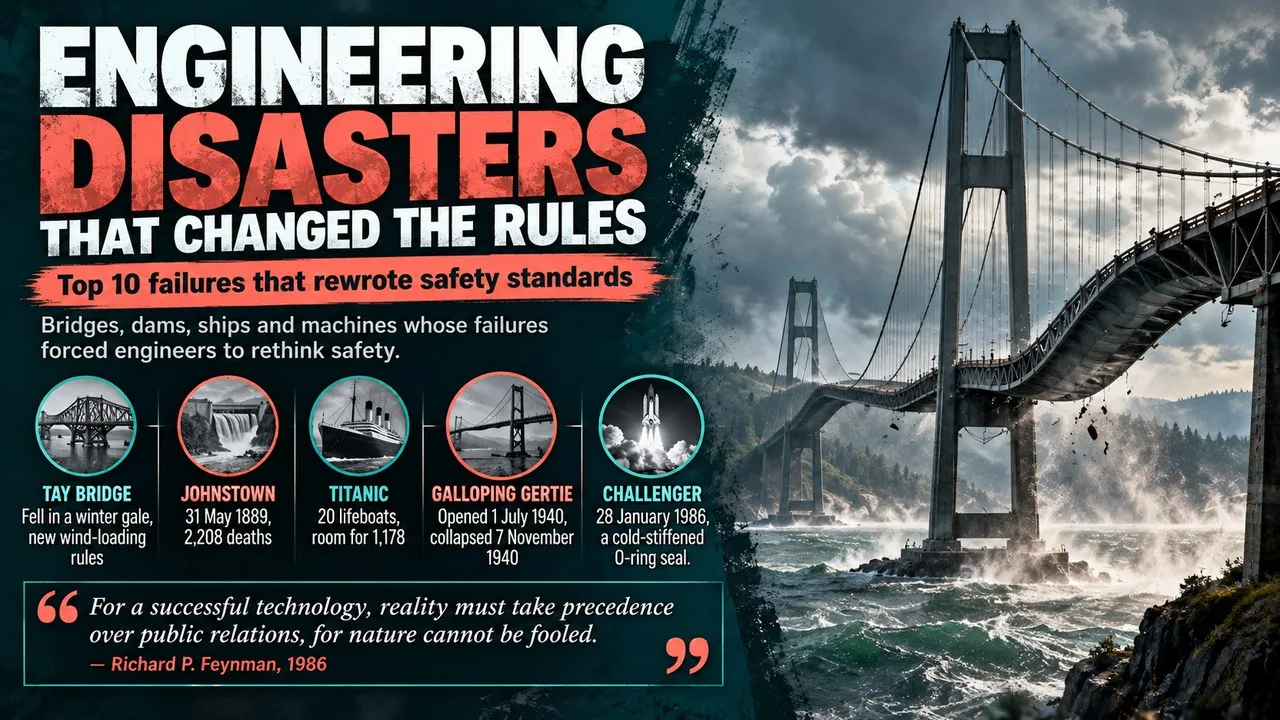
Famous engineering disasters are failures of bridges, dams, ships and machines that cost lives, and each forced engineers to rewrite their safety rules.
This Finepedia guide, written in October 2026, looks at 10 engineering disasters from 1879 to 1986, chosen not only for their death tolls but for what they taught. The facts come from official inquiries, encyclopaedias and engineering histories, and where casualty figures differ between sources we give a range. If you are interested in science and risk, you may also like Finepedia's guides to the most dangerous science experiments in history and the most dangerous bridges in the world.
How We Chose These
Every disaster here was caused, at least in part, by a design, material or management mistake rather than by nature or war alone. We also looked for a clear legacy: a change in law, building codes, safety rules or engineering teaching. The list runs in chronological order, so you can see how the lessons built on one another, from iron railway bridges to the Space Shuttle.
The 10 Engineering Disasters at a Glance
| No. | Disaster | Place | Date | Deaths (approx.) |
|---|---|---|---|---|
| 1 | Tay Bridge collapse | Dundee, Scotland | 28 December 1879 | 59 to 75 |
| 2 | South Fork Dam failure | Johnstown, Pennsylvania | 31 May 1889 | 2,208 |
| 3 | Quebec Bridge collapse | Quebec, Canada | 29 August 1907 | 75 |
| 4 | Sinking of the Titanic | North Atlantic | 15 April 1912 | about 1,500 |
| 5 | Great Molasses Flood | Boston, Massachusetts | 15 January 1919 | 21 |
| 6 | St. Francis Dam failure | Los Angeles County, California | 12 March 1928 | at least 431 |
| 7 | Tacoma Narrows Bridge collapse | Washington State | 7 November 1940 | none |
| 8 | Vajont Dam landslide | north-east Italy | 9 October 1963 | about 1,900 to 2,500 |
| 9 | Hyatt Regency walkway collapse | Kansas City, Missouri | 17 July 1981 | 114 |
| 10 | Space Shuttle Challenger | off Cape Canaveral, Florida | 28 January 1986 | 7 |
1. The Tay Bridge Fell in a Winter Gale
On the stormy night of 28 December 1879, the central section of the new Tay Rail Bridge near Dundee gave way as a passenger train crossed it, and the train plunged into the river. Nobody survived. The official inquiry put the number of known victims at 59, and only 46 bodies were found, although some contemporary counts suggested about 75 people were aboard. The bridge had opened to trains only 19 months earlier, in 1878, and Bouch had been knighted for it.
Key Facts
- Designer: Sir Thomas Bouch
- Opened: 1878
- Cause: no proper allowance for wind loading, plus poor castings
- Result: new British wind-loading rules for bridges
What Changed
The inquiry blamed Bouch for weak bracing, low-quality cast-iron parts and above all for failing to design for strong winds. He died less than a year later, and his design for a crossing of the Forth was abandoned. From then on, British bridges had to be designed to withstand wind pressures as high as 56 pounds per square foot (about 2.7 kilopascals).
2. The South Fork Dam Drowned Johnstown
After days of extremely heavy rain, the South Fork Dam in western Pennsylvania burst on 31 May 1889, about 23 kilometres upstream of the steel town of Johnstown. Some 14.5 million cubic metres of water raced down the valley, briefly flowing as fast as the Mississippi, and killed 2,208 people. The earth dam had been poorly maintained by the private South Fork Fishing and Hunting Club, whose wealthy members, including Pittsburgh industrialists, used the lake as a summer retreat.
Key Facts
- Date: 31 May 1889
- Deaths: 2,208
- Water released: about 14.5 million cubic metres
- Relief: led by Clara Barton and the American Red Cross
Why It Matters
It remains the deadliest flash flood in American history and was among the first big relief operations of the American Red Cross, founded only eight years earlier. Survivors failed to win compensation from the club, and the outcry helped push American courts towards making owners liable for dangerous structures even without proof of negligence.
3. The Quebec Bridge Collapsed Under Its Own Weight
The Quebec Bridge, crossing the St Lawrence near Quebec City, was meant to be the longest cantilever span on Earth. In the summer of 1907 the site engineer noticed that steel members were bending, but the consulting engineer, Theodore Cooper, who was supervising from New York, at first dismissed the problem. On 29 August 1907 the south arm collapsed, killing 75 workers. The real weight of the steel had been badly underestimated in the design.
Key Facts
- River: St Lawrence, Quebec, Canada
- First collapse: 29 August 1907, 75 deaths
- Second accident: 1916, when the central span fell, 13 deaths
- Opened: 1919, and its 549 m main span is still a world record for a cantilever bridge
Did You Know?
Canada's Iron Ring ceremony for new engineers, begun in the 1920s, is often linked to the Quebec Bridge as a reminder of professional duty. A popular story says the first rings were made from the fallen steel, but that tale is not supported by evidence.
4. The Titanic Sank With Too Few Lifeboats
The White Star liner Titanic, the largest ship afloat, hit an iceberg four days into her first crossing from Southampton to New York and sank early on 15 April 1912. About 1,500 of the 2,208 people aboard died, although estimates vary. The hull flooded faster than expected through damaged plates and seams, and the 20 lifeboats could carry only 1,178 people, roughly half of those on board, which was still within the legal rules of the day.
Key Facts
- Builder: Harland and Wolff, Belfast
- Sank: 15 April 1912
- Lifeboats: 20, room for 1,178 people
- Legacy: the first international sea safety convention, 1914
What Changed
The disaster led to the first international convention on safety at sea in 1914, requiring enough lifeboat places for everyone aboard, round-the-clock radio watches and an ice patrol in the North Atlantic. Many of these rules still shape shipping today.
5. A Wave of Molasses Swept Through Boston
On a mild winter day, 15 January 1919, a huge storage tank in Boston's North End burst open. It held about 8,700 cubic metres of molasses, more than 12,000 tonnes, and a sticky wave rushed through the streets at around 56 kilometres per hour, flattening buildings and trapping people and horses. The flood killed 21 people and injured about 150, and clean-up crews worked for weeks.
Key Facts
- Date: 15 January 1919
- Tank: about 15 m tall and 27 m wide
- Deaths: 21, with about 150 injured
- Cause: thin steel and poor testing
Why It Matters
The tank had been built in a rush and was known to leak; the company treasurer who oversaw it had no engineering training and skipped basic tests. A court-appointed auditor rejected the company's claim that anarchists had blown it up, and a 2014 study found the steel walls were only about half the thickness they needed. The resulting lawsuit, one of the first class actions in Massachusetts, is seen as a milestone in the regulation of companies.
6. The St. Francis Dam Failed Two Years After It Opened
The St. Francis Dam in San Francisquito Canyon went up from 1924 to 1926 to store water for the fast-growing city of Los Angeles. Just before midnight on 12 March 1928 it collapsed, sending a wall of water down the valley towards the Pacific and killing at least 431 people. The concrete dam stood on weak, crumbling rock that could not bear its load, and the design had flaws that later investigators found would not have passed modern checks.
Key Facts
- Location: about 64 km north-west of downtown Los Angeles
- Built: 1924 to 1926
- Deaths: at least 431
- Chief engineer: William Mulholland
Why It Matters
William Mulholland, the self-taught engineer who had brought water to Los Angeles, accepted responsibility and retired soon after. In 1929 California gave state engineers the power to review non-federal dams and began licensing civil engineers, and the disaster is still taught as a warning to study the geology beneath any dam.
7. Galloping Gertie Shook Itself Apart
The first Tacoma Narrows Bridge in Washington State opened on 1 July 1940, and it was soon nicknamed Galloping Gertie because its slender deck rose and fell in the wind. On 7 November 1940, in winds of about 64 kilometres per hour, the deck began twisting violently and the main span tore apart and fell into Puget Sound. Because it was caught on film, the collapse is still shown to engineering students around the world.
Key Facts
- Opened: 1 July 1940
- Collapsed: 7 November 1940
- Main span: then the third-longest suspension span in the world
- Deaths: no people, but a dog named Tubby died
What Changed
The collapse showed that wind can make a structure vibrate in ways that grow larger and larger. Since then, suspension bridges have been tested with wind tunnel models and designed with stiffer, more open decks so that air can flow through them.
8. The Vajont Dam Survived but the Valley Did Not
The Vajont Dam in the Italian Alps, about 100 kilometres north of Venice, rose 262 metres, which still places it among the world's highest dams. On 9 October 1963, while the reservoir was being filled, a vast slab of Monte Toc slid into the reservoir. The wave it pushed over the dam destroyed the town of Longarone and nearby villages in the Piave valley, with a death toll usually put at between 1,900 and 2,500. The dam itself barely cracked.
Key Facts
- Location: Erto e Casso, about 100 km north of Venice
- Height: 262 m
- Date: 9 October 1963
- Deaths: roughly 1,900 to 2,500
Why It Matters
Warnings that the mountainside was unstable had been played down by the power company and officials. Vajont became a classic case in geology and engineering ethics, showing that a strong structure is no protection if the ground around it is ignored. The reservoir has never been refilled.
9. A Small Design Change Brought Down the Hyatt Walkways
On 17 July 1981 two suspended walkways in the recently opened Hyatt Regency in Kansas City crashed down into the crowded atrium below, where a tea dance was under way. The collapse killed 114 people and left 216 injured. Investigators found that the original plan to hang both walkways from long continuous steel rods had been changed to use two shorter sets of rods. That change doubled the load on the connections of the upper walkway, which failed.
Key Facts
- Date: 17 July 1981
- Deaths: 114, with 216 injured
- Cause: altered hanger rod connections
- Investigation: the connections as built were only about 30 per cent as strong as the building code required
What Changed
The engineers of record lost their licences, and the case became a standard lesson on responsibility for checking drawings and design changes. It remains one of the deadliest structural collapses in American history.
10. Challenger Was Lost to a Cold-Stiffened Seal
On 28 January 1986 Challenger disintegrated just 73 seconds after launch. All seven astronauts died, among them the schoolteacher Christa McAuliffe. Freezing overnight temperatures had hardened the rubber O-rings sealing a joint on the right-hand solid rocket booster, and hot gas escaped through the joint. Engineers at the booster maker had warned about launching in the cold the night before, but the launch went ahead.
Key Facts
- Mission: STS-51-L
- Date: 28 January 1986
- Crew lost: 7
- Inquiry: the Rogers Commission, including Neil Armstrong and Richard Feynman
Why It Matters
During the public hearings, the physicist Richard Feynman dipped a piece of O-ring material in iced water to show how it lost its flexibility. The inquiry criticised NASA's decision-making, and shuttle flights were halted for almost three years while the boosters were redesigned.
Frequently Asked Questions
What is the most common cause of engineering disasters?
There is rarely a single cause. Most of the failures here combined a technical flaw, such as a weak material or a missed load, with human factors such as rushed schedules, cost cutting or warnings that were ignored.
Did these disasters make engineering safer?
Yes. Each one led to new rules or practices, from wind-loading limits for bridges and lifeboats for all on ships to state dam inspections and stricter checking of design changes.
Conclusion
From the Tay Bridge to Challenger, the same lessons repeat: test the real loads, respect the ground and the weather, and listen when someone raises a warning. The engineers of each generation learned from the failures of the last, which is why bridges, dams and ships are far safer today. For more stories of science and danger, read Finepedia's most dangerous science experiments in history and the most dangerous bridges in the world.
- Rogers Commission (1986), Report of the Presidential Commission on the Space Shuttle Challenger Accident, vols. 1 and 2, Washington, DC.
- Feynman, Richard P. (1986), Personal Observations on the Reliability of the Shuttle, Appendix F to the Rogers Commission report.
- Rothery, Henry Cadogan (1880), Report of the Court of Inquiry upon the Circumstances Attending the Fall of a Portion of the Tay Bridge, HMSO, London.
- McCullough, David (1968), The Johnstown Flood, Simon and Schuster, New York.
- Royal Commission (1908), Report of the Royal Commission on the Quebec Bridge Inquiry, Ottawa.
- Puleo, Stephen (2003), Dark Tide: The Great Boston Molasses Flood of 1919, Beacon Press, Boston.
- Petroski, Henry (1985), To Engineer Is Human: The Role of Failure in Successful Design, St. Martin's Press, New York.
- Encyclopaedia Britannica, entries on the Titanic, the Tacoma Narrows Bridge and the Challenger disaster.
- Wikipedia (accessed October 2026), articles on the Tay Bridge disaster, Johnstown Flood, Quebec Bridge, Titanic, Great Molasses Flood, St. Francis Dam, Tacoma Narrows Bridge (1940), Vajont Dam, Hyatt Regency walkway collapse and Space Shuttle Challenger disaster.
- 10 Most Today, 10 Most Famous Engineering Disasters, 10mosttoday.com (topic reference).

















Log in with