










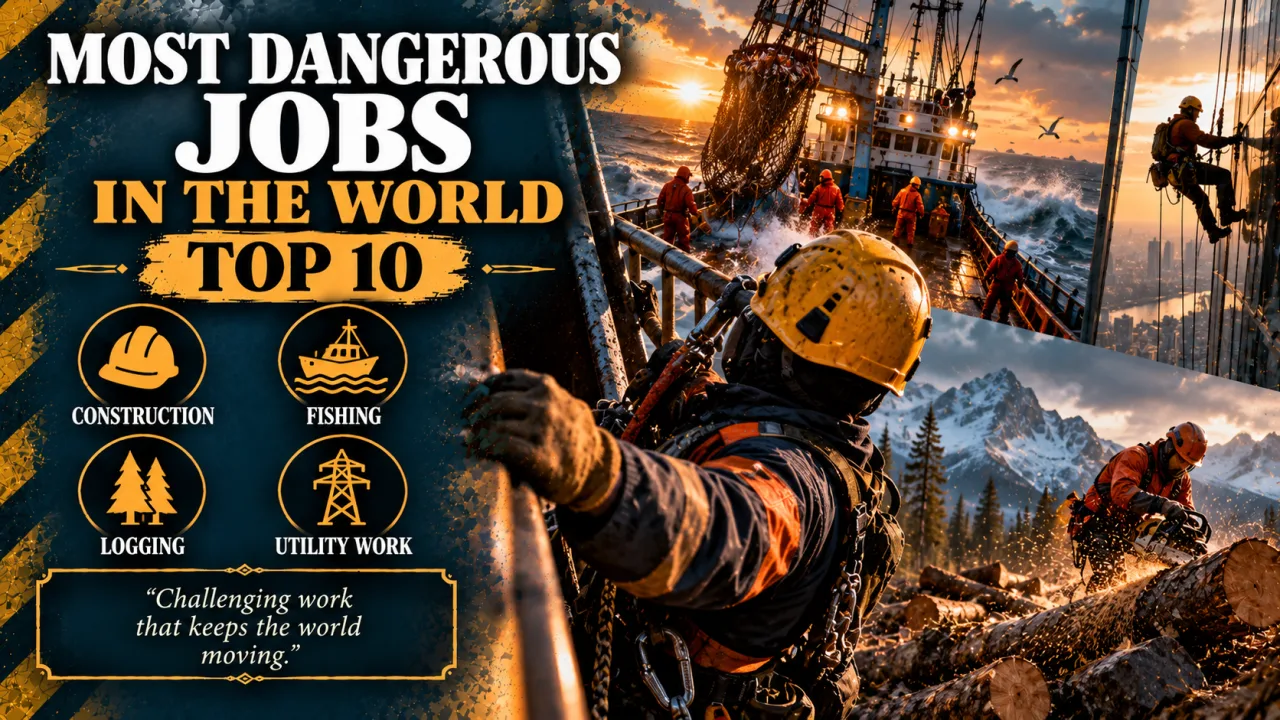
The most dangerous jobs in the world are the ones where a falling tree, a capsized boat or a slip from a roof can end a shift for good, led by logging.
Most people go to work expecting to come home. For a small group of occupations, that expectation carries real odds against it. Official fatality counts show the same handful of jobs at the top year after year: work done outdoors, at height, at sea, underground or behind the wheel, often far from help and usually with heavy machinery close by.
This Finepedia list ranks ten occupations by their fatal work injury rate, as of October 2026. The ranking uses the newest occupation-level figures from the US Bureau of Labor Statistics (BLS) Census of Fatal Occupational Injuries, covering the year 2024 and released in February 2026. Global estimates from the International Labour Organization (ILO) and the latest Great Britain figures from the Health and Safety Executive (HSE) are used to show that the same kinds of work are deadly far beyond one country.
Two numbers frame everything below. In 2024 the BLS recorded 5,070 fatal work injuries in the United States, an average rate of 3.3 deaths per 100,000 full-time equivalent workers. Every job on this list sits at least six times above that average, and the top two are more than twenty-five times higher.
How We Ranked These Jobs
There is no single official list of the most dangerous jobs, and the BLS itself avoids calling any occupation the most dangerous. What it does publish is a fatality rate for each occupation that meets minimum size thresholds. That rate is the fairest yardstick available, so it decides the order here.
- The measure: deaths from work injuries per 100,000 full-time equivalent (FTE) workers. One FTE equals 2,000 hours of work a year, so a job with many part-timers is not penalised or flattered.
- The year: 2024, the most recent complete year with published occupation rates as of October 2026. The 2023 rate is shown for comparison where it helps.
- The scope: injuries only. Deaths from long-term illness, such as cancers caused by dust or chemicals, are not counted in these figures.
- The threshold: BLS only publishes a rate when an occupation had at least five deaths and roughly 20,000 FTE workers in the year. Small, risky groups such as commercial divers therefore have no published rate and appear in Honourable Mentions instead.
- The world view: country-level occupation rates of this quality are rare, so the ILO global estimates and the HSE figures for Great Britain are used to check that the same sectors lead elsewhere. They do.
A rate measures risk to each individual worker, while the raw number of deaths measures the total human cost. Both are given for every entry, because a job with a modest rate but a huge workforce, like truck driving, can lose far more people in a year than a small, extreme trade.
At a Glance
| Rank | Occupation | Fatal injury rate (per 100,000 FTE, 2024) | Deaths in 2024 | Leading cause of death |
|---|---|---|---|---|
| 1 | Logging workers | 110.4 | 51 | Struck by trees, logs and equipment |
| 2 | Fishing and hunting workers | 88.8 | 24 | Vessel incidents and falls overboard |
| 3 | Roofers | 48.7 | 104 | Falls |
| 4 | Structural iron and steel workers | 37.8 | 14 | Falls and contact with objects |
| 5 | Refuse and recyclable material collectors | 37.4 | 36 | Transportation incidents |
| 6 | Aircraft pilots and flight engineers | 36.7 | 73 | Aircraft crashes |
| 7 | Helpers, construction trades | 35.8 | 18 | Falls |
| 8 | Underground mining machine operators | 35.6 | 12 | Contact with machinery and rock |
| 9 | Driver/sales workers and truck drivers | 25.7 | 950 | Roadway crashes |
| 10 | Grounds maintenance workers | 20.9 | 239 | Vehicle incidents, falls and falling objects |
Source for every rate and count in this table: BLS Census of Fatal Occupational Injuries, 2024 data, published February 2026. The all-worker average for comparison is 3.3.
1. Logging Workers
| Attribute | Details |
|---|---|
| Fatal injury rate | 110.4 per 100,000 FTE workers (2024); 98.9 in 2023 |
| Number of deaths (latest year) | 51 in 2024, of whom 41 were fallers |
| Main hazards | Falling and rolling trees, kickback from chainsaws, heavy logging machines, steep ground |
| Typical workplace | Remote forests and hillsides, often hours from a hospital |
| Data source | BLS Census of Fatal Occupational Injuries, 2024 |
What the Job Involves
Loggers cut down trees, trim them, haul the logs to a landing and load them onto trucks for the mill. The job title covers fallers who drop trees with chainsaws, equipment operators who run feller bunchers, skidders and loaders, and the crews who set chokers and cables on steep ground. Much of the work is seasonal and paid by volume, which rewards speed.
Why It Is So Dangerous
A mature tree can weigh several tonnes, and once it starts to move it cannot be stopped. Trees split, twist or fall the wrong way, dead limbs known as widowmakers drop from above, and logs on a slope can roll without warning. The US Occupational Safety and Health Administration (OSHA) describes logging as, by many measures, the most dangerous occupation in the country, pointing to the combination of massive weights, rough terrain, bad weather and isolated sites where medical care is far away.
What the 2024 Numbers Show
Of the 51 logging deaths recorded in 2024, 40 were contact incidents, meaning a worker was struck, crushed or caught by a tree, log or machine. Fallers, the workers who cut trees by hand, accounted for 41 of the 51 deaths on their own. Only four logging deaths involved transportation incidents, which shows how much of the danger sits at the stump rather than on the road.
How Safety Is Improving
OSHA has a dedicated logging operations standard that covers protective clothing, chainsaw handling and felling distances. The biggest single change has been mechanisation: where machines with protective cabs can fell and process trees, workers spend less time on foot under the canopy. Hand felling remains common on steep slopes and in smaller operations, which is why the rate is still the highest of any occupation BLS reports.
Key Figures
- 110.4 deaths per 100,000 FTE workers in 2024, about 33 times the all-worker rate
- 51 deaths in 2024, up from a rate of 98.9 the year before
- 41 of the 51 deaths were fallers
- 40 deaths were contact incidents with objects or equipment
- In Great Britain, the combined agriculture, forestry and fishing sector has a fatal injury rate about 21 times the all-industry average (HSE, 2021/22 to 2025/26)
2. Fishing and Hunting Workers
| Attribute | Details |
|---|---|
| Fatal injury rate | 88.8 per 100,000 FTE workers (2024); 86.9 in 2023 |
| Number of deaths (latest year) | 24 in 2024 |
| Main hazards | Sinkings and capsizings, falls overboard, deck machinery, icing, cold water |
| Typical workplace | Commercial fishing vessels at sea, often in winter storms |
| Data source | BLS Census of Fatal Occupational Injuries, 2024; NIOSH; NTSB |
What the Job Involves
Commercial fishers set and haul nets, longlines and heavy steel pots, sort the catch and keep the boat running for days or weeks at a time. Crews work long shifts on wet, moving decks with winches, cranes and hydraulic haulers. The BLS group also includes a small number of professional hunters and trappers, but fishing makes up most of it.
Why It Is So Dangerous
The National Institute for Occupational Safety and Health (NIOSH), which has tracked fishing deaths since 1991, names three main killers: vessel disasters such as sinkings, capsizings and groundings; crew members falling overboard; and injuries from machinery on deck. Heavy weather, fatigue and strenuous labour make every one of those more likely. NIOSH reported that the commercial fishing industry had a fatality rate more than 40 times the national average in 2019.
Notable Incidents
Two Alaskan crab and cod boats show how quickly things go wrong. On 11 February 2017 the fishing vessel Destination capsized near St. George Island in the Bering Sea; no mayday was sent and all six crew were lost. The National Transportation Safety Board (NTSB) blamed a decision to keep going in heavy freezing spray without enough stability margin for ice. On 31 December 2019 the Scandies Rose capsized south of Sutwik Island after heavy icing; two of the seven crew were rescued by the Coast Guard and five were never found.
How Safety Is Improving
Survival suits, emergency beacons, stability checks and man-overboard drills have all become standard advice, and NIOSH research has targeted the specific fisheries with the worst records. Internationally, the ILO Work in Fishing Convention, 2007 (No. 188) came into force on 16 November 2017, setting binding rules on safety, medical care, rest periods and written work agreements for fishers.
Key Figures
- 88.8 deaths per 100,000 FTE workers in 2024, about 27 times the all-worker rate
- 24 deaths in 2024; 16 of them were transportation incidents, a category that includes vessel incidents
- US Coast Guard figures cited by the NTSB: 805 deaths and 164 people missing in US commercial fishing vessel accidents between 2000 and 2020
- The ILO put the global fishing workforce at about 38 million when Convention No. 188 took effect in 2017
3. Roofers
| Attribute | Details |
|---|---|
| Fatal injury rate | 48.7 per 100,000 FTE workers (2024); 51.8 in 2023 |
| Number of deaths (latest year) | 104 in 2024 |
| Main hazards | Falls from edges, skylights and ladders; heat; power lines |
| Typical workplace | Homes, warehouses and commercial buildings, new builds and repairs |
| Data source | BLS Census of Fatal Occupational Injuries, 2024; OSHA |
What the Job Involves
Roofers strip old coverings and install shingles, tiles, metal sheets and flat membranes. They carry heavy bundles up ladders, work near unprotected edges and often stand on steep or fragile surfaces in full sun. Many work for small contractors where jobs last a day or two, which makes setting up full fall protection on every roof harder to enforce.
Why It Is So Dangerous
Falls are the defining hazard. A slip on loose granules, a step through a skylight or a ladder that shifts can drop a worker two or three storeys onto concrete. Summer heat adds fatigue and dehydration, and overhead electrical lines run close to many residential roofs. Because the work is spread across countless short jobs, roofers often face these risks without a safety officer on site.
What the 2024 Numbers Show
Of the 104 roofers who died in 2024, 83 were killed by falls, slips or trips, about four in every five deaths. Another 11 died from exposure to harmful substances or environments, a BLS category that includes electrocution and extreme heat. OSHA notes that across the whole US construction industry there were 389 fatal falls to a lower level out of 1,034 construction deaths in 2024.
How Safety Is Improving
Since 2012, OSHA has run a national Fall Prevention Campaign with NIOSH and construction partners, urging contractors to plan for guardrails, safety nets or personal fall arrest systems before work starts and to budget for them in every quote. Roofers rank among the occupations most affected by those rules, and the rate did edge down from 51.8 in 2023 to 48.7 in 2024.
Key Figures
- 48.7 deaths per 100,000 FTE workers in 2024, about 15 times the all-worker rate
- 104 deaths in 2024, the highest number on this list after truck drivers and grounds workers
- 83 of the 104 deaths were falls, slips or trips
- In Great Britain, falls from a height caused 53% of construction deaths over 2020/21 to 2024/25 (HSE)
4. Structural Iron and Steel Workers
| Attribute | Details |
|---|---|
| Fatal injury rate | 37.8 per 100,000 FTE workers (2024); 19.8 in 2023 |
| Number of deaths (latest year) | 14 in 2024 |
| Main hazards | Falls from beams and decking, collapsing structures, swinging loads |
| Typical workplace | High-rise frames, bridges, stadiums and industrial plants |
| Data source | BLS Census of Fatal Occupational Injuries, 2024 |
What the Job Involves
Ironworkers raise the steel skeleton of a building or bridge. They guide beams and columns lifted by cranes, bolt and weld connections, lay metal decking and place reinforcing bars. Connectors, the crew members who receive each beam and fix it in place, often stand on narrow steel many floors above the ground.
Why It Is So Dangerous
The job combines two of construction's deadliest hazards: height and heavy suspended loads. A beam swinging from a crane can knock a worker off balance, a partly connected frame can shift, and wind or ice makes every surface less forgiving. Workers must constantly move between tie-off points, which creates brief moments without protection.
What the 2024 Numbers Show
The 14 deaths recorded in 2024 included four falls and four contact incidents with objects or equipment. Because the workforce is small, a few extra deaths move the rate sharply: it nearly doubled from 19.8 in 2023 to 37.8 in 2024. That volatility is a reminder that rates for small occupations should be read over several years, not one.
How Safety Is Improving
OSHA's steel erection rules require fall protection at set heights, controlled decking zones and safe practices for hoisting and connecting. Modern sites increasingly use pre-assembled sections built at ground level, aerial lifts instead of beam walking, and perimeter cables installed as early as possible.
Key Figures
- 37.8 deaths per 100,000 FTE workers in 2024, more than 11 times the all-worker rate
- 14 deaths in 2024
- Rate nearly doubled year on year, from 19.8 in 2023
- Falls and contact incidents each accounted for four deaths in 2024
5. Refuse and Recyclable Material Collectors
| Attribute | Details |
|---|---|
| Fatal injury rate | 37.4 per 100,000 FTE workers (2024); 41.4 in 2023 |
| Number of deaths (latest year) | 36 in 2024 |
| Main hazards | Passing traffic, being struck by their own truck, compactor machinery |
| Typical workplace | Residential streets, commercial routes, transfer stations |
| Data source | BLS Census of Fatal Occupational Injuries, 2024; HSE |
What the Job Involves
Waste collectors drive and crew the trucks that empty bins and dumpsters on fixed routes, often starting before dawn. Crew members ride on the outside of the truck between stops, step into the road hundreds of times a shift and feed material into hydraulic compactors.
Why It Is So Dangerous
Most of the work happens in live traffic. Drivers who are impatient or distracted pass close to stopped trucks, and reversing collection vehicles have limited rear visibility. Riding steps, slippery roads and the crushing force of compaction equipment add to the risk, along with sharp or hazardous items hidden in bags.
What the 2024 Numbers Show
Transportation incidents caused 24 of the 36 collector deaths in 2024, two in every three. That category includes workers hit by other vehicles and those struck or run over by their own truck. The rate fell from 41.4 in 2023 to 37.4 in 2024 but remains more than eleven times the national average.
How Safety Is Improving
Automated side-loading trucks with mechanical arms let one driver empty bins without leaving the cab, removing the riskiest tasks entirely on routes where they can be used. Rear cameras, proximity sensors and route planning that reduces reversing are other common measures.
Key Figures
- 37.4 deaths per 100,000 FTE workers in 2024, more than 11 times the all-worker rate
- 36 deaths in 2024, 24 of them transportation incidents
- In Great Britain the waste and recycling sector's fatal injury rate is about 10 times the all-industry average (HSE, 2021/22 to 2025/26)
6. Aircraft Pilots and Flight Engineers
| Attribute | Details |
|---|---|
| Fatal injury rate | 36.7 per 100,000 FTE workers (2024); 31.3 in 2023 |
| Number of deaths (latest year) | 73 in 2024 |
| Main hazards | Small-aircraft crashes, weather, terrain, low-level flying |
| Typical workplace | Air taxis, charter, crop dusting, medical and tour flights; airlines |
| Data source | BLS Census of Fatal Occupational Injuries, 2024; NIOSH |
What the Job Involves
This group includes airline captains and first officers, but also the far larger and more varied world of commercial flying: air taxis, charter and cargo flights, agricultural spraying, aerial survey, firefighting, sightseeing and air ambulance work. Many of these pilots fly single-engine aircraft into short strips or over rugged country.
Why It Is So Dangerous
The risk is concentrated outside the airline cabin. Small aircraft have fewer backup systems, often fly low, and may operate in poor weather or mountainous terrain with limited navigation support. Crop dusting involves repeated passes a few metres above fields near power lines, and remote bush flying leaves little room for error.
What the 2024 Numbers Show
Almost every pilot death in 2024 was a transportation incident: 72 of 73. The split by job title is telling. Commercial pilots accounted for 61 deaths, while airline pilots, copilots and flight engineers accounted for 12. Large scheduled airlines remain one of the safest ways to travel, and the danger in this occupation comes mainly from smaller operations.
How Safety Is Improving
NIOSH has made Alaskan air taxi and commuter flying a specific research focus because of its accident history, and better weather reporting, terrain-warning systems and stricter operating rules have targeted that segment. Readers interested in the places where flying is hardest can see our guide to the most dangerous airports in the world.
Key Figures
- 36.7 deaths per 100,000 FTE workers in 2024, about 11 times the all-worker rate
- 73 deaths in 2024, 72 of them transportation incidents
- 61 commercial pilot deaths versus 12 among airline pilots, copilots and flight engineers
- Rate rose from 31.3 in 2023
7. Helpers, Construction Trades
| Attribute | Details |
|---|---|
| Fatal injury rate | 35.8 per 100,000 FTE workers (2024); 27.4 in 2023 |
| Number of deaths (latest year) | 18 in 2024 |
| Main hazards | Falls, moving equipment, trench and site hazards |
| Typical workplace | Building sites alongside electricians, carpenters, roofers and masons |
| Data source | BLS Census of Fatal Occupational Injuries, 2024 |
What the Job Involves
Helpers assist skilled tradespeople: carrying materials, setting up scaffolds and ladders, cleaning work areas, holding and cutting materials, and operating basic tools. The role is often the entry point to a trade, so many helpers are young or new to construction.
Why It Is So Dangerous
Helpers share every hazard of the trades they support, but usually with less training and experience. Newer workers are less likely to recognise a weak ladder, an unguarded edge or an unsafe trench, and less likely to speak up when something looks wrong. They also tend to do the physical fetching and carrying that keeps them moving around a busy site.
What the 2024 Numbers Show
Half of the 18 deaths in 2024, nine in total, were falls, slips or trips. The rate jumped from 27.4 in 2023 to 35.8 in 2024; as with ironworkers, a small workforce means each death has a large effect on the figure.
How Safety Is Improving
Site inductions, mentoring by experienced tradespeople and apprenticeship programmes that build safety into training all target this group. Fall-prevention rules apply to helpers in exactly the same way as to the skilled workers beside them.
Key Figures
- 35.8 deaths per 100,000 FTE workers in 2024, nearly 11 times the all-worker rate
- 18 deaths in 2024, half of them falls
- Construction and extraction occupations as a whole lost 1,032 workers in 2024
8. Underground Mining Machine Operators
| Attribute | Details |
|---|---|
| Fatal injury rate | 35.6 per 100,000 FTE workers (2024); 13.9 in 2023 |
| Number of deaths (latest year) | 12 in 2024 |
| Main hazards | Roof and rib falls, moving machinery, explosions, toxic gases |
| Typical workplace | Underground coal and metal mines |
| Data source | BLS Census of Fatal Occupational Injuries, 2024; MSHA |
What the Job Involves
These miners run the continuous miners, roof bolters, shuttle cars and longwall shearers that cut and move coal or ore deep below the surface. They work in confined, dimly lit tunnels where the roof must be supported as fast as it is exposed.
Why It Is So Dangerous
Underground, the rock itself is a hazard: sections of roof or wall can collapse without warning. Heavy machines operate in tight spaces with limited visibility, and methane or coal dust can ignite. Escape routes are long, so a fire or explosion can trap many workers at once.
Notable Incidents
The Upper Big Branch Mine-South explosion in West Virginia on 5 April 2010 killed 29 miners, the worst US mine disaster in 40 years according to the Mine Safety and Health Administration (MSHA). Elsewhere, a fire at a coal mine in Soma, Turkey, on 13 May 2014 killed 301 workers, the deadliest mining accident in that country's history.
How Safety Is Improving
US law requires MSHA to inspect every underground mine at least four times a year. Proximity-detection systems that stop machines when a worker gets too close, rock dusting to make coal dust inert, and real-time gas monitoring have all become standard tools. For a look at mining above ground, see our feature on the biggest open-pit mines on Earth.
Key Figures
- 35.6 deaths per 100,000 FTE workers in 2024, nearly 11 times the all-worker rate
- 12 deaths in 2024, half of them contact incidents with objects or equipment
- Rate rose from 13.9 in 2023, another sign of volatility in small groups
- Mining, quarrying and oil and gas extraction as a sector had a rate of 13.8 in 2024
9. Truck Drivers
| Attribute | Details |
|---|---|
| Fatal injury rate | 25.7 per 100,000 FTE workers (2024); 26.8 in 2023 |
| Number of deaths (latest year) | 950 in 2024, the most of any occupation |
| Main hazards | Highway crashes, fatigue, loading and unloading, roadside work |
| Typical workplace | Interstate highways, city streets, depots and loading docks |
| Data source | BLS Census of Fatal Occupational Injuries, 2024 |
What the Job Involves
The BLS group covers heavy and tractor-trailer drivers on long-haul and regional routes, light truck and delivery drivers, and driver/sales workers who sell and deliver goods along a route. Long-haul drivers may spend weeks away from home, working long days under federal hours-of-service limits.
Why It Is So Dangerous
The workplace is the public road. Drivers face other motorists, weather, construction zones and their own fatigue across hundreds of kilometres a day. Outside the cab, they climb on trailers, secure loads, couple and uncouple rigs and change tyres beside traffic, all of which carry risks of falls and being struck.
What the 2024 Numbers Show
Truck drivers had the largest death toll of any occupation in 2024: 950 deaths, or nearly one in five of all US workplace fatalities. Transportation incidents accounted for 708 of them. Heavy and tractor-trailer drivers alone made up 798 deaths. Across the whole economy, roadway incidents involving motor vehicles killed 1,146 workers in 2024, which is why transportation incidents remain the most common way Americans die at work.
How Safety Is Improving
Electronic logging devices that enforce rest rules, collision-mitigation braking, lane-departure warnings and in-cab cameras are spreading through fleets. The rate dipped from 26.8 in 2023 to 25.7 in 2024. Our article on the most dangerous roads in the world shows how much road conditions themselves can add to the risk.
Key Figures
- 25.7 deaths per 100,000 FTE workers in 2024, nearly 8 times the all-worker rate
- 950 deaths in 2024, the highest count of any occupation
- 798 deaths among heavy and tractor-trailer drivers
- Transportation incidents made up 38.2% of all US work deaths in 2024
10. Grounds Maintenance Workers
| Attribute | Details |
|---|---|
| Fatal injury rate | 20.9 per 100,000 FTE workers (2024); 20.5 in 2023 |
| Number of deaths (latest year) | 239 in 2024 |
| Main hazards | Falls from trees, falling limbs, mowers and vehicles, traffic, heat |
| Typical workplace | Parks, roadsides, private gardens, golf courses, utility corridors |
| Data source | BLS Census of Fatal Occupational Injuries, 2024 |
What the Job Involves
This group includes landscapers and groundskeepers who mow, plant and maintain outdoor spaces, and tree trimmers and pruners who climb or use bucket trucks to cut limbs and remove trees, often near power lines. It is a large and fast-growing workforce, much of it seasonal.
Why It Is So Dangerous
The surprise entry on many lists, grounds work is risky for two different reasons. Tree crews face the same falling-wood hazards as loggers, plus heights and electrical lines. Landscapers spend their days around ride-on mowers, trailers and roadside traffic, where rollovers and vehicle strikes are common.
What the 2024 Numbers Show
Tree trimmers and pruners accounted for 99 of the 239 deaths, split evenly between falls (39) and contact with objects such as falling limbs (39). Landscaping and groundskeeping workers accounted for 131 deaths, 62 of them transportation incidents. The total has risen from 202 in 2020 to 239 in 2024.
How Safety Is Improving
Industry training on rigging and climbing, rollover protection on mowers, high-visibility clothing for roadside crews and rules on minimum approach distances to power lines are the main tools. Because many firms are small, much of the improvement depends on owner training and local enforcement.
Key Figures
- 20.9 deaths per 100,000 FTE workers in 2024, more than 6 times the all-worker rate
- 239 deaths in 2024, up from 202 in 2020
- 99 deaths among tree trimmers and pruners
- 131 deaths among landscaping and groundskeeping workers
How the Ten Compare
| Occupation | Rate 2023 | Rate 2024 | Change | Times the all-worker rate (2024) | Deaths 2024 |
|---|---|---|---|---|---|
| Logging workers | 98.9 | 110.4 | Up | 33x | 51 |
| Fishing and hunting workers | 86.9 | 88.8 | Up | 27x | 24 |
| Roofers | 51.8 | 48.7 | Down | 15x | 104 |
| Structural iron and steel workers | 19.8 | 37.8 | Up | 11x | 14 |
| Refuse and recyclable material collectors | 41.4 | 37.4 | Down | 11x | 36 |
| Aircraft pilots and flight engineers | 31.3 | 36.7 | Up | 11x | 73 |
| Helpers, construction trades | 27.4 | 35.8 | Up | 11x | 18 |
| Underground mining machine operators | 13.9 | 35.6 | Up | 11x | 12 |
| Driver/sales workers and truck drivers | 26.8 | 25.7 | Down | 8x | 950 |
| Grounds maintenance workers | 20.5 | 20.9 | Up | 6x | 239 |
All rates are deaths per 100,000 FTE workers from the BLS hours-based rate tables for 2023 and 2024. The all-worker rate was 3.5 in 2023 and 3.3 in 2024. Multiples are rounded.
Honourable Mentions
Several occupations came close to the top ten or are widely thought of as deadly but did not make the cut on the 2024 rate.
- Farmers, ranchers and other agricultural managers: 19.4 per 100,000 FTE workers and 175 deaths in 2024, just outside the list. The ILO estimates that about one in three fatal work injuries worldwide happens to agricultural workers.
- Miscellaneous agricultural workers (farmhands and labourers): 19.0, with 147 deaths.
- Construction labourers: 15.8, but 334 deaths, the second-highest toll of any occupation after truck drivers.
- Electrical power-line installers and repairers: 13.8 in 2024, down from 18.4 in 2023, with 21 deaths.
- Police officers: the BLS did not publish a 2024 rate; it was 11.3 in 2023, and law enforcement workers suffered 132 deaths in 2024.
- Firefighters: 4.0 per 100,000 and 26 deaths in 2024, risky work but well below the occupations above on fatal injuries alone.
- Offshore oil and gas workers: NIOSH describes the extraction workforce as having an elevated fatality rate, and the Deepwater Horizon explosion in April 2010 killed 11 workers.
- Commercial divers and military personnel: no comparable BLS rate exists. Divers are too few to meet publication thresholds, and the BLS rate calculation excludes resident military.
Why Some Jobs Stay Dangerous
Gravity, Weight and Speed
Nearly every job on this list exposes workers to one of three forces: a fall from height, a heavy object in motion or a vehicle at speed. In the US in 2024, falls, slips and trips killed 844 workers and transportation incidents killed 1,937. In Great Britain, HSE says falls from a height have been the main cause of fatal work injury in almost every year since at least 2001/02.
Isolation
Loggers, fishers, bush pilots and miners often work hours from the nearest hospital. An injury that would be survivable in a city can become fatal when rescue depends on a helicopter, a boat or a long walk out.
Small Firms and Self-Employment
Roofing, logging, fishing and landscaping are dominated by small businesses and owner-operators. BLS figures show self-employed workers had a fatal injury rate of 10.8 in 2024, compared with 2.9 for wage and salary workers. HSE reports a similar pattern in Britain, where around a third of the workers killed in 2025/26 were self-employed.
An Older Workforce
Age raises the stakes. HSE found that workers aged 60 and over accounted for about a third of worker deaths in Great Britain in 2025/26, even though they made up only 12% of the workforce. Many farming, fishing and trucking workforces are getting older.
The Global Picture
The ILO estimates that about 2.93 million people died from work-related causes in 2019: roughly 2.6 million from work-related diseases and about 330,000 from occupational accidents. It names agriculture, construction, forestry and fishing, and manufacturing as the most hazardous sectors, together accounting for around 200,000 fatal injuries a year, or 63% of the total. Great Britain shows how low the numbers can go with strong enforcement: HSE recorded 126 worker deaths in 2025/26, a rate of 0.37 per 100,000 workers, yet agriculture, forestry and fishing still ran at 21 times the average.
Frequently Asked Questions
What is the most dangerous job in the world?
On fatal injury rate, logging is the most dangerous job with reliable data. US loggers died at a rate of 110.4 per 100,000 full-time workers in 2024, about 33 times the all-worker average of 3.3. Commercial fishing is a close second at 88.8, and both lead the rankings in most years.
Which job has the most deaths each year?
Truck driving. In 2024 the BLS recorded 950 deaths among driver/sales workers and truck drivers, more than any other occupation and nearly one in five of all US work deaths. The rate per worker is lower than logging or fishing, but the workforce is many times larger, so the total toll is far higher.
How is a job's fatality rate calculated?
The BLS divides the number of fatal work injuries in an occupation by the total hours worked in that occupation, then scales the result to 100,000 full-time equivalent workers, each working 2,000 hours a year. This lets small and large occupations be compared fairly. Occupations with very few deaths or workers are not given a rate.
Are police officers and firefighters on the list?
No. Both jobs carry real risks, but their fatal injury rates are lower than the top ten. Police officers had a rate of 11.3 in 2023, the latest year published, and firefighters 4.0 in 2024. Much of the danger in firefighting also comes from long-term illnesses, which injury statistics do not count.
Why is commercial fishing so deadly?
Fishers work on moving, icy decks with heavy machinery, often far offshore in winter storms. NIOSH identifies vessel disasters, falls overboard and deck machinery as the main killers. Cold water can incapacitate a person within minutes, so a fall overboard or a capsizing leaves very little time for rescue.
How many people die at work around the world?
The ILO estimates that about 2.93 million workers died from work-related causes in 2019, the latest global estimate. Around 330,000 of those deaths were from accidents at work and about 2.6 million from work-related diseases. It also estimated that 395 million workers suffered non-fatal work injuries that year.
Are dangerous jobs getting safer?
Slowly, in most countries. The overall US fatal work injury rate fell for the second year in a row to 3.3 in 2024, and Britain's rate has fallen sharply since the 1980s, though HSE says the decline has slowed. Rates for individual high-risk jobs still swing from year to year.
Conclusion
The most dangerous jobs share a simple pattern: heavy loads, heights, open water, roads or underground rock, combined with distance from help. Logging and commercial fishing remain far ahead of every other occupation on risk per worker, while truck driving claims the most lives in total because so many people do it.
The 2024 figures also show progress. The US average fell to 3.3 deaths per 100,000 workers, roofers and truck drivers saw their rates edge down, and countries like Great Britain prove that strict enforcement can push fatality rates far lower. Behind every number, though, is a worker who did not come home, which is why these jobs deserve both respect and continued attention to safety. For more of the world's riskiest places, explore our list of the most dangerous mountains in the world.
- U.S. Bureau of Labor Statistics, "Census of Fatal Occupational Injuries Summary, 2024" (February 2026): https://www.bls.gov/news.release/cfoi.nr0.htm
- U.S. Bureau of Labor Statistics, "Rate and number of fatal work injuries in selected occupations, 2024": https://www.bls.gov/charts/census-of-fatal-occupational-injuries/rate-and-number-of-fatal-work-injuries-in-selected-occupations.htm
- U.S. Bureau of Labor Statistics, CFOI current and revised data tables (hours-based rates 2023 and 2024; Table A-5, 2024): https://www.bls.gov/iif/fatal-injuries-tables.htm
- U.S. Bureau of Labor Statistics, "Fatal occupational injuries for selected occupations, 2020-24": https://www.bls.gov/news.release/cfoi.t03.htm
- U.S. Bureau of Labor Statistics, "Dangerous jobs" methodology note: https://www.bls.gov/iif/overview/dangerous-jobs.htm
- International Labour Organization, "Nearly 3 million people die of work-related accidents and diseases" (2023): https://www.ilo.org/resource/news/nearly-3-million-people-die-work-related-accidents-and-diseases
- International Labour Organization, "ILO Work in Fishing Convention No.188 (2007) enters into force" (2017): https://www.ilo.org/resource/news/ilo-work-fishing-convention-no188-2007-enters-force
- Health and Safety Executive, "Work-related fatal injuries in Great Britain, 2026": https://www.hse.gov.uk/statistics/assets/docs/fatalinjuries.pdf
- Health and Safety Executive, "Construction statistics in Great Britain, 2025": https://www.hse.gov.uk/statistics/assets/docs/construction.pdf
- Health and Safety Executive, "Agriculture, forestry and fishing statistics in Great Britain, 2025": https://www.hse.gov.uk/statistics/assets/docs/agriculture.pdf
- NIOSH, "Commercial Fishing Safety": https://www.cdc.gov/niosh/fishing/about/index.html
- NIOSH, "Aviation Workers and Aircrew Health and Safety": https://www.cdc.gov/niosh/aviation/about/index.html
- NIOSH, "Oil and Gas Extraction": https://www.cdc.gov/niosh/oil-gas/about/index.html
- OSHA, "Logging": https://www.osha.gov/logging
- OSHA, "Fall Prevention Campaign": https://www.osha.gov/stop-falls
- NTSB, investigation of the fishing vessel Destination (2017): https://www.ntsb.gov/investigations/Pages/DCA17FM006.aspx
- NTSB, investigation of the fishing vessel Scandies Rose (2019): https://www.ntsb.gov/investigations/Pages/DCA20FM009.aspx
- Mine Safety and Health Administration, "Mine Disaster Investigations Since 2000": https://www.msha.gov/mine-disaster-investigations-2000
- Wikipedia, "Soma mine disaster": https://en.wikipedia.org/wiki/Soma_mine_disaster
- U.S. Chemical Safety Board, "Macondo Blowout and Explosion": https://www.csb.gov/macondo-blowout-and-explosion/

















Log in with