






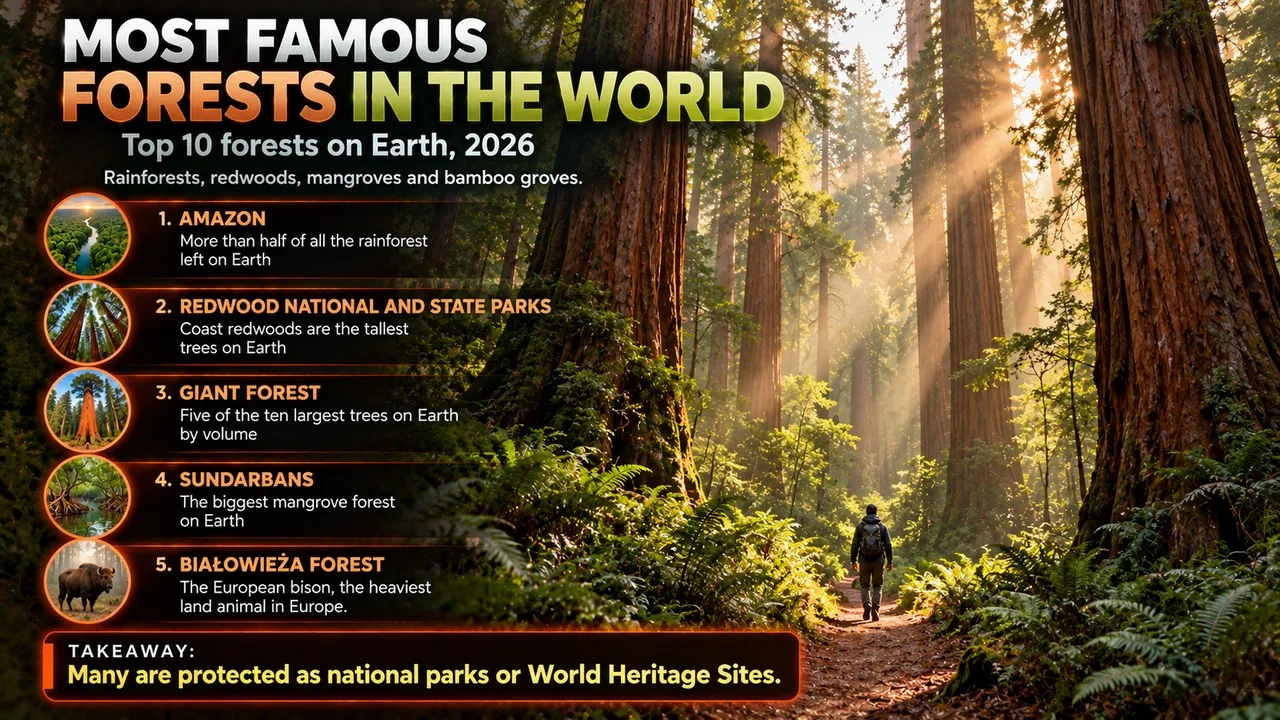
The most famous forests in the world range from the vast Amazon rainforest, about 6 million square km in size, to groves of giant trees in California.
This Finepedia guide, written in October 2026, visits ten forests that are known around the globe for their size, their trees, their wildlife or their strange beauty. They include tropical rainforests, mangrove swamps, mountain woods and a grove of bamboo, spread across five continents. Many are protected as national parks or World Heritage Sites. For more about trees and woodlands, see the Finepedia guides Most Famous Trees in the World: Top 10 and Countries With the Largest Forest Area: Top 10.
How We Chose These
We picked forests that are widely recognised by travellers and scientists alike, giving weight to their size, their natural value, any World Heritage or national park status and their place in culture. We checked areas, dates and species figures against UNESCO, national park services and Wikipedia, as of October 2026. Each forest has a different character, from the dense tropics to cool mountain slopes. We ranked them by how famous they are worldwide and how much they matter to nature.
The 10 Most Famous Forests at a Glance
| Rank | Forest | Country | Type | Known for |
|---|---|---|---|---|
| 1 | Amazon rainforest | Brazil and eight other countries | Tropical rainforest | Largest rainforest on Earth |
| 2 | Black Forest | Germany | Mountain forest | Fairy tales and cuckoo clocks |
| 3 | Redwood National and State Parks | United States | Coastal temperate forest | Tallest trees on Earth |
| 4 | Giant Forest | United States | Mountain sequoia grove | Most massive trees |
| 5 | Daintree Rainforest | Australia | Tropical rainforest | Ancient forest by the reef |
| 6 | Sundarbans | Bangladesh and India | Mangrove forest | Largest mangrove forest |
| 7 | Białowieża Forest | Poland and Belarus | Lowland primeval forest | European bison |
| 8 | Arashiyama Bamboo Grove | Japan | Bamboo grove | Towering bamboo paths |
| 9 | Monteverde Cloud Forest | Costa Rica | Cloud forest | Misty, rich in species |
| 10 | Crooked Forest | Poland | Planted pine grove | Pines bent at the base |
1. The Amazon Is the Largest Rainforest
The Amazon rainforest covers about 6 million square km of the Amazon basin in South America, more than half of all the rainforest left on Earth. About 60 percent lies in Brazil, with the rest spread across Peru, Colombia and six other countries and territories. Scientists estimate it holds around 390 billion trees of some 16,000 species.
Key Facts
- Area: about 6 million square km
- Share in Brazil: about 60 percent
- Trees: an estimated 390 billion
- Countries and territories: nine
Did You Know?
The Amazon is home to one in ten known species on Earth and to hundreds of Indigenous peoples. Large areas have been cleared for cattle, crops and mining, and scientists warn that further losses could push parts of it to turn into dry savanna.
2. The Black Forest Inspired Fairy Tales
Covering the hills of Baden-Württemberg in south-west Germany, the Black Forest is about 160 km long and up to 50 km wide. Its dark fir and spruce woods gave it its name. The Danube, one of Europe's great rivers, begins here, and the highest peak, the Feldberg, reaches 1,493 m.
Key Facts
- Area: about 6,000 square km
- Highest point: Feldberg, 1,493 m
- Location: Baden-Württemberg, Germany
- Rivers rising here: the Danube and the Neckar
Why It Matters
The forest's thick woods and old villages are linked in the popular mind with the folk tales collected by the Brothers Grimm. It is also famous for cuckoo clocks and the rich chocolate-and-cherry Black Forest cake, and tourism now supports about 300,000 jobs.
3. Redwood National and State Parks Protect the Tallest Trees
On California's far northern coast, one national park and three state parks together guard about 560 square km, home to nearly half of the old-growth coast redwoods still standing. Coast redwoods are the tallest trees on Earth, often growing above 90 m in the cool, foggy air of the Pacific coast.
Key Facts
- Area: about 560 square km
- Share of old-growth redwoods protected: 45 percent
- Tallest known tree: Hyperion, about 116 m
- UNESCO World Heritage Site: since 1980
Did You Know?
The location of Hyperion, found in 2006, is kept quiet to protect it, and visitors are asked not to search for it. Scenes for the Star Wars film Return of the Jedi were shot in redwood forests nearby.
4. The Giant Forest Is Home to Huge Sequoias
The Giant Forest, in Sequoia National Park, California, sits at over 1,800 m in the Sierra Nevada. It holds five of the ten largest trees on Earth by volume, including the General Sherman Tree, the biggest single-stem tree known. Giant sequoias can live for more than 3,000 years.
Key Facts
- Area: about 7.6 square km
- Elevation: over 1,800 m
- Famous tree: the General Sherman Tree
- Trails: more than 60 km
Why It Matters
The Giant Forest is the easiest major sequoia grove to visit, so it has played a big role in showing the public why these trees must be protected. Recent wildfires that killed many large sequoias elsewhere have made its care even more urgent.
5. The Daintree Is an Ancient Rainforest
The Daintree Rainforest in Far North Queensland, Australia, covers about 1,200 square km and is often described as one of the oldest rainforests on Earth. It belongs to Queensland's Wet Tropics, listed as a World Heritage Site in 1988. At Cape Tribulation, the forest runs right down to the sea next to the Great Barrier Reef.
Key Facts
- Area: about 1,200 square km
- Location: north of Cairns, Queensland
- World Heritage listing: 1988, as part of the Wet Tropics
- Famous animal: the southern cassowary
Did You Know?
The Daintree is one of the few places on Earth where two World Heritage Sites meet, the rainforest and the reef. In 2021, the land was handed back to its traditional owners, the Eastern Kuku Yalanji people, who now manage it jointly with the state.
6. The Sundarbans Is the Largest Mangrove Forest
The Sundarbans stretches across about 10,000 square km of the Ganges Delta, where three great rivers, the Ganges, the Brahmaputra and the Meghna, reach the Bay of Bengal. Shared by Bangladesh and India, it is the biggest mangrove forest on Earth. Its tangle of tidal channels, mudflats and islands is home to the Bengal tiger.
Key Facts
- Area: about 10,000 square km
- Countries: Bangladesh and India
- Famous animal: the Bengal tiger
- UNESCO World Heritage Site: since 1987 (India) and 1997 (Bangladesh)
Why It Matters
The mangroves shield millions of people from cyclones and storm surges coming off the Bay of Bengal. The tigers here are strong swimmers that move between islands, and they are among the few tigers that live in a mangrove habitat.
7. Białowieża Forest Is Europe's Last Great Primeval Wood
Białowieża Forest, which straddles the Polish–Belarusian frontier, is one of the last surviving parts of the ancient forest that once covered much of lowland Europe. Some of its oak, ash and lime trees are hundreds of years old, and dead trees are left to rot naturally, supporting rare fungi, insects and birds.
Key Facts
- Countries: Poland and Belarus
- UNESCO World Heritage Site: since 1979, later extended
- Famous animal: the European bison
- Bison numbers: more than 800
Did You Know?
The European bison, the heaviest land animal in Europe, died out in the wild in the early 20th century. Animals bred in zoos were brought back to Białowieża in the 1950s, and the forest is now home to the largest free-living herd.
8. Arashiyama Bamboo Grove Is a Path of Giant Stems
The Arashiyama Bamboo Grove, also called the Sagano Bamboo Forest, lies on the western edge of Kyoto, Japan. Walking paths wind between tall stalks of mōsō bamboo that sway and creak in the wind, filtering the sunlight into a soft green glow. The grove sits near the Zen temple of Tenryū-ji.
Key Facts
- Location: Arashiyama, western Kyoto, Japan
- Bamboo type: mōsō bamboo
- Nearby temple: Tenryū-ji, a World Heritage Site
- Entry: free
Why It Matters
Japan's environment ministry lists the sound of the wind in the bamboo among the country's 100 notable soundscapes. The grove is one of the most photographed places in Japan, and early-morning visits are the best way to avoid the crowds.
9. Monteverde Cloud Forest Is Wrapped in Mist
The Monteverde Cloud Forest Reserve, high in the mountains of Costa Rica, was founded in 1972 and protects more than 10,500 hectares of forest that is often bathed in cloud. The constant moisture supports an extraordinary range of life, including more than 2,500 plant species and about 400 kinds of birds.
Key Facts
- Founded: 1972
- Area: over 10,500 hectares
- Plants: more than 2,500 species, with many orchids
- Visitors: about 70,000 a year
Did You Know?
The area was settled in the 1950s by a group of Quakers from Alabama who set aside part of their land to protect the water supply. Monteverde was also the only home of the golden toad, which has not been seen since 1989 and is now thought to be extinct.
10. The Crooked Forest Has Bent Pines
The Crooked Forest, near the village of Nowe Czarnowo in north-western Poland, is a small grove of about 400 Scots pines planted around 1930. Each tree bends sharply sideways just above the ground and then curves back upright, giving the grove a strange, J-shaped look. The pines are surrounded by normal straight trees.
Key Facts
- Location: near Gryfino, West Pomerania, Poland
- Number of bent trees: about 400
- Planted: around 1930
- Height: about 15 m
Why It Matters
Nobody knows for sure why the trees are bent. Some think farmers shaped them for furniture or boat-building, while others blame heavy snow or tanks, but no clear proof exists, and the mystery draws curious visitors.
Frequently Asked Questions
What is the largest forest in the world?
The largest forest overall is the boreal forest, or taiga, which circles the far north across Russia, Canada and Scandinavia. The Amazon is the largest tropical rainforest.
What is the difference between a rainforest and a cloud forest?
A rainforest is defined by heavy year-round rain, while a cloud forest is a type of mountain rainforest that gets much of its moisture from low clouds and mist that settle on the trees.
Conclusion
The most famous forests in the world, from the vast Amazon and the tall redwoods of California to the bison woods of Białowieża and the bamboo paths of Kyoto, show how varied and precious forests are. Many face threats from clearing, fire and climate change, which makes protecting them more important than ever. For more on the world's trees and woodland, read the Finepedia guides Most Famous Trees in the World: Top 10 and Countries With the Largest Forest Area: Top 10.
- UNESCO World Heritage Centre: Redwood National and State Parks, Wet Tropics of Queensland, The Sundarbans, Sundarbans National Park and Białowieża Forest, accessed October 2026.
- US National Park Service, Redwood National and State Parks and Sequoia and Kings Canyon National Parks, accessed October 2026.
- Monteverde Conservation League and Tropical Science Center, Monteverde reserve information, accessed October 2026.
- ter Steege and others, Hyperdominance in the Amazonian Tree Flora, Science, 2013.
- Wikipedia (accessed October 2026): Amazon rainforest, Black Forest, Redwood National and State Parks, Giant Forest, Daintree Rainforest, Sundarbans, Białowieża Forest, Sagano Bamboo Forest, Monteverde Cloud Forest Reserve and Crooked Forest.
- 10 Most Today, 10 Most Beautiful Forests in the World, 10mosttoday.com (topic reference).

























Discussion
Log in with