











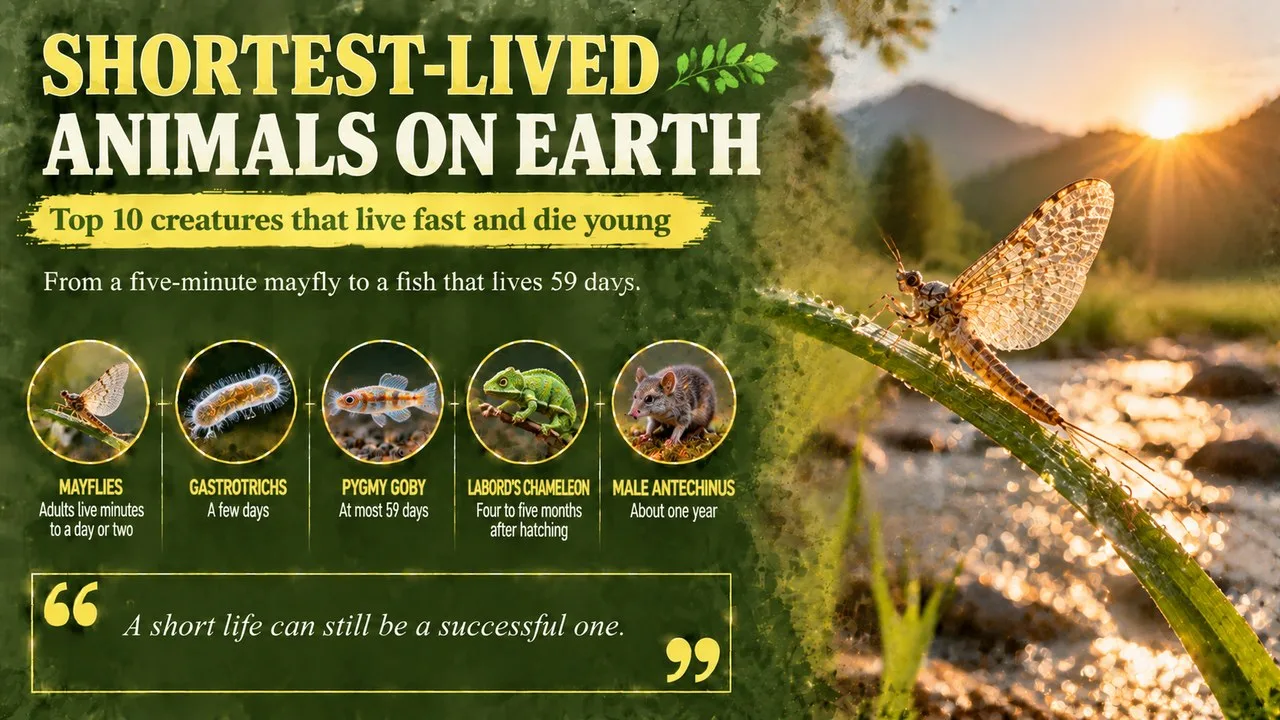
The shortest-lived animals on Earth include a mayfly whose adult life can last five minutes, a fish dying within 59 days and a lizard that lives months.
This Finepedia guide, written in October 2026, looks at 10 animals whose lives, or adult lives, are remarkably short, from tiny insects to a fish, a lizard and a mammal. The facts come from scientific studies, university and museum sources and encyclopaedias. Lifespans in the wild are hard to measure and can vary a lot with weather, food and predators, so we give typical figures and say when a number is only an estimate. If you like animal records, you may also enjoy Finepedia's guides to the longest-living animals on Earth and the slowest animals on Earth.
How We Chose These
We picked ten animals known for living fast and dying young. For some, such as mayflies, it is the adult stage that is so brief, after a much longer life as a young form. For others, such as the pygmy goby and Labord's chameleon, the whole life from egg to old age fits into a few weeks or months. The list runs roughly from the shortest life to the longest. For each one you will find a short profile, four key facts and one more note on why it matters or a surprising detail.
The 10 Shortest-Lived Animals at a Glance
| No. | Animal | Type | Typical lifespan | Note |
|---|---|---|---|---|
| 1 | Mayflies | insect | adults live minutes to a day or two | young live up to several years in water |
| 2 | Gastrotrichs | microscopic animal | a few days | many reproduce without males |
| 3 | Male ants | insect | a few weeks | die soon after mating |
| 4 | Housefly | insect | adults two to four weeks | up to 500 eggs per female |
| 5 | Worker honey bee | insect | a few weeks in summer | winter bees live months |
| 6 | Dragonflies | insect | adults usually five weeks or less | young live up to five years |
| 7 | Seven-figure pygmy goby | fish | at most 59 days | shortest-lived vertebrate |
| 8 | Turquoise killifish | fish | one to five months in the wild | adult in 14 days |
| 9 | Labord's chameleon | lizard | four to five months after hatching | shortest-lived four-limbed animal |
| 10 | Male antechinus | marsupial | about one year | all males die after mating |
1. Mayflies Are Famous for Living a Single Day
Mayflies are delicate winged insects found near rivers, streams and lakes in most parts of the world. Their scientific order is Ephemeroptera, from the Greek for lasting a day. As adults they cannot eat at all, since their mouthparts no longer work, and their only job is to mate and lay eggs before they die.
Key Facts
- Group: order Ephemeroptera, found worldwide near fresh water
- Adult life: from a few minutes to a day or two, depending on species
- Young stage: the nymph, which can live for several years underwater
- Record: the American sand-burrowing mayfly, whose females may die within five minutes
Did You Know?
The American sand-burrowing mayfly, Dolania americana, from the south-eastern United States, is thought to have the shortest adult life of any insect. The adults come out before sunrise in early summer, and they pair up and die within about half an hour, and the females lay their eggs and die within five minutes of taking to the air. Mayflies are also the only insects that moult again after they already have working wings, passing through a dull winged stage before the final adult form.
2. Gastrotrichs Live for Only a Few Days
Gastrotrichs are tiny, worm-like animals found in fresh water, the sea and wet soil. Most are less than a millimetre long, with the full range running from 0.06 mm to 3 mm, and they glide along on bands of tiny hairs on their undersides, which has earned them the nickname hairybellies. They grow up very fast and usually live for only a few days.
Key Facts
- Group: phylum Gastrotricha
- Size: roughly 0.06 to 3 mm long
- Lifespan: a few days
- Habitat: ponds, sea sand, wet mosses and soil
Why It Matters
Many freshwater gastrotrichs reproduce without any males at all. The mothers lay eggs that develop without being fertilised, a process called parthenogenesis, which allows numbers to grow quickly in their short lives. Some species can also lay tough resting eggs that survive drying out or cold, then hatch when conditions improve. These tiny animals are an important part of life in pond mud and in the spaces between grains of sand.
3. Male Ants Die Soon After Mating
In an ant colony, almost all the ants you see are females. Males are only raised at certain times of year, and they do no work in the nest. Their only role is to fly out on a mating flight and pair with a young queen from another colony. After that, their lives are over, and most die within days or a couple of weeks.
Key Facts
- Role: to mate with new queens on the nuptial flight
- Lifespan: usually a few weeks in total
- After mating: most die within about two weeks, often far sooner
- Contrast: some queens survive for as long as about 30 years
Why It Matters
The gap between the sexes is enormous. A queen of the black garden ant can live for many years, and has reached 28 years in captivity, while her mates live only a few weeks. She stores the sperm from her one mating season and uses it for the rest of her life to found and grow a colony that may have tens of thousands of workers. So-called flying ant day is really a flying ant season, with swarms appearing over several weeks of summer.
4. The Housefly Lives Fast in Warm Weather
The housefly is one of the most common insects on Earth, found almost everywhere people live. An adult usually survives somewhere between two and four weeks. In that short time a female may produce as many as 500 eggs, laid in several batches on rotting food, waste or dung. In warm weather, a fly can grow from egg to adult in about two weeks.
Key Facts
- Species: Musca domestica
- Adult life: usually two to four weeks
- Eggs: up to 500 per female in her lifetime
- Larvae: maggots hatch within about a day of the eggs being laid
Did You Know?
Because they breed so fast, houseflies can produce many generations in a single summer. Their speed of growth depends on temperature. In heat the young develop in days, while in cool weather the same stages can take weeks. In winter some adults survive by hibernating in sheltered places. Houseflies can carry germs on their bodies and legs, which is why they are a health concern around food.
5. Worker Honey Bees Wear Themselves Out
A honey bee colony is run by female workers, and their lifespan depends on the season. Workers that hatch in the warm months work so hard, cleaning the hive, feeding young bees and then flying out to collect nectar and pollen, that they live only a few weeks. Workers born in autumn, by contrast, stay inside the hive and can live for several months through the winter.
Key Facts
- Species: western honey bee, Apis mellifera
- Summer workers: live only a few weeks
- Winter workers: can live several months
- Queen: usually three to five years
Why It Matters
Honey bees show that a short life can be shaped by behaviour, not just by genes. Workers and queens start from the same kind of egg, and it is mainly their diet and role as larvae that decides how long they will live. The busy summer workers age quickly from their hard labour in the open air, while the queen, who stays in the hive laying eggs, can outlive thousands of her daughters. Bees are among the most important pollinators of crops worldwide.
6. Dragonflies Spend Most of Their Lives Underwater
Dragonflies are fast, colourful hunters of the air, but the flying adult is only the last, short chapter of their lives. Most of their time is spent as nymphs living underwater in ponds and streams, catching other small animals. In some species the nymph stage goes on for as long as five years.
Key Facts
- Group: order Odonata, suborder Anisoptera
- Nymph stage: months to as long as five years
- Adult life: usually about five weeks or less
- Longest adult life: up to about ten weeks in some species
Did You Know?
Some dragonfly species can be spotted flying for months each summer, which can give the impression that each one lives a long time. In fact the flying season is usually a relay, with new adults coming out as older ones die. Some adults survive only a few days. Dragonflies are ancient insects, and their relatives were flying long before the first dinosaurs appeared.
7. The Pygmy Goby Is the Shortest-Lived Vertebrate
The seven-figure pygmy goby, Eviota sigillata, is a tiny reef fish that grows to about 3 centimetres long. It lives on coral reefs in the tropical Indian and Pacific oceans, from the Seychelles to Micronesia. It holds the record for the shortest known lifespan of any animal with a backbone, living for no more than 59 days.
Key Facts
- Species: Eviota sigillata
- Size: up to about 3 cm long
- Lifespan: at most 59 days
- Range: Indo-West Pacific reefs, at depths of 3 to 20 m
Why It Matters
The goby's whole life is packed into eight weeks. It spends about three weeks drifting in the open sea as a larva, about two weeks settling onto the reef, and only about three weeks as an adult, when it must find a mate and breed. The record was described by the scientists Martial Depczynski and David Bellwood in the journal Current Biology in 2005. Life is so fast that being eaten by a predator is more likely than reaching old age.
8. The Turquoise Killifish Races Against the Dry Season
The turquoise killifish is a small, brightly coloured fish from Zimbabwe and Mozambique. It lives in pools that fill with rain and then dry out within months. To survive, it has become one of the fastest-living animals with a backbone, growing from a hatchling to a breeding adult in just 14 days.
Key Facts
- Species: Nothobranchius furzeri
- Size: up to about 6.5 cm long
- Lifespan: one to five months in the wild, most living up to two months
- Maturity: about 14 days after hatching, the fastest known in a vertebrate
Did You Know?
When the pools dry up, the adults die, but their eggs survive buried in the dry mud for a year or more, waiting for the next rains. In captivity the fish live from about 3 to 16 months, depending on the strain. Because they age so quickly, scientists around the world keep turquoise killifish to study ageing and age-related disease.
9. Labord's Chameleon Lives for Just One Season
Labord's chameleon is a lizard from the dry forests of western Madagascar. In the driest parts of its range, the eggs all hatch together at the start of the rainy season in November, the young grow quickly, and they are adults by January. Once they have bred, every adult dies, so in these places each chameleon lives only four or five months from the day it hatches.
Key Facts
- Species: Furcifer labordi
- Home: dry and spiny forests of western Madagascar
- Lifespan: four or five months from hatching, in the driest areas
- Status: vulnerable, because of habitat loss
Why It Matters
No other tetrapod, meaning a four-limbed animal with a backbone, is known to have a shorter life. For part of each year, the only Labord's chameleons alive are eggs buried in the ground, which hatch with the next rains. In wetter areas they may live six to nine months, and males that are kept in captivity, away from the stress of fighting rivals, can live longer.
10. Male Antechinus Die After One Mating Season
Antechinuses are small, mouse-like marsupials that live in Australia and eat mainly insects and other small animals. They are best known for a strange and brutal life story. Each year, after a breeding season lasting just one to three weeks, every male in the population dies, usually before reaching about one year of age.
Key Facts
- Group: genus Antechinus, small carnivorous marsupials
- Male lifespan: about one year
- Breeding season: one to three weeks long
- Females: can survive to breed in a second year
Did You Know?
During the breeding season, males race to mate with as many females as possible and sleep about three hours less each night. Their stress hormone levels soar, and the body's natural defences against it break down, leading to organ failure and death. A 2024 study from La Trobe University measured the males' lost sleep, though scientists think hormones, rather than tiredness, are the main cause of the die-off. This kind of life, with one burst of breeding followed by death, is very rare in mammals.
Frequently Asked Questions
What animal has the shortest lifespan?
Among insects, the adults of some mayflies live only minutes, though their young live much longer underwater. Among animals with a backbone, the seven-figure pygmy goby holds the record, living no more than 59 days in total.
Why do some animals live such short lives?
Many short-lived animals live where conditions change quickly, such as pools that dry out or seasons with brief bursts of food. They put all their energy into growing up and breeding fast, rather than into long survival.
Conclusion
From a mayfly that dies within minutes of flying to a marsupial whose males all perish after one breeding season, these ten animals show that a short life can still be a successful one. Each has found a way to pass on its genes before time runs out. For more animal records, read Finepedia's guides to the longest-living animals on Earth and the slowest animals on Earth.
- Depczynski, M. and Bellwood, D. R., Shortest recorded vertebrate lifespan found in a coral reef fish, Current Biology, 2005.
- Karsten, K. B. et al., A unique life history among tetrapods: an annual chameleon living mostly as an egg, PNAS, 2008.
- Zaid, E. et al., Semelparous marsupials reduce sleep for sex, Current Biology, 2024.
- University of California IPM, Biology and life cycle: male ants.
- Natural History Museum, London, Flying ant day: when winged ants take their nuptial flight.
- Wikipedia (accessed October 2026), articles on Mayfly, Dolania americana, Gastrotrich, Ant, Housefly, Western honey bee, Dragonfly, Eviota sigillata, Turquoise killifish, Labord's chameleon and Antechinus.
- 10 Most Today, 10 Animals With The Shortest Lifespans, 10mosttoday.com (topic reference).















Log in with