







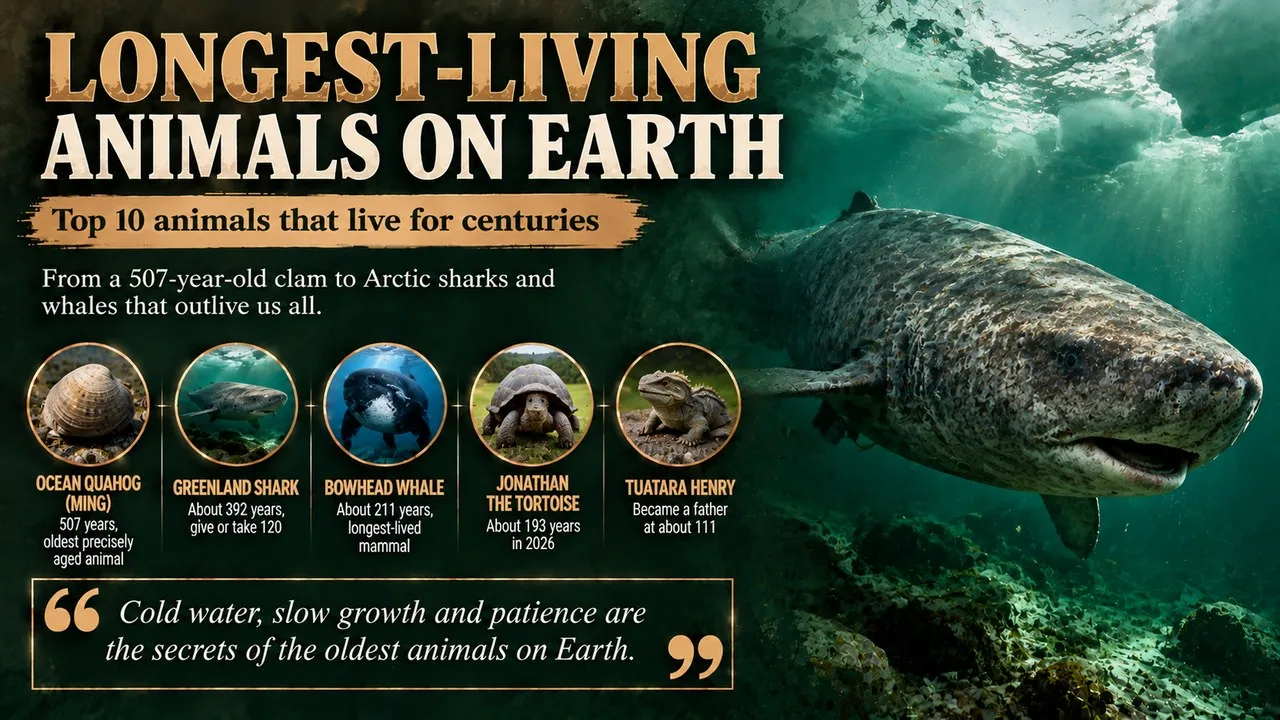
Earth's longest-living animals can survive for centuries, from a 507-year-old Icelandic clam to slow Arctic sharks and whales that easily outlive humans.
This Finepedia guide, written in October 2026, looks at 10 of the longest-living animals known to science. The facts come from published studies, museum and zoo records, Guinness World Records and encyclopaedias. Measuring the age of a wild animal is hard, so for each one we explain how its age was worked out and say clearly where a record is only an estimate or is disputed. If you love the animal world, you may also enjoy Finepedia's guides to animals that can live without food for months and the most famous trees in the world.
How We Chose These
We looked at the highest reliable ages for individual animals, not colonies or clones such as corals and sponges. We also left out animals that are only thought to be able to live forever in theory. The ten are listed roughly from the oldest known age to the youngest, and they include clams, fish, whales, worms, reptiles and an urchin. Many of them share the same secrets: cold water, slow growth and a slow pace of life. For each one you will find a short profile, four key facts and a note on how scientists know its age.
Ageing wild animals is one of the trickiest jobs in biology. Scientists use several clues: yearly bands in hard parts such as clam hinges and fish ear stones, chemical changes in eye tissue that build up slowly through life, radiocarbon left behind by nuclear tests in the 1950s and 1960s, and plain written records for animals kept by people. Each method has a margin of error, which is why many records in this list are given as estimates rather than exact birthdays.
The 10 Longest-Living Animals at a Glance
| No. | Animal | Where it lives | Oldest known or estimated age | How the age was measured |
|---|---|---|---|---|
| 1 | Ocean quahog clam | North Atlantic | 507 years | yearly bands, like tree rings |
| 2 | Greenland shark | North Atlantic and Arctic | about 392 years, give or take 120 | radiocarbon in the eye lens |
| 3 | Lamellibrachia tube worm | Gulf of Mexico seafloor | over 250 years | growth-rate models |
| 4 | Bowhead whale | Arctic seas | about 211 years | chemistry of the eye lens |
| 5 | Rougheye rockfish | North Pacific | 205 years | growth rings in ear stones |
| 6 | Red sea urchin | North-east Pacific | over 200 years | radiocarbon and growth studies |
| 7 | Koi carp Hanako | Japan | claimed 226 years | scale rings, disputed |
| 8 | Jonathan the tortoise | Saint Helena | about 193 years (2026) | historical records |
| 9 | Lake sturgeon | North America | 125 years or more | growth rings in fin bones |
| 10 | Tuatara | New Zealand | over 110 years | zoo and museum records |
1. An Ocean Quahog Clam Reached 507 Years
The ocean quahog is an edible clam that lives in the cold waters of the North Atlantic. In 2006 scientists from Bangor University dredged one off the north coast of Iceland. By counting the yearly growth lines on its hinge, much like tree rings, they first put its age at 405 years, and later work in 2013 raised that to 507 years. Journalists nicknamed it Ming, after the Chinese dynasty ruling when it was born, around 1499.
Key Facts
- Scientific name: Arctica islandica
- Oldest known: Ming, 507 years
- Found: 2006, off northern Iceland
- Age method: annual growth bands, counted like tree rings
Why It Matters
Ming is the oldest individual animal whose age has been worked out precisely. Sadly it died when it was frozen on board ship, before anyone knew how old it was. Because quahogs lay down a new band each year, scientists also use them as natural records of past ocean conditions.
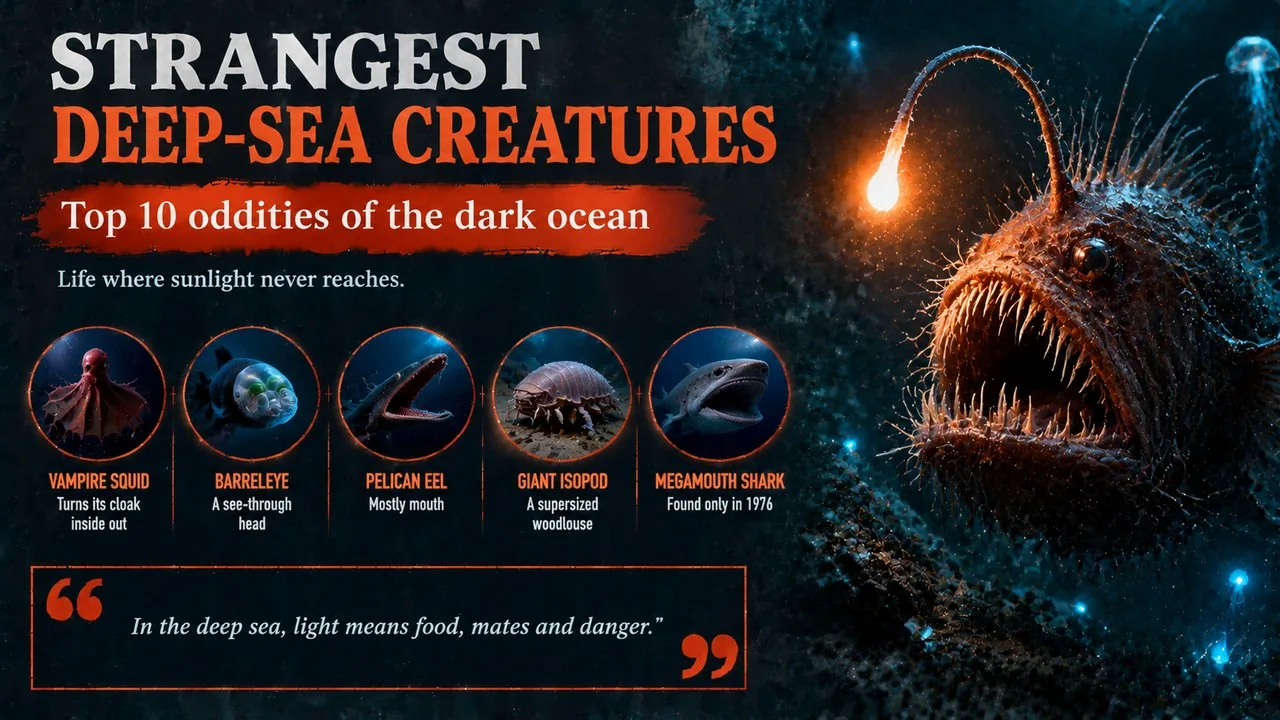
2. The Greenland Shark Is the Longest-Living Animal With a Backbone
The Greenland shark swims slowly through the icy depths of the North Atlantic and Arctic. In 2016 a team of scientists estimated the ages of 28 sharks by radiocarbon dating the proteins in the lenses of their eyes, which form before birth and never change. The largest, a female about 5 metres long, was estimated at 392 years old, give or take 120 years.
Key Facts
- Scientific name: Somniosus microcephalus
- Estimated lifespan: at least 272 years
- Growth: about 0.5 to 1 cm a year
- Breeding age: roughly 150 years
Why It Matters
No other vertebrate is known to live as long. The shark lives in water close to freezing, moves very slowly and has an extremely slow metabolism, which probably helps explain its long life. It has even been found with the remains of moose, horses and reindeer in its stomach, which suggests it scavenges on dead animals that sink to the seabed. Because females may not breed until they are about 150, the species recovers very slowly from overfishing.
3. A Deep-Sea Tube Worm Survives for More Than 250 Years
Lamellibrachia luymesi is a tube worm that lives in clusters on the floor of the northern Gulf of Mexico, 500 to 800 metres down, where oil and methane seep out of the seabed. It has no mouth or gut. Instead it relies on bacteria living inside its body, which turn chemicals from the seep into food. It can grow to more than 3 metres long.
Key Facts
- Scientific name: Lamellibrachia luymesi
- Home: cold seeps in the Gulf of Mexico
- Length: over 3 m
- Estimated lifespan: over 250 years
How Scientists Know
Researchers measured how fast these worms grow, which is extremely slowly, and used that to estimate how long it takes to reach their full size. The answer is more than 250 years, putting them among the longest-lived animals known, though some experts think individuals may live even longer.
4. The Bowhead Whale Is the Longest-Living Mammal
The bowhead whale spends its whole life in the cold seas of the Arctic and has the thickest blubber of any whale, up to about half a metre. Scientists long suspected it lived a very long time, and in the 1990s they found a way to check. By measuring chemical changes in the lenses of the eyes of whales caught by Indigenous hunters, they estimated that one male was about 211 years old.
Key Facts
- Scientific name: Balaena mysticetus
- Home: Arctic and sub-Arctic seas
- Oldest estimate: about 211 years
- Status: longest-lived mammal known
Did You Know?
In 2007 a bowhead caught off Alaska was found with the head of an old explosive harpoon lodged in its blubber. The weapon was made in the late 19th century, which meant the whale had survived being hunted well over a century earlier and was probably between 115 and 130 years old.
5. The Rougheye Rockfish Can Live for 205 Years
The rougheye rockfish is a deep-water fish of the North Pacific, found from Japan and the Bering Sea down to southern California. It is named for the row of small spines beneath its eyes, and it grows to almost a metre long. Like many of its relatives, it lives a remarkably long time, with a record age of 205 years.
Key Facts
- Scientific name: Sebastes aleutianus
- Home: North Pacific, often in deep water
- Length: up to about 97 cm
- Record age: 205 years
How Scientists Know
Fish have small ear stones, called otoliths, that grow a new layer each year, a little like rings in a tree. Counting those layers under a microscope gives scientists an age for each fish, and the rougheye's otoliths show it ranks among the oldest fish in the sea.
6. The Red Sea Urchin May Live for Two Centuries
The red sea urchin is found off western North America, from Alaska to Baja California, usually among kelp forests on rocky shores. Its round body is covered in long, sharp spines, and it grazes on seaweed using a set of five teeth on its underside. It is also harvested for food, especially for sushi.
Key Facts
- Scientific name: Mesocentrotus franciscanus
- Home: north-east Pacific coast
- Usual lifespan: often more than 30 years
- Oldest estimates: over 200 years
Why It Matters
Studies using radiocarbon from nuclear tests in the 1950s and 1960s, which left a chemical marker in the urchins' spiny skeletons, showed they grow very slowly. Some large individuals have been estimated to be more than 200 years old, and older urchins appear to show few signs of ageing.
7. Hanako the Koi Was Said to Be 226 Years Old
Koi are ornamental carp bred in Japan, and most live for a few decades. Hanako, a scarlet koi owned by Komei Koshihara, became famous when she was reported to have lived from about 1751 to 1977. Her age was said to have been worked out by counting growth rings on her scales.
Key Facts
- Species: koi, an ornamental form of the common carp
- Claimed age at death: 226 years
- Died: 1977
- Typical koi lifespan: around 40 years in Japan
A Record in Doubt
No scientific paper confirming Hanako's age has ever been found. Experts point out that scales are the least reliable way to age a carp. Her story is often repeated, but it should be treated as a legend rather than a proven record.
8. Jonathan Is the Oldest Land Animal Alive Today
Jonathan is a Seychelles giant tortoise who spends his days on the lawns of Plantation House, the governor's residence on the South Atlantic island of Saint Helena. He was brought to the island from the Seychelles in 1882, when he already seemed fully grown, which suggests he hatched around 1832. That makes him about 193 years old in 2026.
Key Facts
- Species: Seychelles giant tortoise
- Estimated hatching: about 1832
- Home: Saint Helena, South Atlantic
- Record: oldest land animal alive, per Guinness World Records
Did You Know?
Jonathan has lived through the terms of more than 30 governors. He is now blind from cataracts and can no longer smell his food, but his hearing is said to be excellent, and vets keep him healthy with hand feeding. In 2022 the governor chose 4 December as his official birthday.
9. The Lake Sturgeon Lives Longer Than Most People
The lake sturgeon is a large, ancient-looking fish of the rivers and lakes of North America, with bony plates along its body instead of scales. It grows slowly and breeds late, with females usually not spawning until their mid-20s and then only every four or five years. In 2012 a female caught on Lake Winnebago in Wisconsin was aged at 125 years.
Key Facts
- Scientific name: Acipenser fulvescens
- Home: Great Lakes and other North American waters
- Female maturity: often 24 to 26 years
- Record example: 125 years, Lake Winnebago, 2012
Why It Matters
Because it takes so long to start breeding, the lake sturgeon was badly hit by overfishing and dams in the 19th and 20th centuries. Some models suggest the largest females could live to well over 150 years, which makes protecting older fish very important.
10. The Tuatara Became a Father at 111
The tuatara of New Zealand looks like a lizard but belongs to a separate ancient group of reptiles whose relatives lived alongside the dinosaurs. Tuatara grow slowly and commonly reach 60 years, and in captivity they have lived to more than 100. Some experts believe captive tuatara might even reach 200.
Key Facts
- Home: islands off New Zealand
- Average lifespan: about 60 years
- Notable individual: Henry, at Southland Museum
- Oldest known parent: Henry, at about 111
Did You Know?
Henry, who lives at Southland Museum in the city of Invercargill, became a father in January 2009 at about 111 years old. His partner, Mildred, was around 80. All 11 of their eggs hatched, a big success for the effort to protect the species.
Frequently Asked Questions
What is the longest-living animal ever recorded?
The ocean quahog clam called Ming, at 507 years, is the oldest individual animal with a precisely measured age. Some colonial animals such as corals and glass sponges are thought to live for thousands of years, but they are made of many individuals and are counted differently.
Why do some animals live so long?
Most of the longest-lived animals live in cold water or have very slow lives. They grow slowly, use little energy and breed late, and scientists think this slow pace helps their bodies repair damage and age more slowly. Living in safe places with few predators also matters, since an animal only gets the chance to grow old if nothing eats it first.
Conclusion
From a 507-year-old clam to a tuatara that became a father at 111, these ten animals show that some lives stretch far beyond our own. Cold water, slow growth and patience seem to be their shared secrets, and studying them may one day help scientists understand ageing itself. For more of the animal world, read Finepedia's guides to animals that can live without food for months and the most famous trees in the world.
- Butler, P. G. and others (2013), Variability of marine climate on the North Icelandic Shelf in a 1357-year proxy archive based on growth increments in the bivalve Arctica islandica, Palaeogeography, Palaeoclimatology, Palaeoecology, vol. 373.
- Nielsen, J. and others (2016), Eye lens radiocarbon reveals centuries of longevity in the Greenland shark, Science, vol. 353.
- George, J. C. and others (1999), Age and growth estimates of bowhead whales via aspartic acid racemization, Canadian Journal of Zoology, vol. 77.
- Bergquist, D. C., Williams, F. M. and Fisher, C. R. (2000), Longevity record for deep-sea invertebrate, Nature, vol. 403.
- Ebert, T. A. and Southon, J. R. (2003), Red sea urchins can live over 100 years, Fishery Bulletin, vol. 101.
- Guinness World Records, oldest living land animal (Jonathan).
- Wikipedia (accessed October 2026), articles on the ocean quahog, Ming (clam), Greenland shark, Lamellibrachia luymesi, bowhead whale, rougheye rockfish, red sea urchin, Hanako (koi), Jonathan (tortoise), lake sturgeon and tuatara.
- 10 Most Today, 10 Longest Life Span Animals, 10mosttoday.com (topic reference).

















Log in with