







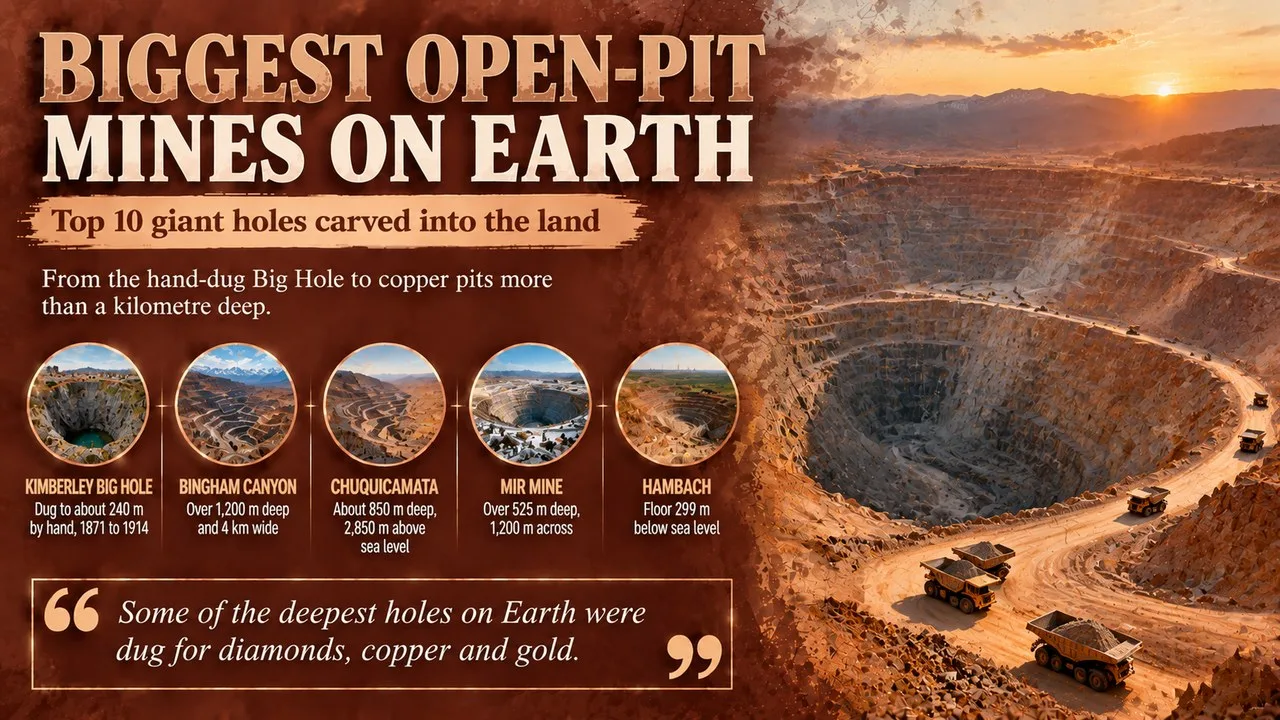
Earth's biggest open-pit mines are vast holes carved into the land, from the hand-dug Big Hole in South Africa to copper pits more than a kilometre deep.
This Finepedia guide, written in October 2026, looks at 10 of the largest and most famous open-pit mines on Earth. The facts come from mining company reports, geological surveys, heritage listings and encyclopaedias, and figures such as depth and output are given as reported in recent years. Mines change size as they are worked, so treat every measurement as a snapshot. If you enjoy stories of big engineering, you may also like Finepedia's guides to Engineering Disasters That Changed the Rules and the Top 10 Countries with Most Natural Resources in the World.
How We Chose These
An open-pit mine is dug from the surface downward in a series of giant steps, called benches, rather than through tunnels. We picked ten pits that stand out for their size, depth, history or the riches they have produced, across six continents' worth of geology. They mine diamonds, copper, gold and coal. The list runs roughly in the order mining began at each site, from the 1870s to the 2000s. For each one you will find a short profile, four key facts and one more note on why it matters or a surprising detail.
The 10 Open-Pit Mines at a Glance
| No. | Mine | Country | Main product | Notable size |
|---|---|---|---|---|
| 1 | Kimberley Big Hole | South Africa | diamonds | dug to about 240 m by hand |
| 2 | Bingham Canyon | United States | copper | over 1,200 m deep, 4 km wide |
| 3 | Chuquicamata | Chile | copper | about 850 m deep |
| 4 | Mir mine | Russia | diamonds | over 525 m deep, 1,200 m across |
| 5 | Udachnaya | Russia | diamonds | about 640 m deep |
| 6 | Hambach | Germany | lignite (brown coal) | floor 299 m below sea level |
| 7 | Grasberg | Indonesia | copper and gold | high in the Papuan mountains |
| 8 | Fimiston Super Pit | Australia | gold | about 3.5 km long |
| 9 | Escondida | Chile | copper | Chile's top copper producer |
| 10 | Diavik | Canada | diamonds | pits inside a subarctic lake |
1. The Kimberley Big Hole Was Dug Mostly by Hand
In 1871 diamonds were found on a small hill on a farm owned by the De Beers brothers in what is now Kimberley, South Africa. A rush followed, and as many as 50,000 diggers worked the site with picks and shovels until 1914. They dug a crater about 463 metres wide and 240 metres deep, and recovered around 2,720 kilograms of diamonds, roughly 13.6 million carats.
Key Facts
- Local name: Groot Gat (Big Hole)
- Mining period: 1871 to 1914
- Diamonds recovered: about 13.6 million carats
- Surface area: about 17 hectares
Did You Know?
The Big Hole is often described as the deepest hole ever dug by hand, a title it shares with the nearby Jagersfontein mine. When digging from the surface became too dangerous, Cecil Rhodes's De Beers company went underground, following the diamond-bearing rock to a depth of about 1,097 metres. Today the pit holds a lake about 40 metres deep, and the site is a museum and tourist attraction. The diamond rush also gave birth to the city of Kimberley and helped build the fortune of De Beers, which went on to dominate the global diamond trade for decades.
2. Bingham Canyon Is the Deepest Open Pit on Earth
Bingham Canyon Mine, known locally as the Kennecott Copper Mine, lies in the Oquirrh Mountains, a short drive from Salt Lake City, Utah. It has been worked since 1906 and is now over 1,200 metres deep and about 4 kilometres wide, covering some 770 hectares. It is often called the largest human-made excavation anywhere, and its lifetime copper output is believed to top every rival in history. Copper ore was first noticed in the canyon in 1848 by the brothers Sanford and Thomas Bingham, who grazed cattle there.
Key Facts
- Owner: Rio Tinto, through Kennecott Utah Copper
- Mining since: 1906
- Copper produced: more than 17 million tonnes
- Landmark status: National Historic Landmark since 1966
Did You Know?
On 10 April 2013 one wall of the pit gave way in a vast landslide, possibly the largest non-volcanic landslide in North American history. Ground radar had warned of movement, so the area had been cleared and no one was hurt, but mining was badly disrupted for months.
3. Chuquicamata Is the Largest Copper Pit by Volume
Chuquicamata, known as Chuqui, sits high in the Atacama Desert of northern Chile, about 2,850 metres above sea level near the town of Calama. Large-scale mining began in the early 20th century, and until 1996 it was Chile's most productive copper mine. Measured by the amount of rock removed, no copper pit anywhere is bigger, and at about 850 metres deep it is also one of the deepest.
Key Facts
- Location: near Calama, Antofagasta Region
- Elevation: about 2,850 m
- Operator: Codelco, Chile's state copper company
- Depth: about 850 m
Why It Matters
Pollution and the growth of waste heaps forced the old company town of Chuquicamata to be abandoned in the 2000s, and its families were moved to nearby Calama. In 2019 Chuquicamata began moving its operations underground, a sign of how deep and costly the open pit had become. The mine has also been an important part of Chile's national story, as copper became the country's biggest export and the industry was taken into state hands around 1970.
4. The Mir Mine Opened a Giant Crater in Siberia
The Mir mine, also called the Mirny mine, lies in the town of Mirny in the Sakha Republic of eastern Siberia. Soviet geologists found diamond-bearing kimberlite rock there in June 1955, and work on the open pit started two years later. Today the hole reaches more than 525 metres deep and about 1,200 metres across.
Key Facts
- Name meaning: Mir means peace in Russian
- Discovered: 13 June 1955
- Open-pit mining: 1957 to 2001
- Notable find: a 342.57-carat diamond in 1980
Did You Know?
Workers faced up to seven months of winter a year. The frozen ground was thawed with jet engines or blasted with dynamite, and at night the whole site was covered over so the machines would not freeze solid. Surface mining ended in 2001, and the site reopened as an underground mine in 2009. The town of Mirny grew up around the pit, and the crater now sits right beside its streets, one of the most striking sights in Siberia.
5. Udachnaya Was Found Two Days After Mir
The Udachnaya pipe is a diamond deposit just outside the Arctic Circle, also in Russia's Sakha Republic. Geologists found it on 15 June 1955, only two days after the Mir find, by a team led by the geologist Vladimir Shchukin. Its name means lucky, and the nearby town of Udachny takes its name from the mine.
Key Facts
- Location: Sakha Republic, near the Arctic Circle
- Discovered: 15 June 1955
- Depth: about 640 m
- Operator: Alrosa
Why It Matters
Udachnaya has been one of Russia's richest diamond sources, with estimated reserves of over 225 million carats. At about 640 metres deep, Udachnaya is often listed among the three deepest open pits anywhere, behind Bingham Canyon and Chuquicamata. Like Mir, it has since moved underground, as the pit had grown too deep to work safely and cheaply.
6. Hambach Reaches Deep Below Sea Level
Hambach is a huge lignite mine in North Rhine-Westphalia, western Germany, run by the energy company RWE. Digging began in 1978 on land once covered by the ancient Hambach Forest. The pit is up to about 500 metres deep, and its floor lies 299 metres below sea level, the lowest human-made point in Germany.
Key Facts
- Product: lignite (brown coal) for power plants
- Opened: 1978
- Mined area: about 44 square km by 2017
- Lowest point: 299 m below sea level
Did You Know?
Hambach is worked by some of the largest land vehicles ever built, including the bucket-wheel excavator Bagger 293, which has worked there since 1995. Machines like it are taller than a 20-storey building and can move hundreds of thousands of tonnes of earth in a single day. Plans to clear more of the forest led to big protests in 2018, and expansion stopped in 2020. Germany's plan to phase out coal means mining should finish by 2030, after which the pit is planned to become a large lake surrounded by new landscape.
7. Grasberg Holds Some of the Biggest Gold Reserves on Earth
Grasberg is a copper and gold mine high in the mountains of Central Papua, Indonesia, close to Puncak Jaya, the highest peak in Oceania. It is run by PT Freeport Indonesia, owned jointly by the Indonesian state and the US company Freeport-McMoRan. The open pit became one of the most productive copper and gold mines anywhere. At about 4,000 metres above sea level in places, the mine is also one of the highest in the world, with ore sent down the mountains to the coast as a slurry through a pipeline.
Key Facts
- Location: Mimika Regency, Central Papua
- Products: copper, gold and silver
- Reserves (end of 2022): about 808 tonnes of gold
- Nearby peak: Puncak Jaya
Why It Matters
The story began in 1936 when the Dutch geologist Jean Jacques Dozy noted a rich ore outcrop that he called the Ertsberg, meaning ore mountain in Dutch. Grasberg's open pit has now been replaced by underground workings, and the mine has also faced long criticism over its impact on rivers and local communities.
8. The Super Pit Sits on the Edge of an Outback Town
The Fimiston Open Pit, better known as the Super Pit, sits right beside the town of Kalgoorlie in Western Australia. It was formed from 1989 by joining many old underground workings on the famous Golden Mile into one giant pit. The pit stretches roughly 3.5 by 1.6 kilometres and is more than 600 metres deep.
Key Facts
- Location: Kalgoorlie, Western Australia
- Created: 1989
- Gold produced in 2019: about 456,000 ounces
- Owner: Northern Star Resources
Did You Know?
Gold was first found around Kalgoorlie in 1893, sparking one of Australia's great gold rushes. The Super Pit was the country's biggest open-cut gold mine until 2015, when Newmont's Boddington mine overtook it. A public lookout lets visitors watch giant trucks wind up and down the terraces, making the mine one of Kalgoorlie's top attractions.
9. Escondida Is Chile's Copper Giant
Escondida lies in the Atacama Desert of northern Chile at about 3,100 metres above sea level. Its name means hidden in Spanish. Run by BHP, it has been Chile's most productive copper mine every year since 1996, often producing more than twice as much as the next largest.
Key Facts
- Location: Antofagasta Region, Chile
- Elevation: about 3,100 m
- Operator: BHP
- Rank: Chile's top copper mine since 1996
Why It Matters
Escondida is so large that, together with its related businesses, it was estimated in 2019 to account for about 2.5 per cent of Chile's economy. Its copper ends up in wires, motors and electronics around the world, much of it shipped to China as concentrate. Running such a mine in one of the driest deserts on Earth also needs huge amounts of water and power, which has pushed the operator towards desalinated seawater and solar energy.
10. Diavik Mined Diamonds From Beneath a Lake
The Diavik Diamond Mine sits on an island in Lac de Gras, in Canada's Northwest Territories, about 220 kilometres south of the Arctic Circle. Its diamond-rich rock lies under the shallow waters of the lake, so engineers built rock-fill dikes to hold back the water and then dug the pits inside them. Commercial production began in 2003, and the mine became one of the most important employers in the region, with around 1,000 workers.
Key Facts
- Location: Lac de Gras, Northwest Territories
- Production began: 2003
- Output: around 7 million carats a year at its peak
- Access: by air or a seasonal ice road
Did You Know?
Diavik produced the Foxfire, one of the largest gem-quality rough diamonds ever found in Canada. Its Tlicho name means caribou crossing stone. Supplies for the year are trucked in over a winter ice road across frozen lakes.
Frequently Asked Questions
Which open-pit mine goes the deepest?
Bingham Canyon in Utah is the deepest, at over 1,200 metres. Chuquicamata in Chile and Udachnaya in Russia follow. Hambach in Germany is not as deep from its rim, but its floor lies the farthest below sea level.
What happens to an open pit when mining ends?
Many old pits slowly fill with groundwater and rain to form lakes, as at the Kimberley Big Hole. Others are turned into parks, museums or planned lakes, as at Hambach, while some continue as underground mines beneath the old pit. Filling a pit safely can take decades, because the water must be watched for acid and metals washed out of the rock.
Conclusion
From the hand-dug Big Hole to the deep copper pits of Utah and Chile, these ten mines show how far people will go to reach the riches underground. They supply the diamonds, gold, copper and coal of modern life, but they also leave scars that will last for centuries. For more stories of big engineering, read Finepedia's guides to Engineering Disasters That Changed the Rules and the Top 10 Countries with Most Natural Resources in the World.
- Rio Tinto Kennecott, Bingham Canyon Mine information.
- Codelco, Chuquicamata division information.
- BHP, Escondida operations overview.
- Northern Star Resources, Kalgoorlie Consolidated Gold Mines (Super Pit).
- Freeport-McMoRan, Grasberg minerals district.
- US National Park Service, National Historic Landmarks: Bingham Canyon Open Pit Copper Mine.
- Wikipedia (accessed October 2026), articles on the Kimberley Mine, Bingham Canyon Mine, Chuquicamata, Mir mine, Udachnaya pipe, Hambach surface mine, Grasberg mine, Fimiston Open Pit, Escondida and Diavik Diamond Mine.
- 10 Most Today, 10 Most Incredible Open Pit Mines, 10mosttoday.com (topic reference).
















Log in with