









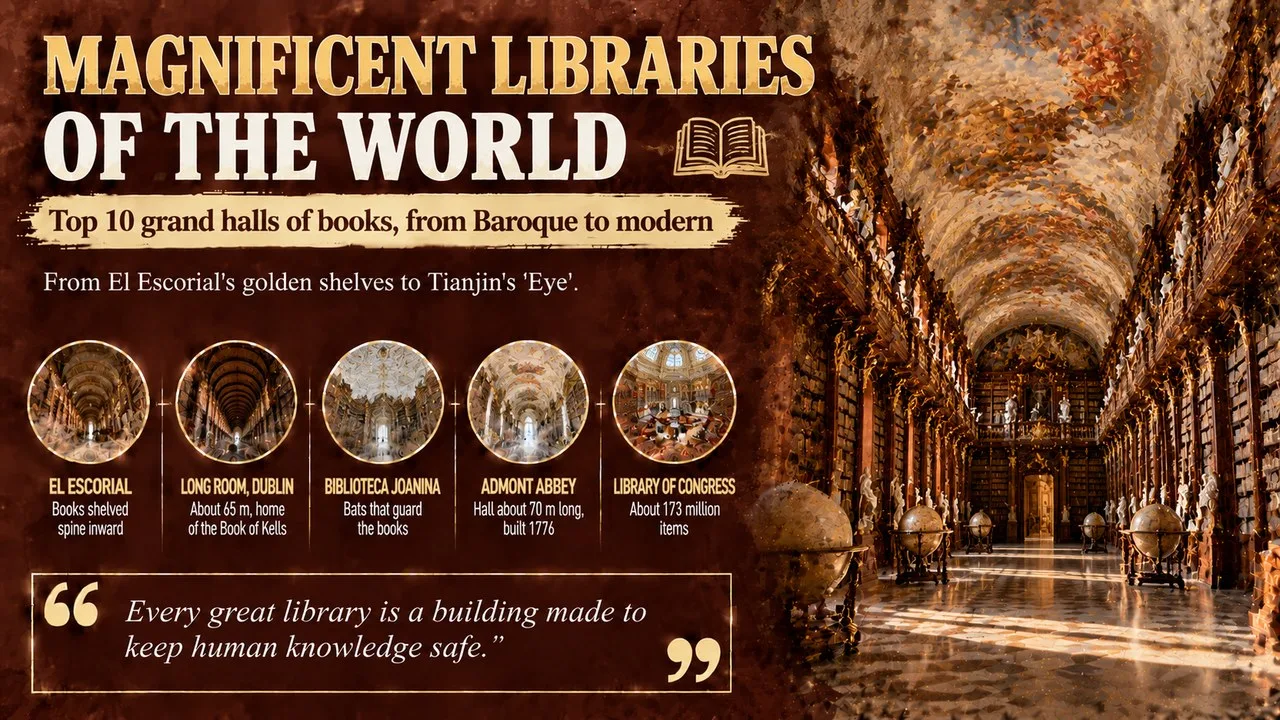
Magnificent libraries of the world include the gilded hall of Admont Abbey, Dublin's Long Room, Coimbra's bat-guarded Joanina and the Library of Congress.
This Finepedia guide, written in October 2026, looks at 10 of the most beautiful and historic libraries on Earth, from Renaissance and Baroque halls to a futuristic library in China. The facts come from UNESCO, the libraries themselves and encyclopaedias. Book counts change over time and are given differently by different sources, so we use the most widely quoted figures and round them where needed. If you enjoy great buildings full of treasures, you may also like Finepedia's guides to the most visited museums in the world and famous clock towers around the world.
How We Chose These
We picked ten libraries famous for their architecture, their history or the treasures on their shelves. Most are in Europe, where monks, kings and universities built grand book halls between the 16th and 18th centuries, but the list also includes the biggest library on the planet and a modern landmark. It runs roughly by the date of each main hall, from the oldest to the newest. For each one you will find a short profile, four key facts and one more note on why it matters or a surprising detail.
The 10 Libraries at a Glance
| No. | Library | Place | Main hall built | Famous for |
|---|---|---|---|---|
| 1 | Royal Library of El Escorial | near Madrid | 1560s to 1580s | books shelved spine inward |
| 2 | Strahov Library | Prague, Czech Republic | 1679 and 1780s | two painted halls |
| 3 | Clementinum Baroque Library | Prague, Czech Republic | 1709 to 1726 works | Jesuit hall and observatory |
| 4 | Long Room, Trinity College | Dublin, Ireland | 1712 to 1732 | Book of Kells, marble busts |
| 5 | Biblioteca Joanina | Coimbra, Portugal | 1717 to 1728 | bats that guard the books |
| 6 | State Hall, Austrian National Library | Vienna, Austria | 1720s | imperial Baroque hall |
| 7 | Abbey Library of St Gallen | Switzerland | 1758 to 1767 | healing place for the soul |
| 8 | Admont Abbey Library | Admont, Austria | 1776 | biggest monastery library |
| 9 | Library of Congress | Washington, US | 1890 to 1897 | world's largest library |
| 10 | Tianjin Binhai Library | Tianjin, China | opened 2017 | the Eye |
1. El Escorial Shelves Its Books Back to Front
The royal library at El Escorial, north-west of Madrid, is part of the vast monastery and palace that King Philip II of Spain built between 1563 and 1584. Its main hall is 54 metres long and 10 metres high, with marble floors, carved wooden bookcases and a curved ceiling covered in frescoes. It holds more than 40,000 printed volumes and thousands of rare manuscripts.
Key Facts
- Location: San Lorenzo de El Escorial, near Madrid, Spain
- Founded by: King Philip II, who ruled from 1556 to 1598
- Main hall: 54 m long, 9 m wide and 10 m high
- World Heritage: El Escorial was inscribed in 1984
Did You Know?
The books in the main hall face the wrong way. They stand with their spines towards the wall and their gilded page edges facing out, which gives the shelves a golden glow and was thought to protect the bindings. The ceiling, painted by Pellegrino Tibaldi and his team, shows the seven liberal arts, including grammar, music, geometry and astronomy, in a style inspired by Michelangelo's Sistine Chapel. Philip II even left money in his will so the library could keep buying books after his death.
2. Strahov Has Two Painted Halls
Strahov Monastery, on a hill above Prague Castle, was founded in 1143 by Premonstratensian canons. Its library has two famous rooms. The Theological Hall, finished in 1679, has a low curved ceiling covered in stucco and paintings, while the taller Philosophical Hall, built under Abbot Václav Mayer from 1779, rises two storeys with walnut shelves and a huge ceiling fresco by Anton Maulbertsch.
Key Facts
- Location: Strahov, Prague, Czech Republic
- Monastery founded: 1143
- Collection: over 200,000 volumes, including more than 3,000 manuscripts
- Halls: the Theological Hall (1679) and the Philosophical Hall (late 18th century)
Why It Matters
Strahov's monks lost their monastery more than once. In 1420, in the religious wars led by the followers of Jan Hus, people from Prague plundered it, and the communist government took it over in 1950 and turned it into a museum of national literature. After 1989 the buildings were given back to the Premonstratensian order. Today visitors can look into the two halls from their doorways, and the library is regarded as one of the best preserved of its kind in the world.
3. The Clementinum Hides a Baroque Treasure in Prague
The Clementinum is a huge complex of buildings in Prague's Old Town that is now home to the Czech national library. It grew from a Jesuit college founded in 1556, and its main building phase took place from 1709 to 1726. The highlight is the Baroque Library Hall, with painted ceilings, gilded carvings and a row of old globes down the centre.
Key Facts
- Location: Old Town, Prague, Czech Republic
- Origin: a Jesuit college from 1556
- Today: home of the Czech Republic's national library
- Weather records: kept at the complex since 1775, the oldest in the Czech lands
Did You Know?
The Clementinum also has an Astronomical Tower, and the weather readings that began there in 1775 make it one of the longest-running weather records in the world. In 1791 the complex even hosted what is often called the first world's fair, an industrial show held when Leopold II was crowned in Bohemia. The library became a legal deposit library from 1782, which means it receives a copy of books published in the country.
4. Dublin's Long Room Is a Cathedral of Books
The Long Room is the great hall of Trinity College Dublin's Old Library, part of the biggest library in Ireland. Built between 1712 and 1732, it is about 65 metres long and normally holds about 200,000 of Trinity's most ancient volumes. In 1860 its roof was raised to add an upper gallery, creating the famous barrel-vaulted ceiling of dark wood.
Key Facts
- Location: Trinity College, Dublin, Ireland
- Size: about 65 m long
- Treasures: the Book of Kells and the Brian Boru harp
- Status: a legal deposit library for Ireland and the UK
Why It Matters
The Long Room is the home of the Book of Kells, a richly painted manuscript of the Gospels made around the 8th or 9th century, which has been at Trinity since 1661. Marble busts of writers and thinkers stand along both sides of the hall. In recent years, staff have carefully cleaned, tagged and packed away most of the books for a major conservation project. The Long Room is due to stay open until the end of 2027, when building work begins, and the books are expected to return around 2030.
5. The Biblioteca Joanina Keeps Bats to Protect Its Books
The Biblioteca Joanina is a Baroque library in the historic centre of Portugal's University of Coimbra. It is named after King John V, who ordered it, and it was built between 1717 and 1728. Its three rooms glow with gilded woodwork, painted ceilings and shelves decorated with Chinese-style designs, and it holds tens of thousands of rare books from the 16th to 18th centuries.
Key Facts
- Location: University of Coimbra, Portugal
- Named after: King John V of Portugal
- Built: 1717 to 1728, receiving its first books in 1750
- World Heritage: part of the University of Coimbra site, inscribed in 2013
Did You Know?
The Joanina has unusual helpers. A small colony of bats lives inside, and at night they eat insects that would otherwise damage the old books. Staff cover the tables each evening and clean up after the bats in the morning. It is one of only two libraries in the world known to protect its books in this way, the other being the palace library at Mafra, also in Portugal.
6. Vienna's State Hall Was Built for an Emperor
The State Hall, or Prunksaal, is the grand central room of the old imperial library in the Hofburg palace in Vienna, now part of the Austrian National Library. Emperor Charles VI ordered the building, which the architect Johann Bernhard Fischer von Erlach began in the early 1720s. After his death in 1723, his son completed the work.
Key Facts
- Location: Hofburg palace, Vienna, Austria
- Architects: Johann Bernhard and Joseph Emanuel Fischer von Erlach
- Ceiling: frescoes by Daniel Gran under a central dome
- Statues: marble emperors, with Charles VI at the centre
Why It Matters
The State Hall is one of the largest Baroque library rooms in Europe and was built to show the power and learning of the Habsburg emperors. Its two wings were arranged into a war side and a peace side, a theme that is repeated in the ceiling paintings. The dome fresco shows the emperor himself, honoured by figures from classical myth. Today the hall still holds about 200,000 old books and is open to visitors.
7. The Abbey Library of St Gallen Is a Healing Place for the Soul
Found in the Swiss town of St Gallen, the abbey library ranks among the world's oldest libraries run by monks. It was founded by Saint Othmar, the first abbot, in the 8th century, and it survived a fire that destroyed the abbey in 937. Its present Rococo hall, designed by Peter Thumb, was built between 1758 and 1767.
Key Facts
- Location: St Gallen, Switzerland
- Founded: 8th century, by Saint Othmar
- Collection: about 160,000 volumes and around 2,100 manuscripts
- World Heritage: inscribed in 1983, with the Abbey of St Gall
Did You Know?
A Greek inscription above the door means healing place for the soul, a phrase taken from the library of the ancient Egyptian king Ramesses II. Inside, carved cherubs on top of the cases hint at the subjects shelved below. The one above the astronomy books, for example, peers through a telescope. Visitors must wear soft overshoes to protect the beautiful wooden floor.
8. Admont Abbey Claims the Biggest Monastery Library
Admont Abbey is a Benedictine monastery beside the Enns River in Styria, Austria, founded in 1074. Its library hall, planned by Josef Hueber and completed in 1776, is a gleaming late-Baroque space of white and gold, measuring roughly 70 by 14 metres, with a ceiling 13 metres high. The abbey claims it is the biggest library belonging to any monastery on Earth.
Key Facts
- Location: Admont, Styria, Austria
- Abbey founded: 1074, by Gebhard, Archbishop of Salzburg
- Hall size: about 70 m long, 14 m wide and 13 m high
- Books in the hall: about 70,000 of the abbey's roughly 200,000 volumes
Why It Matters
The hall shows the Enlightenment idea that faith and science belong together. Its ceiling frescoes by Bartolomeo Altomonte show stages of human knowledge leading up to divine revelation, and the room is filled with statues and gilded shelves. The abbey also runs a natural history museum and art collections, It sits at the edge of Gesäuse National Park, and the name Admont itself comes from the Latin ad montes, meaning at the mountains.
9. The Library of Congress Holds More Than Any Other
Based in Washington, D.C., the Library of Congress was founded in 1800 and is the oldest federal cultural body in the United States. It holds around 173 million items, including books, maps, films, recordings and manuscripts, and employs more than 3,000 staff. Its showpiece is the Thomas Jefferson Building, built between 1890 and 1897, with a magnificent main reading room under a domed ceiling.
Key Facts
- Location: Capitol Hill, Washington, D.C., United States
- Founded: 1800
- Collection: about 173 million items
- Famous building: the Thomas Jefferson Building, opened in 1897
Why It Matters
The library has risen from the ashes more than once. British troops burned Washington in August 1814, during the War of 1812, and over 3,000 volumes were lost. To replace them, Congress bought the 6,487 books that the former president Thomas Jefferson had collected, in 1815. Another fire in 1851 destroyed about two-thirds of Jefferson's books, but the library kept growing until it became the largest in the world.
10. The Tianjin Binhai Library Is Known as the Eye
The Tianjin Binhai Library in the port city of Tianjin, China, opened in October 2017 as one of five main buildings in a new cultural district. Designed by the Dutch firm MVRDV with local architects, it has five levels and floor-to-ceiling terraced shelves that curve around a giant glowing sphere. Through an opening in the front wall, shaped like an eye, the sphere looks like a giant iris.
Key Facts
- Location: Binhai New Area, Tianjin, China
- Opened: October 2017
- Floor space: about 33,700 square metres
- Shelf capacity: designed for about 1.2 million books
Did You Know?
Photos of the library went viral around the world, but they hid a surprise. Because the building was finished in a rush, the rooms that should give access to the highest shelves were never built, so the atrium could not be used for real books. For the opening photos, pictures of book spines were printed on the backs of the upper shelves. The sphere in the middle is an auditorium with room for 110 people.
Frequently Asked Questions
Which library holds the most items?
With about 173 million items, the US Library of Congress is generally seen as the biggest library anywhere. The British Library in London is usually ranked second.
Which is the most beautiful library in the world?
There is no official winner, but the Admont Abbey Library, the Long Room in Dublin, the Biblioteca Joanina and the Abbey Library of St Gallen appear on almost every list of the world's most beautiful libraries.
Conclusion
From a Spanish royal hall with books turned back to front to a modern Chinese library shaped like an eye, these ten places show how much people have valued books and learning over the centuries. Many of them are open to visitors and still serve readers. For more great buildings, read Finepedia's guides to the most visited museums in the world and famous clock towers around the world.
- UNESCO World Heritage Centre, Abbey of St Gall, whc.unesco.org/en/list/268.
- UNESCO World Heritage Centre, Monastery and Site of the Escurial, Madrid, whc.unesco.org/en/list/318.
- UNESCO World Heritage Centre, University of Coimbra – Alta and Sofia, whc.unesco.org/en/list/1387.
- Real Biblioteca del Monasterio de San Lorenzo de El Escorial, Patrimonio Nacional, Salón principal.
- Trinity College Dublin, Old Library Redevelopment Project, tcd.ie.
- Library of Congress, About the Library, loc.gov.
- Wikipedia (accessed October 2026), articles on El Escorial, Strahov Monastery, Klementinum, Trinity College Library, Biblioteca Joanina, Austrian National Library, Abbey library of Saint Gall, Admont Abbey, Library of Congress and Tianjin Binhai Library.
- 10 Most Today, 10 Most Beautiful Libraries In The World, 10mosttoday.com (topic reference).




















Log in with