


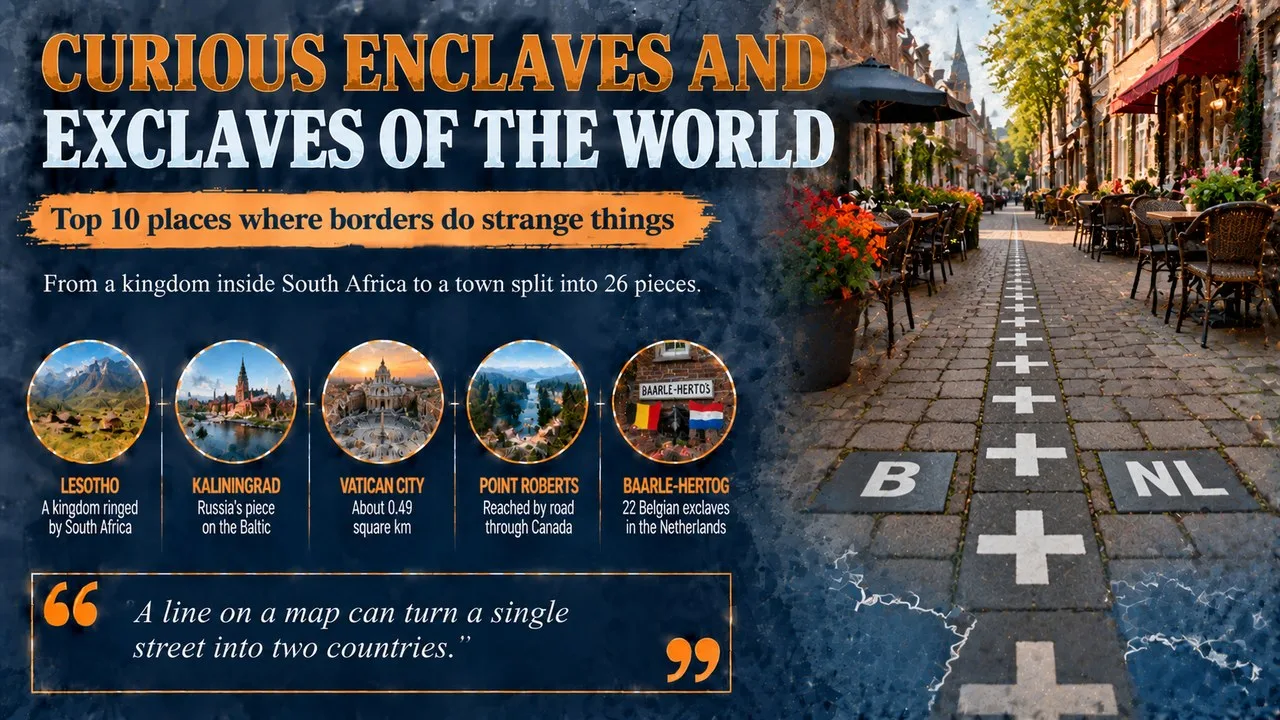
Curious enclaves and exclaves of the world include Vatican City inside Rome, Lesotho inside South Africa and a Belgian town split into 26 separate pieces.
This Finepedia guide, written in October 2026, looks at 10 of the strangest places where borders wrap around a country or cut a piece of one off from the rest. The facts come from treaties, government and local sources, and encyclopaedias. Some of these places are the subject of political claims, so we describe their status as it stands in October 2026 and note where it is disputed. If you enjoy unusual geography, you may also like Finepedia's guides to the largest countries in the world by area and phantom islands that fooled mapmakers.
How We Chose These
An enclave is a territory completely surrounded by another country, while an exclave is a part of a country cut off from its main territory. Many places are both at once. We picked ten famous examples, from independent states to tiny villages, and included a few pene-exclaves, which can only be reached by road through another country. The list runs roughly from the largest and best known to the smallest and most tangled. For each one you will find a short profile, four key facts and one more note on why it matters or a surprising detail.
The 10 Enclaves and Exclaves at a Glance
| No. | Place | Belongs to | Surrounded by or cut off by | Type |
|---|---|---|---|---|
| 1 | Lesotho | independent kingdom | South Africa | enclave country |
| 2 | Kaliningrad Oblast | Russia | Poland, Lithuania and the Baltic Sea | semi-exclave |
| 3 | Cabinda | Angola | both Congos | exclave province |
| 4 | San Marino | independent republic | Italy | enclave country |
| 5 | Vatican City | independent state | the city of Rome, Italy | enclave country |
| 6 | Ceuta and Melilla | Spain | Morocco and the Mediterranean | coastal exclaves in Africa |
| 7 | Point Roberts | United States | Canada and the sea | pene-exclave |
| 8 | Llívia | Spain | France | exclave town |
| 9 | Büsingen am Hochrhein | Germany | Switzerland | exclave village |
| 10 | Baarle-Hertog | Belgium | the Netherlands | 22 tiny exclaves |
1. Lesotho Is a Kingdom Inside Another Country
Lesotho is an independent kingdom in southern Africa that is completely surrounded by South Africa. Just two other nations, San Marino and Vatican City, share this fate of being ringed by a single neighbour, and Lesotho is much bigger than either. Almost all of it is mountainous, lying in the Maloti and Drakensberg ranges.
Key Facts
- Capital: Maseru
- Independence: 4 October 1966, from the United Kingdom
- Lowest point: about 1,400 m above sea level
- Highest point: Thabana Ntlenyana, about 3,482 m, the top of southern Africa
Why It Matters
Even Lesotho's lowest ground sits about 1,400 metres up, higher than the lowest spot of every other nation, which is why it is sometimes called the Kingdom in the Sky. Being wrapped inside South Africa shapes daily life. Many of its people have long worked across the border, and the country sells water from its mountain rivers to its larger neighbour through a large dam and tunnel scheme. It was known as Basutoland under British rule.
2. Kaliningrad Is Russia's Island on the Baltic
Kaliningrad Oblast is a part of Russia lying on the Baltic Sea between Poland and Lithuania, separated from the rest of Russia by hundreds of kilometres. Until 1945 it was the northern part of the German region of East Prussia, and its capital was the old city of Königsberg, founded by the Teutonic Order in 1255.
Key Facts
- Location: Baltic coast, between Poland and Lithuania
- Became Soviet: in 1945, under the Potsdam Agreement
- Renamed: Kaliningrad in 1946, after the Soviet leader Mikhail Kalinin
- Famous for: holding roughly 90 percent of the world's known amber deposits
Did You Know?
The city of Königsberg was the lifelong home of the philosopher Immanuel Kant, and it was famous for a puzzle about its seven bridges that the mathematician Leonhard Euler solved in 1736, a starting point for modern graph theory. Baltiysk, its naval port, is the one Russian harbour on the Baltic that does not freeze over in winter, which makes the region important to Russia's navy. Because Poland and Lithuania both belong to the EU and NATO, any trip by land from the region to mainland Russia means crossing foreign soil, so many people fly or go by sea.
3. Cabinda Is Angola's Oil-Rich Exclave
Cabinda is an Angolan province separated from the main part of Angola by a thin coastal corridor of DR Congo, which also wraps around its southern and eastern sides. The Republic of the Congo lies to the north, and the Atlantic Ocean to the west. It covers about 7,290 square kilometres.
Key Facts
- Belongs to: Angola
- Area: about 7,290 square km
- Population: about 903,000 at the 2024 census
- Economy: dominated by offshore oil, explored since 1954
Why It Matters
Huge oil fields lie under the sea off Cabinda's coast, ranking among the biggest anywhere, and oil makes up most of the province's economy. A treaty signed at Simulambuco in 1885 placed the area under Portugal, and it was governed together with Angola. Its status has been disputed by local separatist groups for decades, and at one point about a third of Cabindans were living as refugees in neighbouring Congo, though many returned after a peace agreement in 2007.
4. San Marino Claims to Be the Oldest Republic
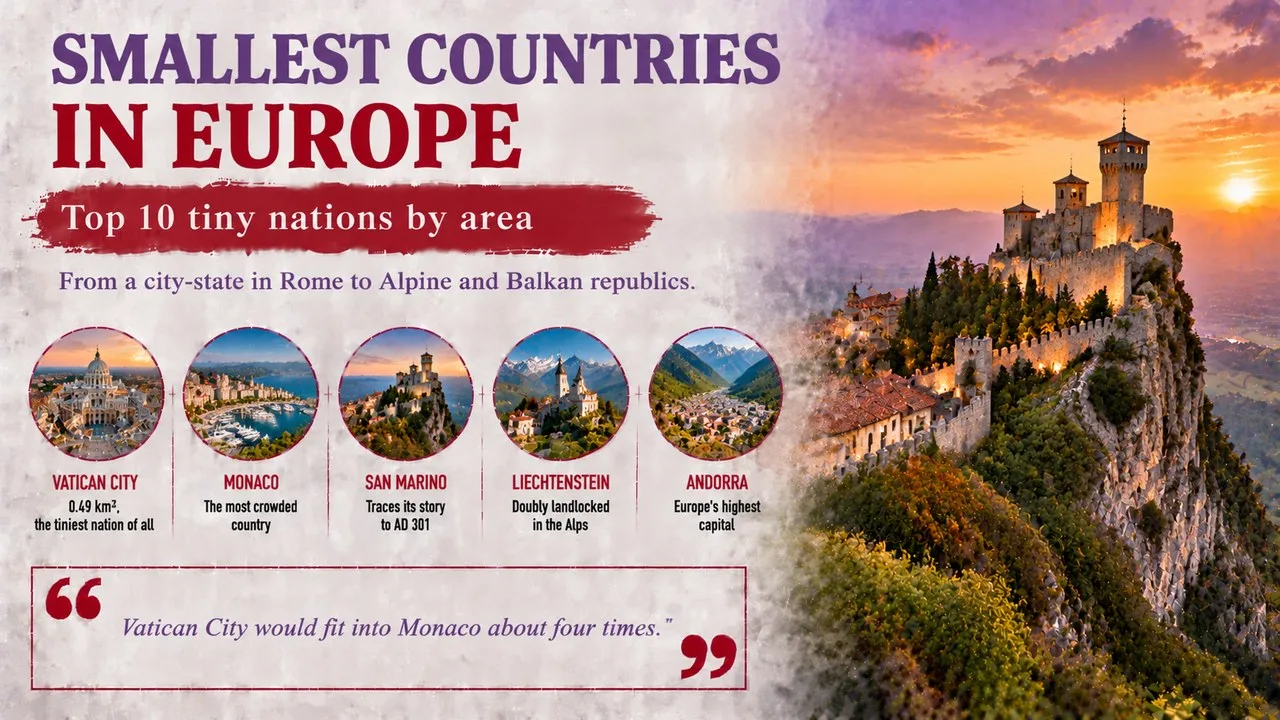
San Marino is a tiny republic completely surrounded by Italy, on the slopes of Monte Titano near the Adriatic coast. The capital town crowns the summit, where three medieval towers line the ridge. It covers about 61 square kilometres.
Key Facts
- Surrounded by: Italy
- Area: about 61 square km
- Founded: AD 301, according to tradition
- World Heritage: its historic centre and Mount Titano, inscribed in 2008
Did You Know?
Tradition says Saint Marinus, a stonemason from Rab, an island now in Croatia, escaped the persecution of Christians in AD 301 and built a small church on Monte Titano, starting the community. San Marino describes itself as the world's oldest independent state still in existence, and its oldest republic with a constitution. Its constitution dates from the 1600s, and it has two joint leaders, called Captains Regent, who hold office for only six months.
5. Vatican City Is the Smallest Country on Earth
Vatican City is an independent city-state entirely surrounded by the city of Rome. With an area of just 0.49 square kilometres and a population of only a few hundred, it is both the smallest country in the world by area and the one with the fewest people. Its ruler is the pope, who leads the Catholic Church.
Key Facts
- Surrounded by: the city of Rome, Italy
- Area: about 0.49 square km
- Created: by the Lateran Treaty of 11 February 1929
- World Heritage: the whole state was inscribed in 1984
Why It Matters
For centuries the popes ruled a large area of central Italy, the Papal States, but they lost it during the unification of Italy in the 19th century. Their status was left unsettled for nearly 60 years, a problem known as the Roman Question, until the Lateran Treaty created the modern state in 1929. Within its walls stand St Peter's Basilica, the Vatican Museums and Michelangelo's painted chapel ceiling, and it is the only country whose whole territory is a World Heritage Site.
6. Ceuta and Melilla Are Spanish Cities in Africa
Ceuta and Melilla are two Spanish cities on the north coast of Africa, each bordered on land only by Morocco. Ceuta faces the Strait of Gibraltar, and Melilla lies further east on the Mediterranean shore. Both are self-governing cities of Spain, and they form the only land borders between the EU and mainland Africa.
Key Facts
- Belong to: Spain, as autonomous cities since 1995
- Melilla: under Spanish control since 1497
- Ceuta: taken by Portugal in 1415, passed to Spain in 1668
- Status: both are claimed by Morocco
Did You Know?
Ceuta was captured on 21 August 1415 by King John I of Portugal, an event often seen as the start of Portugal's overseas empire. When Portugal broke away from Spanish rule in 1640, Ceuta stood alone among Portugal's cities in choosing to remain loyal to Madrid, and the Treaty of Lisbon confirmed it as Spanish in 1668. Today both cities are guarded by high border fences, as many migrants try to cross from Africa into Europe.
7. Point Roberts Is an American Town Reached Through Canada
Point Roberts is a small community at the tip of a peninsula south of Vancouver in British Columbia, Canada, that belongs to the US state of Washington. Driving to any other part of the US means a trip of about 40 kilometres across Canadian land, with two border crossings. It had 1,191 residents at the 2020 census.
Key Facts
- Belongs to: Whatcom County, Washington, US
- Population: 1,191 in 2020
- Created by: the Oregon Treaty of 1846, which set the border along the 49th parallel
- Other access: by boat or small plane across Boundary Bay
Why It Matters
Point Roberts exists because the treaty drew the border along a straight line of latitude, and the tip of the peninsula happened to fall just south of it. Its isolation was felt sharply in 2020, when Canada closed its border to non-essential travel during the COVID-19 pandemic. Local businesses lost about 80 percent of their trade, and a short-term ferry service began linking the town with the US mainland. Older children have long travelled through Canada to attend school in Washington.
8. Llívia Stayed Spanish Thanks to a Single Word
Llívia is a small Spanish town ringed entirely by France, in the Cerdanya valley of the Pyrenees. It belongs to Girona province in Catalonia, and a band of French land roughly 1.6 kilometres across divides it from Spain. About 1,500 people live there.
Key Facts
- Belongs to: Spain, in Girona province, Catalonia
- Surrounded by: France's Pyrénées-Orientales area
- Gap to Spain: about 1.6 km of French territory
- Named after: Livia, wife of the Roman emperor Augustus
Did You Know?
Under the 1659 peace deal between France and Spain, known as the Treaty of the Pyrenees, the villages of the area went to France. Llívia, however, held the title of a town rather than a village, so it stayed with Spain. A road links it to the rest of the country across French soil, and it was once treated as a neutral road. Llívia also keeps the old Esteve Pharmacy, said to be one of Europe's oldest, as part of its town museum.
9. Büsingen Is a German Village That Pays in Swiss Francs
Büsingen am Hochrhein is a German village on the banks of the Rhine that is completely surrounded by Switzerland. It lies about 5 kilometres from the Swiss town of Schaffhausen and a sliver of Swiss land, just about 680 metres across at its thinnest, keeps it apart from Germany. It has about 1,500 residents.
Key Facts
- Belongs to: Germany, in the state of Baden-Württemberg
- Surrounded by: three Swiss cantons, Schaffhausen, Zürich and Thurgau
- Area: about 7.6 square km
- Customs: part of the Swiss customs area, with no border checks since 1967
Why It Matters
Büsingen is politically German but economically almost Swiss. Most residents work in Switzerland and are paid in Swiss francs, which remain the most popular money in the village, even though the euro is legal tender. Electricity comes from Switzerland and is billed in francs. A treaty between the two countries decides which laws are German and which are Swiss, making the village a living lesson in how borders shape everyday life.
10. Baarle-Hertog Is a Patchwork of Two Countries
Baarle-Hertog is a Belgian municipality made up of 26 separate pieces of land, most of which lie inside the Netherlands. It shares a town with the Dutch municipality of Baarle-Nassau, and the border between them weaves through streets, gardens and even buildings. It has fewer than 3,000 residents.
Key Facts
- Belongs to: Belgium, in the province of Antwerp
- Pieces of land: 26 in total, including 22 Belgian exclaves inside the Netherlands
- Dutch enclaves: seven Dutch pockets lie inside the Belgian exclaves
- Origin: medieval deals over land between two noble houses, Breda and Brabant
Did You Know?
Some houses in Baarle are divided between Belgium and the Netherlands, and residents are often said to belong to the country where their front door stands. Painted crosses and markings on the pavement show where the border runs. A treaty signed at Maastricht in 1843 fixed the lines, and the open borders of modern Europe have made life in the town far simpler since the 1990s.
Frequently Asked Questions
What is the difference between an enclave and an exclave?
An enclave is a territory surrounded entirely by another country, as Lesotho is by South Africa. An exclave is a part of a country separated from the main territory, like Kaliningrad. Llívia and Büsingen are both, since they are cut off from home and wrapped inside a neighbour.
Where were the most complicated enclaves in the world?
The border between India and Bangladesh once had nearly 200 enclaves, including the world's only third-order enclave, Dahala Khagrabari, an Indian patch inside a Bangladeshi patch inside an Indian patch inside Bangladesh. On 1 August 2015, a Land Boundary Agreement exchanged 162 of them, ending almost all the tangle.
Conclusion
From a mountain kingdom inside South Africa to a town where the border runs through living rooms, these ten places show how history, treaties and even single words have shaped the map in odd ways. Each one turns ordinary daily life into a lesson in geography. For more strange places, read Finepedia's guides to the largest countries in the world by area and phantom islands that fooled mapmakers.
- UNESCO World Heritage Centre, San Marino Historic Centre and Mount Titano, whc.unesco.org/en/list/1245.
- UNESCO World Heritage Centre, Vatican City, whc.unesco.org/en/list/286.
- Government of India, Ministry of External Affairs, India–Bangladesh Land Boundary Agreement, 2015.
- US Census Bureau, 2020 Census, Point Roberts CDP, Washington.
- Wikipedia (accessed October 2026), articles on Lesotho, Kaliningrad Oblast, Cabinda Province, San Marino, Vatican City, Ceuta, Melilla, Point Roberts, Llívia, Büsingen am Hochrhein, Baarle-Hertog and Enclave and exclave.
- 10 Most Today, 10 Fascinating Enclaves From Around The World, 10mosttoday.com (topic reference).











Log in with