











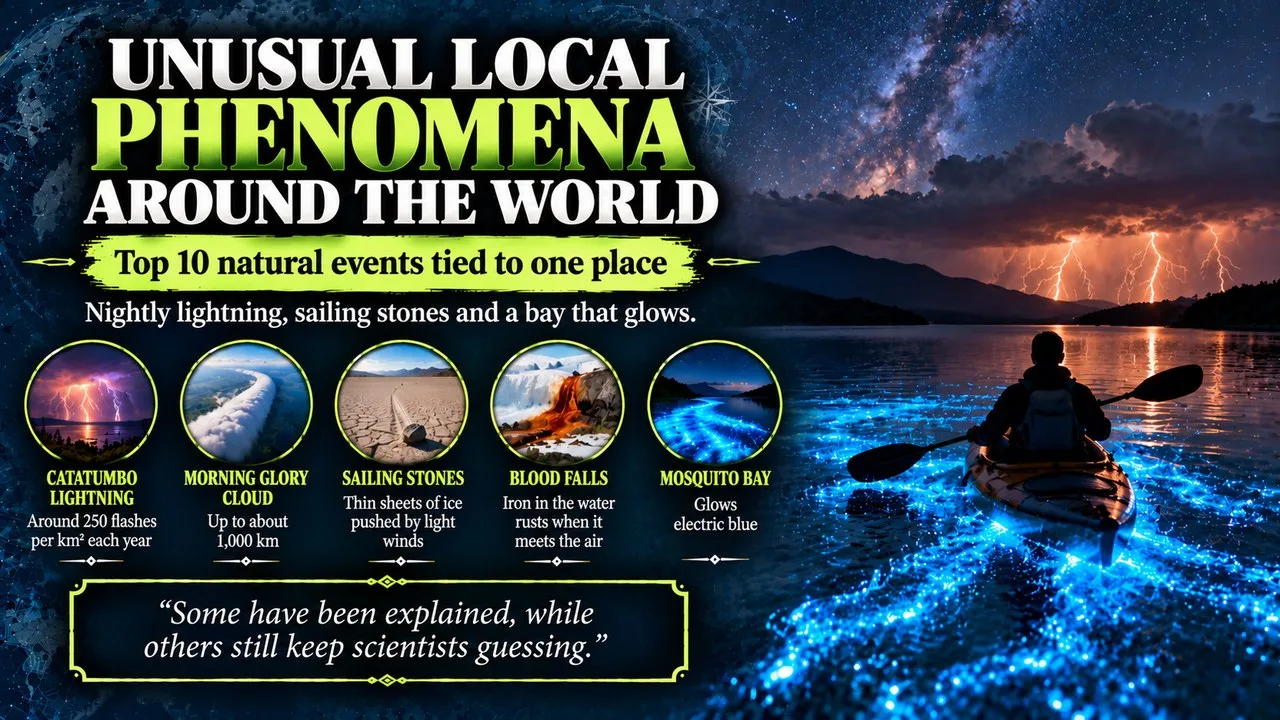
Unusual local phenomena around the world include Venezuela's endless lightning, a glowing bay in Puerto Rico and stones that slide across a desert lakebed.
This Finepedia guide, written in October 2026, presents 10 strange natural events that happen in one particular place, often at a predictable time of year. Each entry explains where to find the phenomenon, what scientists know about its cause and what makes it worth seeing. For more natural curiosities, see the Finepedia guides Surprising Microclimates Around the World: Top 10 and Ball Lightning: The Mysterious Spherical Phenomenon.
How We Chose These
We picked events tied to a specific lake, valley, coast or waterfall rather than ones that can appear almost anywhere. Ball lightning and the northern lights are left out because other Finepedia posts already explain them, and local weather quirks such as fog belts and snowbelts appear in our microclimates guide. Where the cause is still debated, we say so. The order is a guide, not a scientific ranking.
The 10 Local Phenomena at a Glance
| Rank | Phenomenon | Place | Best time to see it |
|---|---|---|---|
| 1 | Catatumbo lightning | Lake Maracaibo, Venezuela | most of the year, at night |
| 2 | Morning Glory cloud | Gulf of Carpentaria, Australia | late September to early November |
| 3 | Sailing stones | Racetrack Playa, California | winter, when the playa floods and freezes |
| 4 | Blood Falls | Taylor Glacier, Antarctica | all year |
| 5 | Synchronous fireflies | Great Smoky Mountains, Tennessee | late May to June |
| 6 | Sardine run | KwaZulu-Natal coast, South Africa | May to July |
| 7 | Rain of fish | Yoro, Honduras | May or June storms |
| 8 | Eternal Flame Falls | Chestnut Ridge Park, New York | nearly all year |
| 9 | Glowing bay | Mosquito Bay, Puerto Rico | dark, moonless nights |
| 10 | Hessdalen lights | Hessdalen valley, Norway | unpredictable |
1. Catatumbo Lightning Flashes Over Lake Maracaibo
Where the Catatumbo River runs into Lake Maracaibo in north-western Venezuela, storms light up the sky on most nights of the year. Local people call it the Relámpago del Catatumbo.
Key Facts
- Frequency: between about 140 and 160 nights in a typical year
- Duration: often seven to ten hours a night
- Density: around 250 flashes per km² each year, the highest on Earth
- Record: recognised by Guinness World Records in 2014
Did You Know?
Warm, humid air from the lake meets cooler winds coming down from the Andes, and the mountains that surround the basin on three sides trap the clouds. The storms are so steady that they faded completely only once in recent memory, during a drought in early 2010.
2. The Morning Glory Cloud Rolls Across Northern Australia
On some spring mornings, a long tube of cloud sweeps in from the Gulf of Carpentaria over the small town of Burketown in Queensland. These roll clouds are the most famous example of a rare kind of atmospheric wave.
Key Facts
- Length: up to about 1,000 km
- Height: a cloud 1 to 2 km thick, often only 100 to 200 m above the ground
- Speed: about 10 to 20 m per second
- Season: late September to early November
Why It Matters
Glider pilots travel to Burketown hoping to ride the rising air at the front of the cloud, rather like surfers on a wave. The local Garrwa people knew the cloud long before Royal Australian Air Force pilots reported it in 1942, and scientists have studied it closely since the 1970s.
3. Sailing Stones Glide Across Racetrack Playa
On a dry lakebed in Death Valley National Park, California, heavy rocks leave long trails behind them, as if they had been pushed by an invisible hand. For decades nobody had seen one move.
Key Facts
- Location: Racetrack Playa, a dry lakebed in Death Valley
- Stone size: mostly 15 to 46 cm across
- Trails: often up to about 100 m long
- Cause: confirmed in 2014 as thin sheets of ice pushed by light winds
Did You Know?
In the winter of 2013 to 2014, researchers set up time-lapse cameras and GPS trackers and finally filmed the stones moving. Rain had formed a shallow pond, which froze into thin panes of ice. As the ice broke up on sunny days, gentle breezes shoved the panes and the rocks crept along at a few metres per minute.
4. Blood Falls Stains an Antarctic Glacier Red
At the end of Taylor Glacier in the McMurdo Dry Valleys of Antarctica, a rust-red stream trickles out of the ice onto frozen Lake Bonney. It looks like a wound in the white landscape, which is how it earned its gruesome name.
Key Facts
- Discovered: 1911, by Australian geologist Thomas Griffith Taylor
- Source: very salty water trapped beneath about 400 m of ice
- Colour: iron in the water rusts when it meets the air
- Life: at least 17 types of microbes living without oxygen
Why It Matters
Early explorers thought red algae caused the colour, but the real cause is iron. The brine is so salty that it stays liquid well below freezing, and its microbes survive in darkness without sunlight. That makes Blood Falls a model for how life might exist under the ice of other worlds, such as Mars or Jupiter's moon Europa.
5. Synchronous Fireflies Light Up the Smokies
For a few weeks each year, thousands of fireflies near Elkmont in Great Smoky Mountains National Park flash in near unison. Waves of light and darkness ripple through the forest, one of the few places in North America where this happens.
Key Facts
- Species: Photinus carolinus
- Season: about two to three weeks, between late May and late June
- Flash pattern: a burst of four to eight flashes, then several seconds of darkness
- Visitor access: a nightly vehicle lottery run by the National Park Service
Did You Know?
The male fireflies flash in step so that the dark pause that follows is shared, which helps them spot the dimmer replies of females on the ground. In 2026 the park issued 120 reservations a night over eight nights, and it uses soil temperatures to predict when the display will peak.
6. The Sardine Run Turns the Sea Into a Feast
Most years between May and July, billions of sardines swim north up South Africa's eastern shoreline towards KwaZulu-Natal. Their huge shoals attract dolphins, sharks, seals, whales and diving seabirds in one of the busiest feeding events in the ocean.
Key Facts
- Fish: Sardinops sagax, known locally as the pilchard
- Shoal size: often over 7 km in length, about 1.5 km across and 30 m deep
- Trigger: a band of cool coastal water, usually below about 21 °C
- Missing years: in some years the run fails or stays offshore
Why It Matters
In terms of biomass, the sardine run may rival the great wildebeest migration of East Africa. Divers and wildlife filmmakers flock to the coast, and fishers net sardines straight from the beaches.
7. Fish Appear After Storms in Yoro, Honduras
In the department of Yoro in northern Honduras, residents say that live fish are found on the ground after the first big storms of the rainy season. They call it the lluvia de peces, or rain of fish, and say it has happened for more than a century.
Key Facts
- Season: the rainy season, usually May or June
- Festival: the Festival de Lluvia de Peces, held since 1998
- Nearest sea: the Atlantic coast, about 72 km away
- Likely cause: fish washed out of underground streams by heavy rain
Did You Know?
Many residents link the event to Father José Manuel Subirana, a Spanish missionary who lived in Honduras from 1855 to 1864 and is said to have prayed for food for the poor. Scientists offer a natural explanation, suggesting that fish living in underground waters are swept to the surface by floods, since no one has clearly seen them fall from the sky.
8. Eternal Flame Falls Burns Behind a Waterfall
In Chestnut Ridge Park, near Buffalo, New York, a little flame flickers in a rocky hollow behind a waterfall. Natural gas seeps out of the rock, and once lit, it can keep burning for long periods.
Key Facts
- Location: Shale Creek Preserve, Chestnut Ridge Park, Orchard Park
- Gas: rich in ethane and propane, about 35 percent
- Output: roughly 1 kg of methane a day, according to a 2013 study
- Source: shale rock about 400 m below the surface
Why It Matters
The 2013 study, by Indiana University and Italian scientists, found that the gas comes from shale that is cooler and younger than usual for gas formation, which may point to an unknown natural process. The flame sometimes goes out and is relit by visitors, and a new trail with steps and railings opened in 2023.
9. Mosquito Bay in Puerto Rico Glows Blue
On the island of Vieques, Mosquito Bay glows electric blue whenever its water is disturbed by a paddle, a fish or a falling raindrop. The light comes from tiny single-celled organisms called dinoflagellates.
Key Facts
- Organism: Pyrodinium bahamense, sometimes called whirling fire
- Record: named the brightest bioluminescent bay by Guinness World Records
- Density: up to about 700,000 dinoflagellates per gallon of water
- Protection: a US National Natural Landmark since 1980
Did You Know?
The bay's narrow mouth keeps the organisms from being washed out to sea, and the surrounding red mangroves supply the nutrients they need. Hurricane Maria in 2017 left the bay dark for weeks, but it later recovered and glowed even more brightly than before.
10. The Hessdalen Lights Still Puzzle Scientists
In a quiet valley in central Norway, glowing balls of light have been reported floating, darting or hovering in the air since at least the 1930s. Most are white, yellow or red, and a sighting can last from a few seconds to more than an hour.
Key Facts
- Location: a 12 km stretch of the Hessdalen valley
- Busiest period: December 1981 to mid-1984, with 15 to 20 sightings a week
- Recent activity: only about 10 to 20 sightings a year by 2010
- Monitoring: an automatic measuring station since 1998
Why It Matters
Hessdalen is one of the few places where unexplained lights can be studied with cameras and instruments year after year. Ideas include burning dust rich in scandium and glowing plasma formed by radon in the air, but there is still no agreed explanation, which keeps scientists returning.
Frequently Asked Questions
Where does lightning strike the most on Earth?
The Catatumbo River area of Lake Maracaibo in Venezuela has the highest density of lightning, with about 250 flashes per km² a year. Kifuka in DR Congo held the record before it.
Why do the sailing stones move?
They move when thin ice forms on a shallow winter pond across the playa. As the ice breaks up, light winds push the panes against the rocks, sliding them across the soft mud.
Conclusion
From a lake lit by lightning to a bay that glows at the touch of a paddle, these local phenomena show how one place can host something seen almost nowhere else. Some have been explained, while others still keep scientists guessing. For more natural curiosities, read the Finepedia guides Surprising Microclimates Around the World: Top 10 and Ball Lightning: The Mysterious Spherical Phenomenon.
- US National Park Service, Synchronous Fireflies and 2026 firefly viewing news release, Great Smoky Mountains National Park, and Racetrack Playa, Death Valley National Park, nps.gov (accessed October 2026).
- Guinness World Records, Brightest bioluminescent bay; BBC Travel, report on Catatumbo lightning, 2014; NPR, report on Mosquito Bay after Hurricane Maria, December 2017.
- Wikipedia (accessed October 2026): Catatumbo lightning, Morning Glory cloud, Sailing stones, Blood Falls, Photinus carolinus, Sardine run, Lluvia de peces, Eternal Flame Falls, Puerto Mosquito and Hessdalen lights.
- 10 Most Today, 10 Most Unusual Local Phenomena From Around the World, 10mosttoday.com (topic reference).




























Discussion
Log in with