










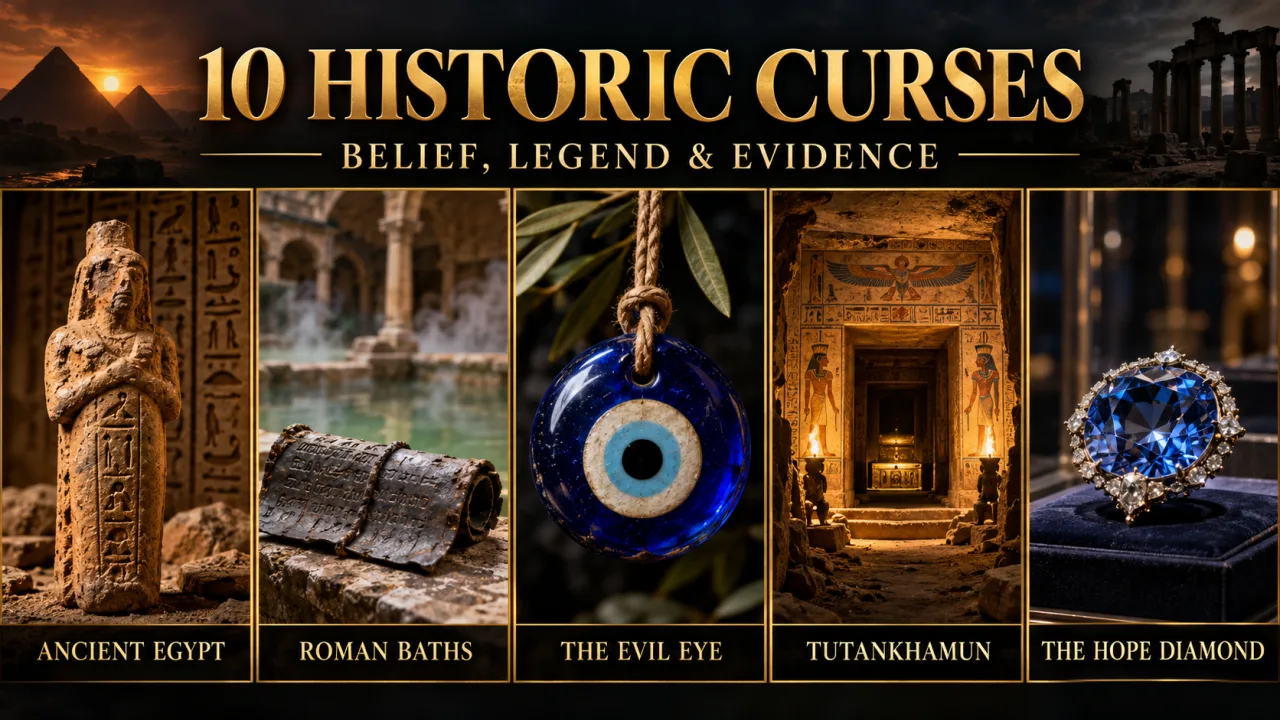
People have blamed curses for misfortune for thousands of years. The objects and inscriptions behind these stories are real historical evidence of belief, ritual, rivalry, and fear; they are not proof that supernatural forces caused later events. Here are ten famous examples, from ancient ritual tablets to modern legends.
1. Egyptian execration figurines
In ancient Egypt, officials sometimes named enemies or rebellious groups on clay objects, figurines, or pottery vessels and then deliberately broke them. Archaeologists call these objects execration texts. The ritual symbolically placed a threat under the power of the Egyptian king and the gods. Some examples list foreign rulers and places, turning a political map into a ritual target. The objects show that Egyptians used symbolic destruction as part of statecraft and religious practice; they do not demonstrate that the named people were harmed by the ritual. Global Egyptian Museum: Execration figurine
2. Roman curse tablets at Bath
At the Roman sanctuary of Sulis Minerva in Bath, visitors threw thin sheets of lead into the sacred spring. Many tablets asked the goddess to punish a thief or recover stolen property. One petitioner, for example, named a stolen cloak and asked that the thief be unable to sleep or eat until the item was returned. The Roman Baths museum has catalogued about 130 such tablets, mostly dating from the second to late fourth centuries CE. They are unusually personal records of everyday disputes, not evidence that curses worked. Roman Baths: Curse tablets
3. The evil eye
Belief in the evil eye—the idea that envy or an admiring gaze can bring harm—appears in many cultures around the Mediterranean and beyond. People developed protective gestures, prayers, amulets, and charms in response. Blue eye-shaped beads remain a familiar modern symbol, but there is no single origin or uniform practice: meanings vary by time and place. Historians study the evil eye as a social belief that explains vulnerability, envy, and protection, rather than as a scientifically verified force.
4. The curse on Sweden’s Björketorp runestone
The Björketorp stone in southern Sweden is part of a group of ancient standing stones. Its runic inscription includes a warning commonly translated as a threat of destruction or death to anyone who violates the monument. The stone is thought to date from the early medieval period, though precise interpretations of its wording and purpose remain debated. The inscription makes the warning tangible: it was carved into a landscape for people to see. It tells us about the power of written threats and sacred boundaries, not about a confirmed supernatural consequence. Blekinge County: Björketorp runestone
5. Shakespeare’s grave inscription
William Shakespeare died in 1616 and was buried in the chancel of Holy Trinity Church in Stratford-upon-Avon. The short verse traditionally associated with his grave warns against moving the bones beneath the stone. It is often repeated as a curse, but a practical explanation is also possible: disturbing burials was a real concern, and the inscription discourages it. The Shakespeare Birthplace Trust notes the verse and the long-standing tradition that Shakespeare’s grave has not been disturbed. The inscription is historical; claims that it carries magical force are folklore. Shakespeare Birthplace Trust: Shakespeare’s death
6. The so-called “Curse of Ham”
The phrase “Curse of Ham” is a misleading name for a later interpretation of the biblical story in Genesis. In the text, Noah’s curse is directed at Canaan, Ham’s son—not at Ham himself. Centuries later, some writers distorted the passage into a supposed divine justification for enslaving Africans and their descendants. That interpretation was used to defend racial oppression; it is not a neutral description of the biblical passage. This example matters because a supposed curse can become a political weapon when people claim it legitimizes harm. David M. Goldenberg, Noah’s Curse
7. The curse of Tutankhamun’s tomb
When archaeologists opened Tutankhamun’s tomb in 1922, newspapers helped popularize a story that those who entered would die under a pharaoh’s curse. The legend grew after Lord Carnarvon, a financial backer of the excavation, died several months later. But most people connected with the excavation did not die soon afterward. A 2002 study in the ''British Medical Journal'' compared the survival of visitors to the tomb with that of people who did not visit and found no evidence of a curse-related effect. The story is a case study in how coincidence, publicity, and fascination with ancient Egypt can build a legend. BMJ: The mummy’s curse
8. The Hope Diamond curse
The Hope Diamond is a large blue diamond now displayed at the Smithsonian National Museum of Natural History. Popular accounts have linked it to a string of disastrous fates, but the museum’s history explains that jeweler Pierre Cartier helped create a fanciful curse story while trying to sell the gem to socialite Evalyn Walsh McLean. The legend made the diamond more dramatic and marketable. Its documented history is compelling without treating the curse as fact: a famous gemstone, a clever sales pitch, and a story that outlived the people who promoted it. Smithsonian: Hope Diamond history
9. The “Scottish play” superstition
Actors have long avoided saying the name ''Macbeth'' inside a theatre, referring to it instead as “the Scottish play.” The Royal Shakespeare Company describes the tradition and the customary ways performers try to counter bad luck if the name is spoken. Theatre is full of rituals, from opening-night customs to habits actors repeat before performances. These practices can help a company feel connected and prepared, but the superstition is part of theatrical culture—not proof that Shakespeare’s tragedy causes accidents. Royal Shakespeare Company: The Scottish play
10. Tecumseh’s supposed presidential curse
A popular American legend says that presidents elected in years ending in zero would die in office, beginning with William Henry Harrison’s death in 1841. The story is often attributed to Shawnee leader Tecumseh, but the curse narrative is not supported by reliable evidence that he made such a prophecy. The pattern appeared to fit several presidents elected from 1840 through 1960, then Ronald Reagan survived an assassination attempt after his 1980 election, and George W. Bush completed his terms after 2000. The sequence is an example of pattern-seeking: a striking run of events can look like a rule until broader evidence and chance are considered. Presidential dates and outcomes can be checked against the National Archives’ records. National Archives: Presidents Indiana Public Media: Tecumseh’s curse
Why curse stories endure
Curses offer a memorable explanation for danger, betrayal, or sudden loss. Some were ritual tools, some were warnings carved into stone, and others were stories shaped by newspapers, theatre, or commerce. Looking closely at the evidence helps separate what people believed from what can be demonstrated. These accounts are valuable history because they reveal how communities understood power, justice, fear, and misfortune.
- HistorySnob: 20 Curses People Took Deadly Seriously Throughout History (inspiration; this article is independently written)
- British Museum: Roman curse tablet
- Museum Wales: Roman lead curse tablet
- Smithsonian Libraries: Noah’s Curse and slavery
















Log in with