








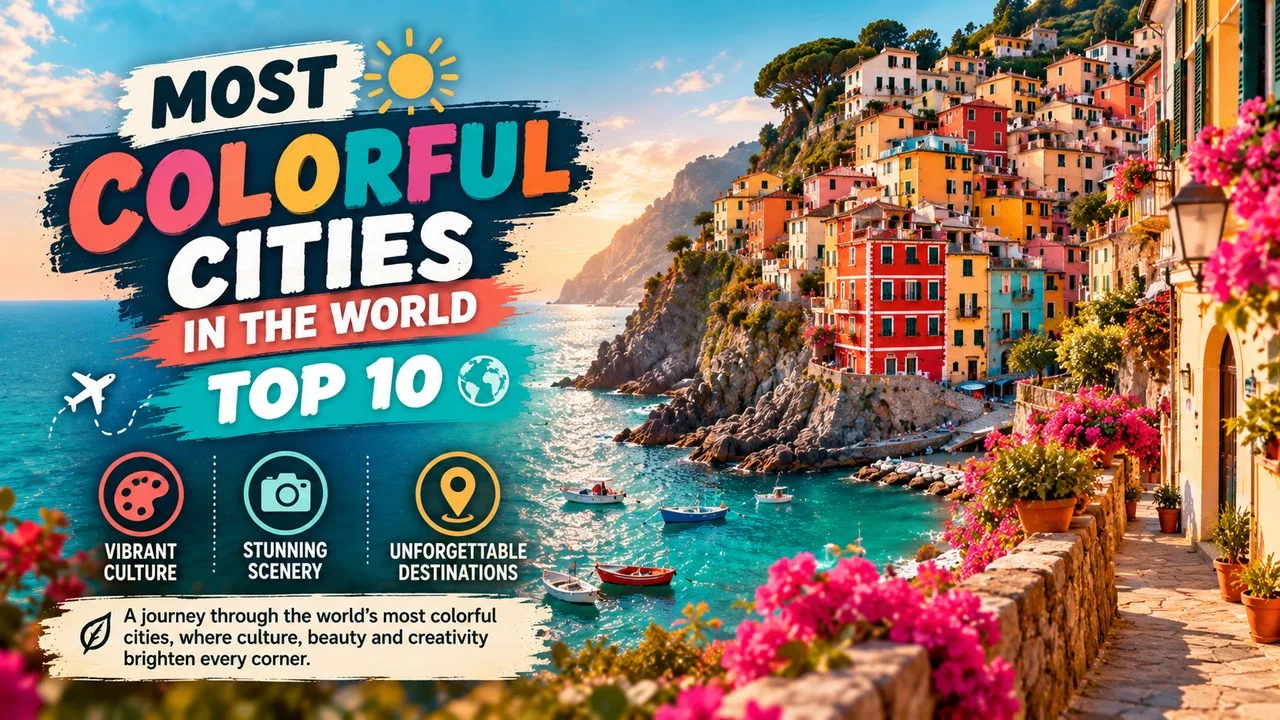
The most colorful cities in the world, led by Jaipur's pink old city and Burano's painted canals, turn ordinary walls into heritage and a reason to travel.
Some cities are remembered for a skyline, a cathedral or a famous meal. Others are remembered for a single sensation: the moment you turn a corner and every wall in sight glows pink, cobalt, saffron or lime. Paint is one of the cheapest building materials there is, yet in a handful of places it has become a civic signature that is protected by law, defended by residents and photographed by millions.
This Finepedia listicle, written as of October 2026, ranks ten of the most vivid painted streetscapes on Earth using a published scorecard rather than a mood board. Each entry explains where the color came from, which popular origin stories hold up, how the place protects its look today and what a visitor will actually see.
How We Ranked the Most Colorful Cities in the World
Color is easy to admire and hard to measure, so Finepedia scored every candidate on four tests that can be checked against maps, heritage records and documented history. Each place received up to 20 points.
- Color coverage (up to 5 points): 5 when color dominates most of a historic town, 4 when it fills a large district, hillside or waterfront, and 3 when it is concentrated in a single street or short strip
- Color identity (up to 5 points): 5 when the place is known worldwide by a color nickname or keeps its look through formal color rules, 4 for a famous multicolored palette without formal rules, 3 when color shares top billing with other attractions
- Heritage protection (up to 5 points): 5 when the painted area lies inside a UNESCO World Heritage Site, 4 for a national or municipal heritage designation, 3 when no formal protection was found
- Depth of tradition (up to 5 points): 5 when the color tradition has a verifiable start date more than 100 years ago, 4 for a long tradition without a firm start date or one between 50 and 99 years old, 3 for a tradition younger than 50 years
- One place per country, so the list travels across the map
- Tiebreaks: first the color coverage score, then the number of Wikipedia language editions covering the place, read on 15 October 2026
Eighteen candidates were scored, including every place on the most widely shared colorful-city roundups and several strong alternatives from Latin America, Asia and Europe. A few famous names did not make the final ten. Santorini is spectacular, but its signature is whitewash with blue domes rather than a full palette, and Longyearbyen in Svalbard is better described as an Arctic mining town with some brightly painted wooden homes. Both appear with the other near misses in the Honorable Mentions.
Most Colorful Cities in the World at a Glance
| # | Place | Country | Signature colors | Score (of 20) |
|---|---|---|---|---|
| 1 | Jaipur (walled city) | India | Terracotta pink | 20 |
| 2 | Burano | Italy | Full rainbow of house fronts | 19 |
| 3 | Willemstad | Curaçao (Kingdom of the Netherlands) | Red, blue, ochre and green | 19 |
| 4 | Guatapé | Colombia | Bright painted reliefs on every facade | 18 |
| 5 | Chefchaouen | Morocco | Shades of blue and white | 17 |
| 6 | Izamal | Mexico | Yellow with white trim | 17 |
| 7 | Valparaíso | Chile | Multicolored hillside houses and murals | 17 |
| 8 | Bo-Kaap, Cape Town | South Africa | Candy pink, lime, turquoise and violet | 15 |
| 9 | La Boca, Buenos Aires | Argentina | Primary colors on wood and zinc | 15 |
| 10 | Nyhavn, Copenhagen | Denmark | Ochre, red, blue and yellow townhouses | 15 |
Travelers who prefer to explore cities on foot can compare several of these places with the picks in Most Walkable Cities in the World: Top 10, and photographers looking for skylines rather than painted streets may enjoy Most Instagrammable Places to Visit: Top 10.
1. Jaipur
| Attribute | Details |
|---|---|
| Location | Capital of Rajasthan, north-western India |
| Founded | 1727 by Sawai Jai Singh II |
| Signature color | Terracotta pink, often called Jaipur pink |
| Population | About 3.1 million (2011 census, city) |
| Status | Walled city inscribed as a UNESCO World Heritage Site in 2019 |
Origins and History
Jaipur was planned from scratch in 1727 when the Kachhwaha ruler Sawai Jai Singh II moved his capital down from the hill fort of Amber to the open plain. With the scholar-architect Vidyadhar Bhattacharya, he laid out a grid of wide market streets that meet at large squares called chaupars, guided by traditional Indian treatises on architecture.
The pink came later. The most widely told account says Maharaja Sawai Ram Singh II had the old city washed in terracotta pink, a color linked with hospitality, before the 1876 visit of the Prince of Wales, the future King Edward VII. The same account says a rule passed in 1877 kept the color compulsory. The historian Giles Tillotson has argued that a pinkish wash was already in use before the royal visit and was merely refreshed for it, so the 1876 story is best read as the moment the look became famous rather than its first appearance.
Key Features
- Uniform pink facades along the main bazaars, a rare case of an entire historic commercial district painted to one civic standard
- The Hawa Mahal, a honeycomb of small latticed windows built in 1799 so royal women could watch street life unseen
- The City Palace and the Jantar Mantar observatory in the heart of the walled city, the latter a separate UNESCO World Heritage Site
- Bazaars arranged by trade, a legacy of the city's original plan for craft and commerce
- The Albert Hall Museum, whose foundation stone the Prince of Wales laid during the same 1876 visit
Significance
Jaipur scores full marks on every test. The pink covers the whole walled city rather than one photogenic lane, it is backed by a long-standing civic rule, the color story has a documented date more than a century old, and UNESCO inscribed the walled city in 2019 for its urban planning. Few other places on Earth combine an 18th-century master plan with a single citywide paint color.
For visitors, the pink also works as a map. Once you leave the walls, the uniform wash stops, which makes the boundary of the historic city visible at street level.
Interesting Facts
- The pink is closer to a warm terracotta or brick tone than to the pastel pink of a modern paint chart
- Jaipur is part of India's Golden Triangle tourist circuit with Delhi and Agra
- The local sporting franchises lean into the nickname, including the Jaipur Pink Panthers kabaddi team
- Outside the walled city, owners are free to choose other colors, so newer districts look very different
2. Burano
| Attribute | Details |
|---|---|
| Location | Northern Venetian Lagoon, about 7 km from central Venice, Italy |
| Known for | Brightly painted houses and needle lace |
| Signature color | A full rainbow, with each house in its own shade |
| Population | Fewer than 3,000 residents |
| Status | Part of Venice and its Lagoon, a UNESCO World Heritage Site since 1987 |
Origins and History
Burano grew up as a fishing community near the older island of Torcello and was long overshadowed by it and by Murano. Its fortunes rose in the 16th century, when island women became famous across Europe for needle lace, a craft that still gives the island a museum and a steady trade in souvenirs.
Nobody can name the year the first house was painted in a loud color. The story told most often is that fishermen picked bold shades so they could find their own homes when lagoon fog rolled in. It is a charming tale, but it is a legend rather than a recorded fact, and the island's current look owes as much to modern regulation as to fishermen.
Key Features
- Small terraced houses packed along narrow canals, painted in adjoining blocks of red, cobalt, lemon, violet and green
- A color system under which owners who want to repaint must apply to the authorities, who indicate which shades are permitted for that building
- The leaning bell tower of the church of San Martino, visible from across the lagoon
- The Lace Museum on Piazza Galuppi, named after the composer Baldassare Galuppi, who was born on the island
- A footbridge to neighboring Mazzorbo, which has vineyards and quieter walks
Significance
Burano shows what happens when an entire settlement treats color as shared property. Because almost every building takes part, the island scores the maximum for coverage, and the permit system gives it a formal color identity that few places can match. It falls one point behind Jaipur only because its color tradition has no firm starting date.
The island also illustrates a modern tension. Its painted houses are homes for a small resident community and, at the same time, a backdrop for large numbers of day visitors arriving from Venice.
Interesting Facts
- Burano was originally formed by several small islands joined by canals, one of which was filled in to create today's main street and square
- The church of San Martino holds a Crucifixion painted by Giambattista Tiepolo in 1727
- Water buses from Venice take roughly 45 minutes to reach the island
- The island is so densely built that it has very little green space
3. Willemstad
| Attribute | Details |
|---|---|
| Location | Capital of Curaçao, southern Caribbean |
| Founded | 1634 (Punda quarter), by the Dutch West India Company |
| Signature color | Red, blue, yellow ochre and various greens |
| Population | About 137,000 (2011) |
| Status | Historic Area of Willemstad, Inner City and Harbour, UNESCO World Heritage Site since 1997 |
Origins and History
The Dutch West India Company took Curaçao from Spain in 1634 and built a walled trading town called Punda on the point beside a deep natural harbor. The suburb of Otrobanda, whose name means "the other side" in Papiamentu, followed across the water in 1707, and the merchant districts of Scharloo and Pietermaai grew later. The town became a major hub of Caribbean commerce, including the Atlantic slave trade.
Willemstad's color has an unusually precise origin. In 1817 the governor, Albert Kikkert, issued a rule forbidding owners in the central districts from finishing their buildings in white lime, because the glare off white walls was said to harm people's eyesight. Owners were free to pick any other color. Popular retellings add that the governor suffered from headaches and secretly owned a paint business; those details are legend, while the eyesight rule is documented.
Key Features
- The Handelskade, a row of gabled waterfront buildings in Dutch style but tropical colors, seen across Sint Anna Bay
- The Queen Emma Bridge, a floating pontoon bridge opened in 1888 that swings aside to let ships pass
- Four historic quarters, Punda, Otrobanda, Scharloo and Pietermaai, each with its own street pattern
- The Mikvé Israel-Emanuel synagogue, whose building dates from 1732, with a sand-covered floor
- Forts and harbor defenses that frame the entrance to the port
Significance
UNESCO describes Willemstad as a European architectural style adapted to the Caribbean in a rich array of colors, and it explicitly links the city's colorful buildings to the 1817 rule. That makes it one of the few places where the color story is both more than 200 years old and written into the official heritage record.
The city loses a point only on coverage, because the brightest buildings line the historic waterfront quarters rather than every street.
Interesting Facts
- Willemstad was the capital of the Netherlands Antilles until that country was dissolved in 2010
- The city is home to about nine in ten people on Curaçao
- The Mikvé Israel-Emanuel congregation is often described as the oldest in continuous use in the Americas
- The UNESCO property covers 86 hectares of the inner city and harbor
4. Guatapé
| Attribute | Details |
|---|---|
| Location | Eastern Antioquia, about 79 km from Medellín, Colombia |
| Founded | 1811; municipality from 1867 |
| Signature color | Brightly painted relief panels called zócalos, set against colorful walls |
| Population | About 6,500 (2015 municipal estimate) |
| Status | No national heritage listing found; local efforts aim to protect the zócalos |
Origins and History
Guatapé is a small Andean town whose fame comes from the lower part of its walls. Most facades carry a zócalo, a band of molded cement relief roughly 80 cm high that originally protected the base of the wall from damp, mud and farmyard animals.
Local historians trace the decorative tradition to 1919, when the builder José María Parra, one of the few masons in town who worked with cement, copied a lamb figure he had admired at a Corpus Christi celebration onto his own house. The building became known as the House of the Three Sheep, neighbors started commissioning their own panels, and the motifs spread from doorways to streets, the main square and the church.
Key Features
- Painted reliefs on almost every building, showing farm animals, mule trains, boats, fruit, religious symbols and the trades of the families inside
- Contrasting colors on doors, balconies and window frames above the zócalos
- The Calle del Recuerdo, a steep cobbled street with restored houses and panels explaining the tradition
- A main square watched over by the white church of Nuestra Señora del Carmen, decorated with colorful details
- Lakeside promenades on the reservoir that surrounds the town
Significance
Guatapé earns top marks for coverage and identity because the zócalos are everywhere and nowhere else has quite the same art form at this scale. Its tradition is more than a century old and has a named founder and year. It drops points only because no formal national heritage listing was found, although university researchers and local officials have been studying how to protect the panels.
The town is also an example of color as storytelling. Each house's panels act like a family business card, so a walk down a single block reads like a picture history of the community.
Interesting Facts
- The hydroelectric reservoir created in the 1970s flooded the old town of El Peñol next door and turned Guatapé into a lakeside resort
- The giant rock known as the Piedra del Peñol rises roughly 220 m and is climbed by a stairway of around 740 steps
- Researchers have catalogued more than a hundred different zócalo motifs
- Modern panels sit beside old ones, so subjects range from rural scenes to airplanes
5. Chefchaouen
| Attribute | Details |
|---|---|
| Location | Rif Mountains, northern Morocco |
| Founded | 1471 by Ali ibn Rashid al-Alami |
| Signature color | Blue and white, earning the nickname the Blue Pearl |
| Population | 46,168 (2024 census, municipality) |
| Status | An emblematic community of the Mediterranean Diet on UNESCO's intangible heritage list (2013); no World Heritage listing |
Origins and History
Chefchaouen began in 1471 as a small fortress built to resist Portuguese raids on northern Morocco. After the fall of Muslim Spain, Andalusi Muslims and Sephardic Jews settled in the town, which is why its alleys, tiled roofs and courtyard houses look more Andalusian than many Moroccan medinas.
The blue has several competing explanations. A popular theory credits the Jewish community, for whom blue symbolized the sky and the divine. Another says it kept mosquitoes away. Photographs from the 1930s, however, show only limited blue, and some residents say the color spread across the medina from the 1970s onwards as tourism grew. The honest answer is that the blue is old in places but became a citywide signature only in recent decades.
Key Features
- A medina in which walls, steps, doors and even paving are washed in shades from pale sky to deep cobalt
- The red-walled Kasbah, the original 15th-century fortress, overlooking the main square of Outa el Hammam
- The Ras el-Maa spring on the edge of town, where locals still do laundry in the stream
- Narrow, stepped lanes that climb the slopes toward the mountain peaks that gave the town its name
- Small workshops selling woven blankets, leather and woodwork, the town's main crafts
Significance
Chefchaouen is the archetype of the single-color town, and it is the place most often used to illustrate the idea of a blue city. It scores the maximum for coverage and identity. It loses points because the medina has no World Heritage listing and because the citywide blue cannot be firmly dated to a century ago.
The town's success has had side effects. Residents regularly repaint walls to keep the blue fresh for visitors, and the color has become part of the local economy as much as a tradition.
Interesting Facts
- The name is usually explained as "look at the horns", a reference to the two peaks above the town
- Locals often shorten the name to Chaouen
- UNESCO added Chefchaouen to its Global Network of Learning Cities in 2020
- The town was under Spanish control during the protectorate period from 1920 to 1956, and Spanish is still widely understood
6. Izamal
| Attribute | Details |
|---|---|
| Location | Yucatán state, about 72 km east of Mérida, Mexico |
| Origins | Maya city founded in the Late Formative period, before 200 BC |
| Signature color | Egg-yolk yellow with white trim, earning the name the Yellow City |
| Population | About 15,000 (2000 estimate) |
| Status | Named a Pueblo Mágico by Mexico's tourism program in 2002; no World Heritage listing |
Origins and History
Izamal is one of the oldest continuously inhabited places in the Americas. Long before the Spanish arrived, it was a major Maya religious center dedicated to the creator god Itzamna and the sun god Kinich Ahau, and its great pyramids still rise between the streets. After the conquest, Franciscan friars built a vast convent on top of one of the Maya platforms, reusing cut stone from the older temples.
The yellow is much more recent and, unusually, has a named author. Between 1959 and 1961 the mayor, Jorge Carlos González Rodríguez, ordered commercial signs stripped from facades and had the buildings of the center painted in yellow and white. A popular story says the town turned yellow for Pope John Paul II's visit in August 1993, but local reporting shows the color was already in place long before.
Key Features
- A historic center in which almost every wall, arch and doorway is yellow with white details
- The Convent of San Antonio de Padua, completed in 1561, whose open atrium is often described as the second largest in the world after the Vatican
- The pyramid of Kinich Kak Moo, whose base covers more than 8,000 square meters, a short walk from the main square
- Horse-drawn carriages that carry visitors through the yellow streets
- Bilingual street signs in Spanish and Yucatec Maya, which remains the home language of many residents
Significance
Izamal scores full marks for coverage and identity because the color is citywide and the nickname is known across Mexico and beyond. It loses points because its Pueblo Mágico status is a tourism designation rather than heritage protection, and because the yellow dates from around 1960 rather than more than a century ago.
It also shows a different way of using color. Instead of a rainbow, Izamal uses a single shade to tie together Maya ruins, colonial churches and modern homes, so the whole town reads as one monument.
Interesting Facts
- Izamal was the first seat of the bishops of Yucatán before they moved to Mérida
- Pope John Paul II met representatives of Indigenous peoples at the convent during his 1993 visit
- Archaeologists have recorded more than 160 significant ancient structures in and around the town
- The town's statue of Our Lady of Izamal is venerated as the patron of Yucatán
7. Valparaíso
| Attribute | Details |
|---|---|
| Location | Pacific coast of central Chile |
| Golden age | Late 19th century, as the leading port on South America's Pacific routes |
| Signature color | Multicolored houses clad in painted corrugated metal, plus murals |
| Population | 284,938 (2024 census, commune) |
| Status | Historic Quarter of the Seaport City of Valparaíso, UNESCO World Heritage Site since 2003 |
Origins and History
Before the Panama Canal opened in 1914, ships traveling between the Atlantic and the Pacific via the Strait of Magellan called at Valparaíso, and the city boomed. Merchants, sailors and immigrants from Britain, Germany, Italy and elsewhere built homes on the steep hills that rise like an amphitheater above the bay.
Many of those houses were wooden and clad in corrugated metal sheets, a material encouraged by fire-safety rules from the late 19th century. Painting the metal protected it from salty air, and local tradition says residents used surplus marine paint from the port. Since the 1990s artists have added murals, beginning with an open-air museum of about 20 murals on Cerro Bellavista inaugurated in 1992.
Key Features
- Hillside neighborhoods such as Cerro Alegre and Cerro Concepción, where nearly every house has its own color
- Historic funicular lifts known as ascensores; 16 survive, and the 15 public ones are protected as national monuments
- Staircases, alleys and retaining walls covered in street art
- Views from the hills over the working harbor and the bay
- La Sebastiana, one of the homes of the poet Pablo Neruda, now a museum on the hills
Significance
UNESCO inscribed Valparaíso as an exceptional record of the early phase of globalization, when it served as the main commercial port on the Pacific coast of South America. Its improvised hillside layout and vernacular buildings are part of that value, and the color is inseparable from them.
The city ranks behind Chefchaouen and Izamal on the coverage tiebreak because the brightest streets cluster on certain hills, while flatter parts of the city look more conventional.
Interesting Facts
- International sailors once nicknamed Valparaíso "Little San Francisco" and the "Jewel of the Pacific"
- In 1996 the World Monuments Fund listed its funiculars among the world's most endangered historic treasures
- Chile's National Congress has met in Valparaíso since 1990
- Wildfires have repeatedly damaged the upper hills, which makes rebuilding and repainting a recurring civic task
8. Bo-Kaap
| Attribute | Details |
|---|---|
| Location | Slopes of Signal Hill, central Cape Town, South Africa |
| Oldest house | 71 Wale Street, built in the 1760s, now the Bo-Kaap Museum |
| Signature color | Candy pink, lime, turquoise, red and violet terraced houses |
| Community | Historic heart of Cape Malay culture |
| Status | Heritage Protection Overlay Zone (2019); 19 sites declared national heritage sites (2019) |
Origins and History
The Bo-Kaap, whose Afrikaans name means "upper Cape", grew on the slopes above the Dutch colonial town in the 18th century. Many of its early residents were enslaved people and political exiles brought to the Cape from South and Southeast Asia and Africa, and their descendants formed the Cape Malay community. The neighborhood's Auwal Mosque, dating from 1794, is regarded as the first mosque in South Africa.
A familiar story says freed residents painted their homes in bright colors to celebrate owning them after years of renting white-painted houses. Historians are more cautious, and research suggests the vivid palette mostly dates from the late 20th century. That makes the color younger than the houses, which include Cape Dutch and Cape Georgian buildings built between about 1790 and 1825.
Key Features
- Rows of single-story and two-story houses, each in a different bright color, on steep cobbled streets
- The Bo-Kaap Museum at 71 Wale Street, the oldest house in the area to survive in its original form
- Several historic mosques, with minarets rising between the colored rooftops
- Small family shops and cafes serving Cape Malay dishes such as bobotie
- Views toward Table Mountain and over the city center
Significance
The South African Heritage Resources Agency describes the Bo-Kaap as holding the largest concentration of pre-1850 architecture in South Africa and as Cape Town's oldest surviving residential neighborhood. In 2019 the city council approved a Heritage Protection Overlay Zone covering hundreds of privately owned homes, and 19 sites were declared national heritage sites.
Its score is held back by the young age of the paint tradition. The neighborhood also faces debate about tourism and rising property prices, so visitors are asked to respect residents' privacy while photographing.
Interesting Facts
- More than half of residents identify as Muslim
- The Heritage Protection Overlay Zone drew more than 2,000 public submissions, most of them in support
- The palette runs through shades of pink, red, blue, green and purple
- Historically, the Bo-Kaap covered a larger area than it does today
9. La Boca
| Attribute | Details |
|---|---|
| Location | South-eastern Buenos Aires, on the Riachuelo river, Argentina |
| Settled by | Largely Genoese and other Italian immigrants from the late 19th century |
| Signature color | Bold primary colors on wooden and corrugated-zinc houses |
| Highlight | Caminito, a short street museum of painted tenements |
| Status | No formal heritage designation found for the painted houses |
Origins and History
La Boca, "the mouth", grew around the old port of Buenos Aires. From the late 19th century, Italian immigrants, many from Liguria, worked in its shipyards, warehouses and docks and lived in conventillos, shared tenements of wood and corrugated zinc raised above the flood-prone ground.
Local histories say residents coated those walls with leftover paint from the shipyards, which explains the patchwork of colors on a single house. The street called Caminito came later. After a rail line closed in the 1950s, the painter Benito Quinquela Martín, who lived nearby, helped turn the abandoned strip into an open-air street museum, painting the walls in bright colors and adding a stage by 1960.
Key Features
- Caminito, a short pedestrian street of multicolored tenements with balconies and murals
- Tango dancers and musicians performing in the street for visitors
- Art galleries and the museum devoted to Quinquela Martín's port paintings
- The blue-and-gold stadium of Boca Juniors, nicknamed La Bombonera
- The old iron transporter bridge over the Riachuelo, opened in 1914
Significance
La Boca is one of the earliest places where color became a working-class trademark, and its link to Italian immigration and early tango gives it a cultural story few painted districts can match. The neighborhood also inspired the tango "Caminito", composed by Juan de Dios Filiberto in 1926.
Its ranking reflects the small size of the painted tourist zone, which covers only a few blocks. Outside it, La Boca is a working-class district with a reputation for petty crime, so most visitors stay on the main streets in daylight, a sensible habit discussed in Most Dangerous Tourist Destinations in the World: Top 10.
Interesting Facts
- Many houses stand on raised foundations because the area flooded often in the past
- Benito Quinquela Martín donated land and buildings for a school, a museum and other institutions in the neighborhood
- La Boca's Genoese roots remain visible in local surnames, food and football nicknames
- The main tourist zone is only a few blocks long
10. Nyhavn
| Attribute | Details |
|---|---|
| Location | Central Copenhagen, between Kongens Nytorv and the harbor, Denmark |
| Built | Canal dug in the early 1670s under King Christian V |
| Signature color | Ochre, red, blue and yellow townhouses |
| Oldest house | No. 9, dating from 1681 |
| Status | Many listed buildings; a museum harbor for historic ships since 1977 |
Origins and History
King Christian V had Nyhavn, the "New Harbor", dug in the early 1670s by soldiers and Swedish prisoners of war, giving ships a channel from the sea to the square of Kongens Nytorv. The quay soon filled with sailors' taverns and merchants' houses and gained a rough reputation that lasted well into the 20th century.
The colorful townhouses on the northern side date mostly from the late 17th and 18th centuries. The oldest, No. 9, was built in 1681; some popular lists put it two decades earlier, but the house itself is dated to 1681. From the 1960s a local society worked to revive the area, the quay was pedestrianized in 1980 and it is now one of Copenhagen's best-known views.
Key Features
- A row of narrow, gabled townhouses in strong colors reflected in the canal
- Historic wooden ships moored along the quays, many of them museum vessels
- Outdoor cafes and restaurants filling the sunny northern side
- Canal-tour boats departing toward the harbor and the city's other waterways
- A large anchor memorial at the head of the canal honoring Danish sailors lost in the Second World War
Significance
Nyhavn is the most famous painted waterfront in Northern Europe and a reminder that bright color is not only a warm-climate habit. Its townhouses are protected as historic buildings, and the canal works as a living maritime museum.
It ranks tenth because the color is concentrated along a single canal, and because the precise history of the paint scheme, as opposed to the buildings, is not well documented.
Interesting Facts
- Hans Christian Andersen lived at three Nyhavn addresses: No. 20 from 1834 to 1838, where he wrote his first fairy tales, No. 67 on and off from 1848 to 1865, and No. 18 from 1871
- The southern side of the canal is reserved for museum ships, while privately owned historic vessels use the northern side
- The canal was once known for beer, sailors and nightlife rather than cafes
- The poet Tom Kristensen described the colorful street in a 1922 poem that borrows characters from Homer's Odyssey
Honorable Mentions
These places were scored but missed the final ten, either on points or because of the one-place-per-country rule.
| Place | Country | Score (of 20) | Why it missed out |
|---|---|---|---|
| Guanajuato | Mexico | 17 | UNESCO-listed silver town with stacked hillside houses in ochre, coral and turquoise; Izamal won Mexico's place on the coverage tiebreak |
| Jodhpur | India | 16 | The Blue City around Mehrangarh Fort; Jaipur took India's place. A 2024 estimate suggests only about half of the roughly 33,000 homes in the old Brahmapuri quarter are still blue |
| Gamcheon Culture Village, Busan | South Korea | 14 | Hillside village transformed by a public art project from 2009 |
| Procida (Marina Corricella) | Italy | 14 | Pastel harbor village and Italian Capital of Culture 2022; Burano represents Italy |
| St. John's (Jellybean Row) | Canada | 14 | Bright Victorian row houses in Newfoundland's capital, boldly repainted from the 1960s and 1970s; often confused with Saint John, New Brunswick |
| Tirana | Albania | 13 | Facades painted in bold colors and patterns during the 2000s under the then mayor, Edi Rama |
| Santorini (Oia) | Greece | 13 | Whitewashed houses with blue domes; famous, but a two-tone look rather than a full palette |
| Longyearbyen | Norway (Svalbard) | 12 | Brightly painted wooden homes in an Arctic mining town; color is a small part of its identity |
Jodhpur deserves a special note. Its blue houses were traditionally associated with Brahmin families of Brahmapuri, and natural indigo was once easy to buy in Rajasthan. Rising costs and the switch from lime plaster to cement have led many owners to repaint in other colors, and local volunteers now fund blue repainting each year.
Canada's entry needed a correction too. The colorful Jellybean Row houses belong to St. John's in Newfoundland and Labrador, not to Saint John in New Brunswick, which is often named in older lists. Saint John has its own claim to fame: it became Canada's first incorporated city by royal charter in 1785.
Comparison: How the Color Began
| Place | When the color took hold | What started it | How it is kept today |
|---|---|---|---|
| Jaipur | 1876 to 1877 (popular account) | Royal order before a state visit | Civic rule for the walled city |
| Burano | No firm date | Fishing community tradition, legend of fog | Permits that set allowed colors |
| Willemstad | 1817 | Governor's ban on white lime finishes | UNESCO heritage management |
| Guatapé | 1919 | A mason's decorative relief, copied by neighbors | Community pride and tourism |
| Chefchaouen | Mostly from the 1970s, older in places | Disputed: faith, mosquitoes, tourism | Regular repainting by residents |
| Izamal | 1959 to 1961 | Mayor's order to paint the center yellow and white | Tourism program and municipal upkeep |
| Valparaíso | Late 19th century, murals from 1992 | Protective paint on metal cladding | UNESCO zone and artists |
| Bo-Kaap | Late 20th century | Residents' choice, often linked to freedom | Heritage Protection Overlay Zone |
| La Boca | Late 19th century, Caminito from the 1950s | Leftover ship paint, then an artist's project | Tourism and local artists |
| Nyhavn | Buildings from 1681 onward | Merchant townhouses on a royal canal | Listed buildings and museum harbor |
Tips for Visiting Colorful Cities
- Go early. Soft morning light makes painted walls glow and the most famous streets are far quieter before tour groups arrive
- Respect residents. In Burano, Bo-Kaap, Chefchaouen and La Boca, the colorful buildings are private homes, so avoid blocking doors or climbing steps for photos
- Pick the right season. Jaipur and Jodhpur are most comfortable between October and March, while Nyhavn is at its liveliest in summer
- Use public transport. Water buses reach Burano, funiculars climb Valparaíso's hills and buses link Guatapé with Medellín
- Budget wisely, because painted districts are often the priciest part of town for food and souvenirs; the ideas in Ways Smart Travelers Save Money Abroad: Top 10 help keep costs down
Buenos Aires, home to La Boca, is one of South America's largest metropolitan areas, and the pressures of big-city life are explored further in Busiest Cities in the World: Top 10.
Frequently Asked Questions
What is the most colorful city in the world?
On Finepedia's scorecard, Jaipur's walled city ranks first with a perfect 20 of 20. Its terracotta pink covers an entire 18th-century planned city, the color has been kept by civic rule since the 1870s, and UNESCO inscribed the walled city as a World Heritage Site in 2019.
Why is Chefchaouen painted blue?
Nobody knows for certain. Popular theories link the blue to the town's Jewish community, for whom it symbolized the sky, or to keeping mosquitoes away. Photographs from the 1930s show only limited blue, and residents say the color spread across the medina from the 1970s as tourism grew.
Do residents of Burano need permission to paint their houses?
Yes. Owners who want to repaint a house on Burano must apply to the local authorities, who indicate the colors permitted for that building. The system keeps neighboring houses in contrasting shades and protects the island's look, which is part of the Venice and its Lagoon World Heritage Site.
Why are Willemstad's buildings so colorful?
In 1817 the governor of Curaçao banned white lime finishes on buildings in the central districts, reportedly because the glare from white walls was harming people's eyes. Owners could choose any other color, and UNESCO now cites this rule as the start of Willemstad's colorful tradition.
Why is Jaipur called the Pink City?
The best-known account says Maharaja Sawai Ram Singh II had the old city painted terracotta pink, a color of hospitality, before the Prince of Wales visited in 1876, and that a rule from 1877 kept it pink. Some historians believe a similar wash was used earlier and was refreshed for the visit.
Is Santorini one of the most colorful places in the world?
Santorini is among the most photographed islands in the world, but its classic look is white houses with blue domes rather than a full palette. Finepedia therefore scored it lower on color identity, and it appears in the Honorable Mentions rather than the top ten.
Conclusion
The most colorful cities in the world prove that paint can do far more than decorate. In Jaipur it became the mark of royal hospitality, in Willemstad it began as a health rule, in Guatapé it grew out of one mason's experiment, and in Burano it is managed house by house like a shared work of art. Each of the ten places on this list has turned color into something residents defend and visitors travel across the world to see.
What they also share is fragility. Paint fades, costs rise and tourism changes neighborhoods, as Jodhpur's slowly fading blue shows. The cities that keep their color do so through rules, pride and constant repainting, which is perhaps the best reason to visit them with care and curiosity.
- Reference topic: 10mosttoday, "World's 10 Most Colorful Cities You'll Absolutely Love", https://10mosttoday.com/worlds-10-most-colorful-cities-youll-absolutely-love/
- UNESCO World Heritage Centre: Jaipur City, Rajasthan (1605), https://whc.unesco.org/en/list/1605/
- UNESCO World Heritage Centre: Historic Area of Willemstad, Inner City and Harbour, Curaçao (819), https://whc.unesco.org/en/list/819/
- UNESCO World Heritage Centre: Historic Quarter of the Seaport City of Valparaíso (959), https://whc.unesco.org/en/list/959/
- UNESCO World Heritage Centre: Historic Town of Guanajuato and Adjacent Mines (482), https://whc.unesco.org/en/list/482/
- UNESCO World Heritage Centre: Venice and its Lagoon (394), https://whc.unesco.org/en/list/394/
- UNESCO Intangible Cultural Heritage: Mediterranean diet, https://ich.unesco.org/en/RL/mediterranean-diet-00884
- Diario de Yucatán: reporting on why Izamal is the Yellow City, https://www.yucatan.com.mx/yucatan/2023/08/03/izamal-ciudad-amarilla-de-yucatan-a-que-debe-su-color-423046.html
- BBC News: "Jodhpur: India's vanishing 'blue' city", 17 October 2024, https://www.bbc.com/news/articles/cp8n57jn23ko
- Buenos Aires official tourism site: Caminito, https://turismo.buenosaires.gob.ar/en/otros-establecimientos/caminito
- Iziko Museums of South Africa: Bo-Kaap Museum, https://www.iziko.org.za/museums/bo-kaap-museum/
- City of Saint John: History, https://saintjohn.ca/en/community/history
- Hans Christian Andersen Centre, University of Southern Denmark: Andersen's homes, https://andersen.sdu.dk/rundtom/faq/index_e.html?emne=boliger&oph=1
- Wikidata sitelink counts, read 15 October 2026


















Log in with