




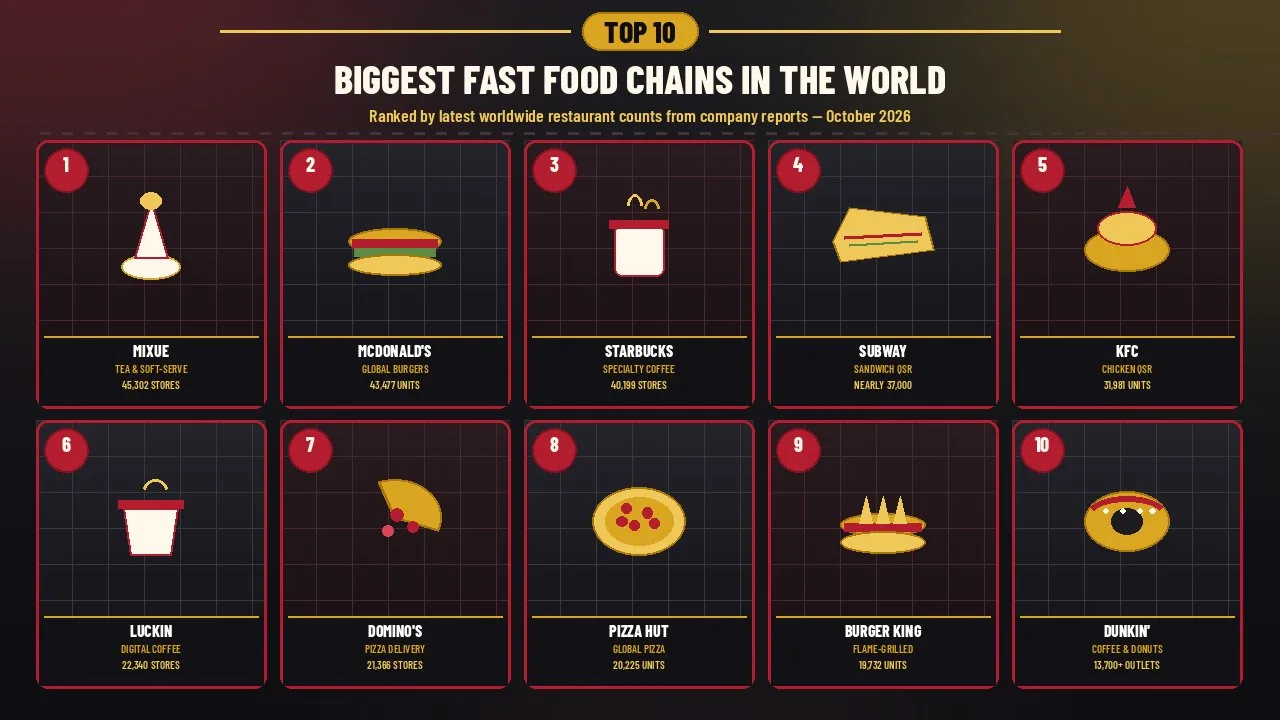
These biggest fast food chains span burgers, chicken, pizza, coffee and tea drinks, ranked by the latest worldwide restaurant counts from company filings.
Quick-service restaurants shape how hundreds of millions of people eat between errands, school runs and late shifts. A single brand can put a counter on a Chinese high street, a U.S. interstate exit and a European transit hub. Store counts move every quarter as franchises open, remodel or close, so any ranking that still quotes 2010s figures is already out of date. Travelers notice the shift when the familiar golden arches share a block with bubble-tea takeaway windows and app-only coffee pickup doors that did not exist in older guidebooks.
This Finepedia list, written as of October 2026, ranks ten of the world's largest quick-service brands by the most recent published worldwide restaurant or store totals we could verify from company annual reports, 10-K or 20-F filings, investor releases and reputable trade reporting that cites those filings. Where two brands sit close together, we keep both data dates visible so readers can see whether a gap is real or just a timing mismatch between a September fiscal year-end and a December calendar close.
The list is about footprint, not taste contests and not a single year of sales. Systemwide or retail sales appear as secondary context only where a company or respected industry summary published a clear figure. Brands known mainly for coffee, tea or soft-serve still count here when they operate as walk-up or counter quick-service stores, because modern QSR trackers treat them as part of the same competitive set as burger and chicken chains. Pure grocery coffee aisles, vending-only machines and sit-down casual dining brands stay out of the main ten.
How We Ranked These Biggest Fast Food Chains
The ranking measure is worldwide restaurants or company-reported stores at the latest comparable reporting date available for each brand (mostly year-end 2024 or late-2024 fiscal cutoffs). When a company reports a range such as nearly 37,000, we keep that wording rather than inventing a false precision. Ties would be broken by the more recent reporting date, then by verified system sales if both dates match.
- Primary score: published worldwide unit count (company-operated + franchised/licensed/partnership stores as the company defines its system).
- Scope: counter and drive-thru quick-service food and beverage brands, including coffee, tea and ice-cream specialty QSR.
- Excluded from the main ten: grocery or packaged-goods only brands, hotel restaurants, and casual-dining chains with table service as the default.
- Secondary context: systemwide or global retail sales, countries or markets served, and founding story, only when sourced.
- Data hygiene: every headline number in the At a Glance table carries a data date; Sources lists the underlying URLs.
Coffee and beverage specialists are included because store density, franchise mechanics and customer visit patterns overlap with classic fast food. Leaving them out would hide the largest story of the mid-2020s: Asia-based tea and coffee brands overtaking legacy burger chains on unit count while still trailing on sales in many categories.
Readers who prefer a food-only filter can still use the At a Glance table: skip Mixue, Starbucks, Luckin and Dunkin' and the remaining burger, chicken, sandwich and pizza brands form their own shorter league table. That filtered view is informative, but it is no longer how global landlords, franchise brokers or Momentum-style F&B trackers describe the competitive set.
The Scorecard
| Rank | Brand | Worldwide units | Data date | Parent / reporting entity | Category focus |
|---|---|---|---|---|---|
| 1 | Mixue (Mixue Group) | 45,302 | 30 Sep 2024 | Mixue Bingcheng (HK IPO materials; Momentum Works) | Tea, ice cream, soft drinks |
| 2 | McDonald's | 43,477 | 31 Dec 2024 | McDonald's Corporation | Burgers, fries, breakfast |
| 3 | Starbucks | 40,199 | 29 Sep 2024 | Starbucks Corporation | Specialty coffee and beverages |
| 4 | Subway | Nearly 37,000 | 2024–2025 company statements | Subway IP LLC / franchise system | Sandwiches, salads |
| 5 | KFC | 31,981 | 31 Dec 2024 | Yum! Brands (KFC Division) | Fried and non-fried chicken |
| 6 | Luckin Coffee | 22,340 | 31 Dec 2024 | Luckin Coffee Inc. | Coffee and tea beverages |
| 7 | Domino's | 21,366 | 29 Dec 2024 | Domino's Pizza, Inc. | Pizza delivery and carryout |
| 8 | Pizza Hut | 20,225 | 31 Dec 2024 | Yum! Brands (Pizza Hut Division) | Pizza and related menu |
| 9 | Burger King | 19,732 | 31 Dec 2024 | Restaurant Brands International | Burgers and flame-grilled QSR |
| 10 | Dunkin' | More than 13,700 | Mid-2024 company/press figures | Inspire Brands | Coffee, doughnuts, breakfast |
Mixue's late-2024 total includes the group's reported system across China and overseas markets and, in prospectus summaries, associated concepts under the same filing umbrella. McDonald's and Starbucks remain within a few thousand units of the leader despite decades of head start. Subway's public language stays at nearly 37,000 rather than a precise census in open press releases. Dunkin' sits clearly below the pizza and burger cluster on units yet still clears other global coffee-and-doughnut brands we checked.
Biggest Fast Food Chains at a Glance
| Rank | Brand | Approx. units | Snapshot | Why it ranks here |
|---|---|---|---|---|
| 1 | Mixue | 45,302 (Sep 2024) | Zhengzhou-rooted tea and soft-serve giant | Highest verified late-2024 store count among QSR brands reviewed |
| 2 | McDonald's | 43,477 (YE 2024) | Global burger system in 100+ markets | Official year-end restaurant census |
| 3 | Starbucks | 40,199 (FYE Sep 2024) | Company-operated and licensed coffee stores | Fiscal 2024 Form 10-K store table |
| 4 | Subway | Nearly 37,000 | Franchise sandwich leader | Company newsroom and 2025 trade interviews |
| 5 | KFC | 31,981 (YE 2024) | Yum! chicken division in ~150 markets | Yum! Brands 2024 Form 10-K |
| 6 | Luckin Coffee | 22,340 (YE 2024) | China-heavy digital coffee | Luckin FY 2024 results |
| 7 | Domino's | 21,366 (YE 2024) | Delivery-first pizza in 90+ markets | Domino's 2024 annual report |
| 8 | Pizza Hut | 20,225 (YE 2024) | Yum! pizza division | Yum! Brands 2024 Form 10-K |
| 9 | Burger King | 19,732 (YE 2024) | RBI flame-grilled burger brand | RBI 2024 Form 10-K |
| 10 | Dunkin' | 13,700+ (2024) | Inspire coffee and doughnuts | Company and trade figures citing global outlets |
Readers comparing food, city and travel habits on Finepedia may also like Healthy Foods for Senior Citizens: Top 10, Most Unhealthy Foods: Top 10 to Limit and Better Swaps, Health Benefits of Coffee: 10 Effects Backed by Research and Busiest Cities in the World: Top 10.
1. Mixue
| Attribute | Details |
|---|---|
| Worldwide units | 45,302 stores as of 30 September 2024 (Mixue Group figure reported via Hong Kong IPO prospectus summaries and Momentum Works) |
| Founded | 1997, Zhengzhou, China (founder commonly named as Zhang Hongchao in company histories) |
| Core offer | Freshly made tea drinks, soft-serve ice cream and low-ticket beverages |
| Footprint note | Majority of stores in China, with thousands more across other Asian markets in prospectus summaries |
| Ranking basis | Highest verified late-2024 QSR store count among brands reviewed for this list |
Mixue's rise is the clearest unit-count story in global quick service this decade. Within about a year it moved from a large regional player into the top worldwide store position by flooding cities with small, franchise-ready shops that sell ice cream and milk tea at prices built for daily habit rather than occasional treat visits. Trade summaries of the group's Hong Kong listing materials put the system at 45,302 stores on 30 September 2024, ahead of McDonald's and Starbucks on the same comparison window.
Origins and History
The brand began in late-1990s Zhengzhou and scaled through a franchise model that standardises equipment, recipes and shop size. Overseas expansion into markets such as Indonesia and Vietnam appears in the same prospectus-era reporting that publicised the 45,302 figure. The business is still far behind legacy coffee leaders on beverage-category sales in Momentum Works summaries, which is a useful reminder that store count and revenue rank can diverge sharply.
Key Features
- Soft-serve and freshly made tea drinks as the default ticket
- Dense franchise rollout aimed at neighbourhood foot traffic
- Ticket prices positioned for high visit frequency
- Group reporting that can include related beverage concepts under one store total
- Rapid year-on-year unit growth through the early 2020s
Significance
Mixue forces Western listicles to update their mental map of fast food. For decades, biggest meant a U.S. burger or sandwich brand. A China-rooted tea and ice-cream system now leads on doors opened, which matters for landlords, franchise brokers and anyone tracking where QSR capital is actually going. Sales leadership remains contested and often still favours Starbucks and large burger systems; unit leadership does not.
The practical lesson for travelers and operators is different from the headline. A neighbourhood that already feels saturated with burgers may still have room for a low-ticket tea shop, and a brand that looks small on a Western highway map may be the densest employer of franchise crews in another region. Unit maps and sales maps tell different truths at the same time.
Interesting Facts
- Momentum Works and follow-on retail press placed Mixue above Starbucks and McDonald's on store count using the 30 September 2024 snapshot.
- Prospectus-era summaries described thousands of overseas stores alongside a much larger China base.
- Category sales rankings in the same research still listed Mixue behind Starbucks and other beverage groups on terminal sales.
- The brand's English trade coverage surged after the Hong Kong IPO filing cycle publicised the store total.
- Soft-serve and tea sit in the same QSR competitive set as coffee chains for many Asian consumers.
2. McDonald's
| Attribute | Details |
|---|---|
| Worldwide units | 43,477 systemwide restaurants at year-end 2024 (McDonald's Restaurants by Market PDF) |
| Founded | 1940 restaurant origins in San Bernardino, California; franchising scaled under Ray Kroc from the mid-1950s |
| Core offer | Burgers, fries, chicken items, breakfast and beverages |
| Markets | Company disclosures referencing on the order of 100-plus countries in related 2024 materials |
| Ownership mix | About 95% franchised globally as of 31 December 2024 (same company supplemental table) |
McDonald's remains the template most people picture when they hear fast food: a limited menu, heavy franchise share and a drive-thru culture that travelled with postwar car ownership. At year-end 2024 the company counted 43,477 systemwide restaurants, up from 41,822 a year earlier, according to its official Restaurants by Market schedule. That still left it a few thousand units behind Mixue's September 2024 total, yet McDonald's continues to lead many conversations about global QSR sales power and brand recognition.
Origins and History
Richard and Maurice McDonald opened their San Bernardino burger stand in 1940. Ray Kroc's franchise organisation turned the Speedee Service System into a multinational corporation later listed as McDonald's Corporation. The brand's twentieth-century expansion relied on real-estate discipline, highly standardised kitchens and local menu twists that still sit under a global brand umbrella.
Key Features
- 43,477 restaurants at 31 December 2024
- United States alone: 13,557 restaurants at the same date
- International Operated Markets and Developmental Licensee segments split the rest of the system
- Roughly 95% of global restaurants franchised at year-end 2024
- Menu core of burgers and fries with substantial breakfast and chicken lines
Significance
Even when it is not number one on unit count, McDonald's still anchors supplier networks, franchise law case studies and the cultural meaning of a quick meal. Its year-end census is among the cleanest public restaurant datasets in the industry, which is why it remains the comparison point every newer giant has to beat.
The 2023-to-2024 jump from 41,822 to 43,477 restaurants also shows that legacy leaders are still adding net units, not merely defending old stores. Growth in developmental-licensee markets, including a large China total in the same schedule, keeps McDonald's in the global race even as beverage specialists compress the gap at the top.
Interesting Facts
- Year-end 2024 restaurants: 43,477 versus 41,822 at year-end 2023.
- U.S. restaurants reached 13,557 at year-end 2024.
- Mainland China developmental-licensee restaurants were listed at 6,820 at year-end 2024 in the same schedule.
- Global franchised share was disclosed at 95% on 31 December 2024.
- The company's market tables remain a primary source for country-level McDonald's counts used by journalists and analysts.
3. Starbucks
| Attribute | Details |
|---|---|
| Worldwide units | 40,199 stores as of 29 September 2024 (Starbucks fiscal 2024 Form 10-K) |
| Founded | 1971 in Seattle; corporate form later expanded under Howard Schultz-era specialty coffee positioning |
| Core offer | Espresso beverages, tea, food cases and packaged coffee |
| Mix | 21,018 company-operated and 19,181 licensed stores at fiscal 2024 year-end |
| Markets | Operations described across dozens of markets in the same filing (commonly summarised near 80-plus) |
Starbucks is the specialty-coffee reference brand that turned a daily espresso drink into a global quick-service habit. Its fiscal 2024 Form 10-K counted 40,199 stores on 29 September 2024, split between company-operated and licensed shops. That places Starbucks third on this unit ranking, close enough to McDonald's that a strong development year on either side can reshuffle the podium.
Origins and History
The first Starbucks store opened in Seattle in 1971. Later leadership shifted the company from bean seller toward a cafe experience built on espresso drinks, seasonal beverages and dense urban clustering. Licensed stores, especially in travel and grocery-adjacent formats, became a major share of the global total.
Key Features
- 40,199 total stores at fiscal year-end 2024
- 21,018 company-operated stores
- 19,181 licensed stores
- North America and International segments both carry large store bases
- Competition framed in filings against specialty coffee and broader QSR beverage players
Significance
Starbucks proves that beverage-led QSR can rival burger chains on doors opened while still competing on very different average tickets and dwell times. It is also the sales benchmark Mixue still trails in freshly made beverage category summaries, which is why unit leadership and sales leadership must be read separately.
Licensed stores nearly match company-operated stores in the fiscal 2024 mix, which is a different risk and control profile from a heavily franchised burger system. Travelers meet Starbucks in airports and malls precisely because the licensed model places the brand inside host venues that a pure company-operated cafe strategy would reach more slowly.
Interesting Facts
- Fiscal 2024 year-end store count: 40,199.
- Company-operated stores were 21,018; licensed stores 19,181.
- The fiscal year ended 29 September 2024, so the snapshot is slightly earlier than calendar year-end burger censuses.
- Filings describe competition from both specialty coffee shops and large QSR beverage players.
- Licensed growth has long been central to international density.
4. Subway
| Attribute | Details |
|---|---|
| Worldwide units | Nearly 37,000 restaurants (Subway newsroom and 2025 company statements to trade press) |
| Founded | 1965 (as Pete's Super Submarines) in Connecticut; later branded Subway |
| Core offer | Made-to-order sandwiches, wraps, salads and bowls |
| Model | Almost entirely franchised small-footprint restaurants |
| Recent trend | Positive global net restaurant growth in 2023–2024 even as U.S. count declined |
Subway built the classic franchise sandwich shop: a narrow footprint, visible prep line and customisable fillings. Company communications in 2024 and 2025 repeatedly describe a system of nearly 37,000 restaurants across more than 100 countries and territories. U.S. franchise disclosure coverage for 2024 showed further domestic closures, yet Subway stated positive global net growth for a second straight year as international openings offset U.S. shrinkage.
Origins and History
Fred DeLuca and Peter Buck started the concept in 1965. Aggressive franchising in the 1980s–2000s produced the densest sandwich footprint in many Western markets. After peak U.S. saturation, the brand's growth story shifted toward master franchise agreements abroad and remodeling at home.
Key Features
- Nearly 37,000 restaurants in company public language
- Freshly assembled sandwiches as the signature format
- Master franchise deals committing thousands of future international restaurants
- U.S. count reported near 19,502 at year-end 2024 in franchise disclosure coverage
- Menu expansion into wraps, salads and bowls alongside classic subs
Significance
Subway shows how unit leadership can coexist with painful domestic rightsizing. It remains one of the few non-burger brands that still sits in the global top five on store count, and its international pipeline is a major part of why the nearly 37,000 figure has stabilised after years of U.S. net closures.
The sandwich line remains easy to localise: protein, bread and sauce swaps cost less to adapt than a full fried-chicken platform. That flexibility helps explain why master franchisees keep signing multi-hundred store commitments even while some mature U.S. corridors still consolidate.
Interesting Facts
- October 2024 newsroom copy cited nearly 37,000 restaurants and more than 10,000 future commitments from recent master deals.
- Trade interviews in 2025 repeated the nearly 37,000 global figure.
- U.S. restaurants fell to about 19,502 at year-end 2024 according to disclosure reporting summarised by major outlets.
- International openings drove the second consecutive year of positive global net growth.
- The brand remains privately held under Roark-era ownership structures discussed in business press, with franchisees operating local shops.
5. KFC
| Attribute | Details |
|---|---|
| Worldwide units | 31,981 restaurants at 31 December 2024 (Yum! Brands Form 10-K) |
| Founded | Franchise era begins 1952; Colonel Harland Sanders' chicken recipe popularised earlier |
| Core offer | Fried and non-fried chicken, sandwiches and sides |
| International share | About 89% of units outside the United States (same 10-K table) |
| System sales | About $34.5 billion in 2024 system sales for the KFC Division |
KFC is Yum! Brands' largest division by restaurants and the clearest global chicken QSR network. At year-end 2024 it operated or franchised 31,981 restaurants across about 150 countries and territories, with roughly 99% of those units franchised. System sales for the division were disclosed at $34,452 million for 2024.
Origins and History
Harland Sanders refined a pressure-fried chicken recipe in Corbin, Kentucky, and began franchising in 1952. The brand later became a PepsiCo restaurant division and then part of Yum! Brands. International growth, especially across Asia and Africa, now dominates the unit mix.
Key Features
- 31,981 units at 31 December 2024
- About 89% of units international
- About 99% franchised
- 2024 division system sales of $34,452 million
- Product range spanning bone-in chicken, sandwiches and localised sides
Significance
KFC demonstrates how a single protein category can support a top-five global footprint. It also shows Yum!'s multi-brand strategy: KFC leads on units inside the parent, while Pizza Hut and Taco Bell play different geographic and menu roles.
Because nearly nine in ten KFC restaurants sit outside the United States, the brand's weekly operating reality is more international than many U.S. media narratives suggest. Local sides, spice levels and sandwich formats change by market, yet the franchise contract and chicken platform still read as one global system in the 10-K.
Interesting Facts
- KFC opened nearly 2,900 gross new restaurants in 2024 across dozens of markets, per Yum! commentary.
- The division surpassed 30,000 worldwide locations during 2024.
- International intensity (about 89%) far exceeds Taco Bell's mix inside the same parent.
- System sales remained in the mid-$30 billion range even with uneven same-store trends.
- Franchisees operate almost the entire system.
6. Luckin Coffee
| Attribute | Details |
|---|---|
| Worldwide units | 22,340 stores at 31 December 2024 (Luckin FY 2024 results) |
| Founded | 2017 in China |
| Core offer | App-ordered coffee and tea beverages, often via pickup stores |
| Mix | Self-operated and partnership stores (14,591 self-operated and 7,749 partnership at year-end 2024) |
| Geography | Overwhelmingly China, with limited overseas testing noted in later updates |
Luckin Coffee rebuilt itself after an early accounting scandal into one of the densest coffee networks on earth. Fiscal year 2024 results put the system at 22,340 stores on 31 December 2024, including self-operated and partnership shops. That lands Luckin sixth on this list, ahead of the largest pizza brands on unit count while remaining geographically concentrated.
Origins and History
Luckin launched in 2017 with a digital ordering model and rapid store openings. After a 2020 fraud crisis and delisting drama, the company restructured, returned to public markets and resumed aggressive expansion. Pickup-oriented stores and partnership formats supported the path back above 20,000 locations.
Key Features
- 22,340 stores at year-end 2024
- 14,591 self-operated stores
- 7,749 partnership stores
- Heavy reliance on mobile ordering and promotions
- Store base still centred on Chinese cities
Significance
Luckin is the clearest example of tech-native coffee QSR competing on convenience rather than third-place seating. Together with Mixue and Starbucks, it shows that beverage chains now occupy three of the top six unit spots worldwide.
Partnership stores let the brand densify cities without putting every lease on the corporate balance sheet. That hybrid model is one reason the year-end 2024 total could clear 22,000 while still leaving room for further 2025 openings reported in later quarterly decks.
Interesting Facts
- Year-end 2024 store total: 22,340.
- Self-operated stores outnumbered partnership stores at that date.
- Quarterly decks in 2025 showed further net openings beyond the year-end base.
- The brand's recovery arc is now a standard case study in China consumer investing.
- Overseas presence remained small relative to the China base in FY 2024 reporting.
7. Domino's
| Attribute | Details |
|---|---|
| Worldwide units | 21,366 stores as of 29 December 2024 (Domino's 2024 annual report) |
| Founded | 1960 in Michigan |
| Core offer | Pizza delivery and carryout, with related sides |
| Split | 6,722 U.S. franchise, 292 U.S. company-owned, 14,352 international at year-end 2024 |
| Sales context | Global retail sales about $19.1 billion in 2024 (company annual report) |
Domino's is the largest pizza company by its own 2024 description, with more than 21,300 locations in over 90 markets. The year-end 2024 store table listed 21,366 total restaurants. International franchise stores (14,352) outnumbered the combined U.S. system, underlining how delivery-led pizza scaled beyond its Midwestern roots.
Origins and History
Tom and James Monaghan bought DomiNick's in Ypsilanti, Michigan, in 1960; the Domino's name followed. A franchise model focused on delivery territories and later on digital ordering tools. Carryout grew as a second major service mode beside delivery.
Key Features
- 21,366 stores at fiscal year-end 2024
- 14,352 international franchise stores
- U.S. franchise stores 6,722; U.S. company-owned 292
- Global retail sales about $19.1 billion in 2024
- Dual emphasis on delivery and carryout
Significance
Domino's shows that a delivery-native operating system can outgrow dine-in pizza rivals on unit count. Its international franchise network is now the majority of the brand, which matters for anyone still thinking of Domino's as mainly a U.S. chain.
Carryout growth did not erase delivery; it added a second high-frequency occasion. Markets that already had strong scooter or car delivery cultures adopted the brand as infrastructure for weeknight meals, which is a different growth engine from tourist-facing burger flags.
Interesting Facts
- Total stores rose from 20,591 at year-end 2023 to 21,366 at year-end 2024.
- International stores alone exceed 14,000.
- Company materials call Domino's the number one pizza company by its global scale metrics.
- Digital ordering is central to the Hungry for MORE strategy described in the annual report.
- Over 90 markets appear in the 2024 corporate description.
8. Pizza Hut
| Attribute | Details |
|---|---|
| Worldwide units | 20,225 restaurants at 31 December 2024 (Yum! Brands Form 10-K) |
| Founded | 1958 in Wichita, Kansas |
| Core offer | Pizza for delivery, carryout and restaurant occasions |
| International share | About 68% of units international |
| System sales | About $13.1 billion in 2024 system sales for the Pizza Hut Division |
Pizza Hut remains Yum!'s pizza division and one of the few pizza brands with a truly global franchise map. Year-end 2024 units stood at 20,225 across about 111 countries and territories, with about 99% franchised and about 68% outside the United States. Division system sales were $13,108 million in 2024.
Origins and History
Frank and Dan Carney opened the first Pizza Hut in Wichita in 1958. The red-roof casual format later coexisted with delivery and carryout units as consumer habits shifted. Under Yum!, the brand shares corporate infrastructure with KFC and Taco Bell while keeping a separate franchise system.
Key Features
- 20,225 units at 31 December 2024
- About 68% international
- About 99% franchised
- 2024 system sales of $13,108 million
- Presence in roughly 111 countries and territories
Significance
Pizza Hut's unit total sits just behind Domino's, which makes the pizza category a two-brand race near the bottom of this top ten. Format mix (dine-in legacy versus delivery) differs by market, so identical unit counts can still mean different guest experiences.
Yum! investors read Pizza Hut beside KFC rather than in isolation: chicken units and system sales dwarf pizza inside the parent, yet Pizza Hut still clears twenty thousand restaurants on its own. That scale keeps it on global landlord shortlists even when Domino's wins the pure delivery narrative.
Interesting Facts
- Pizza Hut Division units: 20,225 at year-end 2024.
- System sales were lower than KFC's inside the same parent despite a still-large footprint.
- International share (about 68%) is high but below KFC's roughly 89%.
- Franchisees run nearly the entire division.
- The brand continues to span delivery, carryout and restaurant occasions depending on market.
9. Burger King
| Attribute | Details |
|---|---|
| Worldwide units | 19,732 restaurants at 31 December 2024 (Restaurant Brands International Form 10-K) |
| Founded | 1954 in Miami, Florida |
| Core offer | Flame-grilled burgers, chicken items and value menus |
| Split | 7,082 restaurants in the U.S. and Canada; 12,650 international |
| System sales | About $27.7 billion global system-wide sales in 2024 |
Burger King is Restaurant Brands International's flagship burger brand and the clearest global challenger to McDonald's in flame-grilled QSR. At year-end 2024 it counted 19,732 restaurants in 125 countries and territories, with international units (12,650) outnumbering the U.S. and Canada total (7,082). Global system-wide sales were disclosed at $27,728 million for 2024.
Origins and History
Insta-Burger King opened in Jacksonville-area history before the Miami Burger King brand scaled under franchisees and later corporate owners. Private-equity eras and the creation of Restaurant Brands International (with Tim Hortons and later Popeyes and Firehouse Subs) reshaped the parent while the Whopper remained the product icon.
Key Features
- 19,732 global restaurants at 31 December 2024
- 12,650 international restaurants
- 7,082 restaurants in the U.S. and Canada
- About $27.7 billion in 2024 system-wide sales
- Presence in 125 countries and territories
Significance
Burger King keeps the burger category competitive on a global map even when it trails McDonald's by more than twenty thousand units. Its heavier international mix also shows how challenger burger brands can grow abroad while fighting share battles in North America.
System-wide sales near $28 billion in 2024 confirm that unit rank understates economic weight. A smaller store base can still move enormous beef, packaging and media spend, which is why sales-only rankings and unit-only rankings both belong in a serious briefing.
Interesting Facts
- International restaurants outnumbered U.S. and Canada restaurants at year-end 2024.
- RBI's consolidated QSR portfolio exceeded 32,000 restaurants across brands at the same date.
- Burger King alone contributed $27,728 million in 2024 system-wide sales.
- Franchisees operate the large majority of the system under RBI's model.
- China ownership changes disclosed around early 2025 affect how company-operated counts are managed in that market.
10. Dunkin'
| Attribute | Details |
|---|---|
| Worldwide units | More than 13,700 outlets in about 40 markets (mid-2024 company figures cited in trade press); franchise materials later describe more than 14,000 restaurants |
| Founded | 1950 in Quincy, Massachusetts (as Open Kettle, then Dunkin' Donuts) |
| Core offer | Coffee, doughnuts and breakfast sandwiches |
| U.S. context | About 9,768 U.S. locations at year-end 2024 in Technomic/NRN summaries of Inspire performance |
| Parent | Inspire Brands |
Dunkin' closes the top ten as the largest U.S.-rooted coffee-and-doughnut QSR with a verified multi-market global footprint above thirteen thousand shops. Mid-2024 company messaging cited more than 13,700 outlets in 40 markets; Inspire franchise pages have also used a more-than-14,000 restaurants line. Exact census timing is less tidy than McDonald's or Yum! year-end tables, so this ranking keeps the conservative more-than-13,700 framing rather than forcing a false single integer.
Origins and History
William Rosenberg opened the concept in Quincy in 1950. Dunkin' Donuts became a Northeast breakfast habit, then a national coffee competitor, then an international franchise brand. Under Inspire Brands it sits beside Sonic, Arby's and other concepts that share services while keeping separate store counts.
Key Features
- More than 13,700 global outlets cited in 2024 company/trade figures
- Roughly 40 markets in those same descriptions
- U.S. base near 9,768 shops at year-end 2024 in industry summaries
- Menu centred on coffee, doughnuts and breakfast
- International growth via master franchise partners in Europe, Asia and the Middle East
Significance
Dunkin' earns the tenth slot as a scaled beverage-and-bakery QSR that still trails the pizza and burger cluster on units yet outranks many famous names that feel bigger than their store counts. It also shows how coffee competition is no longer a Starbucks-only story even in Western markets.
International master franchisees matter more to Dunkin's next decade than another round of U.S. highway infill. The brand already owns morning habit in parts of the Northeast United States; overseas deals are how it turns that habit into a broader global unit base without pretending every market wants the same doughnut assortment.
Interesting Facts
- France master-franchise news in 2024 repeated the more-than-13,700 global outlets figure.
- U.S. unit growth continued in 2024 even while Starbucks remained the larger U.S. coffee footprint.
- South Korea, the Philippines and Saudi Arabia have been cited among the largest international Dunkin' markets in Inspire communications.
- The brand dropped Donuts from everyday branding in the U.S. while keeping doughnut products central.
- Exact global integers move with openings, so this list avoids over-precise undated claims.
Honorable Mentions
Several well-known brands sit just outside this unit top ten or win on other scoreboards.
- Chick-fil-A: consistently among U.S. sales leaders per industry rankings despite a few-thousand-restaurant footprint far below this list's cutoff.
- Taco Bell: 8,757 units at year-end 2024 inside Yum!, with system sales above $17 billion.
- Tim Hortons: 6,043 restaurants at year-end 2024 inside Restaurant Brands International.
- Popeyes: 4,979 restaurants at year-end 2024, still growing internationally under RBI.
- Wendy's and other regional burger brands: culturally huge in home markets without clearing the global unit bar used here.
Sales-based rankings would reshuffle this article heavily toward McDonald's, Starbucks and a few U.S. chicken brands. Unit-based rankings surface Mixue and Luckin. Both views are useful; only one can set the order of a single Top 10.
Frequently Asked Questions
What measure defines the biggest fast food chains here?
Worldwide restaurant or store count from the latest company report or closely related official summary. Sales, transactions and social-media fame are secondary context only.
Do coffee and tea shops count as fast food chains?
Yes for this article when they operate as quick-service counters or pickup stores. Starbucks, Luckin, Mixue and Dunkin' meet that test. Packaged grocery coffee does not.
Why is Mixue ranked above McDonald's?
Because Mixue's reported 45,302 stores on 30 September 2024 exceeded McDonald's 43,477 restaurants at year-end 2024. McDonald's may still lead many sales comparisons; this list ranks doors opened.
Why does Subway lack a single exact integer?
Public company language in 2024–2025 uses nearly 37,000. Inventing a fake precise census would be less honest than keeping the company's own wording.
Is Chick-fil-A missing because it is small?
No. Chick-fil-A is often enormous on U.S. sales per restaurant, but its total unit count sits well below the global brands in this top ten. It appears under Honorable Mentions for that reason.
How often do these counts change?
Every quarter for most public parents. A ranking written from year-end 2024 filings can shift after the next development wave, especially for Mixue and Luckin.
Where should readers verify the numbers?
Start with the Sources links: McDonald's restaurant schedule, Starbucks and Yum! and RBI Forms 10-K, Domino's annual report, Luckin FY 2024 results, Subway newsroom statements and the Momentum Works Mixue store-count reporting.
Conclusion
The biggest fast food chains by worldwide units are no longer a closed club of mid-century American burger and sandwich brands. Mixue's tea and soft-serve system leads the late-2024 snapshot, with McDonald's and Starbucks still packed tightly behind, Subway and KFC holding the next tier, and Luckin, Domino's, Pizza Hut, Burger King and Dunkin' completing a top ten that mixes chicken, pizza, coffee and doughnuts. Unit count is only one way to define biggest, yet it is the cleanest way to see where franchise capital and daily convenience formats are actually spreading.
Check the data dates before quoting any single number in a pitch deck or classroom paper. A September coffee fiscal year-end and a December burger census are close enough for a ranked list, but they are not identical clocks. Read sales figures as a second lens, watch Chick-fil-A-style sales-per-store outliers in Honorable Mentions, and expect Asia-based beverage brands to keep pressuring older league tables through the rest of the 2020s.
- Mixue store-count reporting via Momentum Works (45,302 as of 30 Sep 2024): https://thelowdown.momentum.asia/mixue-overtakes-starbucks-as-worlds-largest-fb-chain-by-store-count/
- Inside Retail Asia summary of the same Mixue comparison: https://insideretail.asia/2025/02/20/chinas-mixue-surpasses-mcdonalds-as-largest-food-chain-globally/
- McDonald's Restaurants by Market 2024 (43,477 year-end): https://corporate.mcdonalds.com/content/dam/sites/corp/nfl/pdf/Restaurants%20by%20Market%202024.pdf
- Starbucks Corporation Form 10-K for fiscal year ended 29 Sep 2024 (40,199 stores): https://www.sec.gov/Archives/edgar/data/829224/000082922424000057/sbux-20240929.htm
- Subway newsroom (nearly 37,000 restaurants): https://newsroom.subway.com/2024-10-01-Subway-Continues-to-Expand-Its-Global-Presence-with-Over-10,000-Future-Restaurant-Commitments
- QSR Magazine interview confirming nearly 37,000 and 2024 global net growth: https://www.qsrmagazine.com/story/subway-stays-in-growth-mode-thanks-to-international-expansion/
- Yum! Brands Form 10-K for year ended 31 Dec 2024 (KFC 31,981; Pizza Hut 20,225): https://www.sec.gov/Archives/edgar/data/1041061/000104106125000013/yum-20241231.htm
- Luckin Coffee FY 2024 results (22,340 stores at 31 Dec 2024): https://investor.luckincoffee.com/news-releases/news-release-details/luckin-coffee-announces-fourth-quarter-and-fiscal-year-2024
- Domino's Pizza 2024 Annual Report (21,366 stores; about $19.1B global retail sales): https://ir.dominos.com/static-files/b1e5a602-06bc-4dc7-8f01-8905f7590eec
- Restaurant Brands International Form 10-K for year ended 31 Dec 2024 (Burger King 19,732): https://www.sec.gov/Archives/edgar/data/1618756/000161875625000087/qsr-20241231.htm
- Dunkin' global outlet figure via World Coffee Portal (more than 13,700 in 40 markets): https://www.worldcoffeeportal.com/news/inspire-brands-signs-deal-with-qsrp-to-launch-dunkin-in-france/
- Topic prompt only (not copied): https://10mosttoday.com/worlds-10-biggest-fast-food-chains/
- Internal Finepedia links used in body: https://finepedia.com/post/healthy-foods-for-senior-citizens-top-10 ; https://finepedia.com/post/most-unhealthy-foods-top-10-to-limit-and-better-swaps ; https://finepedia.com/post/health-benefits-of-coffee-10-effects-backed-by-research ; https://finepedia.com/post/busiest-cities-in-the-world-top-10

















Log in with