






 By

Postwar trials addressed wartime crimes: at Nuremberg and Tokyo, Allied judges tried German and Japanese leaders for aggression, atrocities and mass murder.[1][2]
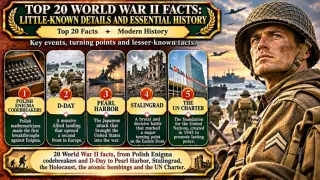
This Finepedia guide, updated in November 2026, explains how the Allies decided to put enemy leaders on trial, what happened at Nuremberg and Tokyo, how the verdicts were received and how the principles of those courts shaped later international law. It is number 19 in Top 20 World War II Facts: Little-Known Details.
Key Facts
| Attribute | Detail |
|---|---|
| Nuremberg tribunal | International Military Tribunal (IMT), 20 November 1945 – 1 October 1946 |
| Nuremberg defendants | 24 indicted, 22 tried; 19 convicted, 3 acquitted, 12 sentenced to death |
| Tokyo tribunal | International Military Tribunal for the Far East (IMTFE), April or May 1946 – 12 November 1948 |
| Tokyo defendants | 28 charged; 25 judged; 7 sentenced to death, 16 to life imprisonment |
| Crimes defined | Crimes against peace, war crimes and crimes against humanity |
| Judges | Four nations at Nuremberg; eleven at Tokyo |
| Legacy | Nuremberg principles affirmed by the UN General Assembly in 1946 and set out by the International Law Commission in 1950 |
Sources: US Holocaust Memorial Museum (USHMM), Wikipedia, Office of the Historian, National WWII Museum and the United Nations.[1][2][3][4][5][6]
Deciding to Hold Trials
During the war, the Allies debated what to do with defeated enemy leaders. USHMM notes that Secretary of State Cordell Hull argued that only a real trial would produce a verdict history would accept, and would stop Germans from later saying they had confessed under pressure.[1]
The London Charter
On 8 August 1945, the four occupying powers, the USSR, France, Britain and the United States, signed the London Agreement, which set up the International Military Tribunal. Its annexed Charter laid down the court's rules and the crimes it would try.[1][7] The American prosecutor Robert Jackson played a decisive part in negotiating it.[1]
Three Crimes
Article 6 of the Charter defined three crimes.[7][1] Crimes against peace meant preparing, starting or fighting an aggressive war. War crimes meant violations of the established rules of warfare, for example killing or abusing prisoners and civilians. Crimes against humanity covered murder, extermination, enslavement, deportation and persecution of civilians, before or during the war.[7]
No Hiding Behind Orders
The Charter also stated that holding high office would not free a defendant from responsibility, and that acting on orders could at most reduce a sentence.[7][6] These rules became central to the later Nuremberg principles.[6]
The Nuremberg Trial
The trial opened on 20 November 1945 in Nuremberg's Palace of Justice, roughly six months after Germany had surrendered.[1][2] Each of the four powers supplied one judge, one alternate and a prosecution team.[1]
The Prosecutors
Each power led its own prosecution. Robert Jackson, a US Supreme Court justice appointed by President Truman, represented the United States; Sir Hartley Shawcross led for Britain; Roman Rudenko for the USSR; and François de Menthon, later replaced by Auguste Champetier de Ribes, for France.[1][2] Jackson delivered the American opening statement on 21 November 1945.[8][1]
The Defendants
On 18 October 1945 the prosecutors indicted 24 men chosen to represent the political, military, economic and diplomatic leadership of Nazi Germany.[1] Only 22 stood trial: Robert Ley, head of the German Labour Front, killed himself before it began, and the industrialist Gustav Krupp was found too ill to be tried. Martin Bormann, the Nazi Party secretary, was never found and was tried in his absence.[1][2] Hermann Göring was the most senior Nazi in the dock.[1]
Organisations on Trial
The indictment also named Nazi and German state organisations. Wikipedia counts six organisations tried alongside the individuals.[2] USHMM records that the court declared four of them criminal: the SS, its intelligence arm the SD, the Gestapo and the Leadership Corps of the Nazi Party.[1]
Documents as Evidence
USHMM says the prosecution based its case mainly on thousands of captured German documents, and also showed films, including footage of the liberated camps.[1][9] All defendants, including Bormann, were represented by lawyers and could present evidence and witnesses.[1]
Related: The Axis and Allies Were Coalitions That Changed Over Time
Genocide in the Indictment
The indictment introduced a newly coined legal word, genocide, for the destruction of national and racial groups.[1] Raphael Lemkin, a Polish-Jewish legal scholar, had invented the term and first published it in 1944.[10][2] Prosecutors used it again and again, yet the final judgment left it out.[1]
The Nuremberg Verdict
The judges gave their verdict on 1 October 1946. They convicted 19 defendants and acquitted three: Franz von Papen, Hjalmar Schacht and Hans Fritzsche.[1][2]
Sentences
Twelve defendants, including Göring and Bormann, were sentenced to death.[1][2] Ten were hanged on 16 October 1946. Göring killed himself the night before.[1][2] Seven men, including Rudolf Hess, Albert Speer and Karl Dönitz, were sent to Spandau Prison; only Hess died behind bars.[2][1]
Later Nuremberg Trials
The IMT was followed by twelve further American trials in Nuremberg. From December 1946 to April 1948, prosecutors under Telford Taylor tried 185 Germans, including doctors, lawyers, industrialists and SS officers.[1][2]
The Tokyo Trial
In Japan, General Douglas MacArthur, the Allied supreme commander, ordered arrests one week after Japan's formal surrender of 2 September 1945, including former prime minister Hideki Tojo.[4][3]
Setting Up the Court
MacArthur established the Far East tribunal by order on 19 January 1946, approving a charter closely modelled on Nuremberg's.[4] Its judges came from eleven countries: the United States, the USSR, Britain, China, France, the Netherlands, Australia, Canada, New Zealand, India and the Philippines.[4][3] The court sat in the former Japanese Army headquarters building at Ichigaya in Tokyo.[4][3]
When It Began
Sources date the start differently. The Office of the Historian and the National WWII Museum date the indictment of 28 defendants and the convening of the court to 29 April 1946, while the museum says the prosecution opened its case on 3 May 1946.[5][4][3]
Crimes Against Peace First
Unlike Nuremberg, the Tokyo court could only try those accused of crimes against peace, the so-called Class A charges. Lesser war crimes were left to other courts.[4][3] Defence lawyers argued that the charges described no crime yet recognised in international law and that Japan had fought in self-defence.[4]
Related: The Holocaust Was a State-Organised Genocide
A Long Trial
The National WWII Museum records that the Tokyo court heard 419 witnesses and received 4,336 exhibits, including statements from 779 people. It also says the prosecution needed 192 days for its case, and the defence a further 225 days.[4]
The Tokyo Verdict
Judgment was read from 4 to 12 November 1948.[5] Of the 28 accused, two died during the trial and one, Shūmei Ōkawa, was found unfit to stand trial.[5][4]
Sentences
Seven were sentenced to death, including Tojo and former prime minister Kōki Hirota. Sixteen received life sentences, Shigenori Tōgō was given twenty years and Mamoru Shigemitsu seven years.[5][3][4] The National WWII Museum says the seven were hanged at Sugamo Prison on 23 December 1948.[4]
Paroles
Three of those sentenced to life died in prison. Wikipedia dates the paroles of the remaining thirteen to 1952–1958; the National WWII Museum gives 1954 to 1956.[3][4]
Dissent
Several judges wrote separate opinions. The Indian judge Radhabinod Pal argued for the acquittal of every defendant, and others criticised the decision not to try Emperor Hirohito.[3][4]
Other Courts in Asia
Beyond Tokyo, Allied countries held their own trials across Asia and the Pacific until 1951. The National WWII Museum says they convicted more than 5,500 lower-ranking defendants, and both it and Wikipedia report that China alone held 13 tribunals, with 504 convictions and 149 death sentences carried out.[4][3]
Criticism
The trials were controversial from the start. Wikipedia notes that charging aggression as a crime was criticised as applying law after the fact.[2] Critics of the Tokyo trial also spoke of victors' justice, pointing to an American-led prosecution and Allied conduct that went untried.[3] Supporters of the Nuremberg trial answer that the defendants had counsel, could call witnesses and present evidence, and that three of them were acquitted.[1][2]
Legacy: The Nuremberg Principles
Wikipedia describes the idea of making individuals answer for breaches of international law as the point where international criminal law really began.[2]
Related: Top 10 Oldest Buildings in the World
The UN Affirms Nuremberg
On 11 December 1946 the UN General Assembly passed resolution 95 (I) without opposition, endorsing the legal principles of the Nuremberg Charter and judgment.[11] The International Law Commission, in 1950, wrote them up as seven principles, the first being that any person who commits an international crime is personally answerable and may be punished.[6][11]
Genocide Convention
On 9 December 1948 the UN adopted the Genocide Convention, which made genocide an international crime.[10] The UN's legal library notes that the General Assembly had already declared genocide an international crime in 1946.[11]
Courts Since
The UN account of resolution 95 (I) says the Nuremberg principles strongly influenced international criminal law, including the statutes of the tribunals for the former Yugoslavia and Rwanda and of the International Criminal Court.[11] The ICC, governed by the Rome Statute, describes itself as the first standing international criminal court anywhere.[12]
Comparison: Nuremberg and Tokyo
| Aspect | Nuremberg (IMT) | Tokyo (IMTFE) |
|---|---|---|
| Created by | London Agreement of four powers, 8 August 1945 | Order of General MacArthur, 19 January 1946 |
| Judges from | 4 countries | 11 countries |
| Trial dates | 20 November 1945 – 1 October 1946 | 29 April or 3 May 1946 – 12 November 1948 |
| Defendants judged | 22 | 25 |
| Death sentences | 12 (10 hanged) | 7 |
| Acquittals | 3 | None |
| Required charge | None of the three was required | Crimes against peace |
Sources: USHMM, Wikipedia, National WWII Museum and Office of the Historian.[1][2][3][4][5]
Timeline
| Date | Event |
|---|---|
| 8 August 1945 | London Agreement and Charter of the IMT |
| 18 October 1945 | Nuremberg indictment of 24 defendants |
| 20 November 1945 | Nuremberg trial opens |
| 19 January 1946 | MacArthur orders the Tokyo tribunal |
| 29 April 1946 | Tokyo indictment of 28 defendants |
| 1 October 1946 | Nuremberg verdict |
| 16 October 1946 | Ten Nuremberg defendants hanged |
| 11 December 1946 | UN General Assembly affirms the Nuremberg principles |
| 12 November 1948 | Tokyo sentences read |
| 9 December 1948 | Genocide Convention approved |
| 1950 | International Law Commission adopts the Nuremberg principles |
Sources: USHMM, Office of the Historian, National WWII Museum and the United Nations.[1][5][4][11][6][10]
Key Figures
- 22: defendants tried at Nuremberg.[1][2]
- 12: Nuremberg death sentences.[1][2]
- 185: defendants in the twelve later Nuremberg trials.[1]
- 28: defendants charged at Tokyo.[4][5]
- 7: Tokyo death sentences.[3][4][5]
- 11: countries that supplied judges at Tokyo.[3][4]
Common Misconceptions
One misconception is that everyone at Nuremberg was convicted. Three defendants were acquitted, and several received prison terms rather than death.[1][2]
Another is that the word genocide was a charge on which the Nuremberg judges convicted. Prosecutors used it, but the judgment did not, and genocide became a defined international crime only with the 1948 convention.[1][10]
A third is that the Tokyo trial was a copy of Nuremberg. Its charter followed the Nuremberg model, but it required a charge of crimes against peace, used a single American-led prosecution team and had judges from eleven countries.[4][3]
Related: Top 10 Greatest Engineering Achievements
Frequently Asked Questions
When were the Nuremberg trials held?
The main trial before the International Military Tribunal ran from 20 November 1945 to 1 October 1946.[1][2]
What were the defendants charged with?
Four counts: conspiracy, crimes against peace, war crimes and crimes against humanity.[1][7]
How many were sentenced to death at Nuremberg?
Twelve, including Bormann in his absence. Ten were hanged on 16 October 1946, and Göring took his own life the night before.[1][2]
What was the Tokyo trial?
The International Military Tribunal for the Far East, which tried Japan's wartime leaders from 1946 to 1948 and sentenced seven to death.[5][4]
What are the Nuremberg principles?
Rules drawn from the Nuremberg Charter and judgment, affirmed by the UN in 1946 and set out in 1950, holding individuals responsible for crimes under international law.[11][6]
Conclusion
The Nuremberg and Tokyo trials were the first attempts to hold the leaders of defeated states personally responsible in international courts. They were criticised then and since, yet their verdicts were reached in open court on the basis of evidence.
Their lasting effect is legal: the crimes they defined and the principles they applied still underpin international criminal law today.[2][11][12]
See all 20 in Top 20 World War II Facts: Little-Known Details
See also
- Top 20 World War II Facts: Little-Known Details
- Top 10 Forged Documents That Saved Lives in World War II
- ^ [1] "International Military Tribunal at Nuremberg". Holocaust Encyclopedia, US Holocaust Memorial Museum. USHMM
- ^ [2] "Nuremberg trials". Wikipedia. Wikipedia
- ^ [3] "International Military Tribunal for the Far East". Wikipedia. Wikipedia
- ^ [4] "Tokyo War Crimes Trial". The National WWII Museum. National WWII Museum
- ^ [5] Foreign Relations of the United States, 1948, Volume VI, Document 613. Office of the Historian, US Department of State. Office of the Historian
- ^ [6] "Principles of International Law Recognized in the Charter of the Nürnberg Tribunal and in the Judgment of the Tribunal" (1950). International Law Commission, United Nations. United Nations
- ^ [7] "Charter of the International Military Tribunal". The Avalon Project, Yale Law School. Avalon Project
- ^ [8] "Nuremberg Timeline". Robert H. Jackson Center. Robert H. Jackson Center
- ^ [9] "Documenting Numbers of Victims of the Holocaust and Nazi Persecution". Holocaust Encyclopedia, US Holocaust Memorial Museum. USHMM
- ^ [10] "What is Genocide?". Holocaust Encyclopedia, US Holocaust Memorial Museum. USHMM
- ^ [11] "Affirmation of the Principles of International Law recognized by the Charter of the Nürnberg Tribunal". UN Audiovisual Library of International Law. United Nations
- ^ [12] "About the Court". International Criminal Court. International Criminal Court

























Discussion
Log in with