




The War Reshaped Borders and International Institutions
 By Dhiraj Sharma · Published
Share Post
Loading…
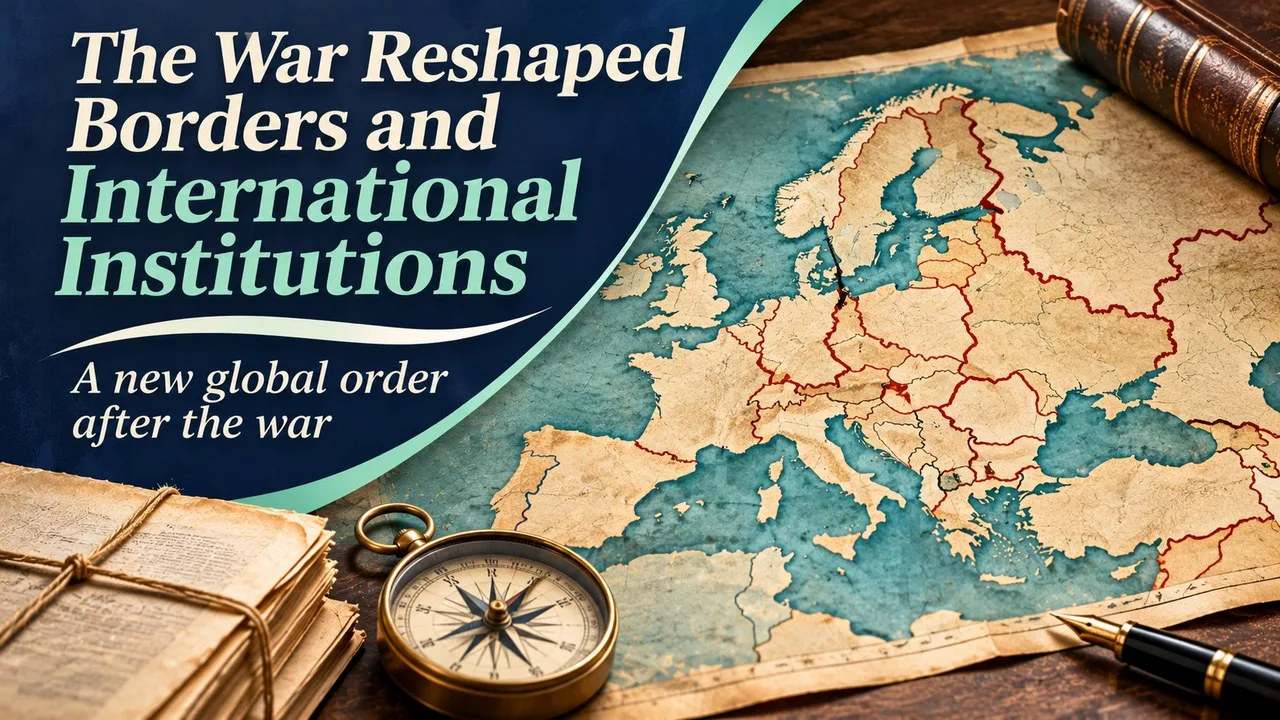
The war reshaped borders and international institutions: Europe and Asia were redrawn, millions were uprooted, and the UN, IMF and World Bank took shape.[1][2]
This Finepedia guide, updated in November 2026, explains how the wartime conferences settled new frontiers, how Germany and Korea came to be divided, why millions of people were forced to move and which global bodies were created during and after the war. It is number 20 in Top 20 World War II Facts: Little-Known Details.
Key Facts
| Attribute | Detail |
|---|---|
| Key conferences | Bretton Woods (July 1944), Yalta (4–11 February 1945), San Francisco (April–June 1945), Potsdam (17 July – 2 August 1945) |
| Germany | Four occupation zones; two German states from 1949 |
| Poland | Lost its eastern lands to the USSR and gained German territory east of the Oder–Neisse line |
| Germans expelled | "Several million" (Office of the Historian); about 10 or 12 million (Wikipedia) |
| New institutions | United Nations (1945); International Monetary Fund and World Bank (agreed 1944) |
| Cold War alliances | NATO (1949); Warsaw Pact (1955) |
| Decolonisation | About three dozen new Asian and African states, 1945–1960 |
Sources: Office of the Historian, US Department of State, and Wikipedia.[1][2][3][4][5]
Deciding the Peace in Wartime
Many of the postwar arrangements were agreed while the fighting was still going on. The Allied leaders met at Yalta and Potsdam in 1945, and their decisions shaped the map that followed.[3][1]
Yalta
At Yalta, in Crimea, between 4 and 11 February 1945, Roosevelt, Churchill and Stalin discussed Germany, Eastern Europe, the United Nations and the war against Japan.[3] They agreed to give France a role in governing Germany, and Stalin promised free elections in the countries freed from Nazi rule.[3] In return for entering the Pacific war, the USSR was promised southern Sakhalin, the Kuril Islands and influence over Manchuria.[3][2]
Potsdam
At Potsdam, from 17 July to 2 August 1945, Stalin, Truman and Churchill, replaced during the conference by Clement Attlee, tried to settle the future of defeated Germany.[1] With no common enemy left in Europe, the Office of the Historian notes, agreement became much harder to reach.[1]
A Divided Germany
The Potsdam leaders confirmed that Germany would be disarmed, demilitarised and split into four occupation zones run by the Americans, British, French and Soviets through an Allied control body.[1][2]
Reparations
The Soviets had already demanded heavy reparations at Yalta. Truman and James Byrnes, his secretary of state, wanted each occupying power to take reparations only from its own zone, partly to avoid repeating the harsh terms of Versailles that many experts blamed for the rise of the Nazis.[1]
Remaking German Society
The Potsdam protocol called for Nazi-era discriminatory laws to be repealed, war criminals to be arrested and tried, and schools and courts to be cleared of authoritarian influence. A national German government was postponed indefinitely.[1]
Two German States
As East–West relations broke down, the zones hardened into separate states. In 1949 the three Western zones became the Federal Republic of Germany and the Soviet zone became East Germany; the Saar joined West Germany in 1957.[2] Austria was also detached from Germany and split into four zones.[2]
Redrawing the Map of Europe
The most dramatic border change came in Poland, which was effectively moved westwards.[1][2]
Related: The UN Charter Was Signed Before Japan's Surrender
Poland Moves West
In exchange for land lost to the USSR in the east, Poland received a large area of eastern Germany.[1] Wikipedia says Poland gave up the Kresy, roughly half of its land before the war, and took over most German territory beyond the Oder–Neisse line, industrial Silesia among it.[2] Close to one-quarter of Germany's 1937 territory was effectively annexed.[2]
Expulsions
Poland and other countries with German minorities began to expel German residents. The Office of the Historian says the Potsdam leaders, fearing a flood of refugees into the western zones, only asked that transfers be orderly and humane.[1] The scale is given differently: the Office of the Historian speaks of several million, while Wikipedia gives about 10 million in one passage and about 12 million in another, including three million from the Sudetenland.[1][2]
Poles Moved Too
Population movement ran in both directions. Wikipedia says the USSR forced out a minimum of 2 million Poles living beyond the new frontier, which ran close to the Curzon Line.[2]
Millions Uprooted
Wikipedia notes that the war in Europe left tens of millions dead and even more displaced, with economies and industry in ruins.[2]
Displaced Persons
Former forced labourers, prisoners and refugees were housed in displaced persons (DP) camps run by the Allies and by the United Nations Relief and Rehabilitation Administration (UNRRA).[6][7] USHMM says over 250,000 Jewish DPs lived in camps and city centres in Germany, Austria and Italy between 1945 and 1952, by which time almost all the camps had closed.[6]
Asia After Japan's Empire
Japan lost the territories it had seized, including Manchuria and Korea.[2] The USSR occupied southern Sakhalin and annexed the Kuril Islands, a dispute that still prevents a Japanese–Russian peace treaty.[2][3]
Korea Divided
Korea, formerly under Japanese rule, was occupied by Soviet troops in the north and American troops in the south, divided at the 38th parallel. Separate states emerged on each side in 1948, and the Korean War later hardened the division.[2]
China
In China the civil war resumed after Japan's defeat. The Communist Party won in 1949, and the Nationalist government withdrew to Taiwan.[2]
Related: Germany Declared War on the United States
New Global Institutions
The Allies also built institutions meant to prevent another depression and another world war.[4][7]
Bretton Woods
In July 1944, delegates from 44 nations met at Bretton Woods, New Hampshire, for the United Nations Monetary and Financial Conference.[4] It created the International Monetary Fund and the International Bank for Reconstruction and Development, known as the World Bank.[4][7] A General Agreement on Tariffs and Trade followed in Geneva in October 1947.[4]
The United Nations
The UN Charter, drafted in San Francisco in 1945, took effect on 24 October 1945.[8][7] At Yalta the Allies had agreed voting rules for a Security Council with five permanent members, each holding a veto.[3][7] The UN counts 51 original members; the Office of the Historian, in a separate article, gives 35 member states in 1946 and 127 by 1970, as newly independent countries joined.[8][5]
From Allies to Rivals
The wartime alliance did not last. The Office of the Historian notes that by the end of April 1945 the new Truman administration was already clashing with the Soviets over Eastern Europe and the UN.[3]
An Iron Curtain
On 5 March 1946, in a speech at Fulton, Missouri, Winston Churchill warned that an "Iron Curtain" had come down across Europe.[2] Western Europe was rebuilt with American aid, while the centre and east of the continent came under Soviet influence.[2][9]
The Marshall Plan
After Secretary of State George Marshall's speech at Harvard on 5 June 1947, the Economic Cooperation Act became law in March 1948. The Office of the Historian says its funding eventually passed $12 billion for rebuilding Western Europe, while Wikipedia gives $13 billion allocated from 1948 to 1952.[9][2] Wikipedia notes that the USSR refused American aid under the plan.[2]
The Cost of Rebuilding
Reconstruction was uneven. Wikipedia, the only source used here for these details, says roughly a quarter of the USSR's capital resources had been destroyed and that its 1945 farm and factory output was well below prewar levels.[2] To recover, the Soviet government borrowed modestly from Britain and Sweden rather than Marshall aid.[2] Early Allied plans for Germany were harsh as well: Wikipedia notes an aim of cutting the German standard of living back to its 1932 level, before the Marshall Plan shifted policy and West Germany became a minor recipient from 1948.[2]
In Britain, Wikipedia adds, bread was rationed from 1946 to 1948, something that had never happened during the fighting.[2] These figures come from a single source and are reported here as Wikipedia's account rather than as cross-checked totals.
Related: The Axis and Allies Were Coalitions That Changed Over Time
NATO and the Warsaw Pact
In 1949 the Americans, Canadians and a number of Western European states founded the North Atlantic Treaty Organization for collective defence against the USSR.[10][2] West Germany joined NATO on 9 May 1955, and the Warsaw Pact was formed five days later.[2]
The End of Empires
The war also weakened the European colonial powers. Japan had driven them out of much of Asia, and after 1945 nationalist movements there demanded independence instead of the restoration of colonial rule.[5][2]
Three Dozen New States
The Office of the Historian counts some three dozen Asian and African countries that won autonomy or full independence between 1945 and 1960.[5] Some transitions were peaceful; others, such as Indonesia's struggle against the Netherlands (1945–1950) and Vietnam's war against France (1945–1954), were long and violent.[5][2]
Decolonisation and the Cold War
Decolonisation overlapped with the Cold War. The United States favoured self-determination in principle, but also wanted to keep its European allies strong and to block communist expansion.[5]
Comparison: Before and After the War
| Aspect | Before the war | After the war |
|---|---|---|
| Germany | One state, enlarged by annexations | Four zones, then two states from 1949 |
| Poland | Eastern lands including the Kresy | Shifted west to the Oder–Neisse line |
| Korea | Japanese colony | Divided at the 38th parallel |
| World body | League of Nations | United Nations |
| International finance | No permanent lending bodies | IMF and World Bank |
| Alliances in Europe | Wartime Allies | NATO and the Warsaw Pact |
| Colonies | Large European empires in Asia and Africa | About three dozen new states by 1960 |
Sources: Office of the Historian and Wikipedia.[1][2][4][5]
Timeline
| Date | Event |
|---|---|
| July 1944 | Bretton Woods Conference creates the IMF and World Bank |
| 4–11 February 1945 | Yalta Conference |
| 17 July – 2 August 1945 | Potsdam Conference |
| 24 October 1945 | UN Charter enters into force |
| 5 March 1946 | Churchill's "Iron Curtain" speech |
| October 1947 | General Agreement on Tariffs and Trade signed in Geneva |
| March 1948 | US Congress passes the Marshall Plan law |
| 1949 | NATO founded; two German states created |
| 1955 | West Germany joins NATO; Warsaw Pact formed |
| 1960 | About three dozen new Asian and African states since 1945 |
Sources: Office of the Historian, the United Nations and Wikipedia.[4][3][1][8][2][9][5]
Key Figures
- 4: occupation zones in Germany and in Austria.[1][2]
- About half: share of Poland's prewar territory lost in the east.[2]
- 10 or 12 million: Germans expelled, according to different passages in Wikipedia.[2]
- 44: nations at Bretton Woods.[4]
- Over $12 billion or $13 billion: Marshall Plan funding, according to the Office of the Historian and Wikipedia respectively.[9]
- About three dozen: new Asian and African states, 1945–1960.[5]
Common Misconceptions
One misconception is that the Cold War began years after 1945. The Office of the Historian notes clashes over Eastern Europe within weeks of Roosevelt's death in April 1945.[3]
Another is that the IMF and World Bank were created after the war. They were agreed at Bretton Woods in July 1944, almost a year before Germany surrendered.[4][7]
A third is that the new borders only affected Germans. Poles, too, were moved in their millions from the eastern lands annexed by the USSR.[2]
Related: The War Ended on Different Dates in Europe and Asia
Frequently Asked Questions
How was Germany divided after the war?
Into four zones under American, British, French and Soviet control. In 1949 the Western zones became West Germany and the Soviet zone East Germany.[1][2]
How did Poland's borders change?
Poland lost its eastern lands to the USSR and gained German territory up to the Oder–Neisse line.[1][2]
Which international institutions came out of the war?
The United Nations, the International Monetary Fund and the World Bank, followed by GATT in 1947.[4][8]
How many people were displaced?
Tens of millions. Wikipedia says more people were displaced than killed in Europe, and the expulsion of Germans alone is put at 10 to 12 million.[2]
How did the war lead to decolonisation?
It weakened European powers and encouraged nationalist movements. Some three dozen Asian and African states won autonomy or independence by 1960.[5]
Conclusion
The Second World War ended with more than a ceasefire. Borders in Europe and Asia were moved, millions of people were forced from their homes, and the wartime alliance split into two rival blocs.
At the same time, the war produced the institutions that still frame international life, from the United Nations to the IMF and World Bank, and it set off the end of the European empires.[1][4][5][8]
See all 20 in Top 20 World War II Facts: Little-Known Details
See also
- ^ [1] "The Potsdam Conference, 1945". Office of the Historian, US Department of State. Office of the Historian
- ^ [2] "Aftermath of World War II". Wikipedia. Wikipedia
- ^ [3] "The Yalta Conference, 1945". Office of the Historian, US Department of State. Office of the Historian
- ^ [4] "Bretton Woods-GATT, 1941–1947". Office of the Historian, US Department of State. Office of the Historian
- ^ [5] "Decolonization of Asia and Africa, 1945–1960". Office of the Historian, US Department of State. Office of the Historian
- ^ [6] "Displaced Persons". Holocaust Encyclopedia, US Holocaust Memorial Museum. USHMM
- ^ [7] "The Formation of the United Nations, 1945". Office of the Historian, US Department of State. Office of the Historian
- ^ [8] "The San Francisco Conference". United Nations. United Nations
- ^ [9] "Marshall Plan, 1948". Office of the Historian, US Department of State. Office of the Historian
- ^ [10] "North Atlantic Treaty Organization (NATO), 1949". Office of the Historian, US Department of State. Office of the Historian



















Discussion
Log in with