






 By
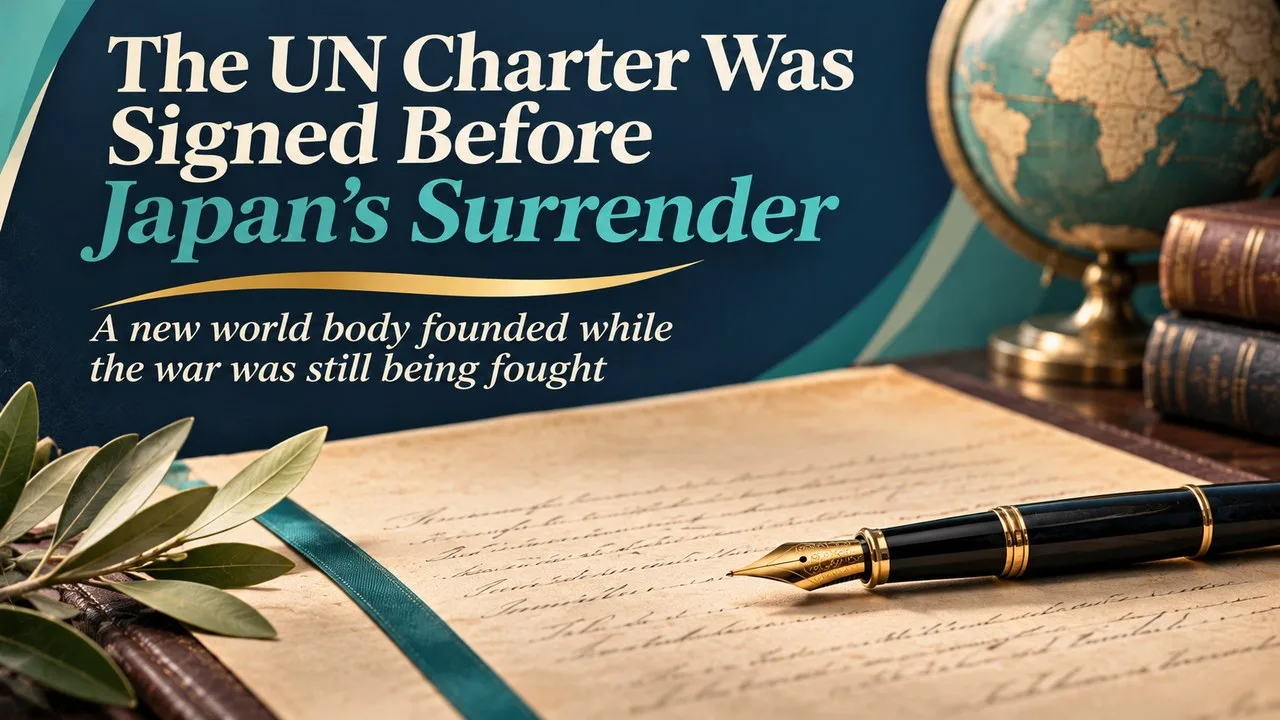
The UN Charter was signed before Japan's surrender: delegates of 50 nations signed it in San Francisco on 26 June 1945, while the Pacific War was still raging.[1][2]
This Finepedia guide, updated in November 2026, explains how the United Nations Charter was drafted while the fighting continued, who signed it, why it came into force only in October 1945 and how its text still bears the marks of the conflict. It is number 18 in Top 20 World War II Facts: Little-Known Details.
Key Facts
| Attribute | Detail |
|---|---|
| Conference | United Nations Conference on International Organization, San Francisco, 25 April – 26 June 1945 |
| Nations at the conference | 50 |
| Charter adopted | 25 June 1945, San Francisco Opera House |
| Charter signed | 26 June 1945, Veterans War Memorial Building |
| Original members | 51, after Poland signed on 15 October 1945 |
| Japan's surrender | Announced 15 August; signed 2 September 1945 |
| Entry into force | 24 October 1945, now marked as United Nations Day |
| Structure | Preamble and 111 articles in 19 chapters |
Sources: United Nations, Office of the Historian, US National Archives and Wikipedia.[1][2][3][4][5]
A Charter Written in Wartime
The San Francisco Conference opened on 25 April 1945, when Germany had not yet surrendered and Japan was still fighting.[1][6] Germany's surrender on 8 May came while the delegates were at work, and Japan fought on for more than two months after the Charter was signed.[7][8]
From Wartime Alliance to Organisation
The name United Nations began as a label for the countries fighting the Axis. It was first used officially on 1 January 1942, when 26 governments put their names to the Declaration by United Nations, pledging to fight on jointly and not to conclude peace on their own.[3][9]
The League's Successor
The new body was to take over from the League of Nations, created in 1919 after the First World War, which had failed to prevent a second global war.[3][2] The US National Archives notes that the need for a successor was first stated officially in the Moscow Declaration of 30 October 1943, issued jointly by the USSR, the United States, Britain and China.[3][9]
Wartime Agencies Came First
Several international bodies were set up before the Charter. The Office of the Historian lists the Food and Agriculture Organization of May 1943, the relief agency UNRRA, founded that November, and the International Monetary Fund and World Bank, agreed in July 1944.[2] A separate Office of the Historian page records that delegates from 44 nations met at Bretton Woods, New Hampshire, in July 1944 to create the IMF and the World Bank, formally the United Nations Monetary and Financial Conference.[10]
The Road to San Francisco
The Charter grew out of three earlier rounds of talks among the main Allies.[9][2]
Dumbarton Oaks
Between 21 August and 7 October 1944, American and British officials met Soviet and then Chinese representatives at Dumbarton Oaks, a mansion in Washington, D.C.[9] They proposed a General Assembly of all members and a Security Council led by the major powers.[2][3]
Yalta
At Yalta, between 4 and 11 February 1945, Roosevelt, Churchill and Stalin settled the voting rules and the veto of the Security Council's permanent members.[9][2] The Office of the Historian notes that Roosevelt also agreed to give Ukraine and Byelorussia their own seats in the General Assembly.[2]
Roosevelt's Death
Roosevelt, who had championed the new organisation, died on 12 April 1945, less than two weeks before the conference he was to host. The delegates later honoured him at a ceremony in Muir Woods, north of San Francisco.[6]
Related: The United Nations Was Named During the War
The San Francisco Conference
The conference lasted exactly two months. The UN's own history calls it a monumental piece of work.[1]
Who Took Part
Forty-six countries were first invited: those at war with both Germany and Japan that had also signed the 1942 Declaration.[1][6] The conference itself added four more: the Ukrainian and Byelorussian Soviet republics, newly liberated Denmark and Argentina, making 50 in all.[1][6]
A Huge Gathering
The UN records 850 delegates. With advisers, staff and the conference secretariat, about 3,500 people took part, and more than 2,500 journalists and observers also attended.[1] Delegation heads from the sponsoring powers, among them Britain's Anthony Eden and the American Secretary of State Edward Stettinius, took turns chairing the plenary sessions.[1]
Working Method
The delegates took as their basis the plans drawn up at Dumbarton Oaks, the deal struck at Yalta and changes proposed by individual governments. The work was divided among four commissions and their committees, and decisions needed a two-thirds majority.[1][6]
Committees and Commissions
Below the plenary sessions sat a steering committee of all delegation heads, an inner committee of 14 delegations and committees for coordination and credentials. The detailed drafting was split among four commissions, covering general provisions, the General Assembly, the Security Council and judicial matters, which in turn supervised twelve technical committees.[1]
Signing on 26 June 1945
Delegates approved the Charter, along with the Statute of the International Court of Justice, without a single vote against on 25 June 1945, meeting in the city's Opera House. The signing followed a day later in the Herbst Theatre, part of the Veterans War Memorial Building.[1][6]
Truman's Warning
President Harry Truman closed the conference by calling the Charter a solid structure on which to build a better world. He added that it would work only if people were determined to use it, and that failing to do so would betray those who had died in the war.[6]
Related: The Atomic Bombings Occurred in August 1945
The Empty Space for Poland
Poland had signed the 1942 Declaration but was not represented in San Francisco, because no generally recognised Polish government existed in time. A space was left for its signature. A new government was announced on 28 June, and Poland signed on 15 October 1945, becoming the 51st original member.[1][4]
Japan Was Still at War
When the Charter was signed, the war in the Pacific had weeks left to run. Japan's emperor announced its surrender on 15 August, after the atomic bombings and the Soviet declaration of war, and Japanese envoys signed the formal surrender on the deck of USS Missouri on 2 September 1945.[7][8] In the weeks between the signing in San Francisco and that ceremony, atomic bombs struck Hiroshima on 6 August and Nagasaki on 9 August, and the USSR declared war on Japan late on 8 August. The Charter's authors therefore finished their work without knowing how or when the Pacific War would end.[8]
Approving the Charter
Signing was not enough. The UN explains that many signatories first needed the consent of their national legislatures.[1] The Office of the Historian says the US Senate approved it on 28 July 1945 by 89 votes to 2, before Japan surrendered.[2]
Avoiding Wilson's Mistake
American planners remembered how the Senate had rejected the League of Nations after the First World War. The Office of the Historian says the Roosevelt administration sought support from both parties; the Republican Party endorsed joining a postwar organisation in September 1943, and both houses of Congress then backed the idea by large majorities.[2]
Entry into Force
The Charter took effect on 24 October 1945, after ratification by all five permanent Security Council members and by more than half of the remaining signatories.[1][5] The Office of the Historian gives the number as 29 ratifications.[2] The date is now marked every year as United Nations Day.[5][3]
What the Charter Created
The Charter set up the main bodies of the new organisation: an Assembly of all members, the Security Council, the Secretariat, a court (the International Court of Justice), and councils for economic and social affairs and for trust territories.[2][4]
The Security Council
The Office of the Historian describes the original Security Council as five permanent members plus six non-permanent ones.[2] The Charter as it reads today, published by the UN, sets the Council at fifteen members.[11][4] Wikipedia notes that 193 states are now parties to the Charter.[4]
Self-Defence and Sovereignty
Article 51 keeps each member's right to defend itself, alone or with others, if attacked, until the Security Council takes action. Article 2 sets out the sovereign equality of members and, in paragraph 7, bars the UN from intervening in matters essentially within a state's domestic jurisdiction.[11][4]
Related: The War Ended on Different Dates in Europe and Asia
Traces of the War in the Text
The Charter still contains so-called enemy state clauses. Article 107 protects measures taken after the war against any country that had fought against a signatory in the Second World War, and Article 53 uses the same definition.[11] Wikipedia lists the enemy state clause among topics related to the Charter.[4]
Born Before Peace
The order of events was therefore unusual: the peace organisation was founded while one of the main Axis powers was still fighting, and the Charter's opening pledge to spare later generations from war was signed before the war itself had ended.[11][1][7]
Comparison: Charter and Surrender Dates
| Event | Date | Place |
|---|---|---|
| Conference opens | 25 April 1945 | San Francisco |
| Germany surrenders | 8 May 1945 | Europe |
| Charter signed | 26 June 1945 | San Francisco |
| US Senate approves Charter | 28 July 1945 | Washington |
| Japan announces surrender | 15 August 1945 | Tokyo |
| Japan signs surrender | 2 September 1945 | USS Missouri, Tokyo Bay |
| Charter enters into force | 24 October 1945 | Washington, as depositary |
Sources: United Nations, Office of the Historian, Wikipedia and the National Archives.[1][2][8][7][3]
Timeline
| Date | Event |
|---|---|
| 1 January 1942 | Declaration by United Nations signed by 26 states |
| 30 October 1943 | Moscow Declaration calls for a new organisation |
| 21 August – 7 October 1944 | Dumbarton Oaks talks |
| 4–11 February 1945 | Yalta Conference |
| 12 April 1945 | Death of Franklin Roosevelt |
| 25 April 1945 | San Francisco Conference opens |
| 25 June 1945 | Charter adopted unanimously |
| 26 June 1945 | Charter signed by 50 nations |
| 2 September 1945 | Japan signs the instrument of surrender |
| 15 October 1945 | Poland signs as the 51st original member |
| 24 October 1945 | Charter enters into force |
Sources: United Nations, US National Archives and Wikipedia.[9][3][1][6][7]
Key Figures
- 50: nations represented at San Francisco.[1][2][3]
- 51: original members, counting Poland.[1][4]
- 850: delegates at the conference, out of about 3,500 participants including advisers and staff.[1]
- 111: articles in the Charter.[4][3]
- 89 to 2: US Senate vote approving the Charter.[2]
- 193: states now party to the Charter.[4]
Common Misconceptions
One misconception is that the United Nations was founded after the war ended. The signing took place on 26 June 1945, more than two months before Japan's formal surrender.[1][7]
Another is that the UN came into being when the Charter was signed. It existed legally only from 24 October 1945, after enough ratifications.[1][5]
A third is that 51 countries signed in San Francisco. Fifty did; Poland signed later, in October.[1][4]
Frequently Asked Questions
When was the UN Charter signed?
Delegates signed it in San Francisco on 26 June 1945, a day after its unanimous adoption.[1][3]
Related: The War Reshaped Borders and International Institutions
Was the war over when the Charter was signed?
Only in Europe. Japan announced its surrender on 15 August and signed it on 2 September 1945.[7][8]
How many countries signed the Charter?
Fifty signed in June 1945, and Poland signed on 15 October, making 51 original members.[1][4]
When did the UN officially come into existence?
Legally, from 24 October 1945, the day the Charter took effect. The date is celebrated as United Nations Day.[5][2]
Does the Charter still mention the Second World War?
Yes. Articles 53 and 107 refer to states that were enemies of a signatory during the Second World War.[11]
Why did Ukraine and Byelorussia sign separately?
At Yalta, Roosevelt agreed to Stalin's request that two Soviet republics, Ukraine and Byelorussia, should have their own seats in the General Assembly. The San Francisco Conference then invited them, so they signed the Charter alongside the USSR.[2][1][6]
Conclusion
The United Nations was designed by the wartime Allies and signed into being while their war with Japan continued. Its founding conference opened before Germany's surrender and finished before Japan's.
That timing explains much of its structure, from the special place of the great powers on the Security Council to the clauses that still mention wartime enemies.[2][11][1]
See all 20 in Top 20 World War II Facts: Little-Known Details
See also
- ^ [1] "The San Francisco Conference". United Nations. United Nations
- ^ [2] "The Formation of the United Nations, 1945". Office of the Historian, US Department of State. Office of the Historian
- ^ [3] "United Nations Charter (1945)". National Archives. National Archives
- ^ [4] "Charter of the United Nations". Wikipedia. Wikipedia
- ^ [5] "United Nations Day, 24 October". United Nations. United Nations
- ^ [6] "United Nations Conference on International Organization". Wikipedia. Wikipedia
- ^ [7] "Surrender of Japan (1945)". National Archives. National Archives
- ^ [8] "Surrender of Japan". Wikipedia. Wikipedia
- ^ [9] "Preparatory Years: UN Charter History". United Nations. United Nations
- ^ [10] "Bretton Woods-GATT, 1941–1947". Office of the Historian, US Department of State. Office of the Historian
- ^ [11] "United Nations Charter (full text)". United Nations. United Nations























Discussion
Log in with