






 By
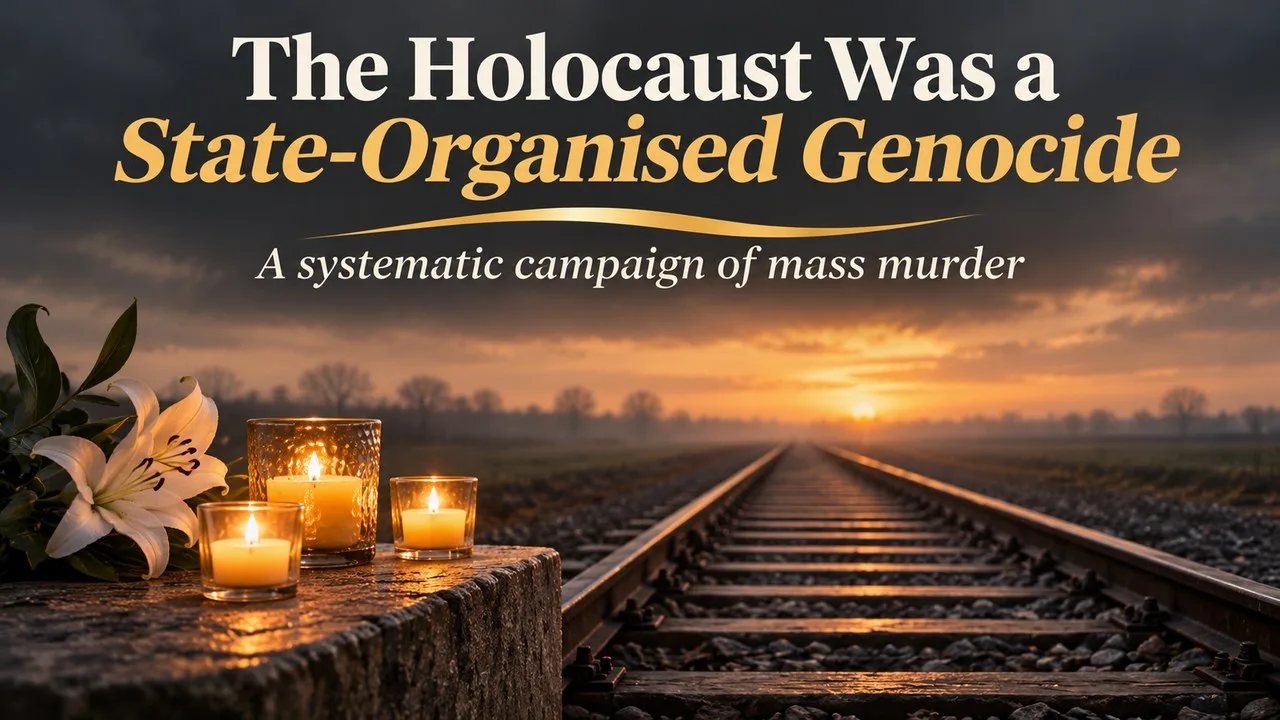
The Holocaust was a state-organised genocide: Nazi Germany, its allies and collaborators murdered about six million European Jews between 1941 and 1945.[1][2]
This Finepedia guide, updated in November 2026, explains how the persecution of Jews grew into continent-wide mass murder, how ministries, police and railways took part, how historians arrived at the death toll and which other groups the regime targeted. It is number 15 in Top 20 World War II Facts: Little-Known Details.
Key Facts
| Attribute | Detail |
|---|---|
| Period | Persecution from 1933; mass murder chiefly 1941–1945 |
| Jewish victims | About six million (USHMM); Yad Vashem's country table gives 5.6 to 5.86 million |
| Share of European Jews killed | Nearly two in three |
| Main methods | Mass shootings, poison gas in killing centres, starvation, disease and brutal treatment in ghettos and camps |
| Killing centres named by USHMM | Auschwitz-Birkenau, Treblinka, Sobibor, Belzec, Chełmno |
| Key meeting | Wannsee Conference, 20 January 1942 |
| Other victims | Soviet prisoners of war, Polish civilians, Roma and Sinti, people with disabilities and others |
Sources: US Holocaust Memorial Museum (USHMM), Yad Vashem and Wikipedia.[1][2][3][4]
What the Holocaust Was
The USHMM defines the Holocaust as the persecution and killing, sponsored by the state, of six million Jews in Europe, carried out by the Nazi regime together with its allied governments and local collaborators. The Hebrew word Shoah, meaning catastrophe, is also used.[1] Wikipedia gives the same figure and adds that this was about two in every three Jews living in Europe.[4]
A State Crime
The killing was organised by a modern state. USHMM stresses that Hitler inspired, ordered and approved the genocide, but that it could not have happened without the work of officials, soldiers, police and ordinary people across Europe.[1] Its article on the Wannsee Conference notes that mass murder on this scale needed the cooperation of government agencies throughout Axis-controlled Europe.[5]
Dates and Definitions
USHMM treats 1933 to 1945 as the Holocaust era, beginning when Hitler came to power, while placing the genocide itself between 1941 and 1945.[1] Wikipedia also dates the mass murder from 1941 to 1945.[4] Some scholars use the word Holocaust more widely to include the murder of other groups, but most reserve it for the genocide of the Jews.[4]
From Persecution to Murder
In 1933 about 9 million Jews lived in Europe, and nearly all of them would be affected.[1] Persecution in Germany came first and grew harsher step by step.
Laws and Pogrom
Anti-Jewish legislation and state-encouraged violence were used to drive Jews out of Germany. In November 1938 the regime staged a pogrom across the country, remembered as Kristallnacht.[4][1] The Nuremberg Laws later served as the basis for deciding who counted as a Jew in the Reich.[5]
Ghettos
Once Germany had overrun Poland in 1939, its occupation authorities began forcing Jews into ghettos.[4][1] The biggest ghettos, in Warsaw and Łódź, were closed off by walls or fences. Jews lost their homes and possessions, and many died from hunger, disease and abuse.[4][2] USHMM estimates that 800,000 to 1,000,000 Jews died in ghettos, labour camps and concentration camps.[2]
Mass Shootings in the East
Germany's attack on the USSR on 22 June 1941 marked a sharp escalation. Mobile SS killing squads, the Einsatzgruppen, together with police and military units, began shooting Jewish men and then women and children.[3][6] USHMM cites German reports that counted 33,771 Jews shot in a two-day massacre at Babyn Yar outside Kyiv at the end of September 1941.[6] USHMM estimates that about 2 million Jews were killed in mass shootings and related massacres in more than 1,500 towns and villages.[2][6]
Related: The War Ended on Different Dates in Europe and Asia
The Wannsee Conference
Fifteen senior figures from the SS, the Nazi Party and the German ministries met on 20 January 1942 in a villa at Wannsee, a Berlin suburb, under the chairmanship of Reinhard Heydrich of the SS.[5][4]
Coordinating, Not Deciding
USHMM explains that the meeting did not decide whether to murder Europe's Jews. Hitler had already approved the plan at some point in 1941, and killings were well under way in the occupied East and in Serbia.[5][3] Heydrich called the meeting to secure the help of the ministries and to make clear that he and his SS security headquarters (the RSHA) were in charge.[5] None of the officials present objected.[5] The meeting showed how deeply the ordinary machinery of government, from the justice and interior ministries to the Foreign Office and the occupation authorities in Poland and the USSR, was drawn into the crime.[5]
Eleven Million Targets
Heydrich listed about 11 million Jews as covered by the plan, including those in Britain and neutral countries such as Switzerland, Sweden and Spain, which Germany did not control.[5]
Killing Centres
From late 1941 the regime set up killing centres where victims were murdered with poison gas soon after arrival.[2][1]
Five Centres
USHMM counts five killing centres built mainly to murder Jews with gas: Treblinka, Sobibor, Belzec, Chełmno and the Birkenau section of Auschwitz. It estimates about 2.7 million Jews died there.[2] Wikipedia adds Majdanek to its list of main extermination camps.[4] Killing reached its peak during Operation Reinhard, which ran from March 1942 until November 1943.[4]
Treblinka
USHMM gives about 925,000 Jewish victims at Treblinka II, second only to Auschwitz.[2] Wikipedia records that in just six weeks from August 1942, Treblinka received some 300,000 deportees from the Radom district.[4]
Auschwitz-Birkenau
Auschwitz began in 1940 as a camp for Polish political prisoners.[7][8] From 1942 it became the main destination for Jews deported from across Europe.[7][8] The Auschwitz-Birkenau State Museum counts almost 1.1 million Jews deported there, and USHMM estimates that about 1.1 million people were killed in the camp, about one million of them Jews; the other victims included some 70,000 Poles, 15,000 captured Soviet soldiers and 21,000 Roma and Sinti.[7][8] On 27 January 1945 Soviet soldiers entered the camp and freed about 7,000 prisoners.[8][4]
Related: Germany's Invasion of Poland Began the War in Europe
Deportation by Rail
Killing on this scale depended on transport. USHMM notes that in late September 1941 Hitler authorised the German railways to carry Jews from Germany, Austria and the Czech lands to occupied Poland and the occupied USSR, where most were later killed.[4] The Auschwitz-Birkenau State Museum counts about 197,000 Jews deported to Auschwitz in 1942, about 270,000 in 1943 and more than 600,000 in 1944.[6] Wikipedia records that between March and early July 1944 alone, 434,000 Hungarian Jews were deported by train, most of them to Auschwitz, where the majority were killed on arrival.[3][7]
Counting the Victims
No single Nazi document lists every death. USHMM explains that the total rests on German records, prewar and postwar census data and wartime Jewish and resistance documents.[2] Yad Vashem describes the same method of comparing population counts before and after the war.[3]
Different Totals
USHMM gives a total of six million Jews.[2][1] Yad Vashem's table of losses by country gives a range from 5,596,000 to 5,860,000, with Poland's losses alone at 2.9 to 3 million.[3] Wikipedia also uses about six million.[4] The differences reflect gaps in prewar census data and border changes, not doubt about the scale of the crime.[3][2]
Names of the Dead
Yad Vashem says it can now identify over 4.7 million victims by name in its database, drawing largely on Pages of Testimony submitted by relatives and survivors.[3]
Other Victims of Nazi Persecution
Millions of people who were not Jewish were also killed by the regime and its allies, for racial, political or ideological reasons.[2][4]
Soviet Prisoners of War
About 5.7 million Red Army soldiers were captured by German forces, and around 3.3 million of them, some 57 per cent, died in captivity.[9][2] In the USHMM table of non-Jewish victims they form the largest single group, ahead of the roughly 1.8 million Polish civilians.[2]
Poles, Roma and Disabled People
USHMM estimates about 1.8 million non-Jewish Polish civilians killed.[2] For Roma and Sinti, USHMM gives at least 250,000 and possibly up to 500,000, while Yad Vashem gives estimates from 200,000 to more than 500,000.[2][3] Between 250,000 and 300,000 disabled people in hospitals and care homes were murdered, among them at least 10,000 children.[2] Wikipedia notes that the genocide of the Roma followed separate policies from those aimed at the Jews.[4]
Related: The Atomic Bombings Occurred in August 1945
Liberation and Evidence
As Allied armies advanced in 1944 and 1945, they reached camps whose prisoners had often survived death marches from the east.[1][3] USHMM lists camps freed by Soviet troops, including Auschwitz, Stutthof, Sachsenhausen and Ravensbrück; by American troops, including Buchenwald, Dachau and Mauthausen; and by British troops, including Bergen-Belsen and Neuengamme.[1]
Destroying the Record
As defeat approached, the Nazis tried to hide their crimes by digging up mass graves, burning bodies and destroying paperwork.[2] USHMM points out that the killing was too extensive to cover up: survivors, witnesses and hundreds of thousands of German documents survived.[2]
Documents in Court
These records became the backbone of postwar justice. USHMM's account of the Nuremberg tribunal says prosecutors built their case mainly on thousands of captured German documents, and also showed films of the liberated camps, including footage of Majdanek and Auschwitz.[10][2]
Comparison: Main Methods of Murder
| Method | Main period | Estimated Jewish victims (USHMM) |
|---|---|---|
| Killing centres (poison gas) | 1942–1944 | About 2.7 million |
| Mass shootings and massacres | 1941–1944 | About 2 million |
| Ghettos, labour and concentration camps | 1939–1945 | 800,000 to 1,000,000 |
| Other violence (riots, death marches, transports) | 1939–1945 | At least 250,000 |
Sources: USHMM; Wikipedia for periods.[2][4]
Timeline
| Date | Event |
|---|---|
| January 1933 | Hitler and the Nazi Party come to power in Germany |
| 1935 | Nuremberg Laws |
| November 1938 | Kristallnacht pogrom |
| September 1939 | Invasion of Poland; ghettos begin to be set up |
| 1940 | Auschwitz opens as a camp for Polish prisoners |
| 22 June 1941 | Invasion of the USSR; Einsatzgruppen mass shootings begin |
| September 1941 | Babyn Yar massacre near Kyiv |
| 20 January 1942 | Wannsee Conference |
| March 1942 – November 1943 | Operation Reinhard |
| 27 January 1945 | Soviet troops reach Auschwitz |
| 8 May 1945 | Germany's surrender ends the war in Europe |
Sources: USHMM, Wikipedia and the Auschwitz-Birkenau State Museum.[1][4][5][7]
Key Figures
- About 9 million: Jews in Europe in 1933.[1]
- About 6 million: Jews murdered in the Holocaust, according to USHMM.[2]
- 5.6 to 5.86 million: Yad Vashem's range from its country-by-country table.[3]
- 15: officials at the Wannsee Conference.[5]
- About 1.1 million: people killed at Auschwitz.[8][7]
- More than 4.7 million: victims' names in Yad Vashem's database.[3]
Common Misconceptions
One misconception is that the Wannsee Conference was where the Holocaust was decided. In fact mass shootings had been going on for months, and the meeting coordinated a policy already approved at the top of the regime.[5][3]
Another is that the Holocaust happened only in death camps. Roughly half of the Jewish victims were shot, starved or worked to death elsewhere, in mass shootings, ghettos and labour camps.[2][6]
A third is that only the SS was involved. Ministries, the railways, the army, local police and collaborators in many countries all took part.[1][5]
Frequently Asked Questions
How many Jewish victims were there?
USHMM and most historians give about six million. Yad Vashem's country-by-country table gives a range of 5.6 to 5.86 million.[2][3][4]
Related: The Eastern Front Was the Largest Theatre of the War
What was decided at the Wannsee Conference?
The meeting of 20 January 1942 coordinated the work of ministries and the SS on the murder of Europe's Jews. The policy itself had already been approved.[5][4]
What were the main killing centres?
USHMM names five: Auschwitz-Birkenau, Treblinka, Belzec, Sobibor and Chełmno. Wikipedia also lists Majdanek.[2][4]
Who else did the Nazis murder?
Victims included Soviet prisoners of war, Polish civilians, Roma and Sinti, people with disabilities, political opponents and others.[2][3]
When was Auschwitz liberated?
Soviet soldiers entered Auschwitz on 27 January 1945, where they found about 7,000 prisoners still there.[8][4]
Conclusion
The Holocaust was not a sudden outburst but a process run by a state. Laws, ghettos, mass shootings and killing centres followed one another, and each step needed officials, police, soldiers and railway staff to carry it out.
Historians count the Jewish victims at about six million, with Yad Vashem's lowest estimate near 5.6 million. Millions of others, from Soviet prisoners to Roma and disabled people, were murdered alongside them.[2][3][1]
See all 20 in Top 20 World War II Facts: Little-Known Details
See also
- Top 20 World War II Facts: Little-Known Details
- Top 10 Forged Documents That Saved Lives in World War II
- Top 10 Overlooked Events of World War II
- ^ [1] "Introduction to the Holocaust". Holocaust Encyclopedia, US Holocaust Memorial Museum. USHMM
- ^ [2] "Documenting Numbers of Victims of the Holocaust and Nazi Persecution". Holocaust Encyclopedia, US Holocaust Memorial Museum. USHMM
- ^ [3] "FAQs about the Holocaust". Yad Vashem. Yad Vashem
- ^ [4] "The Holocaust". Wikipedia. Wikipedia
- ^ [5] "Wannsee Conference and the Final Solution". Holocaust Encyclopedia, US Holocaust Memorial Museum. USHMM
- ^ [6] "Einsatzgruppen". Holocaust Encyclopedia, US Holocaust Memorial Museum. USHMM
- ^ [7] "The number of victims". Auschwitz-Birkenau State Museum. Auschwitz Memorial
- ^ [8] "Auschwitz". Holocaust Encyclopedia, US Holocaust Memorial Museum. USHMM
- ^ [9] "Nazi Persecution of Soviet Prisoners of War". Holocaust Encyclopedia, US Holocaust Memorial Museum. USHMM
- ^ [10] "International Military Tribunal at Nuremberg". Holocaust Encyclopedia, US Holocaust Memorial Museum. USHMM






















Discussion
Log in with