





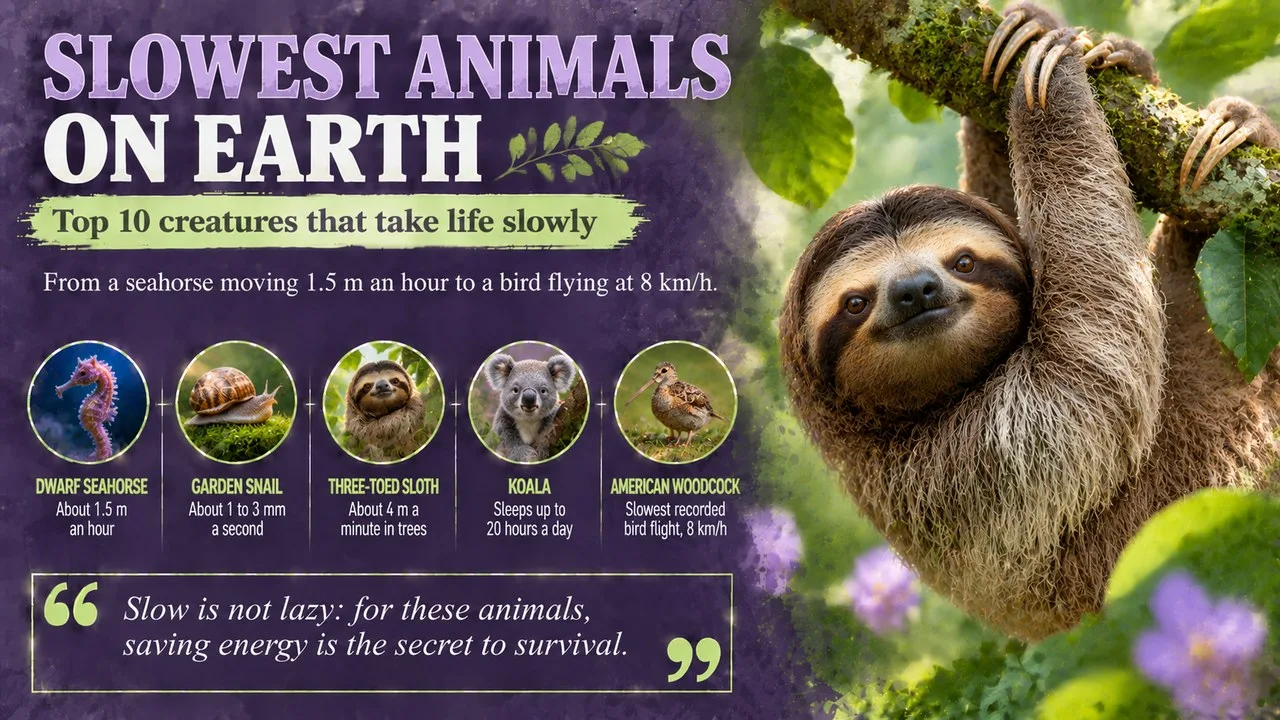
The slowest animals on Earth include a sloth that climbs a few metres a minute, a seahorse that swims 1.5 m an hour and a bird that flies at just 8 km/h.
This Finepedia guide, written in October 2026, looks at 10 of the slowest-moving animals known and why being slow works for them. The facts come from scientific studies, Guinness World Records, wildlife agencies and encyclopaedias. Speeds for wild animals are hard to measure and vary a lot between individuals, so we give typical or record figures and say when a number is only an estimate. If you love the animal world, you may also enjoy Finepedia's guides to the longest-living animals on Earth and animals that can live without food for months.
How We Chose These
We picked ten animals that are famous for moving slowly, on land, in the water and in the air. Some are slow all the time, while others save energy by moving slowly and only speed up when they must. We left out the giant tortoise, since it already features in our longest-living animals and fasting guides. The list runs roughly from the slowest to the less slow, though exact rankings are impossible. For each one you will find a short profile, four key facts and one more note on why it matters or a surprising detail.
The 10 Slowest Animals at a Glance
| No. | Animal | Where it lives | Typical or record speed | Why it is slow |
|---|---|---|---|---|
| 1 | Dwarf seahorse | Gulf of Mexico, Bahamas | about 1.5 m an hour | tiny fins, upright body |
| 2 | Garden snail | worldwide | about 1 to 3 mm a second | moves on a single muscular foot |
| 3 | Banana slug | Pacific coast of North America | about 17 cm a minute | slides on mucus |
| 4 | Starfish | all oceans | a few cm a minute for many | hundreds of tiny tube feet |
| 5 | Three-toed sloth | Central and South America | about 4 m a minute in trees | low-energy leaf diet |
| 6 | Slow loris | South and South-east Asia | slow, careful climbing | stealthy night hunter |
| 7 | Koala | eastern Australia | sleeps up to 20 hours a day | low-energy leaf diet |
| 8 | Gila monster | south-west US and Mexico | slow sprinter | spends 90 percent of life underground |
| 9 | West Indian manatee | Caribbean and Florida | usually a slow cruise | grazes on sea plants |
| 10 | American woodcock | eastern North America | slowest recorded bird flight, 8 km/h | ground-dwelling forest bird |
1. The Dwarf Seahorse Is the Slowest Fish
The dwarf seahorse lives among seagrass beds in warm, shallow seas around the Bahamas, Florida and the Gulf of Mexico. It is only about 2 to 2.5 centimetres long. Guinness World Records lists it as the slowest fish on the planet, managing roughly 1.5 metres in an hour at best.
Key Facts
- Scientific name: Hippocampus zosterae
- Length: usually 2 to 2.5 cm
- Top speed: about 1.5 m an hour
- Lifespan: usually about 1 year, up to 2
Why It Matters
Seahorses swim upright, pushed along by a small fin on the back that beats very fast while two tiny fins near the head steer. Being slow is no handicap for a fish that spends most of its life holding on to seagrass with its tail and blending in. The species is threatened by the loss of the seagrass meadows it depends on. As in every seahorse species, the father rather than the mother carries the young in a pouch until they hatch. Males also stay in a tiny home range of about one square metre, while females wander over an area around a hundred times larger.
2. The Garden Snail Moves on a Wave of Muscle
The garden snail is one of the best-known land snails in the world, native to Europe and the Mediterranean and now found on every inhabited continent. It glides on a single muscular foot, sending waves of contraction along its underside while a film of slime helps it grip and slide. Its coiled case is usually about 25 to 40 millimetres across.
Key Facts
- Scientific name: Cornu aspersum
- Size: case about 25 to 40 mm across
- Popular top-speed figure: about 1.3 cm a second (from 1974)
- Speeds seen in snail races: about 2.4 mm a second
Did You Know?
The often-quoted top speed of around 1.3 centimetres a second dates from a 1974 estimate, but in snail races the fastest competitors have managed only about 2.4 millimetres a second. Garden snails can survive temperatures as low as minus 5 °C by changing the chemistry of their blood. In dry or cold weather, a snail pulls itself inside and seals the opening with a thin layer of dried mucus, which keeps in moisture and keeps out small predators such as ants.
3. The Banana Slug Glides on a Trail of Slime
Banana slugs live in the damp forests of the Pacific coast of North America and are often bright yellow, which gives them their name. Only one land slug on Earth grows bigger than the Pacific banana slug, which can reach about 25 centimetres in length. It moves at roughly 17 centimetres a minute.
Key Facts
- Genus: Ariolimax
- Home: coastal forests from Alaska to California
- Length: up to about 25 cm
- Speed: about 17 cm a minute
Why It Matters
Banana slugs are important recyclers in the forest, eating dead leaves, fungi and animal waste and turning them into rich soil. Drying out is their biggest danger, so they coat themselves in thick mucus and can rest for long periods in dry weather. Their slime also carries chemical signals that help them find mates. Their range runs along the cool coastal rainforests from south-east Alaska to the redwood forests of California.
4. Starfish Walk on Hundreds of Tiny Feet
Starfish, or sea stars, are found in every ocean, from rocky shores down to depths of about 6,000 metres. There are around 1,900 species. Instead of legs, each arm has rows of small tube feet worked by water pressure, which let the animal grip rocks and creep slowly across the seabed. Most species have five arms, though some have many more.
Key Facts
- Class: Asteroidea
- Species: about 1,900
- Movement: water-powered tube feet
- Typical speed: often only a few centimetres a minute
Did You Know?
Many starfish can regrow lost arms, and some can even shed an arm on purpose to escape a predator. When eating a mussel or clam, a starfish slowly pulls the two halves apart and then pushes its own stomach out of its body to digest the soft parts inside.
5. The Three-Toed Sloth Lives Life in the Slow Lane
Three-toed sloths live in the tropical forests of Central and South America, where they pass almost their whole lives dangling upside down from branches. In the trees they usually move at around 4 metres a minute, rising only a little when danger threatens. On the ground they are even slower and almost helpless.
Key Facts
- Genus: Bradypus, from the Greek for slow foot
- Home: tropical forests of Central and South America
- Speed in trees: about 4 m a minute
- Diet: leaves from a small number of trees
Why It Matters
Leaves give very little energy, so sloths save energy by moving slowly and keeping a low body temperature. Their slowness also helps them avoid predators that hunt by sight, such as harpy eagles, jaguars and ocelots. Green algae grow in their grooved fur, giving them camouflage, and some moths live only on sloths. Despite being so slow in the trees, sloths are surprisingly good swimmers, reaching about 13.5 metres a minute in the water. They can also slow their heart rate so much that they can hold their breath for up to 40 minutes. About once a week, a three-toed sloth climbs all the way down to the forest floor to go to the toilet, which is the most dangerous trip of its week.
6. The Slow Loris Moves Slowly but Has a Toxic Bite
Slow lorises are small, big-eyed primates found in South and South-east Asian forests, from Bangladesh and north-east India to the Philippines and Java. They come out at night and creep slowly and carefully along branches, which helps them sneak up on insects without being seen. At least eight species are recognised.
Key Facts
- Genus: Nycticebus
- Home: South and South-east Asia
- Active: at night
- Species: at least eight
Why It Matters
Slow lorises are the only primates known to have a toxic bite. The toxin comes from a gland on the inside of the elbow, and it seems to be used mainly in fights between lorises. Sadly, all slow lorises are under threat from forest loss and from the illegal pet trade.
7. The Koala Saves Energy by Sleeping Most of the Day
The koala is a tree-dwelling marsupial found in the eucalyptus woodlands of eastern and southern Australia. It is often wrongly called the koala bear, but it is not a bear at all; wombats are its nearest living cousins. Koalas feed almost only on eucalyptus leaves, which are low in energy and contain substances that are toxic to most other mammals.
Key Facts
- Scientific name: Phascolarctos cinereus
- Home: eastern and southern Australia
- Sleep: up to 20 hours a day
- Weight: about 4 to 15 kg
Why It Matters
To cope with such a poor diet, koalas move little and sleep for up to 20 hours a day. Their slowness makes them very vulnerable to bushfires, which can spread quickly through eucalyptus forests, as was seen in the great fires of 2019 and 2020. Like other marsupials, a mother koala raises her tiny newborn, called a joey, in a pouch, where it stays for its first six or seven months. The koala's scientific name comes from Greek words meaning pouch and bear.
8. The Gila Monster Is a Slow but Venomous Lizard
The Gila monster is a chunky, sluggish reptile of the deserts of the south-western US and northern Mexico. It grows up to about 56 centimetres long, and no other venomous lizard is native to the US. It cannot run fast, but it has good stamina for its size.
Key Facts
- Scientific name: Heloderma suspectum
- Home: Arizona, nearby US states and Sonora, Mexico
- Length: up to about 56 cm
- Time underground: about 90 percent of its life
Did You Know?
Because it is so sluggish, the Gila monster is rarely a danger to people, although its bite is painful. Its back is covered in beaded scales with tiny bones inside them, patterned in black with pink, orange or yellow. Arizona's state laws make it illegal to harm one, yet the lizard's scary reputation still leads some people to kill it. A substance in its venom, exendin-4, led to a family of modern medicines for type 2 diabetes and weight loss.
9. The Manatee Is a Gentle, Slow-Moving Grazer
The West Indian manatee is a large sea mammal that lives in warm coastal waters, rivers and springs from Florida and the Caribbean down to northern Brazil. It moves slowly, often alone or in small groups, and spends many hours a day grazing on underwater plants. It uses its sensitive whiskers to find its way. Adults are usually about 3 metres long and weigh 200 to 600 kilograms, and they may eat up to a tenth of their body weight in plants each day.
Key Facts
- Scientific name: Trichechus manatus
- Home: from Florida and the Caribbean to northern Brazil
- Feeding: grazes for five or more hours a day
- Cold limit: water below about 20 °C can be dangerous
Why It Matters
Because manatees are slow and often rest near the surface, they are at risk of being struck by boats. In winter, Florida manatees gather in warm springs and rivers such as Crystal River and Blue Spring, which have become important protected areas for them.
10. The American Woodcock Is the Slowest-Flying Bird
The American woodcock is a small, plump shorebird that lives mainly in young forests and brushy fields of eastern North America. Its brown and black feathers give it excellent camouflage on the forest floor. No bird has been clocked flying more slowly: about 8 kilometres an hour.
Key Facts
- Scientific name: Scolopax minor
- Home: eastern North America
- Slowest recorded flight: about 8 km/h
- Nicknames: timberdoodle, among others
Did You Know?
In spring, male woodcocks put on courtship flights in the half-light of morning and evening, spiralling high into the air and twittering before tumbling back to the ground. The species has been slowly declining since the 1960s, mainly because of habitat loss. Woodcocks feed by pushing their long, flexible bills into soft soil to find earthworms, and their eyes sit so high on the head that they can probably see all the way around them while they feed.
Frequently Asked Questions
Which animal is the slowest of all?
Among animals that move from place to place, the dwarf seahorse is often named the slowest, managing only about 1.5 metres an hour. Some animals, such as sea anemones and corals, move even less, but they spend most of their lives fixed in one place.
Why are some animals so slow?
Most slow animals have a diet low in energy, such as leaves, or live where moving fast is not needed. Moving slowly saves energy, and for many it also helps them hide from predators.
Conclusion
From a seahorse that barely moves to a bird that flies slower than a bicycle, these ten animals show that being slow can be a clever way to survive. Saving energy, hiding from predators and living on simple food all reward a slow pace of life. For more of the animal world, read Finepedia's guides to the longest-living animals on Earth and animals that can live without food for months.
- Guinness World Records, slowest fish (dwarf seahorse).
- Cornell Lab of Ornithology, All About Birds: American Woodcock.
- US Fish and Wildlife Service, West Indian manatee species profile.
- Australian Koala Foundation, koala facts.
- Wikipedia (accessed October 2026), articles on the dwarf seahorse, Cornu aspersum, banana slug, starfish, sloth, three-toed sloth, slow loris, koala, Gila monster, West Indian manatee and American woodcock.
- 10 Most Today, 10 Slowest Animals in the World, 10mosttoday.com (topic reference).



















Log in with