











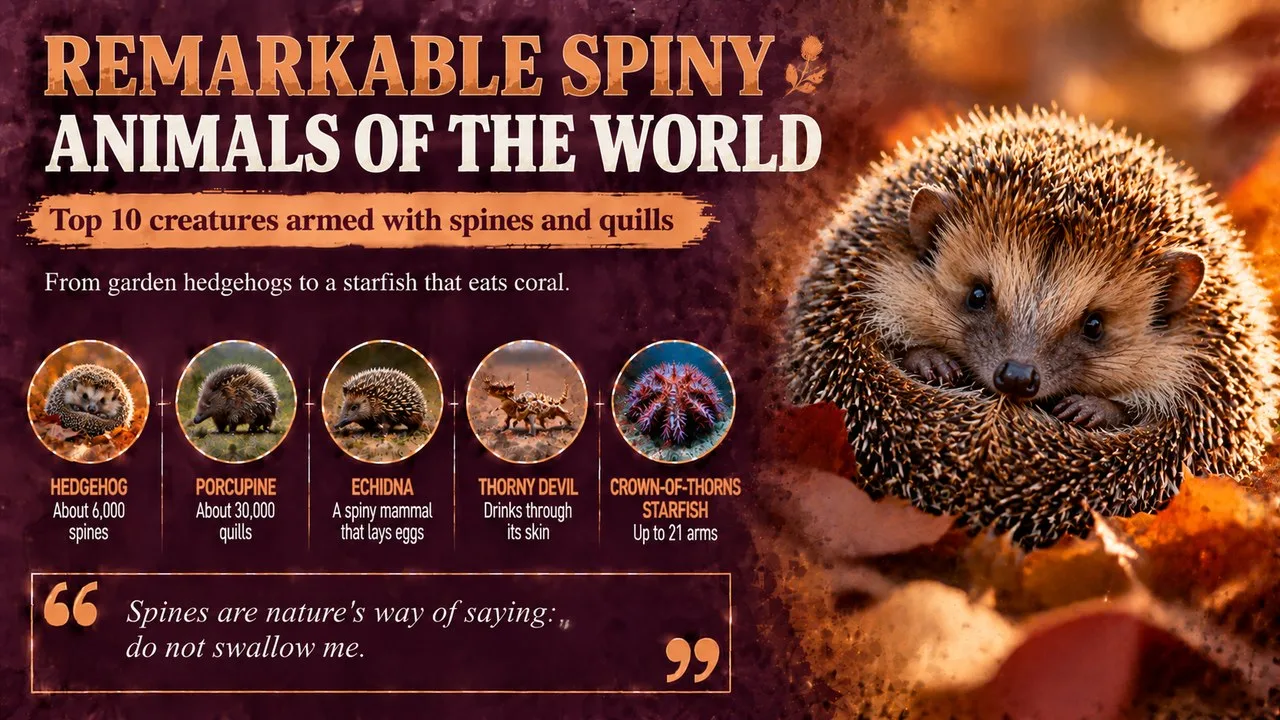
Remarkable spiny animals of the world include a hedgehog with about 6,000 spines, a porcupine with 30,000 quills and a lizard that drinks with its skin.
This Finepedia guide, written in October 2026, looks at 10 animals that protect themselves with spines, quills or thorny scales, from familiar garden visitors to a coral-eating starfish and a tiny spider. The facts come from zoos, museums, scientific studies and encyclopaedias. Spine counts and sizes vary between individuals and species, so we give typical figures and say when a number is an estimate. If you enjoy unusual wildlife, you may also like Finepedia's guides to the most dangerous sea creatures and the slowest animals on Earth.
How We Chose These
We picked ten animals whose spines are central to how they live, whether for defence, for collecting water or even for making sound. We wanted a wide spread of animal groups, so the list includes mammals, reptiles, a fish, a starfish and a spider. It runs from the mammals through to the invertebrates. Each entry has a short profile, four key facts and one more note on why it matters or a surprising detail.
The 10 Spiny Animals at a Glance
| No. | Animal | Group | Where it lives | What its spines do |
|---|---|---|---|---|
| 1 | Hedgehog | mammal | Europe, Asia and Africa | roll into a prickly ball |
| 2 | North American porcupine | mammal | forests of North America | barbed quills that detach |
| 3 | Echidna | egg-laying mammal | Australia and New Guinea | shield it while it digs in |
| 4 | Lowland streaked tenrec | mammal | Madagascar | rub together to make sound |
| 5 | Spiny mouse | mammal | Africa and the Middle East | skin tears away to escape |
| 6 | Thorny devil | lizard | Australian deserts | channel water to the mouth |
| 7 | Armadillo girdled lizard | lizard | western South Africa | guard it when it curls up |
| 8 | Porcupinefish | fish | warm and temperate seas | stand up when it inflates |
| 9 | Crown-of-thorns starfish | starfish | Indo-Pacific reefs | venomous thorns |
| 10 | Spiny orb-weavers | spider | tropics worldwide | hard spikes on the abdomen |
1. The Hedgehog Turns Into a Ball of Spines
Hedgehogs are small, insect-eating mammals native to large areas of Europe, Asia and Africa. People also brought them to New Zealand. There are 17 species. The familiar European hedgehog carries around 6,000 spines, which are hollow hairs stiffened with keratin, the same protein found in human fingernails. When danger threatens, it tucks in its face, legs and soft belly and rolls into a tight, prickly ball.
Key Facts
- Species: 17, in five genera
- Spines: about 6,000 on a European hedgehog
- Defence: two large back muscles control the direction of the spines
- Winter: hedgehogs can hibernate, with body temperature falling to just a few degrees
Did You Know?
Hedgehogs sometimes perform a strange habit called self-anointing. When they meet a new smell, they lick and chew the source, work up a frothy saliva and then spread it over their spines with their tongue. Nobody knows for certain why they do it. Unlike a porcupine's quills, a hedgehog's spines are not barbed and do not come out easily.
2. The North American Porcupine Carries 30,000 Quills
Porcupines are big, quill-covered rodents. The North American porcupine ranges from Alaska and Canada to the mountains of northern Mexico and spends a lot of time climbing trees. An adult is covered in about 30,000 quills, each one a hollow, modified hair around 5 to 7 cm long with tiny backward-facing barbs at the tip.
Key Facts
- Species: Erethizon dorsatum
- Quills: about 30,000, covering all but the belly, face and feet
- Quill length: roughly 5 to 7 cm
- Relatives: the largest porcupines rank as the third-biggest rodents, after capybaras and beavers
Why It Matters
A popular myth says porcupines can shoot their quills, but they cannot. The quills are only loosely attached, so they come away easily when a predator touches them, and the barbs then work them deeper into the attacker's skin. Before using them, a porcupine gives plenty of warning by raising its quills, chattering its teeth and releasing a strong smell. Scientists have studied the barbs to help design better hypodermic needles and surgical staples.
3. The Echidna Is a Spiny Mammal That Lays Eggs
Echidnas, sometimes called spiny anteaters, live in Australia and New Guinea. Together with the platypus, the four living species are the only mammals that lay eggs. Their spines are modified hairs, and when frightened an echidna partly buries itself or curls into a ball, leaving mostly spines on show. They use long snouts and sticky tongues to feed on ants, termites and worms.
Key Facts
- Group: monotremes, the egg-laying mammals
- Species: four, the short-beaked echidna and three long-beaked echidnas
- Young: a baby echidna is called a puggle
- Lifespan: up to 50 years recorded in captivity
Did You Know?
The mother lays a single soft, leathery egg straight into a pouch on her belly. The puggle hatches after about ten days, drinks milk that seeps from patches of skin, since echidnas have no teats, and stays in the pouch until its own spines begin to grow. One long-beaked species from New Guinea, Zaglossus attenboroughi, honours the broadcaster Sir David Attenborough.
4. The Streaked Tenrec Talks With Its Quills
The lowland streaked tenrec is a small, shrew-like mammal from the rainforests of northern and eastern Madagascar. It has a black coat with bright yellow stripes and a mix of spines and quills, which can detach to protect it. It is only about 14 cm long and spends much of its time digging for earthworms in the forest floor.
Key Facts
- Species: Hemicentetes semispinosus
- Size: about 14 cm long, weighing roughly 125 to 280 g
- Home: lowland forests of Madagascar
- Unusual skill: makes sound by rubbing special quills together
Why It Matters
A small patch of quills on the tenrec's back works like a musical instrument. When the animal vibrates the patch, the quills rub against each other and produce a high-pitched sound too high for people to hear. This method, called stridulation, is used by crickets and some snakes, and no other mammal is known to make sound in this way. Mothers and their young may use it to keep in touch while foraging.
5. The Spiny Mouse Can Shed and Regrow Its Skin
Spiny mice are small rodents from Africa and the Middle East, named for the stiff, bristly guard hairs on their backs. They look much like ordinary house mice, but genetic studies suggest they are closer relatives of gerbils. What makes them truly remarkable is not their spines but the very fragile skin beneath.
Key Facts
- Genus: Acomys, with around 20 species
- Range: deserts and dry lands of Africa and the Middle East
- Coat: stiff, spine-like guard hairs on the back
- Ability: can lose patches of skin and regrow it with little scarring
Why It Matters
In 2012 scientists reported in the journal Nature that African spiny mice can let their skin tear away when a predator grabs them, the first time this skill was found in a mammal. Even more surprising, the wounds heal quickly and regrow hair follicles, sweat glands and even cartilage with little or no scar. Researchers now study spiny mice in the hope of learning how to improve wound healing in humans.
6. The Thorny Devil Drinks Through Its Skin
Known as the thorny devil, this small lizard comes from the deserts and scrub of central and western Australia. Its whole upper body is covered with cone-shaped spines, and it has a soft, spiny lump behind its head that acts as a decoy. When threatened, it dips its real head between its front legs so that a predator sees only the decoy.
Key Facts
- Species: Moloch horridus, the only member of its genus
- Size: up to about 21 cm long, including the tail
- Diet: almost entirely ants, often thousands in a single day
- Lifespan: around 15 to 20 years
Why It Matters
Water is scarce in the Australian desert, and the thorny devil has a clever way of gathering it. The tiny grooves between its scales act like straws. When it touches damp sand or dew, water is drawn along these channels by capillary action all the way to the corners of its mouth. The lizard can even shovel wet sand onto its back to collect moisture this way.
7. The Armadillo Girdled Lizard Bites Its Own Tail
The armadillo girdled lizard lives among rocky outcrops in the dry Succulent Karoo region of western South Africa. It is covered in thick, square scales, and its tail is ringed with spines. When frightened, it rolls into a ring and grips its own tail in its mouth, turning itself into a spiky hoop that is very hard for a predator to swallow.
Key Facts
- Species: Ouroborus cataphractus
- Size: up to about 20 cm long
- Home: rocky slopes in the Northern and Western Cape
- Diet: mainly termites, plus beetles, millipedes and other small prey
Did You Know?
The lizard's scientific name comes from the ouroboros, the ancient symbol of a serpent swallowing its own tail. Unusually for a lizard, each female bears one or two babies alive rather than laying eggs, and may even feed them. These lizards live in social groups that can number dozens, and they were once heavily collected for the pet trade, which is now illegal.
8. The Porcupinefish Puffs Up Into a Spiky Balloon
Porcupinefish are slow-swimming fish of warm and temperate seas around the world. There are about 18 species, and all of them have a clever two-part defence. When alarmed, a porcupinefish gulps water or air and swells to almost twice its normal height, and the sharp spines that usually lie flat stand up all over its body.
Key Facts
- Family: Diodontidae, with about 18 species
- Defence: inflates its body and raises its spines
- Teeth: fused into a strong beak for cracking shells
- Toxin: some species carry tetrodotoxin in their organs
Did You Know?
Porcupinefish are close relatives of pufferfish, and the two are often confused. The porcupinefish's beak-like teeth are strong enough to crush sea urchins and the shells of molluscs. Some species carry a powerful nerve poison called tetrodotoxin in their liver and other organs, so a predator that swallows one may pay a heavy price.
9. The Crown-of-Thorns Starfish Devours Living Coral
Found on coral reefs across the Indian and Pacific oceans, including the Great Barrier Reef, the crown-of-thorns ranks among the biggest starfish on Earth, usually 25 to 35 cm across, with up to 21 arms. Its upper surface is covered in sharp spines 4 to 5 cm long that carry toxins and can give people a painful wound.
Key Facts
- Species: Acanthaster planci
- Size: usually 25 to 35 cm across, with up to 21 arms
- Diet: living coral, which it digests by pushing its stomach out over it
- Outbreak: 15 or more starfish in a hectare, according to the Great Barrier Reef Foundation
Why It Matters
In normal numbers these starfish are a natural part of the reef. But every so often their numbers explode, and during an outbreak they can strip a reef of up to 90 percent of its living coral. Large outbreaks were first noticed near Green Island, off Cairns, in the early 1960s. Divers now help control them, for example by injecting them with vinegar or a bile-salt solution.
10. Spiny Orb-Weavers Wear Armour of Spikes
Spiny orb-weavers, of the genus Gasteracantha, are small spiders found in warm parts of the world, with the most species in tropical Asia. The females have broad, hard, brightly coloured bodies that look like tiny shells, usually armed with six sharp spikes around the edge. They spin round webs to catch flying insects.
Key Facts
- Genus: Gasteracantha, with around 70 species
- Females: usually six prominent spines on the abdomen
- Males: much smaller, without big spines or bright colours
- Danger to people: their bites are generally harmless
Did You Know?
The genus name comes from the Greek words for belly and thorn. Only one species, Gasteracantha cancriformis, lives in the Americas, where it is common in gardens and citrus groves in Florida. Because of their shape, these spiders are sometimes called crab spiders, star spiders or kite spiders, though they are not related to true crab spiders.
Frequently Asked Questions
What are animal spines made of?
It depends on the animal. The spines of hedgehogs, porcupines, echidnas and tenrecs are modified hairs made of keratin. A thorny devil's spines are scales, while a starfish's spines grow from its hard inner skeleton.
Are hedgehogs and porcupines related?
No. Hedgehogs are related to shrews and moles, while porcupines are rodents. Their spines evolved separately, an example of what scientists call convergent evolution, and the same is true of echidnas and tenrecs.
Conclusion
From the hedgehog curled up in a garden to a starfish chewing its way across a coral reef, these ten animals show how many ways nature has found to put spines to work. They use them to defend themselves, to drink, to signal and even to escape by tearing free. For more remarkable creatures, read Finepedia's guides to the most dangerous sea creatures and the slowest animals on Earth.
- Smithsonian's National Zoo and Conservation Biology Institute, North American porcupine, nationalzoo.si.edu.
- People's Trust for Endangered Species, Hedgehog facts and figures, ptes.org.
- Australian Museum, Short-beaked Echidna, australian.museum.
- Great Barrier Reef Foundation, Crown-of-thorns starfish, barrierreef.org.
- Seifert, A. W. et al., Skin shedding and tissue regeneration in African spiny mice (Acomys), Nature, 2012.
- Wikipedia (accessed October 2026), articles on Hedgehog, Porcupine, North American porcupine, Echidna, Lowland streaked tenrec, Acomys, Thorny devil, Armadillo girdled lizard, Porcupinefish, Crown-of-thorns starfish and Gasteracantha.
- 10 Most Today, 10 Coolest Spiny Animals in the World, 10mosttoday.com (topic reference).















Log in with