







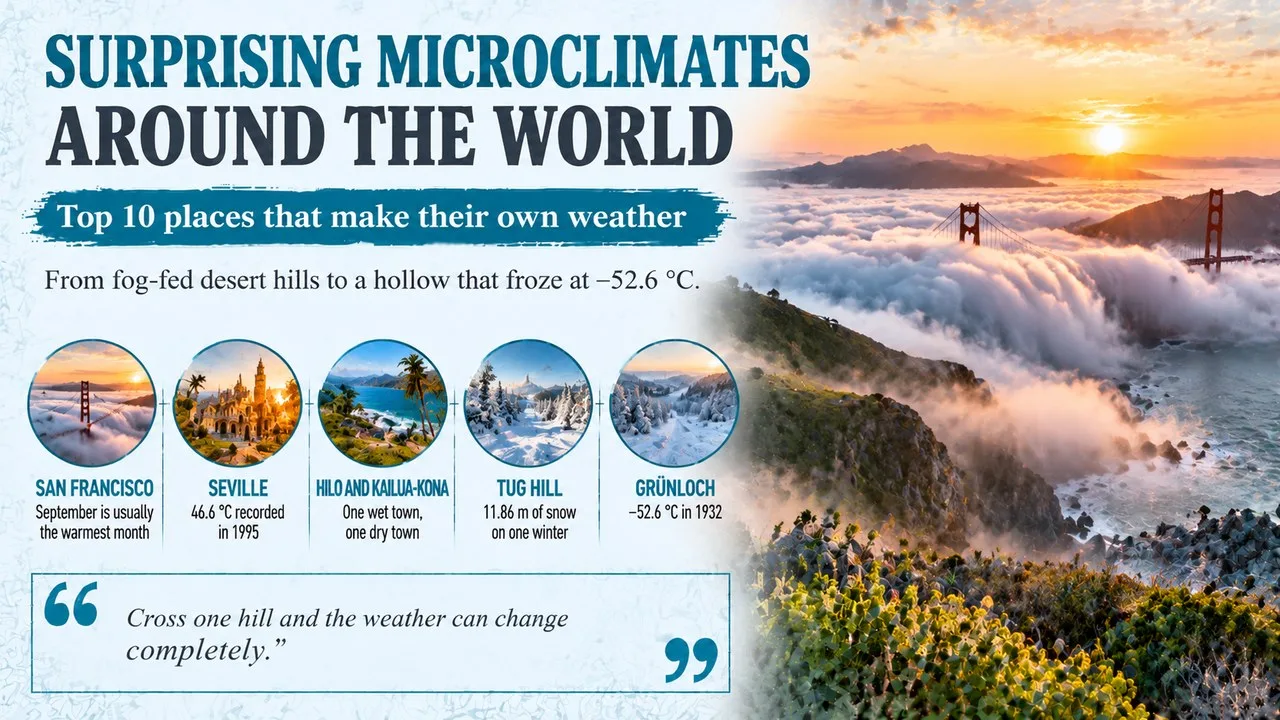
Surprising microclimates around the world include foggy San Francisco, a Scottish garden of exotic plants and an Austrian sinkhole that fell to −52.6 °C.
This Finepedia guide, written in October 2026, looks at 10 places where the weather behaves very differently from the land around them, from fog-fed desert hills in Peru to a snowbelt in New York State. The facts come from national weather services, heritage bodies and encyclopaedias. Weather records are measured in different ways and some older readings are unofficial, so we say when a figure is an estimate or not part of the official record. If you enjoy weather extremes, you may also like Finepedia's guides to the coldest places in the world and the most breathtaking desert landscapes.
How We Chose These
A microclimate is a small area, from a few metres to a few kilometres across, whose weather stays measurably different from its surroundings. Hills, valleys, the sea, ocean currents and even buildings can all create one. We chose ten well-documented examples that show a wide range of causes, including fog, sea breezes, warm currents, mountain winds, lake snow and trapped cold air. Each entry has a short profile, four key facts and one more note on why it matters or a surprising detail.
The 10 Microclimates at a Glance
| No. | Place | Country | Main cause | Standout fact |
|---|---|---|---|---|
| 1 | San Francisco | United States | Pacific fog | September is usually the warmest month |
| 2 | Lomas fog oases | Peru and Chile | coastal fog | green hills in a near-rainless desert |
| 3 | Sydney | Australia | sea breezes | inner west far hotter than the coast |
| 4 | Seville | Spain | valley heat trap | 46.6 °C recorded in 1995 |
| 5 | Saint Helena | United Kingdom territory | height and trade winds | interior 5 to 6 °C cooler than Jamestown |
| 6 | Hilo and Kailua-Kona | United States | mountain rain shadow | one wet town, one dry town |
| 7 | Inverewe Garden | United Kingdom | warm ocean current | exotic plants further north than Moscow |
| 8 | Calgary | Canada | Chinook winds | winter warm spells that melt snow |
| 9 | Tug Hill | United States | lake-effect snow | 11.86 m of snow in one winter |
| 10 | Grünloch | Austria | trapped cold air | −52.6 °C in 1932 |
1. San Francisco Lives Under a Summer Blanket of Fog
San Francisco is famous for cool, foggy summers, even though nearby inland valleys bake in the heat. As hot air rises over California's interior, it pulls cool, moist air from the Pacific through the Golden Gate strait, and with it come fog and brisk winds. The city's hills then sort that fog unevenly, so some districts stay grey while others a few streets away enjoy sunshine.
Key Facts
- Cause: cool ocean air drawn inland by heat in the valleys
- Warmest month: usually September, not July or August
- Pattern: fog is thinner in the eastern districts
- Contrast: October days are, on average, warmer than July days
Did You Know?
Because summer fog is so common, the warmest weather in San Francisco usually arrives in September and October, once the fog eases. Western districts near the ocean, such as the Sunset, tend to be cooler and greyer than sheltered areas further east.
2. The Lomas of Peru and Chile Are Oases Made of Fog
Along the coast of Peru and northern Chile lies one of the driest deserts on Earth, where many years pass with no rain at all. Yet scattered along it are patches of green hills called lomas, or fog oases. They survive on thick sea fog that rolls in from the cold Pacific and settles on hills close to the shore, watering plants that grow nowhere else.
Key Facts
- Number: about 100 lomas, spread along roughly 2,800 km of coast
- Rainfall: often only 3 to 13 mm a year
- Fog names: Peruvians call it garúa, while Chileans say camanchaca
- Green season: roughly May to November, during the southern winter
Why It Matters
The lomas cover less than 2 percent of the coastal desert but hold many plants found only there, which is why scholars have compared each one to an island of vegetation surrounded by desert. The fog forms because the cold Humboldt Current chills the air above the sea. One of the best places to see a loma is the Lachay National Reserve, about 105 km north of Lima, where the hills turn green in the foggy months.
3. Sydney's Coast and Western Suburbs Feel Like Different Cities
On a hot summer day, people in Sydney's beachside suburbs and those in the western suburbs can experience very different weather. Sea breezes keep the coast relatively mild, but they often fail to reach far inland, where hot air from the Australian interior and dense housing can push temperatures much higher. In late spring and summer, the west can be 6 to 10 °C hotter than the city centre.
Key Facts
- City centre: on average about 15 days a year above 30 °C
- Penrith, in the west: on average about 67 days a year above 30 °C
- Record: 48.9 °C at Penrith on 4 January 2020
- Relief: sudden cool changes called southerly busters
Did You Know?
When Penrith reached 48.9 °C in January 2020, it was briefly hotter than anywhere else on Earth. Sydney's coast is often saved on scorching days by a southerly buster, a sharp change of wind from the south that can bring a sudden fall in temperature, gusty winds and sometimes a dramatic roll of cloud. These changes strike south-eastern Australia's coast around 32 times a year.
4. Seville Sits in the Frying Pan of Spain
Seville, in southern Spain, lies in the broad valley of the Guadalquivir river, which is often called the frying pan of Spain. Far from the cooling sea breezes of the coast, the valley traps hot summer air. As a result, Seville is far hotter in summer than the beaches of the Andalusian coast, and is often described as the hottest large city in Europe.
Key Facts
- Location: the Guadalquivir valley in Andalusia
- Summer: average daytime highs above 36 °C in the hottest months
- Record: 46.6 °C, measured at the city's airport on 23 July 1995
- Nickname of the valley: the frying pan of Spain
Why It Matters
Heat is a serious health risk in Seville, and the city has led the way in warning people about it. In July 2022 it led the world by giving a heatwave its own name, calling it Zoe, as part of a pilot project called proMETEO that links heat forecasts to health risks. Shade from narrow streets, courtyards and canvas awnings stretched over shopping streets has long been part of the way the city copes.
5. Saint Helena Packs Several Climates Into a Small Island
Saint Helena is a remote volcanic island in the South Atlantic, a British overseas territory famous for Napoleon's last years of exile. Although it covers only about 122 square kilometres, its weather changes sharply from one side to the other. The steep, rugged ground means that the capital and the high interior feel like two different places.
Key Facts
- Area: about 122 square kilometres
- Jamestown summer: about 21 to 28 °C
- Interior: on average about 5 to 6 °C cooler than Jamestown
- Rain: very low in Jamestown, but 750 to 1,000 mm a year on high ground
Did You Know?
Jamestown sits in a narrow valley on the sheltered north coast, so it stays warm, sunny and dry. The high central areas and the south coast, facing the almost constant trade winds, are cloudier and much wetter. Napoleon's home at Longwood was in the damp, breezy uplands, and the island keeps weather stations at Longwood and at Blue Hill.
6. Hilo and Kailua-Kona Share an Island but Not a Climate
On the Big Island of Hawaii, two towns show how much a mountain can change the weather. Hilo, on the east coast, faces the moist trade winds, which shed their rain as they rise over the land. Kailua-Kona, on the west coast, lies in the shelter of the Hualālai volcano and the higher peaks beyond, so it stays sunny and dry.
Key Facts
- Hilo rainfall: about 3,220 mm a year at the airport
- Rain days in Hilo: about 272 a year
- Kailua-Kona rainfall: about 481 mm a year
- Kona record: on average the warmest spot in the whole country in January
Why It Matters
This contrast is known as a rain shadow. Hilo ranks as one of the wettest cities in the United States, and parts of upper Hilo get more than 5,000 mm a year. The dry, sunny Kona coast, meanwhile, is a magnet for beach holidays. Hawaii's mountains create many such contrasts, with lush rainforest and near-desert sometimes only a short drive apart.
7. Inverewe Garden Grows Exotic Plants in the Scottish Highlands
Inverewe Garden sits on a sheltered loch in Wester Ross, on the north-west coast of Scotland, further north than Moscow. In 1862 Osgood Mackenzie began turning this barren, windswept land into a garden, first planting belts of trees to break the wind. Today it holds more than 2,500 exotic plants from around the world.
Key Facts
- Founded: 1862, by Osgood Mackenzie
- Plants: over 2,500 exotic species and varieties
- Owner: the National Trust for Scotland, from 1952
- Helper: the warm waters of the Gulf Stream and North Atlantic current
Why It Matters
Warm water carried across the Atlantic by the Gulf Stream keeps winters on this coast unusually mild for its latitude. Combined with the shelter of the trees, that allows plants from much warmer places to thrive in the Highlands. Mackenzie's daughter Mairi Sawyer carried on his work and in 1952 handed the garden to the National Trust for Scotland, which still cares for it.
8. Calgary's Chinook Winds Bring Sudden Winter Thaws
Calgary, near the Rocky Mountains in Alberta, has long, cold winters, but they are often broken by spells of startling warmth. These come from Chinook winds, dry westerly winds that warm up as they rush down the eastern slopes of the Rockies. A Chinook can raise the temperature by many degrees within hours and melt snow so fast that the Blackfoot people call it the snow eater.
Key Facts
- Cause: warm, dry wind sweeping down from the Rocky Mountains
- Nickname: the snow eater
- Calgary in January: average daily temperature about −7.6 °C
- Nearby record: Claresholm, Alberta, reached 24 °C on 27 February 1992
Did You Know?
Chinooks have set some astonishing records. At Spearfish, in South Dakota, the temperature rose from −20 °C to 7 °C in just two minutes on 22 January 1943, according to the US National Weather Service. When Calgary hosted the 1988 Winter Olympics, its speed skating oval was fully enclosed, partly to protect the ice from both bitter cold and melting Chinooks.
9. Tug Hill Is Buried by Lake-Effect Snow
Tug Hill is an upland area in northern New York State, just east of Lake Ontario. In winter, freezing winds blow across the lake's open water, pick up moisture and warmth, and then dump it as heavy snow when they reach the rising ground. The result is one of the snowiest places in the eastern United States.
Key Facts
- Location: east of Lake Ontario, in northern New York State
- Average snowfall: more than 5 m in a typical winter
- One winter: 11.86 m at Hooker, in 1976 to 1977, a state record
- One day: 2 m at Montague in January 1997, an unofficial state record
Why It Matters
Lake-effect snow can fall in narrow bands, so one town may be buried while another a few kilometres away sees little. The Great Lakes create several of these snowbelts, and similar effects occur near other large lakes and seas, such as the coasts of northern Japan. The National Weather Service office in Buffalo issues special warnings for these intense, very local storms.
10. The Grünloch Sinkhole Is a Trap for Freezing Air
The Grünloch is a large hollow, or doline, on a high limestone plateau in the Alps of Lower Austria, about 1,270 m above sea level. It is around 500 m across, with a floor only about 100 m wide. On calm, clear nights, cold air slides down its slopes and pools at the bottom, where it cannot escape, making the hollow far colder than the hills around it.
Key Facts
- Location: Dürrenstein plateau, near Lunz am See, Lower Austria
- Lowest reading: −52.6 °C, measured in February or March 1932
- Recent reading: −47.1 °C on 25 December 2003
- Status: often called the cold pole of Central Europe
Did You Know?
The 1932 reading was taken at some point between 19 February and 4 March, so the exact night is not known. It is not part of Austria's official national record, which was set at a regular weather station and is much milder. The cold is so harsh that the plants on the floor resemble tundra, surviving only where winter snow covers and insulates them. Hollows like this are known as frost hollows.
Frequently Asked Questions
What is a microclimate?
A microclimate is the climate of a small area, usually from a few metres to a few kilometres across, that differs in a lasting, measurable way from its surroundings. It can be warmer, colder, wetter, drier or windier.
What causes a microclimate?
The shape of the land, nearby water, ocean currents, winds and the materials covering the ground all play a part. Cities can create their own microclimates too, because concrete and asphalt soak up heat by day and release it at night.
Conclusion
From fog-fed hills in a desert to a hollow where the air froze to more than −50 °C, these ten places show how local the weather can be. Mountains, coasts, lakes and currents can turn a short journey into a trip between climates. For more weather wonders, read Finepedia's guides to the coldest places in the world and the most breathtaking desert landscapes.
- US National Weather Service, Rapid City office, The Black Hills Chinook of January 22, 1943, weather.gov.
- US National Weather Service, Buffalo office, Lake effect snow, weather.gov.
- National Trust for Scotland, Inverewe, nts.org.uk.
- Saint Helena Island Info, Climate, sainthelenaisland.info.
- Reuters, In world's first, Spain's Seville to name and classify heatwaves, 22 June 2022.
- Wikipedia (accessed October 2026), articles on Microclimate, San Francisco, Lomas, Lachay National Reserve, Climate of Sydney, Southerly buster, Seville, Saint Helena, Hilo, Kailua-Kona, Inverewe Garden, Chinook wind, Calgary, Lake-effect snow and Tug Hill.
- German Wikipedia (accessed October 2026), article on Grünloch.
- 10 Most Today, 10 Fascinating Microclimates Around the World, 10mosttoday.com (topic reference).













Log in with