







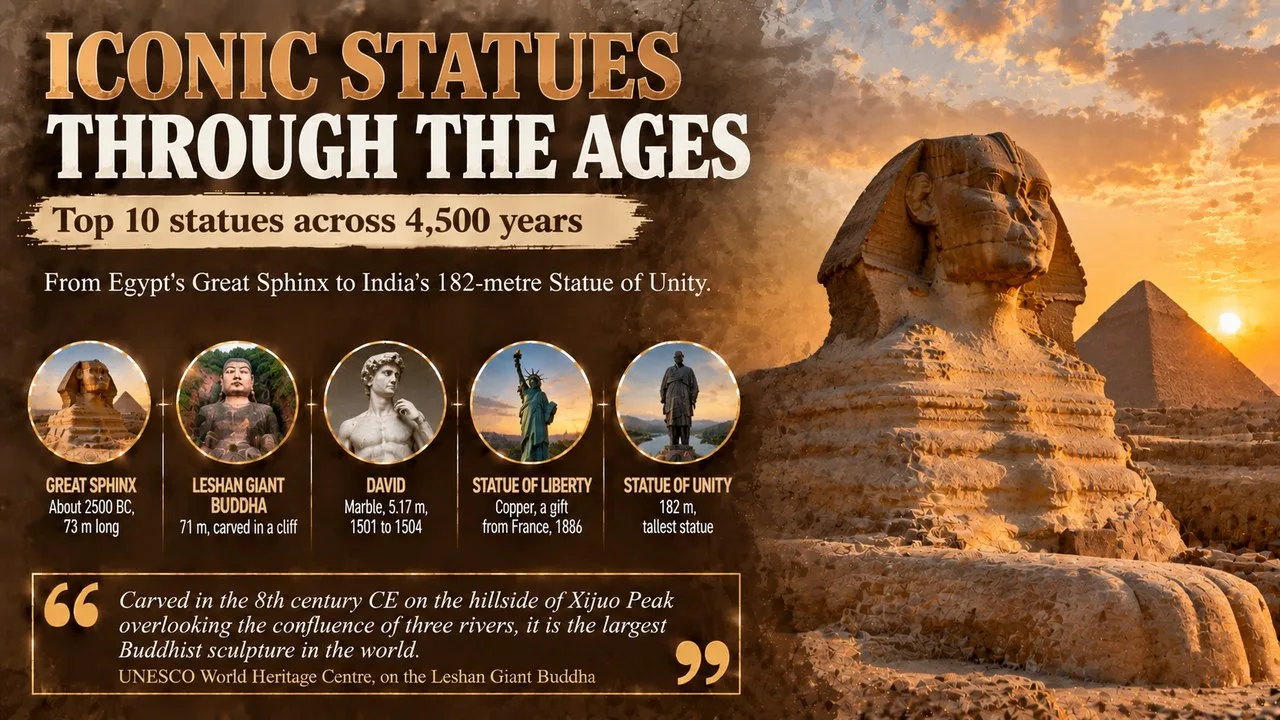
Iconic statues through the ages range from Egypt's Great Sphinx and Michelangelo's David to the Statue of Liberty and India's 182-metre Statue of Unity.
This Finepedia guide, written in October 2026, looks at 10 of the most famous statues on Earth, from ancient stone giants to modern bronze and concrete. The facts come from UNESCO, museum and park authorities and encyclopaedias, and where experts disagree about who made a statue or when, we say so. Heights are given as officially reported. If you enjoy great landmarks, you may also like Finepedia's guides to famous obelisks around the world and the oldest surviving buildings on Earth.
How We Chose These
We picked ten statues that are famous across the world, chosen to cover more than 4,500 years and every inhabited continent we could. They include carvings cut straight from rock, figures moved across islands, Renaissance marble and modern record breakers. The list runs roughly in date order, from the oldest to the newest. For each one you will find a short profile, four key facts and one more note on why it matters or a surprising detail.
The 10 Statues at a Glance
| No. | Statue | Location | Made | Size or material |
|---|---|---|---|---|
| 1 | Great Sphinx of Giza | Egypt | about 2500 BC | 73 m long, 20 m high |
| 2 | Olmec colossal heads | Mexico | by about 900 BC | basalt, up to 3.4 m |
| 3 | Leshan Giant Buddha | China | AD 713 to 803 | 71 m, carved in a cliff |
| 4 | Moai | Easter Island (Chile) | about 1250 to 1500 | volcanic tuff, up to about 10 m erected |
| 5 | David | Florence, Italy | 1501 to 1504 | marble, 5.17 m |
| 6 | Statue of Liberty | New York, US | 1886 | copper, 46 m statue |
| 7 | The Thinker | Paris, France | first large bronze 1904 | bronze, about 1.85 m |
| 8 | The Little Mermaid | Copenhagen, Denmark | 1913 | bronze, 1.25 m |
| 9 | Christ the Redeemer | Rio, Brazil | 1922 to 1931 | concrete and soapstone, 30 m |
| 10 | Statue of Unity | Gujarat, India | 2018 | 182 m, tallest statue |
1. The Great Sphinx Guards the Pyramids of Giza
The Great Sphinx of Giza is a huge creature with the body of a lion and the head of a man, carved from the natural limestone of the Giza Plateau in Egypt. It is about 73 metres long and 20 metres high, and it gazes eastward. No older large-scale sculpture is known from Egypt.
Key Facts
- Location: Giza Plateau, Egypt
- Made: Old Kingdom, around 2500 BC
- Size: about 73 m long and 20 m high
- World Heritage: part of the Memphis and its Necropolis site
Did You Know?
Most experts think the Sphinx was carved in the reign of the pharaoh Khafre, or possibly his father Khufu, and that its face shows one of the kings, though there is no agreement on which. Its missing nose was not shot off by Napoleon's soldiers, as is often claimed. Studies of the face show it was deliberately removed with tools, long before 1798. Over the centuries, drifting sand has covered the Sphinx as high as its neck more than once, and it has been dug out and repaired again and again, from ancient Egyptian times to modern restorations.
2. The Olmec Colossal Heads Are Portraits in Basalt
The Olmec colossal heads are giant carved stone heads made by the Olmec, one of the earliest civilisations of Mesoamerica, in the lowlands beside the Gulf of Mexico. They date from at least 900 BC and range from about 1.2 to 3.4 metres high. Each wears its own headdress, and many experts believe they are portraits of powerful rulers rather than gods.
Key Facts
- Location: Veracruz and Tabasco, Mexico
- Made: by at least 900 BC
- Height: about 1.2 to 3.4 m
- Number known: 17
Why It Matters
The basalt boulders came from the Tuxtlas mountains, and some were moved more than 150 kilometres to Olmec centres such as San Lorenzo and La Venta. The heaviest weigh dozens of tonnes, so moving them without wheels or large animals was an enormous task. The first head was found in 1862 at Tres Zapotes. Two San Lorenzo heads were re-carved from even older stone thrones, which suggests that the Olmec sometimes reused monuments when a new ruler came to power. Several of the heads can now be seen in museums in Xalapa and Villahermosa.
3. The Leshan Giant Buddha Is Carved Into a Riverside Cliff
The Leshan Giant Buddha sits in a sandstone cliff where the Min and Dadu rivers meet, near the city of Leshan in Sichuan, China. It is 71 metres tall, making it the largest stone Buddha in the world and by far the tallest statue made before modern times. The seated Buddha looks out across the water towards the sacred Mount Emei. Its shoulders are about 28 metres wide, and visitors can walk down a steep stairway cut into the cliff beside it, or view the whole figure from a tourist boat on the river.
Key Facts
- Location: Leshan, Sichuan Province, China
- Built: AD 713 to 803, in the Tang dynasty
- Height: 71 m
- World Heritage: with Mount Emei, since 1996
Did You Know?
Work began under a monk named Haitong, who hoped the Buddha would calm the dangerous currents that wrecked boats on the rivers. Legend says that when the money ran short, he blinded himself to prove how sincere he was. His followers finished the statue some 90 years after it was begun. Its smallest toenail is said to be big enough for a person to sit on, and hidden channels in its hair and robes still carry rainwater away to protect the stone.
4. The Moai Watch Over Easter Island
The moai are large stone figures that the Rapa Nui people of Easter Island carved in the eastern Pacific, between about 1250 and 1500. More than 900 are known. Most were carved at the Rano Raraku quarry, and hundreds were hauled across the island to stand on stone platforms known as ahu.
Key Facts
- Location: Easter Island (Rapa Nui), Chile
- Made: about 1250 to 1500
- Number: more than 900
- Tallest erected: Paro, almost 10 m and about 82 tonnes
Why It Matters
The moai are thought to show deified ancestors, and most stood facing inland over their clans' lands. Their heads are huge, about three-eighths of the whole figure. By the late 19th century every standing moai had been toppled, and many have since been raised again. One unfinished figure at the quarry would have stood about 21 metres tall.
5. Michelangelo's David Became a Symbol of Florence
David is a marble statue of the biblical hero, carved by Michelangelo between 1501 and 1504. At 5.17 metres tall, it was the first colossal marble statue of the High Renaissance. It was first meant to stand high on Florence Cathedral, but it was placed instead in the Piazza della Signoria, the city's political heart, and unveiled on 8 September 1504.
Key Facts
- Artist: Michelangelo
- Made: 1501 to 1504
- Height: 5.17 m
- Today: Galleria dell'Accademia, Florence, since 1873
Did You Know?
The block of marble had been cut decades earlier and partly worked by another sculptor, Agostino di Duccio, then left unused for years. Michelangelo was in his mid-20s when he took it on. The statue shows David before his fight with Goliath, tense and alert, rather than after his victory as earlier artists had done. The statue came to stand for the defence of Florence's freedom, and a copy has stood in its original place since 1910.
6. The Statue of Liberty Was a Gift From France
The Statue of Liberty stands on Liberty Island in New York Harbor. It was paid for by the French people as a present to America, designed by the sculptor Frédéric Auguste Bartholdi, with an iron frame built by Gustave Eiffel. It was dedicated on 28 October 1886.
Key Facts
- Location: Liberty Island, New York
- Dedicated: 28 October 1886
- Statue height: about 46 m
- Material: copper skin over an iron frame
Why It Matters
Lady Liberty holds a torch in her right hand and a tablet marked 4 July 1776 in her left, while a broken chain lies at her feet. For millions of immigrants arriving by sea, she was their first sight of America. A poem by Emma Lazarus, written to raise money for the pedestal, is now mounted inside it. The copper has turned green with age, a natural coating that now protects the metal underneath. Since 1933 the monument has been looked after by the US National Park Service. Including its pedestal and foundation, the monument rises about 93 metres above the ground, and visitors can climb up into the crown.
7. Rodin's The Thinker Is the Symbol of Deep Thought
The Thinker is a bronze figure by the French sculptor Auguste Rodin of a man seated on a rock, chin resting on his hand, lost in thought. Rodin first made it as part of The Gates of Hell, a project commissioned for a planned museum of decorative arts in Paris, a huge doorway inspired by Dante's Divine Comedy, which he began in 1880. The first of the large bronze casts was made in 1904, and it now sits in the garden of the Musée Rodin, the sculptor's museum in Paris.
Key Facts
- Artist: Auguste Rodin
- Original name: The Poet
- First large bronze: 1904
- Height: about 1.85 m
Did You Know?
At first, the figure was meant to show Dante himself, looking down on the circles of the poem. More than 20 other full-sized bronze casts now exist in different countries, some of them made after Rodin's death, and the pose has become a worldwide image for philosophy.
8. The Little Mermaid Is Copenhagen's Small Icon
Edvard Eriksen's bronze Little Mermaid sits on a waterside rock beside the Langelinie promenade in Copenhagen. It shows the mermaid from Hans Christian Andersen's 1837 fairy tale, at the moment she is becoming human. It is only 1.25 metres tall, yet it has drawn crowds of tourists since 1913.
Key Facts
- Location: Langelinie, Copenhagen
- Sculptor: Edvard Eriksen
- Unveiled: 1913
- Height: 1.25 m
Did You Know?
The statue was paid for by Carl Jacobsen of the Carlsberg brewing family, who had loved a ballet of the story. The ballerina Ellen Price was asked to model but would not pose nude, so the sculptor's wife, Eline, modelled for the figure instead. The statue has been vandalised many times, and in 1964 its head was sawn off and never found, so a new one had to be made.
9. Christ the Redeemer Spreads Its Arms Over Rio
Christ the Redeemer is a figure of Jesus in Art Deco style on the summit of Corcovado mountain in Rio de Janeiro. Paul Landowski, a French sculptor, designed it, and the engineer Heitor da Silva Costa of Brazil led the building work, with the face sculpted by Gheorghe Leonida. It was built from 1922 to 1931 and opened on 12 October 1931.
Key Facts
- Location: Corcovado, Rio de Janeiro
- Built: 1922 to 1931
- Height: 30 m, plus an 8 m pedestal
- Arm span: about 28 m
Why It Matters
The statue is made of reinforced concrete covered in a mosaic of soapstone tiles and weighs about 635 tonnes. Its open arms have become a symbol of Rio and of Brazil, and the summit at around 700 metres gives wide views over the city, Sugarloaf Mountain and the bay, and in 2007 a worldwide public vote named it among the New Seven Wonders. Because it stands so high, it is often struck by lightning, and its rods and stone surface are regularly repaired.
10. India's Statue of Unity Towers Over Every Rival
India's Statue of Unity stands beside the Narmada River near Kevadia in Gujarat, India. It shows Sardar Vallabhbhai Patel, India's first deputy prime minister, who helped unite hundreds of princely states into the new country after independence. At 182 metres, it is the tallest statue in the world.
Key Facts
- Location: near Kevadia, Gujarat, India
- Unveiled: 31 October 2018
- Height: 182 m
- Sculptor: Ram V. Sutar
Did You Know?
The statue has a concrete and steel core clad in bronze plates weighing around 1,700 tonnes. Part of the iron for its foundations came from old farm tools and scrap collected from villages across India. It faces the Sardar Sarovar Dam and has a viewing gallery high up in the figure. Building began in October 2013 and cost about US$422 million, and it was opened on 31 October 2018, the 143rd anniversary of Patel's birth.
Frequently Asked Questions
What is the tallest statue in the world?
India's Statue of Unity holds the record, at 182 metres. Before it was finished in 2018, the record belonged to the Spring Temple Buddha in Henan, China.
What is the oldest famous statue in the world?
Among the statues in this list, the Great Sphinx of Giza is the oldest, carved about 4,500 years ago. Much older small figures exist, such as prehistoric carved figurines, but they are not monumental statues.
Conclusion
From the Sphinx in the desert to a giant bronze figure in India, these ten statues show how people have used stone and metal to honour gods, rulers, heroes and ideas. Each has become a symbol of its place and draws visitors from around the world. For more great landmarks, read Finepedia's guides to famous obelisks around the world and the oldest surviving buildings on Earth.
- UNESCO World Heritage Centre, Memphis and its Necropolis, whc.unesco.org/en/list/86.
- UNESCO World Heritage Centre, Mount Emei Scenic Area, including Leshan Giant Buddha Scenic Area, whc.unesco.org/en/list/779.
- UNESCO World Heritage Centre, Rapa Nui National Park, whc.unesco.org/en/list/715.
- US National Park Service, Statue of Liberty National Monument.
- Galleria dell'Accademia di Firenze, Michelangelo's David.
- Musée Rodin, The Thinker.
- Wikipedia (accessed October 2026), articles on the Great Sphinx of Giza, Olmec colossal heads, Leshan Giant Buddha, Moai, David (Michelangelo), Statue of Liberty, The Thinker, The Little Mermaid (statue), Christ the Redeemer (statue) and Statue of Unity.
- 10 Most Today, 10 Most Famous Statues in the World, 10mosttoday.com (topic reference).

















Log in with