






 By
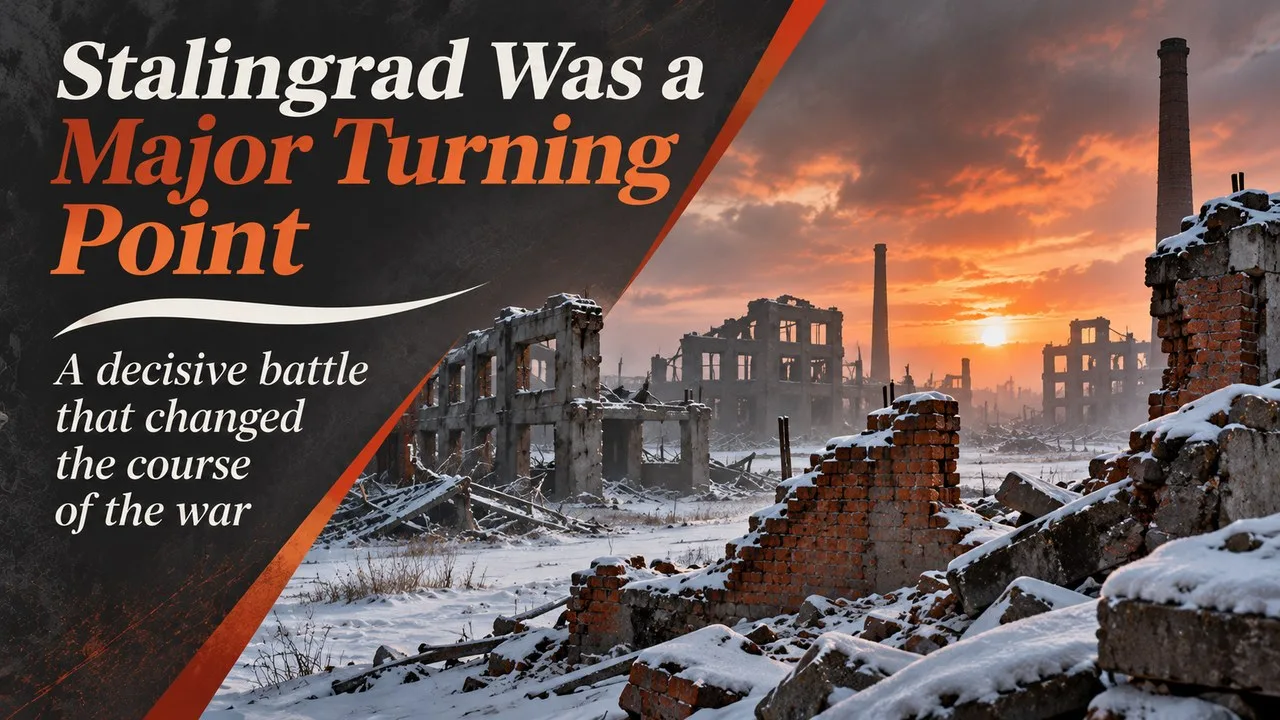
Stalingrad was a major turning point: from mid-1942 to February 1943 the Red Army stopped Germany's drive to the Volga and destroyed the Sixth Army.[1][2]
This Finepedia guide, updated in November 2026, follows the Battle of Stalingrad from the German summer offensive through the street fighting, the Soviet encirclement and the surrender, and explains why the sources give such different casualty figures. It is number 16 in Top 20 World War II Facts: Little-Known Details.
Key Facts
| Attribute | Detail |
|---|---|
| Dates | 17 July 1942 (first clashes) or 23 August 1942 (assault on the city) to 2 February 1943 |
| Place | Stalingrad, now Volgograd, on the Volga River in southern Russia |
| Main commanders | Friedrich Paulus (German Sixth Army); Vasily Chuikov (Soviet 62nd Army); Georgy Zhukov and Aleksandr Vasilevsky (counter-offensive) |
| Turning point | Operation Uranus, launched 19 November 1942 |
| Germans captured | About 91,000 (Britannica, IWM, Wikipedia); History.com says nearly 100,000 |
| Axis losses | Over 800,000 (Britannica) or about 850,000 (National Army Museum); Wikipedia gives 800,000 to 1.5 million |
| Soviet losses | About 1.1 million (Britannica, Wikipedia citing Krivosheev) |
| Result | Destruction of the German Sixth Army; Germany never regained the initiative in the south |
Sources: Britannica, Imperial War Museums (IWM), Wikipedia, History.com and the National Army Museum.[1][2][3][4][5]
Why Germany Went to Stalingrad
Having failed to capture Moscow during the winter campaign of 1941–42, Hitler shifted his main effort south in 1942. The aim was to destroy the remaining Soviet forces there and seize the oilfields of the Caucasus.[2][1]
A City on the Volga
Stalingrad stretched for about 50 km (30 miles) beside the Volga. It was a major industrial centre, making tractors and weapons, and the river was a key shipping route between western and eastern Russia.[1][4] Taking it would cut Soviet links with the south and protect the northern flank of the drive to the Caucasus.[1][3]
A Name That Mattered
The city bore Stalin's name, which gave it great propaganda value for both sides. Britannica calls it a potential personal and propaganda triumph for Hitler, and History.com notes that the Soviets felt a special need to hold it for the same reason.[1][4]
Operation Blue
The offensive, Case Blue (Fall Blau in German), began on 28 June 1942 with quick German gains.[1][3] On 9 July Hitler changed the plan, ordering Stalingrad and the Caucasus to be taken at the same time and splitting Army Group South in two. Britannica argues that this division strained German supply lines and opened a gap between the two groups.[1]
The Assault on the City
Historians disagree on when the battle began. Britannica and Wikipedia note that the first fighting with the Soviet Stalingrad Front took place far outside the city on 17 July 1942. Wikipedia says the most common start date is 23 August, the day the German Sixth Army reached the city, and History.com also dates the assault from 23 August.[1][3][4]
"Not One Step Back"
On 28 July Stalin issued Order No. 227, demanding that Soviet forces give up no more ground.[1][4] He also refused to evacuate civilians, believing the troops would fight harder for them. History.com says the city had more than 400,000 residents.[1][4]
The Bombing of 23 August
On 23 August the Sixth Army struck the northern suburbs while the Luftwaffe bombed the city heavily, reducing much of it to rubble.[1][3] Wikipedia calls it the heaviest air raid yet seen in the East.[3] History.com notes that the number of civilians killed in the raids is unknown but believed to be in the tens of thousands.[4]
Street Fighting
The Soviet 62nd Army under General Vasily Chuikov fought for every street, factory and house. By mid-September the defenders held only a narrow strip along the river, about 15 km (9 miles) long and 3 to 5 km wide, supplied by boats crossing the Volga.[1][2] Snipers, small assault groups and hand-to-hand fighting in cellars and factories marked the battle.[4][3] By October the Germans controlled most of Stalingrad, yet the Soviets still held on along the river bank.[2][1]
Related: Germany's Invasion of Poland Began the War in Europe
Pavlov's House
One of the best-known episodes was the defence of a single apartment block, later called Pavlov's House, by a small group under Sergeant Yakov Pavlov. Wikipedia records Chuikov's claim that its defenders killed more Germans than the enemy had lost in taking Paris.[3] The ruin is now part of the memorial complex in Volgograd.[3]
Operation Uranus
While the Germans were drawn into the city, Zhukov and Vasilevsky built up fresh Soviet forces on both sides of it.[1][2][4]
Striking the Flanks
On 19 November 1942 the Soviets launched Operation Uranus. Instead of attacking the strong German forces in the city, they hit the long flanks, which were held by weaker Romanian, Hungarian and Italian armies on the open steppe.[1][3] The two pincers met at Kalach, about 100 km (60 miles) west of the city, on 23 November.[1]
How Many Were Trapped
Estimates of the trapped force differ. Britannica speaks of about 250,000 men of the Sixth Army and Fourth Panzer Army, History.com of nearly 300,000 trapped soldiers, and Wikipedia of about 330,000 Axis soldiers, including Romanians, Italians, Croatians and tens of thousands of Soviet auxiliaries.[1][4][3]
The Pocket
Hitler forbade a breakout and ordered the trapped army to hold the Volga line.[2][1]
The Failed Airlift
Hitler promised that the Luftwaffe would keep the Sixth Army supplied from the air. Wikipedia says the airlift averaged only about 105 tons a day against the 750 tons needed, and the Luftwaffe lost nearly 500 aircraft trying.[3][1]
Manstein's Relief Attempt
In December Field Marshal Erich von Manstein tried to fight his way through to the pocket in Operation Winter Storm, but Hitler would not let Paulus break out to meet him, and the attempt failed.[1][3] A new Soviet offensive further west, Operation Little Saturn, smashed the mostly Italian forces there and ended hopes of relief.[4][1]
Related: Midway Turned the Tide in the Pacific
Surrender
The final Soviet attack, Operation Ring, began on 10 January 1943.[1] Hitler promoted Paulus to field marshal, reminding him that no German field marshal had ever surrendered, but on 31 January Paulus gave himself up.[1][3] The last German troops in the northern pocket surrendered on 2 February.[1][5] About 91,000 Germans were taken prisoner, and only some 5,000 to 6,000 ever returned home, the last in 1955.[1][2][3]
Counting the Cost
Stalingrad is often called the bloodiest battle of the war, but its toll is hard to fix. History.com speaks of nearly two million people killed or wounded on both sides.[4]
Axis Losses
Britannica puts total Axis losses, counting Romanians, Italians and Hungarians as well as Germans, at more than 800,000 killed, wounded, captured or missing. The National Army Museum gives about 850,000.[1][5] Wikipedia's range runs from 800,000 to 1.5 million.[3] IWM gives German losses for the whole campaign as 500,000 men, including 91,000 prisoners.[2]
Soviet and Civilian Losses
Britannica and Wikipedia, citing the Russian historian Grigori Krivosheev, give about 1.1 million Soviet casualties. Wikipedia also cites a higher estimate of about 1.35 million.[1][3] Britannica estimates 40,000 civilian deaths, while History.com speaks only of tens of thousands of civilian dead.[1][4] Wikipedia reports a much wider range: incomplete records from the Volgograd party archive list 42,754 city residents killed, while the Russian historian Tatyana Pavlova has estimated about 235,000 civilian deaths, including the surrounding countryside.[3]
The Fate of the Prisoners
Most of the men captured at Stalingrad did not survive captivity. Weakened by hunger, cold and disease during the encirclement, they were marched to prison camps and later sent to labour camps across the USSR, where most died.[3][1][4] Wikipedia records that the last survivors were sent home only in 1955, after a request from the West German chancellor Konrad Adenauer.[3]
Germany's Allies
The Romanian, Italian and Hungarian armies on the flanks also suffered heavily. Wikipedia quotes the historian Stephen Walsh, who puts their combined losses at about 494,000, including about 159,000 Romanians, 115,000 Italians and 143,000 Hungarians.[3] Britannica likewise counts these allies in its Axis total of more than 800,000.[1]
Why It Was a Turning Point
Britannica describes Stalingrad as the battle that stopped the German advance in the East and turned the tide in the Allies' favour, and Britannica adds that most historians rank it as the war's greatest battle.[1][3] The National Army Museum says the Axis never recovered from the defeat.[5]
Related: The Eastern Front Was the Largest Theatre of the War
A Shock in Germany
History.com says it was the first defeat Hitler publicly acknowledged.[4] The National WWII Museum notes that the regime feared the news would damage morale at home, while opponents of the Nazis drew hope from it. In Munich, the White Rose resistance group referred to Stalingrad in its sixth and final leaflet, shortly before its leaders were arrested.[6]
From Defence to Offence
The Sixth Army had been wiped out and Army Group B driven back in disorder. From early 1943 the initiative on the southern front lay with the Red Army.[3][1]
Hero City and Memorial
In 1945 Stalingrad was named a Hero City.[1] A vast memorial complex on Mamayev Kurgan, the hill that dominated the battlefield, was completed in 1967. Its centrepiece, The Motherland Calls, is a 52-metre statue of a woman raising a sword.[1][3] Wikipedia notes that the memorial also includes the ruins of a grain silo and Pavlov's House.[3]
Comparison: German and Soviet Positions
| Aspect | Germany and its allies | USSR |
|---|---|---|
| Aim | Take the city, cut the Volga and cover the Caucasus drive | Hold the city at all costs |
| Key order | Hitler: no breakout from the pocket | Stalin: Order No. 227, "Not one step back" |
| Weak point | Flanks held by Romanian, Hungarian and Italian armies | Narrow river-bank foothold in the city |
| Supply | Airlift of about 105 tons a day against 750 needed | Boats and later ice crossings over the Volga |
| Casualty estimates | 800,000 to 1.5 million (all Axis) | About 1.1 to 1.35 million |
| Outcome | Sixth Army destroyed; about 91,000 captured | Strategic initiative in the south |
Sources: Britannica, Wikipedia, IWM and History.com.[1][3][2][4]
Timeline
| Date | Event |
|---|---|
| 28 June 1942 | German summer offensive (Case Blue) begins |
| 17 July 1942 | First fighting far outside Stalingrad |
| 28 July 1942 | Stalin's Order No. 227 |
| 23 August 1942 | Sixth Army reaches the city; heavy Luftwaffe raid |
| 14 October 1942 | Defenders pushed close to the Volga |
| 19 November 1942 | Operation Uranus begins |
| 23 November 1942 | Encirclement completed at Kalach |
| December 1942 | Manstein's relief attempt fails; Operation Little Saturn |
| 10 January 1943 | Operation Ring begins |
| 31 January 1943 | Paulus surrenders |
| 2 February 1943 | Last German troops surrender |
Sources: Britannica and Wikipedia.[1][3]
Key Figures
- About 50 km: how far the city stretched beside the Volga.[1][4]
- 19 November 1942: start of Operation Uranus.[1][2]
- About 105 tons: daily airlift deliveries, against 750 tons needed.[3]
- About 91,000: Germans taken prisoner.[1][2][3]
- 5,000 to 6,000: prisoners who returned home.[1][3]
- About 1.1 million: Soviet casualties, using Krivosheev's figure.[1][3]
Common Misconceptions
One misconception is that the Germans never took most of Stalingrad. By October the Germans controlled most of Stalingrad, and the Soviet defenders were confined to a strip along the river bank.[2][1]
Another is that the battle was won by the defenders in the city alone. The decisive blow came from outside, when Operation Uranus struck the weakly held flanks and encircled the German force.[1][3]
A third is that the casualty figures are settled. The sources differ by hundreds of thousands, depending on who is counted and how.[1][3][5]
Frequently Asked Questions
When did the Battle of Stalingrad take place?
From summer 1942 to 2 February 1943. Some sources start it on 17 July 1942, others on 23 August.[1][3][4]
Related: Pearl Harbor Did Not Happen in a Vacuum
Who won the Battle of Stalingrad?
The USSR. The Soviet counter-offensive encircled the German Sixth Army, which surrendered.[1][2]
How many soldiers were captured?
About 91,000 Germans surrendered, according to most sources; History.com says nearly 100,000.[1][3][4]
What was Operation Uranus?
The Soviet counter-offensive of 19 November 1942 that attacked the flanks and surrounded the German forces in the city.[1][3]
Why is Stalingrad seen as a turning point?
It destroyed a whole German army, ended the German advance in the south and handed the initiative to the Red Army.[1][5]
Conclusion
Stalingrad began as one objective in a German summer offensive and became a battle that neither side would give up. The Red Army held a strip of the river bank long enough to prepare a counter-blow that trapped the Sixth Army.
The exact toll is still disputed, but the result is not: after February 1943 the German army in the East was on the defensive.[1][3][5]
See all 20 in Top 20 World War II Facts: Little-Known Details
See also
- Top 20 World War II Facts: Little-Known Details
- Top 10 Overlooked Events of World War II
- Top 10 Inventions That Changed Warfare: Chariots to Drones
- ^ [1] "Battle of Stalingrad" (Raymond Limbach). Encyclopaedia Britannica. Britannica
- ^ [2] "What You Need To Know About The Battle Of Stalingrad". Imperial War Museums. IWM
- ^ [3] "Battle of Stalingrad". Wikipedia. Wikipedia
- ^ [4] "Battle of Stalingrad". History.com. History.com
- ^ [5] "End of the Sixth Army. Field Marshal Paulus during his interrogation at Red Army HQ", 1943. National Army Museum, London. National Army Museum
- ^ [6] "Stalingrad and the Growth of the Anti-Nazi Resistance". The National WWII Museum. National WWII Museum

























Discussion
Log in with