






 By
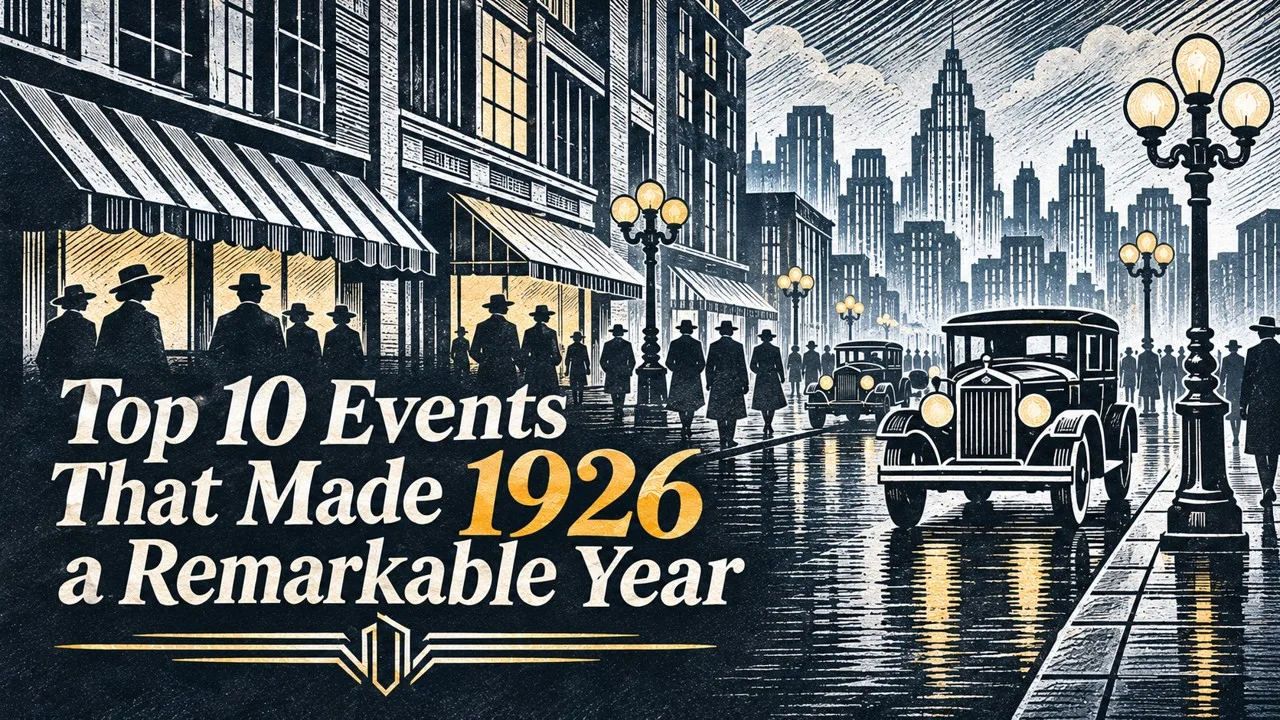
A nine-day strike, a record Channel swim, an airship over the North Pole and a novelist who vanished: ten events that made 1926 remarkable. The year 1926 fell in the middle of the Roaring Twenties, a decade of rapid change. Cars, radio, cinema and aviation were transforming daily life, while many countries were still recovering from the First World War.
It was a year of record-breaking feats and new technologies. People flew over the North Pole, swam the English Channel faster than ever before and heard synchronised sound in a feature film.
It was also a year of social conflict and natural disaster. Britain faced its largest industrial dispute, and a powerful hurricane devastated a booming American city.
Popular culture produced some of its most famous moments. The death of a film idol prompted extraordinary scenes, and a best-selling novelist disappeared in circumstances that are still discussed today.
Political changes in 1926 had lasting effects. The relationship between Britain and its dominions was redefined, and a new imperial era began in Japan.
The events in this list come from Britain, the United States, the Arctic and Japan. They range from sport and entertainment to politics and transport.
Some of these events involved disputed claims or unexplained details. Where historians disagree, that is noted.
Each entry names the event, where it happened and when in 1926, followed by an account of what happened and why it mattered.
The entries are arranged in chronological order.
Together, they offer a snapshot of a world on the move, nearly a century ago.
Many other notable things happened in 1926 that could not fit in this list. The future Queen Elizabeth II was born in London in April. The American rocket pioneer Robert Goddard launched the first liquid-fuelled rocket in March, in a field in Massachusetts. In London, the Scottish inventor John Logie Baird demonstrated his television system to an invited audience in January. The children's book Winnie-the-Pooh by A. A. Milne was published in October, and the escape artist Harry Houdini died on Halloween. Such a crowded year shows how quickly the world was changing.
Key Facts
| # | Event | Place | Date in 1926 |
|---|---|---|---|
| 1 | The General Strike | United Kingdom | 4 to 12 May |
| 2 | Flights to the North Pole | The Arctic | 9 and 12 May |
| 3 | Gertrude Ederle swims the Channel | English Channel | 6 August |
| 4 | The premiere of Don Juan | New York City | 6 August |
| 5 | Rudolph Valentino dies | New York City | 23 August |
| 6 | The Great Miami Hurricane | Florida, United States | 18 September |
| 7 | The Balfour Declaration of 1926 | London | November |
| 8 | Route 66 | United States | 11 November |
| 9 | Agatha Christie's disappearance | England | 3 to 14 December |
| 10 | Hirohito becomes emperor | Japan | 25 December |
1. Britain Comes to a Halt
In 1926, coal mine owners in Britain sought to cut miners' wages and lengthen their hours. The miners refused, and the Trades Union Congress called a general strike in their support [1].
On 4 May, around 1.7 million workers in transport, printing, heavy industry and other sectors stopped work. The government organised volunteers to keep essential services running, and it published its own newspaper while normal papers were disrupted [1].
The strike ended after nine days without achieving its aims. The miners continued their own strike for months before being forced back to work. The following year, Parliament passed a law restricting certain kinds of strikes.
Related: Top 10 Most Bizarre Phobias: Strange Fears That Exist
2. Flying Over the Top of the World
On 9 May 1926, the American aviators Richard Byrd and Floyd Bennett flew from Spitsbergen and claimed to have reached the North Pole. Their claim was celebrated at the time, but later analysis led many historians to doubt that they reached the pole [2].
Three days later, the airship Norge flew from Spitsbergen over the North Pole and on to Alaska. On board were the Norwegian explorer Roald Amundsen, the American Lincoln Ellsworth and the Italian designer and pilot Umberto Nobile, along with a crew [2].
The Norge flight is widely regarded as the first verified journey to the North Pole by air. Because earlier claims to have reached the pole on foot are also disputed, some historians consider it the first undisputed visit to the pole by anyone.
3. The Woman Who Beat the Men's Record
On 6 August 1926, the American swimmer Gertrude Ederle became the first woman to swim across the English Channel. She swam from France to England in about 14 and a half hours [3].
Her time beat the existing record set by men by nearly two hours. She faced rough seas, and at one point her trainer reportedly urged her to give up, but she refused [3].
Ederle returned to the United States as a heroine and was celebrated with a ticker-tape parade in New York City. Her achievement challenged widely held beliefs about women's athletic abilities.
4. Synchronised Sound Comes to the Movies
On the same day as Ederle's swim, the film Don Juan premiered in New York. Produced by Warner Bros. and starring John Barrymore, it was the first feature-length film with a synchronised musical score and sound effects, using a system called Vitaphone [4].
The film did not include spoken dialogue, but the sound was recorded on discs that were synchronised with the projector. The premiere programme also included short films with recorded speeches and musical performances [4].
The success of Vitaphone encouraged Warner Bros. to produce The Jazz Singer in 1927, which included synchronised singing and some spoken lines. Within a few years, silent films had largely given way to sound.
5. The Death of a Screen Idol
Rudolph Valentino was one of the biggest stars of silent cinema, famous for romantic roles in films such as The Sheik. He was idolised by millions of fans [5].
Related: Top 10 Oldest Buildings in the World
In August 1926, he became seriously ill and died in New York at the age of 31. The news caused an outpouring of grief [5].
Huge crowds gathered outside the funeral home where his body lay, and disorder broke out as people tried to see him. Newspapers reported cases of extreme grief among fans, though some reports may have been exaggerated. The scenes became a famous example of the power of film celebrity.
6. A Storm That Ended a Boom
In the early 1920s, Florida experienced a huge real estate boom, and Miami grew rapidly. Many new residents had never experienced a major hurricane [6].
On 18 September 1926, a powerful hurricane struck Miami directly. Many people went outside during the calm eye of the storm, believing it had passed, and were caught when the winds returned [6].
The hurricane killed hundreds of people and caused enormous damage. It helped bring the Florida land boom to an end, and the state's economy suffered a downturn several years before the Great Depression.
7. A New Definition of Empire
At an Imperial Conference in London in 1926, leaders of Britain and its self-governing dominions, including Canada, Australia, New Zealand and South Africa, discussed their relationship [7].
The conference adopted a report, known as the Balfour Declaration, which described Britain and the dominions as autonomous communities within the British Empire, equal in status and not subordinate to one another [7].
The declaration was given legal force by the Statute of Westminster in 1931. It marked an important step in the transformation of the British Empire into the Commonwealth of Nations.
8. The Birth of the Mother Road
On 11 November 1926, a new numbered system of highways was approved in the United States. One of the new routes, designated Route 66, ran from Chicago to Los Angeles [8].
Related: 10 Sikh Gurus: The Pillars of Sikhism Who Shaped Faith, Equality, Courage, and Humanity
Route 66 became one of the most famous roads in the world. During the Dust Bowl of the 1930s, many families migrated west along it, and John Steinbeck called it the mother road in his novel The Grapes of Wrath [8].
The road later became a symbol of American road travel and popular culture. It was officially removed from the highway system in 1985, but many parts survive as historic routes and tourist attractions.
9. The Novelist Who Vanished
In 1926, Agatha Christie published The Murder of Roger Ackroyd, a novel that made her famous. On the evening of 3 December, she disappeared from her home in Berkshire [9].
Her car was found abandoned the next morning near a chalk pit in Surrey. A huge search followed, involving police, volunteers and newspapers. Eleven days later, she was found staying at a hotel in Harrogate, registered under a different name [9].
The reasons for her disappearance have never been fully explained. Her family said she had suffered memory loss, while others have suggested emotional distress over the end of her marriage. Christie herself rarely spoke about it.
10. A New Era in Japan
On 25 December 1926, Emperor Taisho of Japan died, and his son Hirohito became emperor. His reign was given the era name Showa [10].
Hirohito's reign spanned some of the most dramatic events in Japanese history, including militarism, the Second World War, defeat, occupation and the country's post-war economic recovery [10].
He reigned until his death in 1989, making him the longest-reigning monarch in Japanese history. His role during the war years remains a subject of historical debate.
Conclusion
The year 1926 captured many of the forces shaping the modern world. Aviation, sound film and new highways pointed to the future, while strikes and economic changes reflected deep social tensions.
Related: Top 10 Tallest Buildings in the World
Several events from 1926 had long-lasting effects. Sound film transformed entertainment, and the Balfour Declaration helped reshape the British Empire.
The year also produced enduring mysteries and controversies, from Byrd's polar claim to Agatha Christie's disappearance.
The achievements of people like Gertrude Ederle challenged assumptions and inspired others to attempt new feats.
Within a few years, the Great Depression would bring the optimism of the 1920s to an end, and the Miami hurricane offered an early warning of economic fragility.
Historians continue to study 1926 as part of the transformation of the world between the two world wars.
Looking back nearly a century later, 1926 offers a fascinating glimpse of a world that was both very different from ours and recognisably modern.
Newspapers, newsreels and radio broadcasts spread news of these events faster than ever before. For the first time, millions of people in different countries could follow a Channel swim, a polar flight or the search for a missing novelist almost as it happened, helping to create the shared celebrity culture that remains familiar today.
For people living through it, 1926 probably did not feel like a turning point. Daily life went on, with work, family and local concerns taking priority over distant events. Only with hindsight do historians see how many threads of the twentieth century, from mass media to the end of empire, can be traced through this single year.
- ^ [1] Accounts of the General Strike. Wikipedia: 1926 United Kingdom general strike Wikipedia: Trades Union Congress
- ^ [2] Accounts of the polar flights. Wikipedia: Norge (airship) Wikipedia: Richard E. Byrd
- ^ [3] Accounts of Gertrude Ederle. Wikipedia: Gertrude Ederle Wikipedia: English Channel
- ^ [4] Accounts of Don Juan. Wikipedia: Don Juan (1926 film) Wikipedia: Vitaphone
- ^ [5] Accounts of Rudolph Valentino. Wikipedia: Rudolph Valentino Wikipedia: The Sheik (film)
- ^ [6] Accounts of the Miami hurricane. Wikipedia: 1926 Miami hurricane Wikipedia: Florida land boom of the 1920s
- ^ [7] Accounts of the Balfour Declaration. Wikipedia: Balfour Declaration of 1926 Wikipedia: Statute of Westminster 1931
- ^ [8] Accounts of Route 66. Wikipedia: U.S. Route 66 Wikipedia: The Grapes of Wrath
- ^ [9] Accounts of Agatha Christie. Wikipedia: Agatha Christie Wikipedia: The Murder of Roger Ackroyd
- ^ [10] Accounts of Hirohito. Wikipedia: Hirohito Wikipedia: Showa era























Discussion
Log in with