






 By
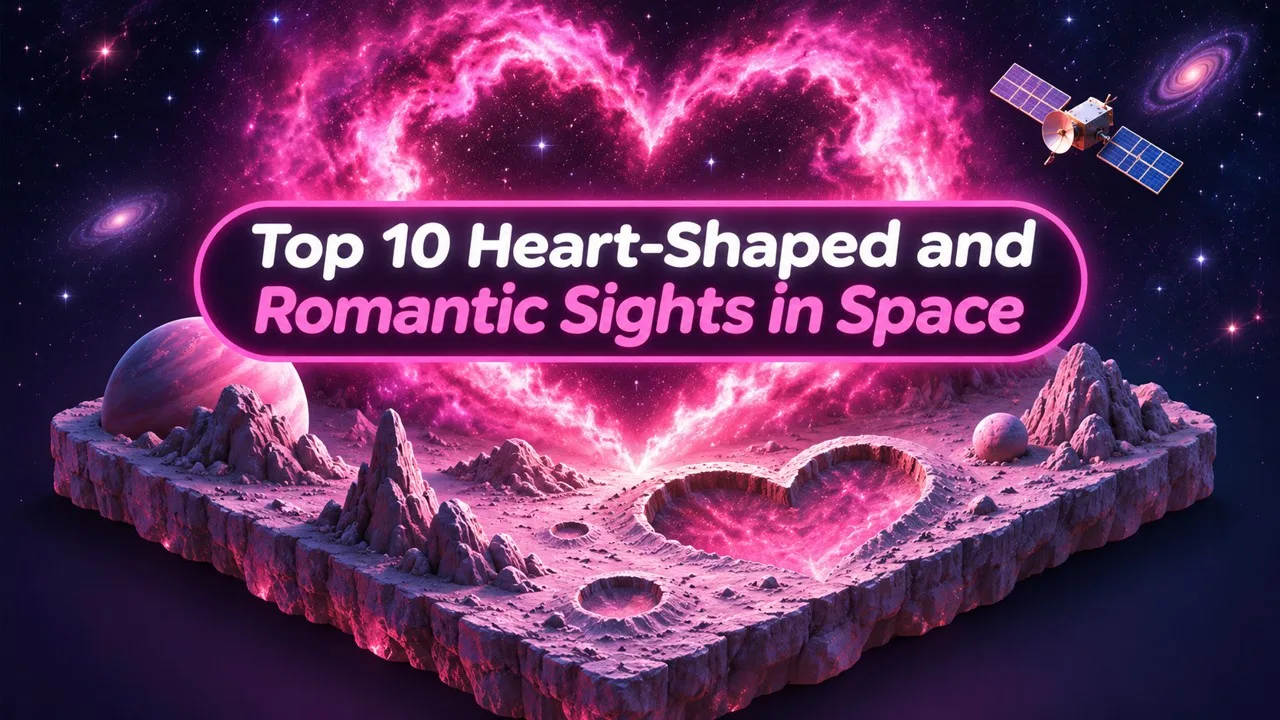
Space has a romantic side, from a heart-shaped plain on Pluto and the Heart and Soul nebulae to a cosmic rose and moons named for famous lovers. Astronomy is a science of measurement, but the sky has always invited romance. People have named stars after lovers, told stories about constellations and looked up together on clear nights. Modern telescopes and space missions have added new sights that seem made for Valentine's Day, from heart-shaped clouds of gas to galaxies that look like roses.
The ten sights below are the Heart Nebula, the Soul Nebula, the heart on Pluto, the Rosette Nebula, the galaxy pair Arp 273, the asteroid Eros and the spacecraft that landed on it, the planet Venus, the moons of Uranus named for lovers, Einstein rings and close meetings of Venus and the Moon. The shapes are coincidences of perspective and physics, but the science behind each one is real.
Many of the images described here are made with long exposures and filters that record light invisible to the human eye. The colors in astronomical photographs are often chosen to show different chemical elements, such as hydrogen, oxygen and sulfur. That means a nebula seen through a small backyard telescope looks much fainter and grayer than its famous pictures. The shapes, however, are real, and patient observers with dark skies can still trace them.
Key Facts
| # | Sight | Type | Why it seems romantic |
|---|---|---|---|
| 1 | The Heart Nebula | Emission nebula in Cassiopeia | Its overall shape resembles a heart |
| 2 | The Soul Nebula | Emission nebula in Cassiopeia | Paired with the Heart Nebula as Heart and Soul |
| 3 | Tombaugh Regio | Surface region on Pluto | A bright heart-shaped plain photographed in 2015 |
| 4 | The Rosette Nebula | Emission nebula in Monoceros | Its shape resembles a rose or rosette |
| 5 | Arp 273 | Interacting galaxies in Andromeda | Hubble's image resembles a rose |
| 6 | 433 Eros and NEAR Shoemaker | Near-Earth asteroid | Orbited on Valentine's Day and landed on soon after |
| 7 | Venus | Planet | Named after the Roman goddess of love |
| 8 | The moons of Uranus | Moons named from Shakespeare | Juliet, Cupid and other romantic names |
| 9 | Einstein rings | Gravitational lensing | Light bent into a ring, like a cosmic wedding band |
| 10 | Conjunctions of Venus and the Moon | Sky event | A bright pairing visible to the naked eye |
1. A Heart of Glowing Gas
The Heart Nebula, also known as IC 1805, is a large cloud of glowing gas in the constellation Cassiopeia, about 7,500 light-years from Earth. In wide-field photographs, its outline resembles a heart [1].
The nebula glows because young, hot stars at its center emit ultraviolet light that energizes the surrounding hydrogen gas. The stars form an open cluster, known as Melotte 15, and their radiation and winds have carved out the shapes seen in the nebula [1].
The nebula is too faint to see with the naked eye, but it is a favorite target for astrophotographers, especially around Valentine's Day. Its shape is an example of pareidolia, the human tendency to see familiar forms in random patterns, combined with the real sculpting effects of starlight.
2. A Soul Beside the Heart
Close to the Heart Nebula in the sky lies the Soul Nebula, also known as IC 1848 or the Embryo Nebula. Together, the two are often called the Heart and Soul nebulae and are photographed as a pair [2].
The Soul Nebula is another region where new stars are forming. Like the Heart Nebula, it glows because hot young stars energize its hydrogen gas. Both are part of a larger complex of star formation in the Perseus Arm of the Milky Way [2].
The pairing has a romantic appeal, but it also has scientific value. Studying such regions helps astronomers understand how massive stars form and how their radiation shapes surrounding clouds. In 2010, NASA's WISE space telescope produced a widely shared infrared image of the pair.
Related: Top 10 Interesting Facts About the Milky Way Galaxy
3. A Heart on Pluto
When NASA's New Horizons spacecraft flew past Pluto in July 2015, it revealed a large, bright region shaped roughly like a heart. The feature was informally named Tombaugh Regio, after Clyde Tombaugh, who discovered Pluto in 1930 [3].
The western part of the heart is a smooth plain of nitrogen ice called Sputnik Planitia. It has no visible impact craters, suggesting the surface is young and constantly renewed. Scientists believe the ice slowly circulates in large convection cells [3].
The heart became one of the most famous images of the mission and appeared widely in news coverage and on merchandise. It also changed scientific views of Pluto, showing that a small, distant world could be geologically active. For many people, it gave the dwarf planet a friendly, memorable face.
4. A Rose in Space
The Rosette Nebula is a large cloud of gas and dust in the constellation Monoceros, about 5,000 light-years from Earth. In photographs, its circular shape with a hollow center resembles a flower [4].
At the center of the nebula is an open cluster of young stars, whose radiation and stellar winds have cleared a cavity in the gas. The surrounding gas glows red from energized hydrogen, giving the nebula its rose-like color in many images [4].
Because of its shape and color, the Rosette Nebula is often featured in Valentine's Day astronomy images. It is also a working laboratory for astronomers, who study how young stars affect their surroundings and how new stars form within the nebula's dense regions.
5. A Galaxy Pair Shaped Like a Rose
Arp 273 is a pair of interacting galaxies in the constellation Andromeda, about 300 million light-years from Earth. The larger galaxy has been distorted by the gravity of its smaller companion, creating spiral arms that resemble the petals of a rose [5].
In April 2011, the Hubble Space Telescope team released a detailed image of Arp 273 to celebrate the telescope's twenty-first anniversary in space. The image quickly became popular and is often described as a cosmic rose [5].
Related: Quasars: Distant Beacons or Local Oddballs?
The galaxy is listed in the Atlas of Peculiar Galaxies compiled by the astronomer Halton Arp in 1966. Interacting galaxies like Arp 273 help scientists understand how galaxies grow and change, as gravitational encounters trigger bursts of star formation.
6. A Landing on the Asteroid of Love
433 Eros is a near-Earth asteroid named after the Greek god of love. It was discovered in 1898 and was one of the first asteroids found to come close to Earth's orbit [6].
NASA's NEAR Shoemaker spacecraft entered orbit around Eros on 14 February 2000, Valentine's Day. It studied the asteroid for a year, mapping its surface and measuring its composition [6].
On 12 February 2001, the spacecraft made a controlled descent to the surface, becoming the first spacecraft to land on an asteroid, even though it had not been designed for landing. The Valentine's Day timing and the asteroid's name made the mission a favorite story for science writers.
7. The Planet of Love
Venus, the brightest planet in the night sky, is named after the Roman goddess of love and beauty. It often appears as a brilliant morning or evening star, which has made it a symbol of romance in many cultures [7].
The real planet is far from romantic. Its thick atmosphere of carbon dioxide traps heat, making its surface hotter than any other planet in the Solar System, with temperatures around 460 degrees Celsius. Its clouds contain sulfuric acid, and its surface pressure is about 90 times that of Earth [7].
Related: Top 25 Interesting Facts About the Solar System
Venus rotates very slowly and in the opposite direction from most planets, so a day on Venus is longer than its year. Despite its harsh conditions, Venus remains a symbol of love in art and literature, and its brightness makes it one of the easiest planets to find.
8. Moons Named for Lovers
Most of the moons of Uranus are named after characters from the works of William Shakespeare and Alexander Pope. Several of those names have romantic connections [8].
One moon, discovered in 1986 in images from Voyager 2, is named Juliet, after the heroine of Romeo and Juliet. Another, discovered in 2003, is named Cupid, after a character in Timon of Athens who is named for the Roman god of love. Other moons include Rosalind, Desdemona and Miranda, all heroines from Shakespeare [8].
There is no moon named Romeo, but the naming tradition has given the Uranus system a literary character. The small inner moons, including Juliet and Cupid, interact with each other and with the planet's rings, and some may collide in the distant future.
9. Rings of Light
An Einstein ring forms when light from a distant galaxy is bent by the gravity of another galaxy lying almost exactly in front of it. If the alignment is close enough, the background galaxy appears as a ring of light around the nearer one [9].
The effect was predicted by Albert Einstein's general theory of relativity. The first complete Einstein ring was identified in 1988 using radio observations. Since then, telescopes such as Hubble and the James Webb Space Telescope have found many more [9].
Einstein rings are sometimes compared to cosmic wedding rings in popular coverage. They are scientifically valuable because they allow astronomers to measure the mass of the lensing galaxy, including dark matter, and to study distant galaxies magnified by the lens.
Related: Top 10 Most Romantic Ways to Propose to Someone
10. When Venus Meets the Moon
Some of the most romantic sights in the sky need no telescope at all. When the crescent Moon passes close to Venus in the evening or morning sky, the two brightest objects in the night sky appear side by side [10].
Such pairings are called conjunctions. The objects are not actually close to each other in space. They only appear near each other from Earth's point of view. Conjunctions of the Moon and Venus happen frequently, and occasionally the Moon passes directly in front of Venus, an event called an occultation [10].
Photographers and sky watchers often seek out these events, and the image of a slender Moon with a bright star nearby appears in many cultures' art and symbols. They are a reminder that some of the most beautiful sights in space are visible from a backyard to anyone who looks up.
Conclusion
The ten sights above show how easily human eyes find romance in the cosmos. A heart-shaped nebula, a frozen heart on Pluto, a galaxy shaped like a rose and moons named for lovers all owe their appeal to coincidence and imagination.
Behind each one, however, is real science, from star formation and gravitational lensing to the geology of distant worlds. Romantic names and shapes help draw attention to that science, and they give people one more reason to look up at the night sky together.
Many observatories, planetariums and astronomy clubs hold special public events around Valentine's Day, using these objects to introduce visitors to the night sky. Pairing a little romance with real astronomy has proved a reliable way to spark curiosity about the universe.
- ^ [1] Accounts of the Heart Nebula and its star cluster. Wikipedia: Heart Nebula Wikipedia: Cassiopeia
- ^ [2] Accounts of the Soul Nebula. Wikipedia: Soul Nebula Wikipedia: WISE
- ^ [3] Accounts of Tombaugh Regio and Sputnik Planitia. Wikipedia: Tombaugh Regio Wikipedia: Sputnik Planitia
- ^ [4] Accounts of the Rosette Nebula. Wikipedia: Rosette Nebula Wikipedia: Monoceros
- ^ [5] Accounts of Arp 273 and the Hubble anniversary image. Wikipedia: Arp 273 Wikipedia: Atlas of Peculiar Galaxies
- ^ [6] Accounts of Eros and NEAR Shoemaker. Wikipedia: 433 Eros Wikipedia: NEAR Shoemaker
- ^ [7] Accounts of the planet Venus. Wikipedia: Venus Wikipedia: atmosphere of Venus
- ^ [8] Accounts of the moons of Uranus and their names. Wikipedia: moons of Uranus Wikipedia: Juliet (moon)
- ^ [9] Accounts of Einstein rings and gravitational lensing. Wikipedia: Einstein ring Wikipedia: gravitational lens
- ^ [10] Accounts of conjunctions and occultations. Wikipedia: conjunction (astronomy) Wikipedia: occultation




















Discussion
Log in with