






 By
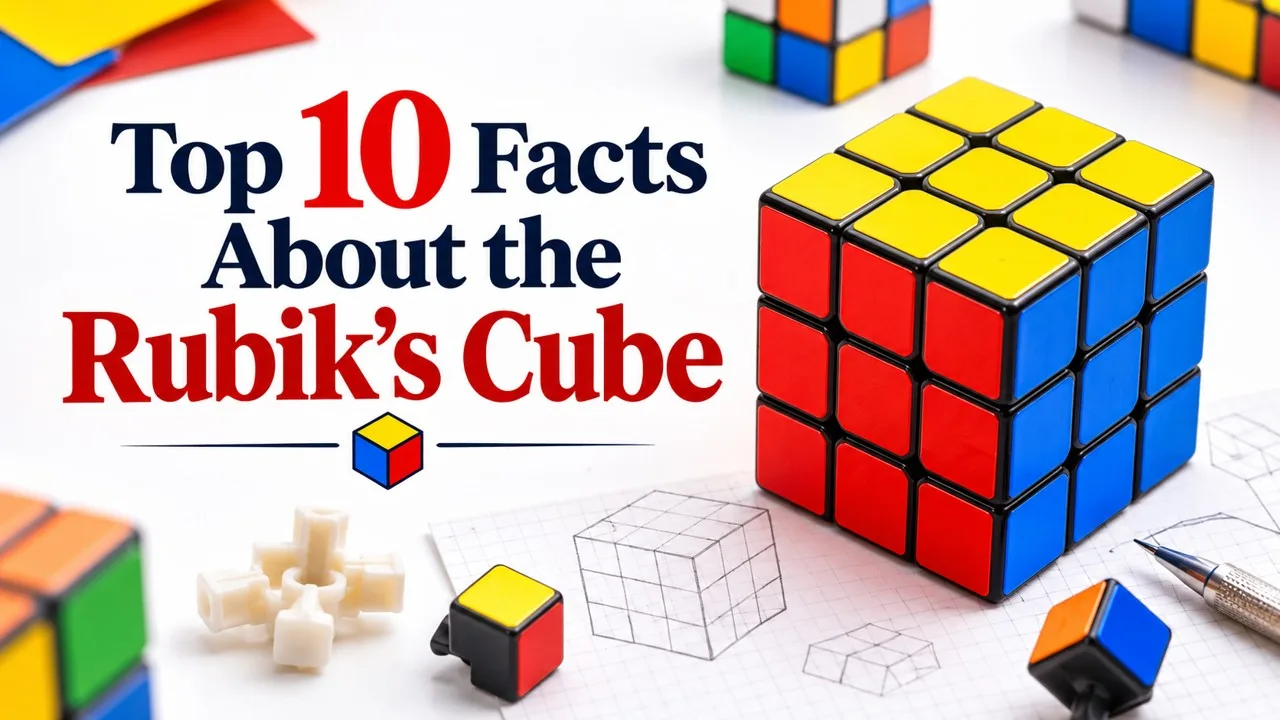
The Cube began as a geometry exercise in 1970s Budapest, and its fame as a toy sits on a mechanism, a huge position count, and a short maximum solution length.
The ten points below are the 1974 origin and the "Magic Cube" name, the inventor's classroom account, the core-and-cubie mechanism, the number of reachable positions, God's number, the parity rules that make some arrangements illegal, the rise of speedcubing, later hardware, the Cube as a robotics and search benchmark, and cube mosaics in art. Thinner popular claims about green marketing and therapy are not used here as if they were the main file. This is geometry and history. It will not display official wordmarks or packaging, and it will not teach a solving method.
Key Facts
| Point | What is documented | A limit |
|---|---|---|
| 1 | Ernő Rubik assembled the first Cube in Budapest in 1974 and first sold it as the Magic Cube | The 1980 international toy launch is a later chapter |
| 2 | Rubik has described it as a way to think about moving three-dimensional form | An educational origin does not cancel the fact that it became a puzzle |
| 3 | A fixed core holds face centers; the edge and corner pieces move around them | The color of a center is, on a standard cube, a fixed reference |
| 4 | There are 43,252,003,274,489,856,000 reachable positions on a 3x3x3 | That figure counts legal positions, not every way the stickers could be peeled |
| 5 | In 2010 researchers showed that every legal position can be solved in at most twenty face turns | "God's number" is a maximum, not a typical human solve |
| 6 | Some arrangements of pieces are impossible unless the Cube is taken apart or stickers are moved | A single swapped pair is the classic example of an illegal state |
| 7 | Competitive speedcubing has an official history from a 1982 world championship and, later, a 2004 association | Record times keep falling; a published number is not a forever fact, and methods will not be taught here |
| 8 | Later cubes turn more freely than the first stiff prototypes | Hardware helps; it is not the whole of a fast solve |
| 9 | The puzzle has been used as a test for robots and for search algorithms | A fast machine solve does not, by itself, invent surgery or a self-driving car |
| 10 | Artists have used many cubes as tiles for mosaics and sculptures | This article will not rebuild a famous face or display a trademarked center logo |
1. Budapest, 1974, and a Cube That Was First "Magic"
In 1974 Ernő Rubik, a Hungarian architect and lecturer, built the first working Cube in Budapest [1]. It was patented and, in Hungary, sold as the Magic Cube, or Bűvös kocka, before an international toy company launched it under the inventor's name in 1980. The path from a workshop object to a worldwide product ran through fairs, licenses, and a late-1970s appetite for a handheld puzzle. The later brand is part of the commercial history. The 1974 object is the origin [1].
The unexpected fact is how late the world met a puzzle that already had a Hungarian name and a Hungarian public [1]. This article will not display a wordmark or a box. The careful fact is a documented year, a documented first name, and a documented later global launch. Invention and marketing are two dates. Popular memory often keeps only the second.
A cube can be several years old as an object and still look, in a later advertisement, as if it had just been born.
2. A Teaching Object That Escaped the Classroom
Rubik has long described the Cube as a way for students, and for himself, to understand how parts of a three-dimensional object can move while the object stays whole [2]. That classroom account is the best-supported story of the motive. It does not require us to pretend that the object was never a toy. Students wanted to restore the colors; that desire is already the puzzle. The later mass product is what happens when a spatial exercise also happens to be deeply, almost endlessly, rearrangeable [2].
The unexpected fact is that "I built it to teach geometry" and "people would not put it down" can both be true [2]. This article will not turn the classroom story into a unique moral. The careful fact is a documented inventor's account and a documented later life as entertainment. Education was a starting brief. Fascination was the result that traveled.
A teaching aid can succeed so well that the lesson is forgotten and only the itch to restore six faces remains.
3. A Core That Stays, and Pieces That Travel
The standard 3x3x3 Cube is not a stack of twenty-seven free little cubes [3]. A hidden core holds the six face centers, which, on a normally assembled puzzle, keep their facing and therefore their colors as a reference. Twelve edge pieces and eight corner pieces, often called cubies, move around that core when a face is turned. Once that mechanism is seen, many popular mysteries shrink: centers are not "moving colors" in the same sense as corners, and a turn is a permutation of a known set of pieces [3].
Related: Top 10 Curious Facts About Quicksand
The unexpected fact is that the hardest-looking object in a living room is, mechanically, a fairly strict little machine [3]. This article will not offer a way to disassemble one. The careful fact is a documented architecture of core, centers, edges, and corners. Geometry here is not a metaphor. It is the hardware.
A face can spin and still leave, at its middle, a piece that has not gone anywhere.
4. Forty-Three Quintillion Legal Places to Be
The number of reachable positions of a standard 3x3x3 Cube is 43,252,003,274,489,856,000 [4]. The figure is famous because it is large enough to feel like infinity in the hand and still be exact. It counts only positions that can be reached by turning faces from a solved cube. If stickers could be peeled and replaced without respect to the mechanism, the count would be different, and larger, because some of those arrangements are illegal. The legal number is already enough to make a random mid-solve look, to an untrained eye, like chaos [4].
The unexpected fact is that a pocket object can have a position count that needs a comma in almost every group of three digits [4]. This article will not treat the number as a dare. The careful fact is a documented enumeration of the legal set. Vastness is real. It is also finite, which is what makes a general theory of solutions possible.
A mix of colors can look unique and still be, in a mathematician's census, one address among tens of quintillions.
5. Twenty Moves Are Enough, If the Player Is God
In 2010 a team including Tomas Rokicki, Herbert Kociemba, Morley Davidson, and John Dethridge, using a large amount of computer time, showed that every legal position can be solved in at most twenty face turns, in the usual "face-turn metric" [5]. That maximum is nicknamed God's number: the worst-case length of a perfect solution. Most human solves, even fast official ones, are longer, because people use methods they can remember, not a complete search. Twenty is a ceiling, not a coaching target [5].
The unexpected fact is that a puzzle with more than forty-three quintillion positions still has a small, finite worst case [5]. This article will not teach how to approach that ceiling. The careful fact is a documented 2010 result and a documented meaning of the nickname. Difficulty for a person and difficulty for a complete search are different measurements.
Related: Top 10 Facts About Thunderstorms People Often Miss
A "God" here is only an algorithm that never wastes a turn. The number is a theorem about the diameter of a graph.
6. Some Arrangements Cannot Happen, However Messy the Cube Looks
Not every way of placing the pieces is reachable by turns [6]. The Cube's moves preserve certain parities and orientation totals. A common demonstration is that a single pair of edge pieces cannot be merely swapped, with everything else solved, unless the puzzle has been taken apart or its colors have been moved by hand. Beginners sometimes think they have reached such a state and that the Cube is "broken." Usually they have mis-solved a step; occasionally a cube has actually been reassembled wrongly. The illegal states are part of why the legal count is the number it is [6].
The unexpected fact is that a thoroughly mixed-looking cube can still be, in a precise sense, too mixed to be real [6]. This article will not give a repair-by-disassembly guide. The careful fact is a documented set of constraints in the move group. Apparent chaos is rule-bound. The rules are why a solution always exists for a cube that has only been turned.
A permutation can be visible and still be, if it breaks a parity, a position the mechanism refuses to acknowledge as its own.
7. Speedcubing Has an Official History, and Its Records Will Not Sit Still
Competitive solving is older than the later internet culture around it [7]. A world championship was held in Budapest in 1982. In 2004 the World Cube Association was organized to standardize contests and official results. Times have fallen from many seconds in early meets to a few seconds in recent official lists, helped by better methods and better-turning hardware. Because the records keep moving, this article will not freeze a single published result as if it were permanent. It will also not teach a named method. CFOP and other staged systems exist; they are a literature, not a paragraph of instructions [7].
The unexpected fact is that a toy from 1980 now has, like a sport, a rulebook and a record list [7]. The careful fact is a documented 1982 championship, a documented later association, and a documented long decline in official times. Speed is a social fact. A stopped clock on a webpage is not.
Related: Top 10 Facts About Elevators
A championship can make a private fidget into a public, timed attempt, and still leave the first inventor's classroom a long way behind.
8. Later Cubes Turn More Easily Than the First Ones Did
The earliest Cubes were relatively stiff, and a mid-turn could lock [8]. Later puzzle hardware, including smoother mechanisms and, in many modern speed cubes, magnets and looser tensions, made rapid turning more reliable. Competitors care about this; so do casual solvers who remember a childhood cube that barely moved. Hardware is not the whole of a fast official result, which still depends on look-ahead, recognition, and practice. It is a large part of why a 1980s object and a current contest object can feel like different tools that share a geometry [8].
The unexpected fact is that the "same" puzzle has been, mechanically, redesigned under the surface [8]. This article will not name a factory list or a lubricant recipe. The careful fact is a documented improvement in turning quality over time. The group of moves is the same. The hand's experience is not.
A geometry can stay fixed while a mechanism becomes, year by year, less of a fight.
9. Machines and Search Algorithms Have Used the Cube as a Test
Because the legal position space is large but exactly described, the Cube has been a convenient benchmark for search algorithms and for robots that must look, plan, and then turn faces quickly [9]. Research papers and public demonstrations have both used it that way. Robot solve times, like human ones, keep being improved and should not be cited here as a single immortal record. What does not follow is a straight line from a tabletop robot to surgery or to a self-driving car. Those fields have their own files. The Cube is a clean, closed problem; many other problems are not [9].
The unexpected fact is that a children's puzzle can be a serious test of planning and of mechanical cycle time [9]. This article will not treat a demonstration video as a general theory of intelligence. The careful fact is a documented use in robotics and in algorithmic search, and a documented temptation to over-claim the spillover. A benchmark is a tool for researchers. It is not a key to every machine.
Related: Top 25 Interesting Facts About the Solar System
A robot that finishes a cube is impressive. It has solved a cube. The next sentence should stay that modest.
10. A Grid of Cubes, Used as Tiles
Artists have built mosaics and sculptures from many ordinary cubes, using the six colors as a rough palette and the faces as pixels [10]. The results can be portraits, patterns, or abstract walls. This article will not reconstruct a famous likeness in cubes, and it will not display an official center logo or a trademarked package as if those were the art. The interesting fact is simpler: a mass-made puzzle has a second life as a modular colored brick, closer to a tessera than to a toy in mid-solve [10].
The unexpected fact is that a device invented to be restored to one pattern is often, in art, deliberately left unrestored [10]. The careful fact is a documented mosaic and sculpture practice, kept at the level of a method of tiling, not a gallery of protected images. Color and grid are the medium. The solved state is optional.
A wall of cubes can be a picture. It can also be, if the artist wants, only a wall of cubes.
Conclusion
The ten points above include a 1974 Budapest origin, a classroom motive, a core-and-cubie machine, a forty-three-quintillion legal space, a twenty-move worst case, a set of impossible parities, an official speedcubing history, later hardware, a robotics benchmark, and a mosaic art. Marketing and method-talk are easy to pile on top. The geometry is the part that does not go stale.
A cube in the hand is a group, a graph, and a toy. The last of those is how most people meet it. The first two are why it still rewards a closer look.
- ^ [1] Historical accounts of Ernő Rubik's 1974 prototype, of the Hungarian Magic Cube, and of the 1980 international launch, without official packaging or wordmarks. https://www.britannica.com/biography/Erno-Rubik https://www.britannica.com/story/inventing-the-cube
- ^ [2] Rubik's and museum or biographical accounts of the Cube as a spatial-teaching object that also became a popular puzzle. https://www.britannica.com/biography/Erno-Rubik related Hungarian design and applied-art histories
- ^ [3] Explanations of the standard 3x3x3 mechanism, including a fixed core, face centers, and moving edge and corner cubies. https://www.britannica.com/science/geometry https://www.britannica.com/science/mechanics-physics
- ^ [4] Standard enumerations of the 43,252,003,274,489,856,000 reachable positions of the 3x3x3 Cube, distinguished from illegal sticker rearrangements. https://www.britannica.com/science/combinatorics Cube20 project materials
- ^ [5] The 2010 demonstration that God's number in the face-turn metric is 20, by Rokicki, Kociemba, Davidson, and Dethridge. https://www.cube20.org/ https://www.britannica.com/science/group-theory
- ^ [6] Group-theoretic accounts of the Cube's move group, including parity and orientation constraints that make some arrangements unreachable by turns alone. https://www.britannica.com/science/group-theory https://www.britannica.com/science/permutation
- ^ [7] Historical accounts of the 1982 world championship and of the World Cube Association, founded in 2004, without a frozen record time and without a solving tutorial. World Cube Association https://www.britannica.com/biography/Erno-Rubik
- ^ [8] Accounts of later speed-cube hardware as distinct from early stiff mechanisms, without a brand list or a lubricant recipe. https://www.worldcubeassociation.org/ https://www.britannica.com/topic/toy
- ^ [9] Research and demonstration accounts of robot and algorithm solvers, treated as benchmarks in a closed puzzle and not as a general key to other machines. https://www.britannica.com/technology/artificial-intelligence https://www.britannica.com/technology/robot-technology
- ^ [10] Accounts of cube mosaics and sculptures as a tiling practice, without reconstructions of famous faces or official logos. https://www.britannica.com/art/mosaic-art https://www.britannica.com/art/sculpture





















Discussion
Log in with