






 By
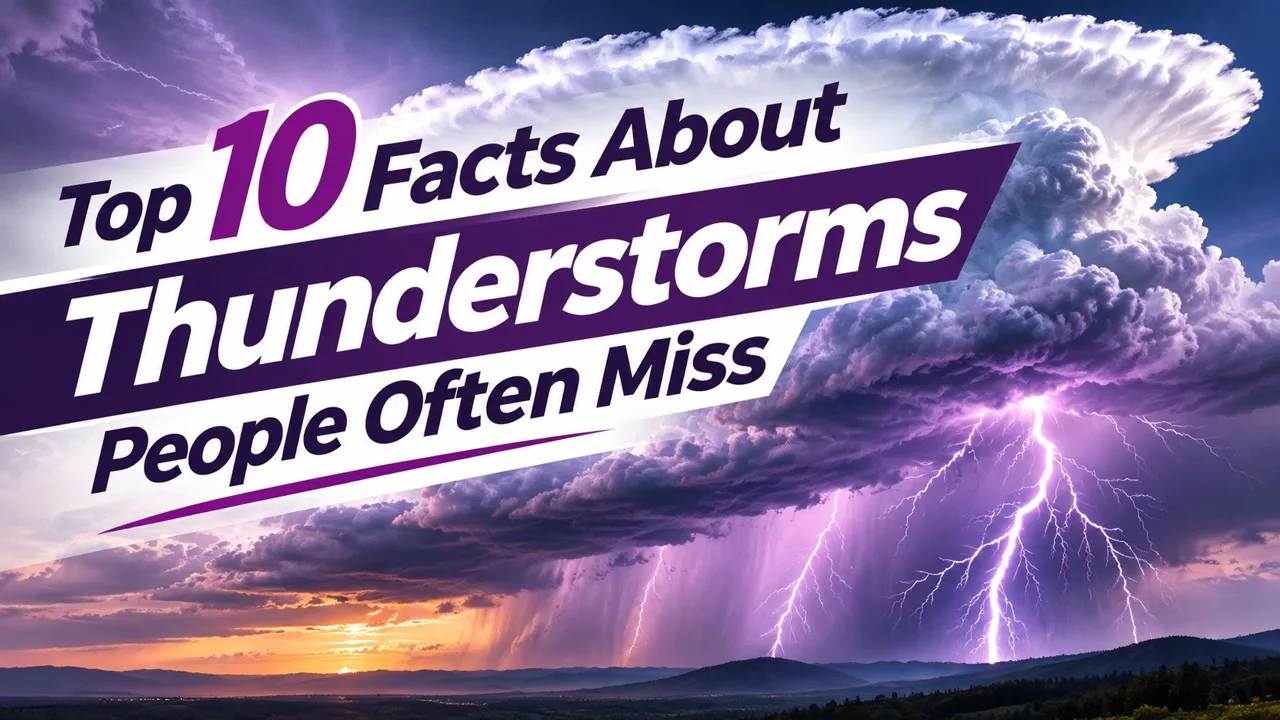
Lightning can strike one building again and again, and a flooded road is often the greater storm risk; metal does not uniquely attract a bolt. A thunderstorm is a familiar weather system with a few facts that sit awkwardly beside proverbs: a strike can return to the same tower, a shower can, rarely, carry a current, and the phrase about calm after a storm is a poor guide to downed wires and rising water [4][5][9]. The ten notes below are those distinctions, written as general public information, not as personal advice for any one house, body or journey [2][8][10]. They are also distinct from an earlier list about rain itself [7]. This article will not quote a lyric, and it will not turn a safety slogan into a lecture [7][10].
A storm can be measured, and a proverb can be wrong. The useful work is to keep the measurement, and to keep the warning general.
Key Facts
These are documented thunderstorm facts, with popular sayings marked where they fail.
Ten Facts at a Glance
| Rank | Claim | Careful version |
|---|---|---|
| 1 | Research flights through storms | A NASA program flew an F-106 through a very large number of thunderstorms to study lightning; the flights are a research fact, not a stunt to copy |
| 2 | Indoor plumbing and a strike | A lightning current can, rarely, travel through plumbing or wiring; this is a general safety note, not a personal risk assessment |
| 3 | Metal and lightning | Metal does not uniquely attract lightning the way jewelry folklore claims; height, isolation and a conductive path matter more |
| 4 | Animals falling in rain | Small animals have, on occasion, been lifted and dropped by strong updrafts or waterspouts; the reports are weather, not a song |
| 5 | Fires that help make lightning | Intense wildfires can build pyrocumulonimbus clouds that produce their own lightning |
| 6 | After the storm | The minutes and hours after a cell passes can still hold danger, including lingering lightning, damaged lines and flood water |
| 7 | The same place, twice | Lightning often returns to a tall, exposed structure; a well-known New York tower is struck many times in a year |
| 8 | How hot a channel is | A lightning channel is, in standard estimates, far hotter than the visible surface of the Sun; the figures are order-of-magnitude measurements of the channel, not of the air in a whole storm |
| 9 | Wood is not a magic shelter | A small wooden shed or a tree is not, by itself, a reliable shelter from lightning |
| 10 | Flooded roads | In many storm deaths, the immediate hazard is water on a road, not a bolt; the public slogan is a general warning, not a travel plan |
1. A Research Airplane, Through a Cloud
In the early 1980s, NASA's Storm Hazards program flew an F-106 aircraft through a very large number of thunderstorms, commonly reported as nearly fifteen hundred, in order to study how lightning attaches to an airframe [1]. The unexpected fact is institutional. A storm that people are told to avoid was, for a defined research program, a workplace, with instruments and a purpose [1]. This article will not treat those flights as a stunt, and it will not describe a technique for flying in weather. The careful fact is the program, and the knowledge it was after: attachment points, currents, and the behavior of a metal aircraft in electrified cloud.
A research flight can be real and still be a bad model for anyone else. The model, here, is a data set, not a dare.
2. A Rare Indoor Path
Public weather guidance has long noted that a lightning current can, in uncommon cases, travel through metal plumbing or household wiring, which is why a shower, a wired device, or a fixture can be a poor place to linger in a close thunderstorm [2]. The chance, for any one person and any one storm, is small. It is not zero [2]. The unexpected fact is only the path, which does not have to come through a window. This article will not estimate a personal risk, will not inspect a house, and will not become medical advice. The careful fact is general: indoor conductors can carry a strike, and official guidance treats that as a reason for caution, not as a riddle.
A wall can hide a wire. The wire is the reason a general warning exists, and the warning is as far as this list will go.
Related: Top 10 Rare Cloud Formations and How They Form
3. A Folklore About Metal
A persistent claim says that metal, especially a watch, a necklace, or a small object on the body, uniquely attracts lightning [3]. Lightning is a discharge that seeks a convenient path between cloud and ground, or between regions of charge; what matters more are height, isolation, sharpness of a conductor, and whether a person is already part of a path [3]. Metal can conduct a current if a strike is already occurring. That is not the same as a bracelet summoning a bolt. The unexpected fact is the correction, not a permission to ignore storms. This article will not give a dressing rule, and it will not pretend that standing under a tall isolated object becomes safe if the object is not metal. The careful fact is the physics of the path.
An attractor, in folklore, is usually a height or a lonely tree. The folklore about jewelry is the part that does not survive a careful sentence.
4. A Fall of Small Animals, Occasionally
There are documented cases, uncommon but real, in which small animals, especially fish or frogs, have been lifted by strong updrafts or waterspouts and later fallen with rain [4]. The reports are weather, and they do not need a song, a lyric, or a joke about other things falling from the sky [4]. The unexpected fact is the updraft, which can move a light body some distance. The careful fact is the scale: small animals, occasional reports, a physical mechanism. This article will not treat the phenomenon as a biblical omen, and it will not invent a frequency. A rare meteorological oddity is still an oddity.
A falling fish can have a waterspout behind it. The waterspout is the explanation that belongs in a thunderstorm list.
5. Smoke, a Cloud, and a Strike
Lightning starts many fires, which is the familiar direction of the relationship. Intense wildfires can also build tall, moisture-bearing pyrocumulonimbus clouds, and those clouds can produce their own lightning, a feedback that researchers have documented in severe fire seasons [5]. The unexpected fact is the reversal. A fire can help make the storm that starts still more fire [5]. This article will not become a firefighting manual, and it will not treat every wildfire as a thunder factory. The careful fact is the cloud type, and the possibility of fire-induced lightning when a blaze is already extreme.
Related: Top 10 Coldest Places in the World
A storm can be a child of a fire as well as a parent. The child has a name, and the name is enough.
6. When a Cell Has Passed
The proverb about calm after a storm is a comfort, not a forecast. After a thunderstorm cell moves on, lightning can still occur from a trailing anvil or a nearby cell, power lines can be down, trees can be weakened, and water can still be rising in a dip or a creek [6]. The unexpected fact is the clock. Danger does not end at the last loud clap a person happened to hear [6]. This article will not inventory every household risk, and it will not offer a minute-by-minute rule. The careful fact is general: the period after a storm can still be hazardous, in more than one way.
A silence can be a gap between cells. The gap is not, by itself, a declaration of safety.
7. The Same Tower, Many Times
The saying that lightning never strikes the same place twice is false as a rule. A tall, exposed structure offers a repeated path, and some towers are struck over and over in a single season [7]. The Empire State Building, in New York, is a frequently cited example, hit many times in a typical year, which is why it has long been used in observations of lightning [7]. The unexpected fact is routine. A famous bolt can be, for a skyscraper, a regular event. This article will not borrow a skyline as a logo, and it will not treat any one building as unique in kind. The careful fact is the repeat, and the height that makes the repeat likely.
A proverb can be tidy and still be wrong. The tower is the counterexample that does not require a second proverb.
Related: Top 10 Extremes and Records on Planet Earth
8. A Narrow Channel, Extremely Hot
A lightning channel is, in standard estimates, on the order of 30,000 degrees Celsius, often rounded in popular accounts to about 50,000 degrees Fahrenheit, far hotter than the visible photosphere of the Sun, which is around 5,500 degrees Celsius [8]. The unexpected fact is the contrast, which is real, and also easy to over-read. The figure describes a narrow, brief channel, not the air temperature of a whole storm, and not a measurement that every bolt has had taken with the same instrument [8]. This article will keep the comparison as an order of magnitude, not as a contest with a star. The careful fact is the heat of the path, and the shortness of the path in time and in width.
A number can be dramatic and still be a channel measurement. The channel is what is hot; the countryside around it is not a second sun.
9. A Shed Is not Automatically Safe
Guidance about lightning shelters usually favors a substantial building or a fully enclosed metal vehicle, and it treats trees, bleachers, fences and small isolated sheds as poor options [9]. Wood does not "attract" lightning in the jewelry sense, and it is also not a charm against a strike; a lone tree is a common risky place, and a light wooden shelter may not offer the protection people assume [9]. The unexpected fact is the disappointment of a folk material. This article will not design a shelter, and it will not offer medical advice about injuries. The careful fact is general: a small wooden structure is not, by itself, a reliable refuge.
A porch can feel like cover and still be a weak plan. The plan belongs in official weather guidance, not in a custom-built list of instructions.
Related: Top 10 Most Destructive Typhoons in Recorded History
10. Water on the Road
In many places, the storm deaths that officials count are more often drownings in vehicles or in flood water than deaths by lightning, which is why a long-running public slogan tells drivers not to enter a flooded roadway [10]. The unexpected fact, for a lightning list, is the competitor hazard. A thunderstorm is a rainstorm and a windstorm as well as an electrical storm [10]. This article will not become a driving lesson, and it will not invent a local statistic. The careful fact is general: shallow-looking water can hide a deep or moving flood, and turning around is the public advice, offered here only as that advice already exists.
A bolt is not the only way a thunderstorm can kill. The road is, in the record, often the more ordinary risk, and the record is the reason for the slogan.
Conclusion
The ten facts above are a research airplane, a rare indoor path, a correction about metal, an occasional fall of small animals, fire-built lightning, a hazardous aftermath, a tower struck again and again, a very hot narrow channel, a caution about small shelters, and a flooded road. They are general facts about storms, not a personal briefing, and they do not need a lyric or a proverb left unexamined.
A thunderstorm is electricity, water and wind. The decent way to list it is to keep those three in proportion, to correct the sayings that fail, and to leave advice in the general, public tense in which it already exists.
- ^ [1] Accounts of NASA's Storm Hazards research flights with an F-106 aircraft through a very large number of thunderstorms. Britannica: thunderstorm Britannica: military aircraft
- ^ [2] Public weather-safety overviews noting that a lightning current can, rarely, travel through plumbing or wiring, offered as general information, not personal advice. Britannica: lightning
- ^ [3] Physical accounts of lightning paths, and of why small metal objects do not uniquely attract strikes. Britannica: lightning
- ^ [4] Meteorological accounts of small animals occasionally lifted and dropped by updrafts or waterspouts, without lyrics or omen language. Britannica: waterspout
- ^ [5] Descriptions of pyrocumulonimbus clouds and of lightning generated in association with intense wildfires. Britannica: wildfire Britannica: cumulonimbus
- ^ [6] Public-safety discussions of hazards that can remain after a thunderstorm cell has passed, including lingering lightning, damaged lines and flood water. Britannica: thunderstorm
- ^ [7] Accounts of repeated lightning strikes on tall structures, including frequent strikes on a well-known New York tower. Britannica: Empire State Building Britannica: lightning
- ^ [8] Standard estimates of lightning-channel temperature, compared with the Sun's photosphere as an order of magnitude, not as a whole-storm air temperature. Britannica: lightning Britannica: photosphere
- ^ [9] Lightning-safety guidance on substantial buildings and vehicles, and on the limits of trees and small sheds as shelter, offered as general information. Britannica: lightning
- ^ [10] Public-safety accounts of storm-related flooding and of the risk of driving into flooded roadways, distinct from lightning deaths. Britannica: flood Britannica: thunderstorm






















Discussion
Log in with