





 By
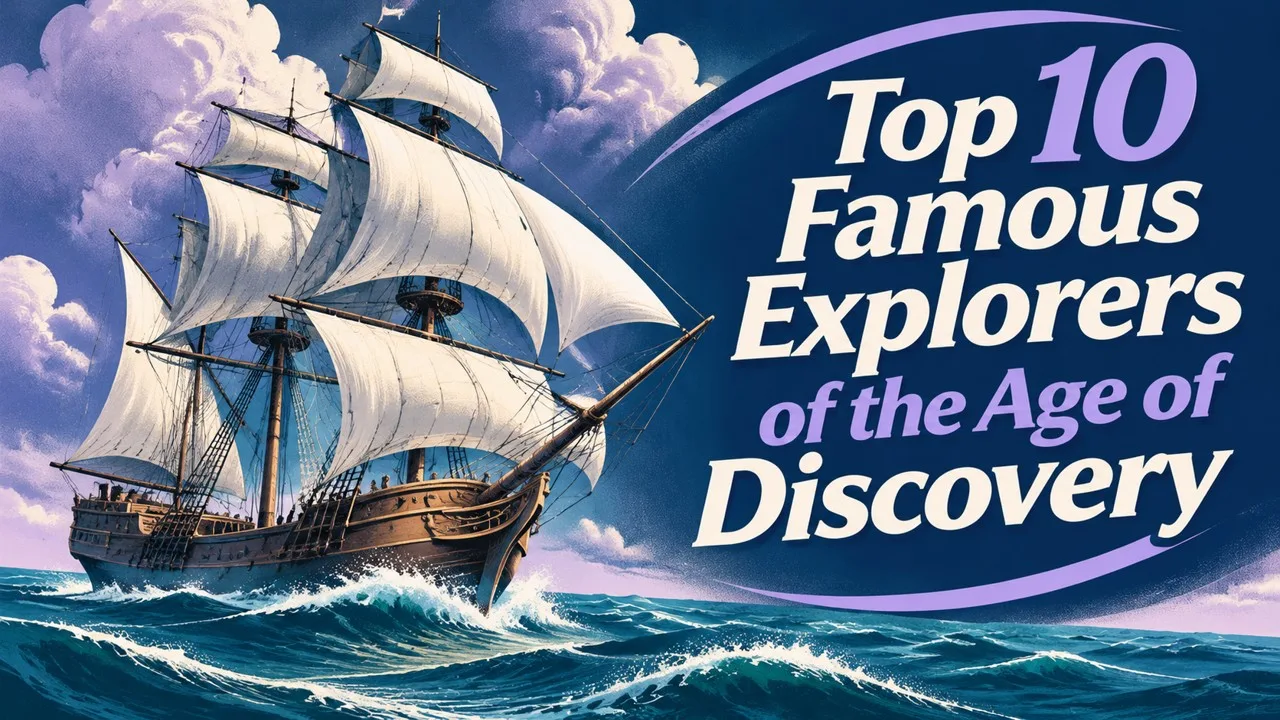
From Zheng He's treasure fleets to Magellan's voyage around the globe, these ten famous explorers of the Age of Discovery connected the world by sea. The Age of Discovery, from the fifteenth to the seventeenth century, was a period when sailors made long ocean voyages to reach new lands and trade routes. Improved ships, compasses and navigation methods allowed them to sail far beyond familiar coasts.
These voyages connected continents that had been isolated from each other, leading to trade, the exchange of crops and animals, and also to conquest, colonisation and the suffering of many Indigenous peoples. This list introduces ten explorers whose voyages changed the map of the world.
Key Facts
The ten explorers below sailed between 1405 and 1643 for China, Portugal, Spain, England, France and the Netherlands.
Explorers of the Age of Discovery at a Glance
| # | Explorer | Main voyage | Sailed for | Achievement |
|---|---|---|---|---|
| 1 | Zheng He | 1405 to 1433 | Ming China | Commanded the great treasure fleets |
| 2 | Bartolomeu Dias | 1487 to 1488 | Portugal | First European to round the Cape of Good Hope |
| 3 | Christopher Columbus | 1492 | Spain | Reached the Americas |
| 4 | Vasco da Gama | 1497 to 1499 | Portugal | First sea voyage from Europe to India |
| 5 | John Cabot | 1497 | England | Reached North America for England |
| 6 | Pedro Alvares Cabral | 1500 | Portugal | Reached Brazil |
| 7 | Ferdinand Magellan | 1519 to 1522 | Spain | Led the first voyage around the world |
| 8 | Jacques Cartier | 1534 to 1542 | France | Explored the St Lawrence River |
| 9 | Francis Drake | 1577 to 1580 | England | First captain to sail his own ship around the world |
| 10 | Abel Tasman | 1642 to 1643 | Dutch Republic | First European to reach Tasmania and New Zealand |
1. Zheng He
Zheng He was a Muslim court official from Yunnan who served the Yongle emperor of the Ming dynasty. Between 1405 and 1433 he led seven great voyages across the Indian Ocean. [1]
His treasure fleets were enormous. The first voyage is said to have included more than 300 ships and about 28,000 men, with some of the largest wooden ships ever built. [1]
The fleets visited South-East Asia, India, Sri Lanka, the Arabian Peninsula and the east coast of Africa. They carried gifts and brought back envoys and exotic goods, including a giraffe presented at the Ming court.
The voyages displayed Ming power and encouraged foreign rulers to send tribute to China.
After Zheng He's death, the Ming court ended the voyages, and China turned away from large-scale ocean exploration.
Key Figures
- Served: the Yongle emperor
- Voyages: seven, 1405 to 1433
- First fleet: more than 300 ships
- Furthest reach: East Africa
Why It Made the List
Zheng He led the largest fleets of the early fifteenth century. His voyages came decades before Europeans reached the Indian Ocean by sea.
2. Bartolomeu Dias
Bartolomeu Dias was a Portuguese navigator sent by King John II to find a sea route around Africa. He set out in 1487 with three ships. [2]
In early 1488, storms carried his ships south past the tip of Africa. When Dias turned north again, he found the coast now ran east, proving that Africa could be sailed around. [2]
Dias reached as far as the Great Fish River in present-day South Africa before his tired crew forced him to turn back.
On the way home he saw the cape he had passed. According to tradition, he named it the Cape of Storms, but the king renamed it the Cape of Good Hope because it promised a route to India.
Dias later died in 1500 when his ship sank in a storm near the same cape during another expedition.
Key Figures
- Sailed for: King John II of Portugal
- Rounded the cape: 1488
- Furthest point: Great Fish River
- Died: 1500, at sea near the cape
Why It Made the List
Dias proved that ships could sail from the Atlantic into the Indian Ocean. His voyage made Vasco da Gama's journey possible.
3. Christopher Columbus
Christopher Columbus was a navigator from Genoa who sailed for Queen Isabella and King Ferdinand of Spain. He planned to reach Asia by sailing west across the Atlantic. [3]
Related: Top 10 Unsung People Behind Famous Journeys
He left Spain in August 1492 with three ships, the Nina, the Pinta and the Santa Maria. On 12 October 1492 he landed on an island in the Bahamas. [3]
Columbus made four voyages to the Caribbean and the coasts of Central and South America. He believed until his death in 1506 that he had reached Asia.
His voyages began lasting contact between Europe and the Americas, known as the Columbian Exchange, in which crops, animals, people and diseases crossed the Atlantic.
His governorship of Hispaniola was marked by brutality toward the Taino people, and his legacy is now strongly debated.
Key Figures
- Born: Genoa
- Sailed for: Spain
- First landfall: 12 October 1492, Bahamas
- Voyages: four
Why It Made the List
Columbus's voyages connected Europe and the Americas permanently. They changed the history of both continents.
4. Vasco da Gama
Vasco da Gama left Lisbon in July 1497 with four ships to find a sea route to India. He followed the route around Africa opened by Bartolomeu Dias. [4]
After stopping on the east coast of Africa, he hired a local pilot who guided the fleet across the Indian Ocean. On 20 May 1498 da Gama arrived near Calicut, on the Malabar coast of India. [4]
The return journey was difficult, and many of his crew died of scurvy. Still, the spices he brought back proved the route could be profitable.
Da Gama made later voyages to India, and in 1524 he was appointed viceroy of Portuguese India. He died in Kochi that same year.
His voyage allowed Portugal to build a trading empire in Asia, challenging Arab and Venetian control of the spice trade.
Key Figures
- Departed: Lisbon, July 1497
- Reached India: 20 May 1498, near Calicut
- Became viceroy: 1524
- Died: Kochi, 1524
Why It Made the List
Vasco da Gama opened the sea route from Europe to Asia. It transformed world trade and began centuries of European presence in India.
5. John Cabot
John Cabot, born Giovanni Caboto, was an Italian navigator who sailed for King Henry VII of England. Like Columbus, he hoped to reach Asia by sailing west. [5]
In 1497 he sailed from Bristol on a small ship called the Matthew. On 24 June 1497 he landed on the coast of North America, probably Newfoundland or Cape Breton Island. [5]
Cabot reported rich fishing grounds, where cod were said to be so plentiful they could be caught in baskets.
Related: Top 10 Phantom Islands That Never Existed
He set out again in 1498 with several ships, but he disappeared and his fate remains unknown.
His voyage later formed the basis of English claims to North America.
A replica of the Matthew was sailed across the Atlantic in 1997 to mark the 500th anniversary of the voyage.
Key Figures
- Born: Giovanni Caboto, Italy
- Sailed for: Henry VII of England
- Ship: the Matthew
- Landfall: 24 June 1497
Why It Made the List
Cabot's voyage was the first European visit to mainland North America since the Vikings. It launched England's interest in the New World.
6. Pedro Alvares Cabral
Pedro Alvares Cabral was a Portuguese commander who led a large fleet of 13 ships to India in 1500, following Vasco da Gama's route. [6]
Sailing far west into the Atlantic to catch favourable winds, the fleet sighted land on 22 April 1500. Cabral claimed this land, now Brazil, for Portugal. [6]
After a short stay, Cabral continued to India, where he established trade at Calicut and Kochi. His fleet lost several ships in storms, including the one carrying Bartolomeu Dias.
Historians still debate whether the landing in Brazil was accidental or planned.
Cabral's claim led to Brazil becoming a Portuguese colony and, eventually, the largest Portuguese-speaking country.
A letter written by Pero Vaz de Caminha, a member of the fleet, described the land and its people and is often called the birth certificate of Brazil. It is one of the earliest European descriptions of the country.
Key Figures
- Fleet: 13 ships
- Reached Brazil: 22 April 1500
- Sailed for: Portugal
- Continued to: India
Why It Made the List
Cabral's landing began Portuguese Brazil. It explains why Brazil differs from its Spanish-speaking neighbours.
7. Ferdinand Magellan
Ferdinand Magellan was a Portuguese navigator who sailed for Spain. In September 1519 he set out with five ships and about 270 men to reach the Spice Islands by sailing west. [7]
In 1520 he discovered a passage at the tip of South America, now called the Strait of Magellan. He then crossed the vast ocean he named the Pacific, meaning peaceful. [7]
The crossing took months, and many sailors died of hunger and scurvy. In the Philippines, Magellan was killed in the Battle of Mactan on 27 April 1521.
Related: Top 10 Facts About the First Voyage Around the World
Juan Sebastian Elcano took command and returned to Spain in September 1522 with one ship, the Victoria, and only 18 of the original crew.
The voyage was the first to sail around the world and proved the true size of the Earth.
Key Figures
- Departed: September 1519
- Ships: five
- Magellan killed: 27 April 1521, Mactan
- Completed by: Juan Sebastian Elcano, 1522
Why It Made the List
Magellan's expedition was the first circumnavigation of the globe. It showed how vast the Pacific Ocean is.
8. Jacques Cartier
Jacques Cartier was a French navigator from Saint-Malo, sent by King Francis I to find gold and a passage to Asia. [8]
On his first voyage in 1534, he explored the Gulf of St Lawrence and claimed the land for France. [8]
On his second voyage in 1535, he sailed up the St Lawrence River to the Iroquoian villages of Stadacona, near modern Quebec City, and Hochelaga, near modern Montreal.
Cartier used the word Canada, from an Iroquoian word for village, to describe the region, and the name later spread to the whole country.
His third voyage in 1541 failed to find riches, but his explorations laid the foundation for French claims in North America.
He also brought back samples he believed were gold and diamonds, but they turned out to be worthless minerals.
Key Figures
- Home port: Saint-Malo
- Sailed for: Francis I of France
- First voyage: 1534
- Name recorded: Canada
Why It Made the List
Cartier opened the route into the heart of North America. His voyages led to the creation of New France.
9. Francis Drake
Francis Drake was an English sea captain and privateer. Between 1577 and 1580 he made the second voyage around the world, after Magellan's expedition. [9]
Sailing in his ship the Golden Hind, he raided Spanish ports and treasure ships along the Pacific coast of the Americas. [9]
Drake also reached the west coast of North America, possibly near California, and claimed it for England as Nova Albion.
Related: Top 10 Most Bizarre Phobias: Strange Fears That Exist
He returned to England with huge treasure, and Queen Elizabeth I knighted him aboard his ship in 1581.
Drake later served as a commander against the Spanish Armada in 1588.
Spain regarded him as a pirate, and the Spanish called him El Draque, the Dragon.
His voyage brought back so much treasure that the investors, including the queen, earned a huge return.
Key Figures
- Voyage: 1577 to 1580
- Ship: the Golden Hind
- Knighted: 1581
- Later fame: the Spanish Armada, 1588
Why It Made the List
Drake was the first captain to complete a circumnavigation in command throughout. He became a symbol of English sea power.
10. Abel Tasman
Abel Tasman was a Dutch navigator working for the Dutch East India Company. In 1642 he set out from Batavia, now Jakarta, to explore the great southern lands. [10]
In November 1642 he reached an island he named Van Diemen's Land, later renamed Tasmania in his honour. [10]
In December 1642 he became the first European to reach New Zealand. A clash with Maori in a bay on the South Island left several of his sailors dead.
On his return journey in 1643, Tasman visited Tonga and Fiji.
His voyages showed that Australia was not connected to a vast southern continent, as many Europeans had believed.
Tasman never actually saw the mainland of Australia on that first voyage, as he sailed past its southern coast far out to sea.
Key Figures
- Employer: Dutch East India Company
- Reached Tasmania: November 1642
- Reached New Zealand: December 1642
- Also visited: Tonga and Fiji
Why It Made the List
Tasman's voyages added Tasmania and New Zealand to European maps. His name lives on in the island and the Tasman Sea.
Conclusion
The explorers of the Age of Discovery connected the world's oceans and continents. Their voyages led to global trade, exchange and empire.
Their achievements came at a great cost to many Indigenous peoples. Remembering both sides helps us understand how the modern world was formed.
- ^ [1] "Zheng He". Wikipedia. Wikipedia: Zheng He Wikipedia: Ming treasure voyages
- ^ [2] "Bartolomeu Dias". Wikipedia. Wikipedia: Bartolomeu Dias Wikipedia: Cape of Good Hope
- ^ [3] "Christopher Columbus". Wikipedia. Wikipedia: Christopher Columbus Wikipedia: Columbian exchange
- ^ [4] "Vasco da Gama". Wikipedia. Wikipedia: Vasco da Gama Wikipedia: Calicut
- ^ [5] "John Cabot". Wikipedia. Wikipedia: John Cabot Wikipedia: Matthew (1497 ship)
- ^ [6] "Pedro Alvares Cabral". Wikipedia. Wikipedia: Pedro Alvares Cabral Wikipedia: Colonial Brazil
- ^ [7] "Ferdinand Magellan". Wikipedia. Wikipedia: Ferdinand Magellan Wikipedia: Juan Sebastian Elcano
- ^ [8] "Jacques Cartier". Wikipedia. Wikipedia: Jacques Cartier Wikipedia: Saint Lawrence River
- ^ [9] "Francis Drake". Wikipedia. Wikipedia: Francis Drake Wikipedia: Golden Hind
- ^ [10] "Abel Tasman". Wikipedia. Wikipedia: Abel Tasman Wikipedia: Dutch East India Company


















Discussion
Log in with