





Top 10 Facts About the First Voyage Around the World
 By Dhiraj Sharma · Published
Share Post
Loading…
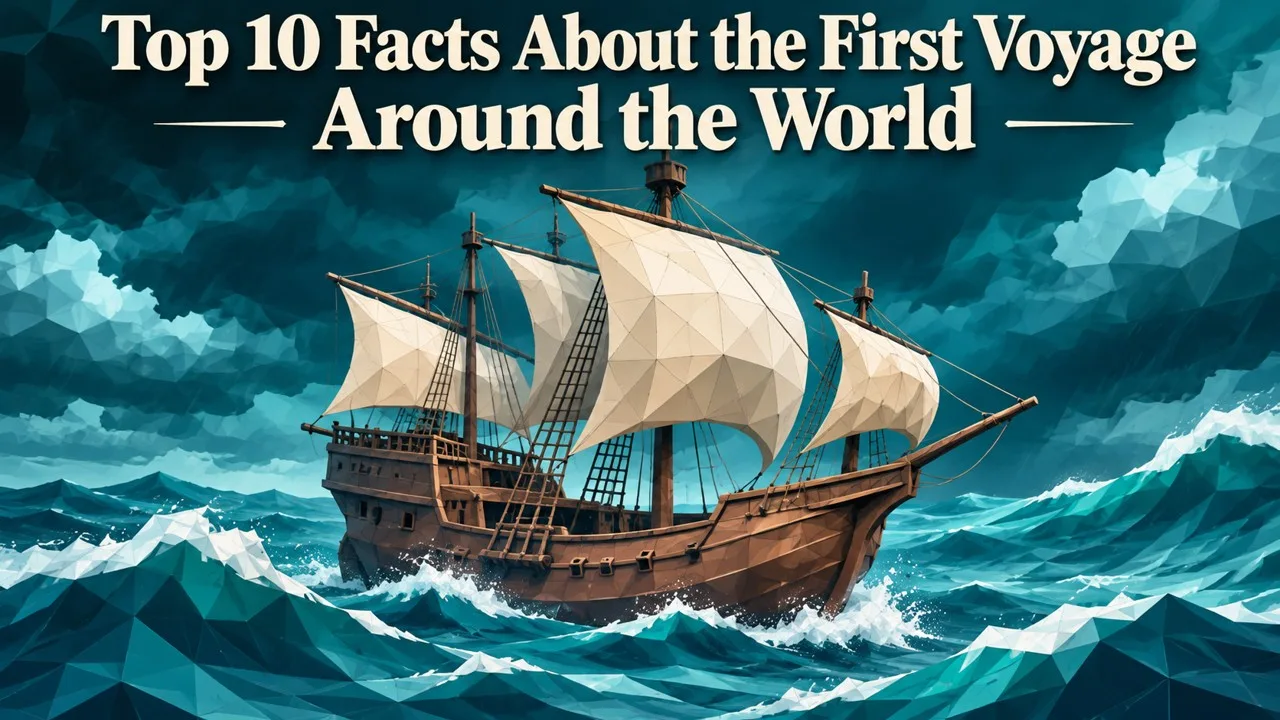
About 270 men set out with Magellan in 1519; 18 came home on one ship three years later. Ten facts about the first voyage around the world. In September 1519, five ships left southern Spain under the command of Ferdinand Magellan, a Portuguese navigator sailing for the Spanish crown. Almost three years later, one battered ship returned with eighteen of the original crew, having sailed all the way around the world.
The expedition was not designed as a circumnavigation. Its goal was to reach the Spice Islands, in what is now eastern Indonesia, by sailing west, and to show that the islands lay in the half of the world assigned to Spain under the Treaty of Tordesillas. Completing the loop was largely a consequence of that mission.
The voyage involved mutiny, starvation, shipwreck, desertion and war. Magellan himself died halfway through. Much of what is known comes from the journal of Antonio Pigafetta, an Italian scholar who sailed with the fleet and survived.
These ten facts trace the expedition from its departure to its return, and explain why it changed European understanding of the size of the planet.
Key Facts
| # | Fact | Date | Place |
|---|---|---|---|
| 1 | Fleet sails | September 1519 | Sanlucar de Barrameda, Spain |
| 2 | Mutiny at San Julian | April 1520 | Puerto San Julian, Argentina |
| 3 | Strait of Magellan | October and November 1520 | Southern tip of South America |
| 4 | Naming the Pacific | November 1520 | South Pacific |
| 5 | Starvation and scurvy | Late 1520 to early 1521 | Crossing the Pacific |
| 6 | Battle of Mactan | April 27, 1521 | Mactan, Philippines |
| 7 | Enrique of Malacca | 1511 to 1521 | Southeast Asia |
| 8 | Trinidad and Victoria | 1521 to 1522 | Spice Islands |
| 9 | Discovery of the lost day | July 1522 | Cape Verde Islands |
| 10 | Return of the Victoria | September 6, 1522 | Sanlucar de Barrameda, Spain |
1. A Portuguese Captain for Spain
Magellan had served Portugal in Asia and Africa, but after falling out with King Manuel I, he offered his plan to Spain. King Charles I, the future Holy Roman Emperor Charles V, agreed to finance it [1].
The fleet included five ships, the Trinidad, San Antonio, Concepcion, Victoria and Santiago, with about 270 men from many countries, including Spain, Portugal, Italy, Greece and France. It sailed from Sanlucar de Barrameda on September 20, 1519 [1].
Portugal viewed the voyage as a threat and reportedly tried to sabotage it. Some Spanish captains also resented serving under a Portuguese commander, setting the stage for conflict. The ships carried trade goods such as bells, mirrors, knives and cloth to exchange for spices, as well as large stores of biscuit, wine, salted meat and other provisions meant to last for two years. By modern standards, all five ships were small wooden vessels.
2. A Mutiny in Patagonia
While the fleet wintered at Puerto San Julian, on the coast of Patagonia, three of the five captains rebelled against Magellan in April 1520. They seized ships and demanded changes to his leadership [2].
Magellan regained control through a combination of force and cunning. One rebel captain was killed during the fighting, and another was later executed. A third, Juan de Cartagena, was marooned on the coast with a priest when the fleet departed [2].
Dozens of other mutineers were sentenced to death but pardoned, because Magellan needed them as crew. Among them was Juan Sebastian Elcano, who would later bring the expedition home. During the long stay at San Julian, the crew encountered local Indigenous people, whom the Europeans called Patagones, a name that may have come from a character in a Spanish romance. Pigafetta exaggerated their height, giving rise to European legends of Patagonian giants.
Related: Top 10 Strangest Deep-Sea Creatures
3. Finding the Passage
In October 1520, after the loss of the Santiago in a storm, the fleet found an opening in the coast near the southern tip of South America. The passage proved to be a winding channel more than 500 kilometers long [3].
The ships took more than a month to navigate it. During this time, the crew of the San Antonio deserted and sailed back to Spain, taking a large share of the expedition's supplies [3].
The fires seen on the shore at night led to the name Tierra del Fuego, land of fire. The passage itself became known as the Strait of Magellan. It remained an important route between the Atlantic and Pacific until the opening of the Panama Canal in 1914. Its narrow channels, strong currents and sudden winds made it dangerous for sailing ships.
4. An Ocean Named for Its Calm
When the fleet emerged from the strait into a vast ocean in late November 1520, the waters were calm. Magellan named it the Mar Pacifico, the peaceful sea [4].
Europeans had little idea of the ocean's size. The crossing took more than three months, far longer than Magellan had expected, and the ships saw only a few small, uninhabited islands along the way [4].
The voyage revealed that the Pacific was much larger than any European had imagined, changing ideas about the size of the Earth and the distance between Europe and Asia. Magellan's estimate of the distance had been based on maps that greatly underestimated the circumference of the Earth. The fleet happened to sail through a part of the ocean with few islands, missing many inhabited ones.
5. Leather, Sawdust and Rats
During the Pacific crossing, supplies ran out. Pigafetta wrote that the crew ate biscuits full of worms, drank yellow, foul-smelling water and chewed leather that had been soaked in seawater [5].
They also ate sawdust and rats, which were sold among the crew at high prices. Many men suffered from scurvy, caused by a lack of vitamin C, and their gums swelled so badly that they could not eat [5].
Related: Top 10 Famous Shipwrecks That Rewrote History
Around nineteen men died during the crossing. The fleet finally reached Guam in March 1521, where the crew were able to obtain fresh food. The encounter at Guam began badly. Local Chamorro people took items from the ships, and the Europeans retaliated by burning houses and killing several islanders, naming the islands after thieves. The ships then sailed on to the Philippines.
6. Death on Mactan
After reaching the Philippines, Magellan formed an alliance with Rajah Humabon of Cebu, who accepted Christian baptism. Magellan then attempted to force the chief of nearby Mactan, Lapulapu, to submit [6].
On April 27, 1521, Magellan led a small force ashore. Lapulapu's warriors, who greatly outnumbered them, defeated the attackers, and Magellan was killed [6].
Lapulapu is celebrated today as a national hero in the Philippines, the first recorded local leader to resist European colonizers in the islands. Soon after the battle, many of the remaining officers were killed at a feast hosted by Humabon. Pigafetta, who was wounded in the battle, described Magellan as fighting to protect his retreating men. A monument in Mactan, Lapulapu City, now commemorates the battle, and a reenactment is held each year.
7. The Interpreter Who May Have Gone Around First
Magellan's servant and interpreter, known as Enrique of Malacca, had been enslaved and brought to Europe after the Portuguese conquest of Malacca in 1511. He traveled with Magellan on the expedition [7].
When the fleet reached the Philippines, Enrique was able to communicate with local people in a Malay language. Some historians suggest that if he originally came from that region, he may have been the first person to travel all the way around the world [7].
His origins are uncertain, however, and he disappeared from the record after the massacre in Cebu. Magellan's will had promised him freedom, but the remaining officers reportedly refused to honor it. Enrique's name appears in Pigafetta's account and in Magellan's will, which was written before the fleet left Spain. Scholars in Malaysia, Indonesia and the Philippines have each argued for different possible origins for him.
Related: Top 10 Geographical Extreme Points of the World
8. Two Ships, Two Fates
With too few men to sail three ships, the survivors burned the Concepcion. The Trinidad and Victoria reached the Spice Islands in November 1521 and loaded valuable cloves [8].
The Trinidad tried to return east across the Pacific but was forced back and captured by the Portuguese. The Victoria, commanded by Elcano, sailed west across the Indian Ocean and around Africa, avoiding Portuguese ports where possible [8].
The journey home was another ordeal. Many crew members died of hunger and scurvy, and some were captured when the ship stopped at the Cape Verde Islands for supplies. When the Victoria finally rounded the Cape of Good Hope in May 1522, it had been at sea for weeks without landing. Elcano chose the risky route through Portuguese-controlled waters because the Pacific crossing was thought to be even more dangerous.
9. A Missing Day
When the Victoria stopped at the Cape Verde Islands in July 1522, the crew discovered that their calendar was one day behind the date kept on shore. Pigafetta had kept careful records and was puzzled by the difference [9].
The explanation was that, by sailing westward around the world, they had gained a day relative to people who stayed in one place. The observation was one of the first recorded examples of this effect [9].
The same phenomenon later led to the creation of the International Date Line, where the calendar date changes for people crossing the Pacific. The current International Date Line was established in practice in the nineteenth century. Fictional travelers have also been caught out by the effect, most famously in Jules Verne's novel Around the World in Eighty Days.
10. Eighteen Men and a Ship Full of Cloves
On September 6, 1522, the Victoria arrived back in Sanlucar de Barrameda with eighteen men from the original crew. A few others who had been captured or left behind returned later [10].
Related: Top 10 Strange Deep-Sea Animals
Despite the enormous losses, the cargo of cloves was valuable enough to cover the costs of the expedition. Elcano was granted a coat of arms showing a globe with the motto Primus circumdedisti me, meaning you were the first to go around me [10].
The voyage proved that the Earth could be circumnavigated by sea and revealed the true scale of the Pacific. It also deepened rivalry between Spain and Portugal over the Spice Islands. The dispute was settled in 1529 by the Treaty of Zaragoza, in which Spain gave up its claims to the islands in exchange for a payment from Portugal. Elcano died on a later expedition to the Spice Islands in 1526.
Conclusion
The first voyage around the world was a triumph of navigation and endurance, but it came at enormous human cost. Most of those who set out never returned.
It changed how Europeans understood the world, revealing its size and the vast extent of the Pacific Ocean. It also opened new routes for trade and colonization, with lasting consequences for the peoples of the Americas and Asia.
Historians continue to debate the roles of Magellan, Elcano and others, and the voyage is commemorated in Spain, Portugal and the Philippines.
Its 500th anniversary, marked from 2019 to 2022, renewed interest in the expedition and its legacy.
- ^ [1] Accounts of the expedition. Wikipedia: Magellan expedition Wikipedia: Ferdinand Magellan
- ^ [2] Accounts of the mutiny. Wikipedia: Puerto San Julian Wikipedia: Juan Sebastian Elcano
- ^ [3] Accounts of the strait. Wikipedia: Strait of Magellan Wikipedia: Tierra del Fuego
- ^ [4] Accounts of the Pacific. Wikipedia: Pacific Ocean Wikipedia: Age of Discovery
- ^ [5] Accounts of the crossing. Wikipedia: Antonio Pigafetta Wikipedia: Scurvy
- ^ [6] Accounts of Mactan. Wikipedia: Battle of Mactan Wikipedia: Lapulapu
- ^ [7] Accounts of Enrique. Wikipedia: Enrique of Malacca Wikipedia: Capture of Malacca
- ^ [8] Accounts of the ships. Wikipedia: Victoria (ship) Wikipedia: Trinidad (ship)
- ^ [9] Accounts of the lost day. Wikipedia: International Date Line Wikipedia: Cape Verde
- ^ [10] Accounts of the return. Wikipedia: Victoria (ship) Wikipedia: Treaty of Tordesillas






















Discussion
Log in with