






 By
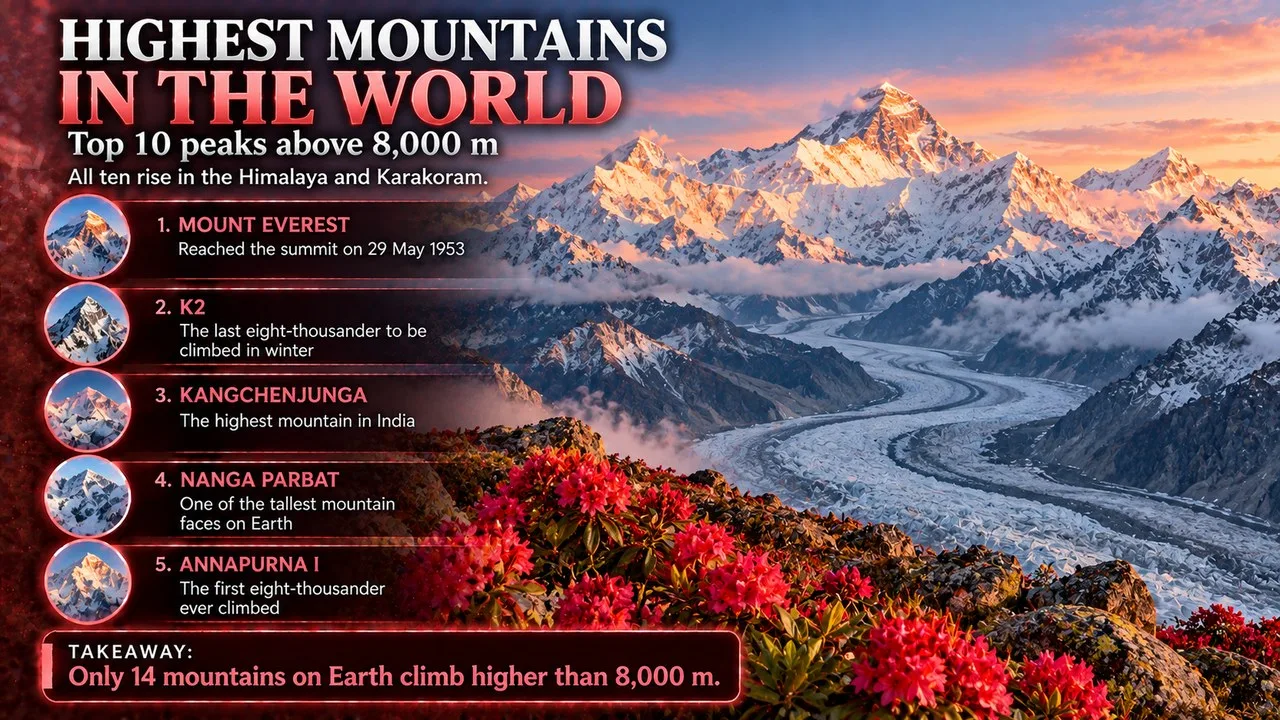
The highest mountains in the world all stand in Asia, in the Himalayas and the Karakoram, and every one of the top ten rises above 8,000 metres. Mount Everest leads at 8,848.86 metres, the height Nepal and China announced jointly in December 2020.[2] K2 is second at 8,611 metres and Kangchenjunga third at 8,586 metres.[3][4] Together with four lower peaks, these mountains make up the 14 eight-thousanders recognised by the International Mountaineering and Climbing Federation (UIAA).[1]
This Finepedia list, updated in October 2026, ranks the top 10 highest mountains in the world by summit height above sea level. For each mountain it gives the height, location, first ascent, the meaning of its name and the stories that made it famous.
Key Facts
The table below sums up the ten mountains on this list, with the height, range, location and first ascent of each.
The 10 Mountains at a Glance
| Rank | Mountain | Height | Range | Location | First ascent |
|---|---|---|---|---|---|
| 1 | Mount Everest | 8,849 m (29,032 ft) | Himalayas | China–Nepal border | 1953 |
| 2 | K2 | 8,611 m (28,251 ft) | Karakoram | Pakistan-administered Kashmir and Xinjiang, China | 1954 |
| 3 | Kangchenjunga | 8,586 m (28,169 ft) | Himalayas | Nepal and Sikkim, India | 1955 |
| 4 | Lhotse | 8,516 m (27,940 ft) | Himalayas | Tibet, China and Khumbu, Nepal | 1956 |
| 5 | Makalu | 8,485 m (27,838 ft) | Himalayas | China–Nepal border | 1955 |
| 6 | Cho Oyu | 8,188 m (26,864 ft) | Himalayas | Khumbu, Mahalangur Himal | 1954 |
| 7 | Dhaulagiri I | 8,167 m (26,795 ft) | Himalayas | Nepal | 1960 |
| 8 | Manaslu | 8,163 m (26,781 ft) | Himalayas | Nepal | 1956 |
| 9 | Nanga Parbat | 8,126 m (26,660 ft) | Himalayas | Pakistan-administered Kashmir | 1953 |
| 10 | Annapurna I | 8,091 m (26,545 ft) | Himalayas | Nepal | 1950 |
Sources: the individual mountain articles listed in the references.[2][3][4][5][6][7][8][9][10][11]
How the Ranking Works
The list ranks independent mountains by the height of their summit above sea level. The eight-thousanders are the 14 mountains recognised by the UIAA whose summits are higher than 8,000 metres and are independent enough of nearby peaks.[1] There is no formally agreed definition of prominence, and the UIAA has at times considered expanding the list to 20 peaks by adding major satellite peaks of the 14.[1] Subsidiary summits, such as Lhotse Middle or Lhotse Shar, are therefore not ranked separately.[5]
Height above sea level is not the only way to measure a mountain. Mauna Kea in Hawaii is the tallest when measured from its base. It rises more than 10,200 metres from the floor of the ocean but reaches only 4,205 metres above sea level.[2] The summit of Chimborazo in Ecuador is 2,168 metres farther from the centre of the Earth than Everest's summit, because the Earth bulges at the equator.[2]
How the Himalayas Were Made
The Himalayas were pushed up after the Indian tectonic plate collided with the Eurasian plate.[12] India's defining geological history began about 70 million years ago, when it split away from the supercontinent Gondwana and moved north.[12] The Karakoram, home of K2, is about 500 kilometres long and is the most glaciated place on Earth outside the polar regions.[13] Its Siachen Glacier, 76 kilometres long, and Biafo Glacier, 63 kilometres long, are the second- and third-longest glaciers outside the polar regions.[13]
1. Mount Everest (8,849 m)
Mount Everest lies in the Mahalangur Himal sub-range of the Himalayas, and its summit marks part of the China–Nepal border.[2] In 2020, a joint survey by Nepal and China measured its height as 8,848.86 metres, a figure based on the highest point of rock rather than the snow and ice above it.[2]
Related: Top 10 Most Dangerous Mountains in the World
Name
The Tibetan name is often written as Chomolungma.[2] The British Surveyor General of India, Andrew Waugh, said he could not find a commonly used local name, partly because Nepal and Tibet kept foreigners out. He decided that Peak XV should be named after his predecessor as Surveyor General, Sir George Everest.[2] On the Nepalese side, the mountain is protected within Sagarmatha National Park, and on the Chinese side within the Qomolangma National Nature Reserve.[2]
First Ascent
Tenzing Norgay and Edmund Hillary made the first documented ascent of Everest in 1953, by the Southeast Ridge route.[2] In 1978, Reinhold Messner and Peter Habeler made the first ascent without supplemental oxygen.[2]
Interesting Facts
- Deaths: As of May 2024, 340 people had died on Everest, and more than 200 bodies remain on the mountain because it is too dangerous to recover them. [2]
- Winds: Strong summit winds can blow climbers into chasms and, by lowering the air pressure, reduce the oxygen available by up to 14 percent. [2]
- Geese: George Lowe, a member of the 1953 expedition, said he saw bar-headed geese flying over the summit. [2]
- First winter ascent: Leszek Cichy and Krzysztof Wielicki of a Polish team made the first winter ascent of an eight-thousander when they reached the summit of Everest on 17 February 1980. [1]
2. K2 (8,611 m)
K2, also known as Mount Godwin-Austen, is the second-highest mountain on Earth at 8,611 metres.[3] It lies in the Karakoram range, partly in the Gilgit-Baltistan region of Pakistan-administered Kashmir and partly in the China-administered Trans-Karakoram Tract in Xinjiang.[3]
Name
A British team first surveyed the mountain in 1856. Thomas Montgomerie sketched the two most prominent peaks of the Karakoram from Mount Haramukh, about 210 kilometres to the south, and labelled them K1 and K2, with the K standing for Karakoram.[3]
First Ascent
The Italian climbers Lino Lacedelli and Achille Compagnoni first reached the summit on 31 July 1954, by the Abruzzi Spur. They were part of an Italian expedition led by Ardito Desio.[3]
Interesting Facts
- The Savage Mountain: K2 got its nickname after George Bell, a climber on the 1953 American expedition, said, "It's a savage mountain that tries to kill you." [3]
- Deadliest of the five: Before 2021, about one person had died on K2 for every four who reached the summit, making it the deadliest of the world's five highest mountains. [3]
- Last in winter: In January 2021, K2 became the last eight-thousander to be climbed in winter, by a team of ten Nepalese climbers led by Nirmal Purja and Mingma Gyalje Sherpa. [3]
3. Kangchenjunga (8,586 m)
Kangchenjunga is the third-highest mountain in the world. It lies in the border region between Koshi Province of Nepal and the Indian state of Sikkim.[4] Its summit rises to 8,586 metres in the Kangchenjunga Himal, a section of the Himalayas bounded by the Tamur, Lhonak and Teesta rivers.[4]
Related: Top 10 Geographical Extreme Points of the World
Name
The Schlagintweit brothers explained the local name as meaning "the five treasures of the high snow", from Tibetan words.[4] Kangchenjunga is considered a sacred mountain in Nepal and Sikkim.[4]
First Ascent
Joe Brown and George Band of the 1955 British Kangchenjunga expedition first climbed the mountain on 25 May 1955.[4] They stopped just short of the true summit, keeping a promise to Tashi Namgyal, the Chogyal of Sikkim, that the top of the mountain would remain untouched.[4]
Interesting Facts
- Once the highest: Until 1852, Kangchenjunga was believed to be the highest mountain in the world. Calculations by the Great Trigonometrical Survey of India in 1849 showed that Everest, then called Peak XV, was higher. [4]
4. Lhotse (8,516 m)
Lhotse is the fourth-highest mountain on Earth, after Everest, K2 and Kangchenjunga.[5] Its main summit, at 8,516 metres, sits on the border between the Tibet Autonomous Region of China and the Khumbu region of Nepal.[5] Its name means "South Peak" in Tibetan, which reflects its close link to Everest.[5]
First Ascent
The Swiss climbers Ernst Reiss and Fritz Luchsinger first climbed the main summit on 18 May 1956, as members of the Swiss Mount Everest/Lhotse Expedition.[5]
Interesting Facts
- Four summits: The main ridge has four summits: Lhotse Main at 8,516 metres, Lhotse Middle at 8,414 metres, Lhotse Central II at 8,372 metres, and Lhotse Shar. [5]
- Everest massif: With Everest to the north and Nuptse to the west, Lhotse forms the high point of the horseshoe-shaped Everest massif. Because the South Col between Lhotse and Everest is so high, Lhotse is the least prominent of the eight-thousanders. [5]
- South Face: The standard route by the Reiss Couloir is of medium difficulty, but its extremely steep South Face is regarded as one of the hardest climbs in the world. [5]
5. Makalu (8,485 m)
Makalu is the fifth-highest mountain on Earth, with a summit at 8,485 metres.[6] It stands in the Mahalangur Himalayas 19 kilometres southeast of Mount Everest, on the China–Nepal border.[6] Makalu is an isolated peak shaped like a four-sided pyramid.[6]
First Ascent
Lionel Terray and Jean Couzy of a French expedition led by Jean Franco first reached the summit on 15 May 1955.[6] A year earlier, in the autumn of 1954, a French reconnaissance expedition had made the first ascents of the subsidiary summits Kangchungtse and Chomo Lonzo.[6]
6. Cho Oyu (8,188 m)
Cho Oyu is the sixth-highest mountain in the world at 8,188 metres.[7] It is the westernmost major peak of the Khumbu section of the Mahalangur Himalaya, 20 kilometres west of Mount Everest.[7] Its name means "Turquoise Goddess" in Tibetan.[7]
Related: Top 10 Highest Mountains in the United States
First Ascent
Herbert Tichy, Joseph Jöchler and Pasang Dawa Lama, a Sherpa on an Austrian expedition, first climbed it on 19 October 1954 by the northwest ridge.[7]
Interesting Facts
- The easiest eight-thousander: Cho Oyu is close to the Nangpa La, a 5,716-metre glaciated pass that is the main trading route between Tibetans and the Sherpas of the Khumbu. Because of this and the moderate slopes of its standard route, it is considered the easiest 8,000-metre peak to climb. [7]
- Height: New measurements by Nepal's Survey Department and the Finnish Meteorological Institute in 1996 put the height at 8,188 metres. [7]
7. Dhaulagiri I (8,167 m)
Dhaulagiri is the seventh-highest mountain in the world at 8,167 metres. It is the highest mountain lying entirely within one country, Nepal.[8] Its Nepali name comes from Sanskrit: dhawala means dazzling, white or beautiful, and giri means mountain.[8]
First Ascent
A Swiss-Austrian-Nepali expedition first climbed it on 13 May 1960. The summit team included Kurt Diemberger, Peter Diener, Ernst Forrer, Albin Schelbert, Nyima Dorje Sherpa and Nawang Dorje Sherpa.[8]
Interesting Facts
- Once the highest: Survey calculations in 1808 showed Dhaulagiri to be the highest mountain surveyed up to that time. [8]
- Steep rise: It rises 7,000 metres from the Kali Gandaki River 30 kilometres away. The river flows through the Kali Gandaki Gorge, the deepest in the world. [8]
8. Manaslu (8,163 m)
Manaslu, also called Kutang, is the eighth-highest mountain in the world at 8,163 metres.[9] It is in the Mansiri Himal in west-central Nepal. It is the highest peak in Gorkha District and lies about 64 kilometres east of Annapurna.[9] Manaslu means "mountain of the spirit". The name comes from the Sanskrit word manasa, meaning intellect or soul.[9]
First Ascent
Toshio Imanishi and Gyalzen Norbu of a Japanese expedition first climbed Manaslu on 9 May 1956.[9] Before that success, four Japanese expeditions between 1950 and 1955 had explored routes up its north and east faces.[9]
9. Nanga Parbat (8,126 m)
Nanga Parbat, known in Shina as Diamer, is the ninth-highest mountain on Earth at 8,126 metres.[10] It lies just southeast of the northernmost bend of the Indus River in the Gilgit-Baltistan region of Pakistan-administered Kashmir. It forms the western anchor of the Himalayas and is the westernmost eight-thousander.[10]
Related: Top 10 Longest Mountain Ranges in the World
First Ascent
The Austrian climber Hermann Buhl first reached the summit on 3 July 1953, by the Rakhiot Flank, as a member of a German-Austrian expedition.[10] He climbed without oxygen and is the only person to have made the first ascent of an 8,000-metre peak alone.[10]
Interesting Facts
- Killer Mountain: Nanga Parbat is known as an extremely difficult climb and has been nicknamed the Killer Mountain because of its many climber deaths. [10]
- Rupal Face: Its south side has what is often called the highest mountain face in the world. The Rupal Face rises 4,600 metres above its base. [10]
- The Messners: In 1970, the brothers Günther and Reinhold Messner made the third ascent of the mountain and the first ascent of the Rupal Face. [10]
10. Annapurna I (8,091 m)
Annapurna is the tenth-highest mountain in the world at 8,091 metres. It is in the Annapurna range of Gandaki Province, in north-central Nepal.[11] The mountain is named after Annapurna, the Hindu goddess of food and nourishment, who is said to live there. In Sanskrit, the name can be translated as "everlasting food".[11]
First Ascent
Maurice Herzog and Louis Lachenal of a French expedition led by Herzog reached the summit on 3 June 1950. This made Annapurna the first eight-thousander to be climbed.[11]
Interesting Facts
- Danger: For decades, Annapurna I had the highest ratio of deaths to summits of all the main eight-thousanders. Its fatality rate is now about 13.42 percent. [11]
- South Face: The 3,000-metre south face was first climbed in 1970 by Don Whillans and Dougal Haston, without supplementary oxygen, on a British expedition led by Chris Bonington. [11]
- Conservation: The whole massif is protected within the 7,629-square-kilometre Annapurna Conservation Area, the first and largest conservation area in Nepal. [11]
- Trekkers: In 2014, a snowstorm near Annapurna and Dhaulagiri killed at least 43 people. [11]
Climbing All 14 Eight-thousanders
All 14 eight-thousanders were first climbed between 1950 and 1964. The first was Annapurna I in 1950 and the last was Shishapangma in 1964.[1] Shishapangma lies in Tibet, which China kept closed to foreigners until 1978. It was climbed by a Chinese team led by Xu Jing.[1] In 1986, the Italian climber Reinhold Messner became the first person to climb all 14, without supplementary oxygen.[1] The Polish climber Jerzy Kukuczka created more than ten new routes on eight-thousanders.[1]
Key Figures
- 8,848.86 m: Official height of Mount Everest, announced in December 2020. [2]
- 14: Mountains recognised as eight-thousanders. [1]
- 340: Deaths on Everest as of May 2024. [2]
- 1 in 4: Roughly the ratio of deaths to summits on K2 before 2021. [3]
- 1950: Year Annapurna I became the first eight-thousander to be climbed. [11]
- 1986: Year Reinhold Messner completed all 14 eight-thousanders. [1]
- 4,600 m: Height of Nanga Parbat's Rupal Face. [10]
- 10,200 m: Height of Mauna Kea from its base on the ocean floor. [2]
Frequently Asked Questions
What is the highest mountain in the world?
Mount Everest, at 8,848.86 metres, on the China–Nepal border.[2]
Which is the deadliest of the highest mountains?
K2 has long been the deadliest of the five highest mountains. Annapurna I had the highest ratio of deaths to summits among the main eight-thousanders for decades.[3][11]
Which eight-thousander was climbed first?
Annapurna I, by Maurice Herzog and Louis Lachenal on 3 June 1950.[11]
Which eight-thousander is easiest to climb?
Cho Oyu is considered the easiest because of its moderate standard route.[7]
Who first climbed all 14 eight-thousanders?
Reinhold Messner, in 1986, without supplementary oxygen.[1]
See also
- Top 10 Largest Islands in the World
- Top 10 Deepest Lakes in the World
- Top 10 Longest Rail Tunnels in the World
- ^ [1] "Eight-thousander". Wikipedia. Wikipedia
- ^ [2] "Mount Everest". Wikipedia. Wikipedia
- ^ [3] "K2". Wikipedia. Wikipedia
- ^ [4] "Kangchenjunga". Wikipedia. Wikipedia
- ^ [5] "Lhotse". Wikipedia. Wikipedia
- ^ [6] "Makalu". Wikipedia. Wikipedia
- ^ [7] "Cho Oyu". Wikipedia. Wikipedia
- ^ [8] "Dhaulagiri". Wikipedia. Wikipedia
- ^ [9] "Manaslu". Wikipedia. Wikipedia
- ^ [10] "Nanga Parbat". Wikipedia. Wikipedia
- ^ [11] "Annapurna". Wikipedia. Wikipedia
- ^ [12] "Himalayas". Wikipedia. Wikipedia
- ^ [13] "Karakoram". Wikipedia. Wikipedia





















Discussion
Log in with