





 By
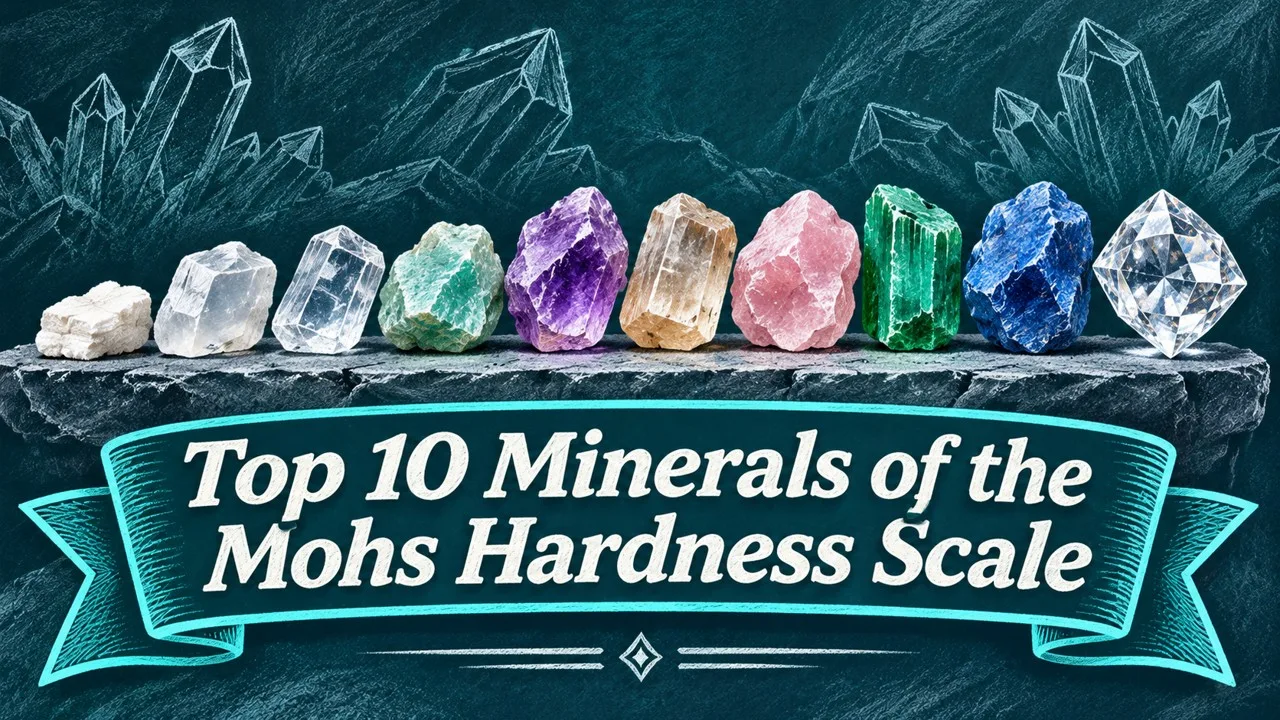
From soft talc to unbeatable diamond, the ten minerals of the Mohs hardness scale help geologists, jewellers and students test how hard a material really is. The Mohs scale of mineral hardness ranks minerals by their ability to scratch one another. It was devised in 1812 by the German geologist Friedrich Mohs, who chose ten common minerals as reference points from the softest to the hardest.
The scale is ordinal, which means it shows order but not equal steps. Diamond at 10 is far more than ten times harder than talc at 1, and the gap between corundum and diamond is especially large. Even so, the simple scratch test remains one of the quickest ways to identify minerals in the field.
Key Facts
The ten reference minerals below are listed from the softest to the hardest.
The Mohs Scale Minerals at a Glance
| # | Mineral | Mohs hardness | Chemical makeup | Everyday link |
|---|---|---|---|---|
| 1 | Talc | 1 | Hydrated magnesium silicate | Talcum powder |
| 2 | Gypsum | 2 | Hydrated calcium sulfate | Plaster and drywall |
| 3 | Calcite | 3 | Calcium carbonate | Limestone and marble |
| 4 | Fluorite | 4 | Calcium fluoride | Fluorescence and steelmaking |
| 5 | Apatite | 5 | Calcium phosphate | Teeth and bones |
| 6 | Orthoclase | 6 | Potassium aluminium silicate | Granite and ceramics |
| 7 | Quartz | 7 | Silicon dioxide | Sand, glass and watches |
| 8 | Topaz | 8 | Aluminium silicate with fluorine | Gemstone |
| 9 | Corundum | 9 | Aluminium oxide | Rubies, sapphires and abrasives |
| 10 | Diamond | 10 | Pure carbon | Gemstones and cutting tools |
1. Talc
Talc is the softest mineral on the Mohs scale and can be scratched with a fingernail. It feels soapy or greasy to the touch, which is why its massive form is called soapstone. [1]
Chemically it is a hydrated magnesium silicate, built from thin sheets of atoms that slide over one another very easily. This layered structure explains both its softness and its slippery feel. [1]
Talc has many uses. Ground into powder, it has been used in cosmetics and baby powder, and it is also used in paper, plastics, paint and ceramics. Soapstone has been carved into bowls, ornaments and sculptures for thousands of years because it is so easy to shape.
Concerns about some talc deposits being contaminated with asbestos have led to legal cases and to some companies withdrawing talc-based baby powder.
Key Figures
- Mohs hardness: 1
- Formula type: hydrated magnesium silicate
- Scratched by: a fingernail
- Rock form: soapstone
Why It Made the List
Talc marks the bottom of the scale. Its softness and slipperiness make it one of the most useful industrial minerals.
2. Gypsum
Gypsum has a hardness of 2 and can also be scratched with a fingernail, though with more effort than talc. It forms in many places where salty water has evaporated, leaving thick layers of mineral behind. [2]
It is made of calcium sulfate combined with water. When heated, gypsum loses part of its water and becomes plaster of Paris, named after large deposits near Paris. Mixed with water again, it sets hard. [2]
Gypsum is used to make drywall, plaster and cement, and farmers spread it on soil. A clear variety called selenite forms large crystals, and the Cave of the Crystals in Naica, Mexico, contains gypsum beams more than 10 metres long.
Alabaster, a fine-grained form, has been used for carvings since ancient times.
Key Figures
- Mohs hardness: 2
- Formula type: hydrated calcium sulfate
- Heated product: plaster of Paris
- Giant crystals: Naica, Mexico
Why It Made the List
Gypsum is one of the most widely used minerals in building. Its giant crystals are among nature's most spectacular sights.
3. Calcite
Calcite has a hardness of 3 and can be scratched by a copper coin or a steel knife. It is one of the most common minerals on Earth and the main component of limestone and marble. [3]
It is made of calcium carbonate, the same material found in seashells, coral skeletons and chalk. A simple test for calcite is to add weak acid, which makes it fizz as carbon dioxide is released. [3]
Related: Grand Canyon: A Geological Marvel Carved by the Colorado River
Clear calcite crystals, known as Iceland spar, show double refraction, so anything seen through them appears doubled. Some historians have suggested that Viking navigators may have used similar crystals as sunstones to find the sun on cloudy days, though this remains debated.
Calcite also forms stalactites and stalagmites in limestone caves.
Key Figures
- Mohs hardness: 3
- Formula: calcium carbonate
- Optical property: double refraction
- Common rocks: limestone and marble
Why It Made the List
Calcite builds much of Earth's sedimentary rock and many famous buildings. Its optical tricks have fascinated scientists for centuries.
4. Fluorite
Fluorite has a hardness of 4 and can be scratched easily by a steel knife. It forms cube-shaped and eight-sided crystals in a wide range of colours, including purple, green, blue and yellow. [4]
It is made of calcium fluoride. The word fluorescence comes from fluorite, because some specimens glow under ultraviolet light, and the element fluorine was also named after the mineral. [4]
Fluorite is used as a flux in steelmaking and aluminium production and is the main source of fluorine for chemicals. A banded purple variety called Blue John, found in Derbyshire, England, has been made into ornaments for centuries.
Very pure fluorite is used for special camera and telescope lenses.
Because it is fairly soft and splits easily along flat planes, fluorite is rarely worn in rings, but collectors prize its clear, colourful crystals, and many museums display large specimens.
Key Figures
- Mohs hardness: 4
- Formula: calcium fluoride
- Gave its name to: fluorescence and fluorine
- Famous variety: Blue John, Derbyshire
Why It Made the List
Fluorite links geology with chemistry and optics. It gave its name to a whole branch of light science.
5. Apatite
Apatite has a hardness of 5 and is scratched by a steel knife with some effort. It is a group of calcium phosphate minerals, often found as green, blue or yellow six-sided crystals. [5]
The mineral part of human teeth and bones is a form of apatite called hydroxyapatite. Tooth enamel, the hardest tissue in the body, is mostly made of it. [5]
Apatite is the main source of phosphate rock, which is mined to make fertilisers. Large deposits in Morocco, China and other countries are essential to world agriculture.
Its name comes from a Greek word meaning to deceive, because it was often mistaken for other minerals.
Fluoride in toothpaste helps protect teeth because it can turn part of the hydroxyapatite in enamel into fluorapatite, a slightly harder and more acid-resistant form of the same mineral.
Related: Top 10 Amazing Animals of the Amazon Rainforest
Key Figures
- Mohs hardness: 5
- Formula type: calcium phosphate
- In the body: teeth and bones
- Main use: phosphate fertiliser
Why It Made the List
Apatite connects geology with biology and farming. It is literally part of our bodies and helps grow our food.
6. Orthoclase
Orthoclase is a potassium feldspar with a hardness of 6. It can scratch glass and cannot be scratched by a steel knife. Feldspars are the most common group of minerals in Earth's crust. [6]
Orthoclase is found in granite and many other igneous rocks, often as pink or white crystals. Its name comes from Greek words meaning straight break, because it splits at right angles. [6]
It is used to make ceramics, glass and porcelain. A gemstone variety called moonstone shows a soft, glowing sheen caused by thin layers inside the crystal.
Weathering of feldspars over long periods produces clay minerals, which are important in soils.
On the Mohs scale, orthoclase sits between window glass and a steel file in hardness, which makes it a handy reference point when testing unknown minerals in the field.
Key Figures
- Mohs hardness: 6
- Mineral group: feldspar
- Common rock: granite
- Gem variety: moonstone
Why It Made the List
Orthoclase represents the feldspars that make up much of the planet's crust. It is essential to ceramics and soil formation.
7. Quartz
Quartz has a hardness of 7 and can scratch glass and steel. It is the second most common mineral in Earth's continental crust after feldspar. [7]
Made of silicon dioxide, quartz forms six-sided crystals and occurs in many colourful varieties, such as purple amethyst, yellow citrine and pink rose quartz. Fine-grained types include agate and jasper. [7]
Quartz produces an electrical charge when squeezed, an effect called piezoelectricity. This property is used in quartz watches and electronic circuits to keep accurate time.
Most sand on beaches is made of quartz grains, and quartz sand is the main raw material for glass.
Related: Top 10 Most Popular Underground Caves in the World
Quartz is so hard and chemically stable that it survives long after other minerals have broken down. That is why quartz sand builds up on beaches and in deserts all over the world.
Key Figures
- Mohs hardness: 7
- Formula: silicon dioxide
- Varieties: amethyst, citrine, rose quartz
- Special property: piezoelectricity
Why It Made the List
Quartz is everywhere, from beaches to watches. Its hardness and electrical properties make it essential to modern technology.
8. Topaz
Topaz has a hardness of 8 and can scratch quartz. It is a silicate mineral containing aluminium and fluorine and forms well-shaped crystals. [8]
Pure topaz is colourless, but impurities and natural radiation give it shades of yellow, brown, pink and blue. Much of the blue topaz sold today is made by treating colourless stones with radiation and heat. [8]
Large topaz crystals can weigh many kilograms. Brazil is a major source, and imperial topaz from Minas Gerais is especially prized for its pinkish-orange colour.
Topaz is the traditional birthstone for November.
The name topaz may come from Topazios, an island in the Red Sea mentioned by ancient writers, though the stone mined there was probably a different gem. In the past, many yellow stones were simply called topaz, so old records can be confusing.
Key Figures
- Mohs hardness: 8
- Formula type: aluminium fluorosilicate
- Major source: Brazil
- Birthstone: November
Why It Made the List
Topaz is one of the hardest common gemstones. Its many colours make it popular in jewellery.
9. Corundum
Corundum has a hardness of 9, making it the hardest natural mineral after diamond. It is made of aluminium oxide. [9]
Red corundum is called ruby, and corundum of any other colour is called sapphire. The red colour of ruby comes from chromium, and blue sapphires get their colour from iron and titanium. [9]
Because it is so hard, corundum is used as an abrasive. Emery, a dark rock rich in corundum, has been used for polishing and grinding since ancient times. Synthetic corundum is used in watch faces and some smartphone camera covers.
Synthetic rubies were first made in the late nineteenth century, and a synthetic ruby crystal was used in the first laser in 1960.
Related: Top 10 Giant Sinkholes and Blue Holes
Some of the most valuable gems in the world are corundum. Burmese rubies and Kashmir sapphires from the late nineteenth and early twentieth centuries command especially high prices at auction.
Key Figures
- Mohs hardness: 9
- Formula: aluminium oxide
- Gem varieties: ruby and sapphire
- Abrasive rock: emery
Why It Made the List
Corundum is both precious and practical. It gives us famous gems and tough industrial materials.
10. Diamond
Diamond has a hardness of 10, the top of the Mohs scale. It is made of pure carbon atoms arranged in a very strong crystal structure. [10]
Diamonds form under high pressure and temperature deep in the Earth's mantle and are carried to the surface by volcanic eruptions in rocks called kimberlites. Most natural diamonds are more than a billion years old. [10]
Diamond is the hardest natural material and is used in cutting, drilling and polishing tools. It also conducts heat extremely well. Gem diamonds are graded by cut, colour, clarity and carat weight.
Graphite, the material in pencils, is also pure carbon, but its atoms are arranged in soft sheets.
Synthetic diamonds have been made since the 1950s using high pressure and temperature, and newer methods grow them from carbon-rich gas. Today most industrial diamonds are synthetic.
Key Figures
- Mohs hardness: 10
- Formula: pure carbon
- Source rock: kimberlite
- Typical age: more than 1 billion years
Why It Made the List
Diamond tops the scale and sets the limit of natural hardness. It is both the most famous gem and a vital industrial tool.
Conclusion
The ten Mohs minerals give a simple but powerful way to compare hardness. They range from soft talc and gypsum used in powders and plaster to tough quartz, corundum and diamond used in tools and jewellery.
A pocket knife, a copper coin and a fingernail are still enough to place many minerals on the scale. Two centuries after Friedrich Mohs created it, the scale remains a basic tool in geology classrooms and the field.
- ^ [1] "Talc". Wikipedia. Wikipedia: Talc Wikipedia: Soapstone
- ^ [2] "Gypsum". Wikipedia. Wikipedia: Gypsum Wikipedia: Cave of the Crystals
- ^ [3] "Calcite". Wikipedia. Wikipedia: Calcite Wikipedia: Iceland spar
- ^ [4] "Fluorite". Wikipedia. Wikipedia: Fluorite Wikipedia: Blue John (mineral)
- ^ [5] "Apatite". Wikipedia. Wikipedia: Apatite Wikipedia: Hydroxyapatite
- ^ [6] "Orthoclase". Wikipedia. Wikipedia: Orthoclase Wikipedia: Moonstone (gemstone)
- ^ [7] "Quartz". Wikipedia. Wikipedia: Quartz Wikipedia: Piezoelectricity
- ^ [8] "Topaz". Wikipedia. Wikipedia: Topaz Wikipedia: Topaz
- ^ [9] "Corundum". Wikipedia. Wikipedia: Corundum Wikipedia: Ruby
- ^ [10] "Diamond". Wikipedia. Wikipedia: Diamond Wikipedia: Kimberlite






















Discussion
Log in with