






Top 10 Shipboard Traditions of the Transatlantic Liner Era
 By Dhiraj Sharma · Published
Share Post
Loading…
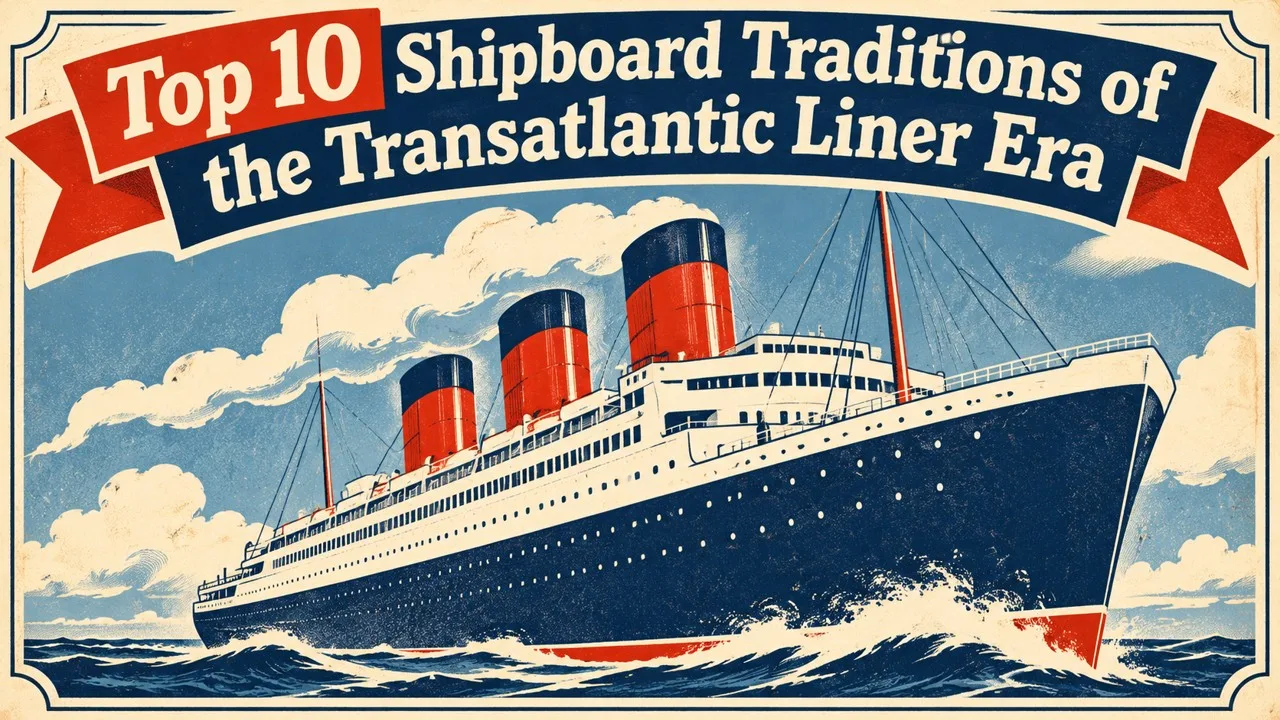
The great Atlantic liners ran on rituals, from daily mileage bets and mid-morning beef tea to lifeboat drills and clocks that changed every night. From the late nineteenth century to the 1950s, the fastest way to cross the North Atlantic was by ocean liner. Ships such as Mauretania, Olympic, Normandie and Queen Mary carried businesspeople, tourists, celebrities and, in far larger numbers, emigrants. A crossing took about five to seven days, long enough for every ship to develop routines that passengers remembered for the rest of their lives.
The ten traditions below are the daily mileage pool, the captain's table, dressing for dinner, the lifeboat drill, the Blue Riband, beef tea on deck, the changing of the ship's clocks, onboard newspapers, departure farewells and the persistent myth of POSH. Practices differed between companies, decades and classes of travel, so these are described as common customs rather than fixed rules.
Key Facts
| # | Tradition | What happened on board | Context |
|---|---|---|---|
| 1 | The mileage pool | Passengers bet on how far the ship had traveled in a day | Results posted around noon |
| 2 | The captain's table | Selected passengers dined with the master | A mark of status |
| 3 | Dressing for dinner | Evening dress in first class most nights | First and last nights were often informal |
| 4 | The lifeboat drill | Passengers mustered at boat stations | Required under international safety rules |
| 5 | The Blue Riband | An honor for the fastest crossing | Recognized by average speed, not a single race |
| 6 | Beef tea | Hot broth served to passengers in deck chairs | A remedy for cold winds and seasickness |
| 7 | The changing of the clocks | Ship's time adjusted as the vessel crossed time zones | Westbound days were longer |
| 8 | Onboard newspapers | Ships printed daily news received by radio | A new link to the world |
| 9 | Departure farewells | Crowds, music and paper streamers at sailing | A public ritual on the quay |
| 10 | The POSH myth | Port out, starboard home, supposedly stamped on tickets | No documentary support |
1. Betting on the Ship's Daily Run
One of the most popular pastimes in the smoking rooms of liners was the daily pool on the ship's run. Passengers bought numbers or bid in an auction for ranges of possible distances, and the winner was the person whose figure matched the mileage covered in the previous twenty-four hours [1].
The figure was announced around noon, when the ship's position was fixed by navigation. Because weather, currents and the captain's decisions affected speed, the pool was a mix of chance and amateur guesswork, and experienced travelers liked to discuss the weather with officers before bidding [1].
Gambling at sea occupied a legal gray zone, and professional card sharps were a known hazard on some routes. Lines often posted warnings about them. The mileage pool, by contrast, was a sociable ritual that gave passengers a reason to gather every day and to watch the progress of a ship that otherwise seemed to be surrounded by an unchanging ocean.
2. An Invitation to Sit With the Captain
In first class on major liners, an invitation to dine at the captain's table was a social prize. Captains, or the purser on their behalf, selected guests who were prominent, well connected or simply interesting, and seating was arranged with care [2].
The custom served the shipping company as well as the passengers. A famous guest at the captain's table made good publicity, and the captain acted as a host as well as a navigator. On large ships, other senior officers, such as the chief engineer or the ship's surgeon, also hosted tables [2].
In practice, captains on busy routes could not always attend every meal, especially in bad weather or near land, when they were needed on the bridge. The tradition continues in modified form on modern cruise ships, where captain's receptions and invitations remain part of the voyage, though they are now usually aimed at loyal customers rather than social celebrities.
3. Formal Dress, With Exceptions
First-class passengers on the great liners were expected to dress for dinner, which for men usually meant a dinner jacket or full evening dress and for women an evening gown. The dining saloons were designed to resemble grand hotels, and dress was part of the theater [3].
Related: Top 10 Most Famous Cruise Ships in the World
A widely reported convention was that passengers did not dress formally on the first and last nights of a crossing. On the first night, luggage might not have been unpacked, and on the last night, trunks were already packed for arrival. The custom is described in many travel memoirs, though practice varied [3].
Formal dress was less important in second and third class, where passengers wore their best ordinary clothes. As air travel took over the business market in the 1950s and 1960s and liners became more holiday-oriented, formal nights became fewer, but they remain a feature of some modern cruise lines, a direct inheritance from the liner era.
4. Drills After the Titanic
The sinking of Titanic in April 1912 changed safety at sea. Titanic carried lifeboats for only about half of the people on board, which met the outdated regulations of the time, and no full lifeboat drill had been held for passengers [4].
In response, the first International Convention for the Safety of Life at Sea, known as SOLAS, was agreed in London in 1914. It required enough lifeboat places for everyone on board, continuous radio watch on passenger ships and regular drills. The convention was delayed by the First World War, but its principles shaped later rules [4].
Lifeboat drills became a fixed ritual of every crossing. Passengers were shown their boat stations, told how to wear lifejackets and given a signal to listen for. For many travelers, the drill was the moment the reality of the ocean became clear. Modern cruise ships still hold musters before or shortly after departure.
5. The Unofficial Prize for Speed
The Blue Riband was an unofficial honor for the passenger liner that made the fastest average-speed crossing of the North Atlantic. It had no single governing body for most of its history, and records were tracked by the press and shipping enthusiasts [5].
Famous holders included Cunard's Mauretania, which held the westbound record from 1909 to 1929, Germany's Bremen, Italy's Rex, France's Normandie and Cunard's Queen Mary. In 1935, a British politician, Harold Hales, donated a trophy, the Hales Trophy, to formalize the honor, though some companies were reluctant to take part [5].
Related: Top 10 Largest Cruise Ships Ever Built
The last liner to win the Blue Riband was SS United States, in 1952, with an average speed of more than 34 knots eastbound. Records mattered for national prestige and advertising, and some ships were said to fly a long blue pennant after a win, though accounts of that practice vary. The competition ended as jet aircraft took over Atlantic travel.
6. A Mid-Morning Cup on Deck
On many liners, stewards served beef tea or bouillon to passengers on deck in the middle of the morning. Passengers sat in rented deck chairs, often wrapped in rugs, and the hot drink helped against the cold North Atlantic wind [6].
Beef tea had a long history as a restorative drink in Victorian Britain, often given to invalids. At sea, it was thought to settle stomachs and was easier to take than a full meal for passengers feeling unwell. The custom is mentioned in many memoirs and in company publicity [6].
The deck chair itself was part of the ritual. Passengers booked a chair through the deck steward early in the voyage, and the location mattered, since some spots were sheltered and others exposed. Beef tea, deck rugs and afternoon tea created a structured day at sea, a structure that modern cruise ships still echo with scheduled snacks and activities.
7. Clocks That Changed Every Night
A transatlantic liner moved through several time zones, so ship's time had to be adjusted. On many ships, clocks were moved by roughly an hour on most nights of the voyage, often around midnight, so that passengers gradually adapted to local time at the destination [7].
Westbound voyages, from Europe to North America, effectively had days of about twenty-five hours, which many passengers welcomed. Eastbound voyages lost an hour each day, which some found tiring. The adjustment was announced on the daily program and was a regular topic of conversation [7].
Related: Top 10 Famous Shipwrecks That Rewrote History
This gradual change is one reason ocean travel is sometimes said to have produced less disruption than modern jet lag. Passengers adjusted one hour at a time, rather than all at once. Navigation officers, meanwhile, worked in their own system of time based on the ship's position, which governed the noon fix used for the mileage pool.
8. News Delivered by Wireless
Before radio, a ship at sea was out of touch with the world for days. Wireless telegraphy, developed by Guglielmo Marconi and his company around 1900, changed that. Ships could receive news broadcasts and transmit messages for passengers, and some began to print their own newspapers [8].
By the 1900s and 1910s, larger liners produced daily news sheets containing headlines, stock market reports and sports results received by wireless. Passengers could follow events on land, and businesspeople could trade from the middle of the ocean [8].
Wireless also proved vital for safety. During the Titanic disaster, wireless operators called for help, and the ship Carpathia responded. After 1912, rules required continuous radio watches on passenger ships. For ordinary passengers, though, the most familiar result was the morning newspaper slipped under the cabin door, a small sign that the ocean was no longer cut off from the world.
9. Bands, Streamers and Farewells
Sailing day on a great liner was a public occasion. Friends and relatives came aboard before departure, often for parties in cabins, until a bell or announcement asked visitors to go ashore. Crowds gathered on the quay to watch the ship leave [9].
Paper streamers thrown between passengers on deck and people on shore became a widely recorded custom, especially on some routes, with the streamers stretching and breaking as the ship pulled away. Ship's bands often played as the vessel left the dock [9].
Related: Top 10 Famous Lighthouses with Remarkable Stories
For emigrants, departure could be far more emotional, since many did not expect to return. Photographs and newsreels of liner departures show a mixture of celebration and grief. The ritual of the farewell, with music and visible gestures, gave shape to a moment of separation, and it remains part of some modern cruise departures.
10. A Famous Acronym Without Evidence
A popular story holds that the word posh comes from Port Out, Starboard Home, supposedly written on the tickets of wealthy passengers traveling between Britain and India so that they had cabins on the shaded side of the ship. The story is often attached to the liner era in general [10].
Etymologists have found no evidence for it. No tickets marked POSH have been found, and the shipping company most associated with the route, P&O, has said it has no record of the practice. The word posh appears in other senses, including slang for money, earlier than the acronym story [10].
The myth persists because it is neat and memorable. It also fits a real concern: on hot routes, cabin position mattered for comfort. But the acronym appears to be a later invention, and most dictionaries now describe the origin of posh as uncertain. It is a good example of how a satisfying story can outlive the evidence.
Conclusion
The ten traditions above show how a crossing became a small society with its own calendar. Mileage pools, beef tea and changing clocks marked the days. Captain's tables and formal dress marked status. Lifeboat drills and wireless newspapers reflected new technology and the hard lessons of disaster.
Some of these customs survive on modern cruise ships, which borrowed the language and rituals of the great liners even as their purpose changed. And at least one famous liner story, POSH, turns out to be a myth, which is a reminder that nostalgia for the liner era can produce its own folklore.
- ^ [1] Accounts of liner life, including daily routines and passenger entertainment. Wikipedia: ocean liner Britannica: ocean liner
- ^ [2] Background on liner dining and social customs in first class. Wikipedia: RMS Queen Mary Wikipedia: SS Normandie
- ^ [3] Accounts of evening dress conventions. Wikipedia: black tie Wikipedia: RMS Mauretania
- ^ [4] The 1914 SOLAS convention and Titanic's lifeboat capacity. Wikipedia: SOLAS Wikipedia: lifeboats of the Titanic
- ^ [5] Histories of the Blue Riband, the Hales Trophy and SS United States. Wikipedia: Blue Riband Wikipedia: SS United States
- ^ [6] Background on beef tea as a Victorian restorative drink. Wikipedia: beef tea Wikipedia: deckchair
- ^ [7] Background on time zones and ship's time. Wikipedia: time zone Wikipedia: celestial navigation
- ^ [8] Histories of maritime wireless and the Marconi Company. Wikipedia: Marconi Company Wikipedia: RMS Carpathia
- ^ [9] Background on emigration by sea and departures. Wikipedia: transatlantic crossing Wikipedia: Ellis Island
- ^ [10] Etymological accounts rejecting the POSH acronym. Wikipedia: posh Online Etymology Dictionary: posh





















Discussion
Log in with