






 By
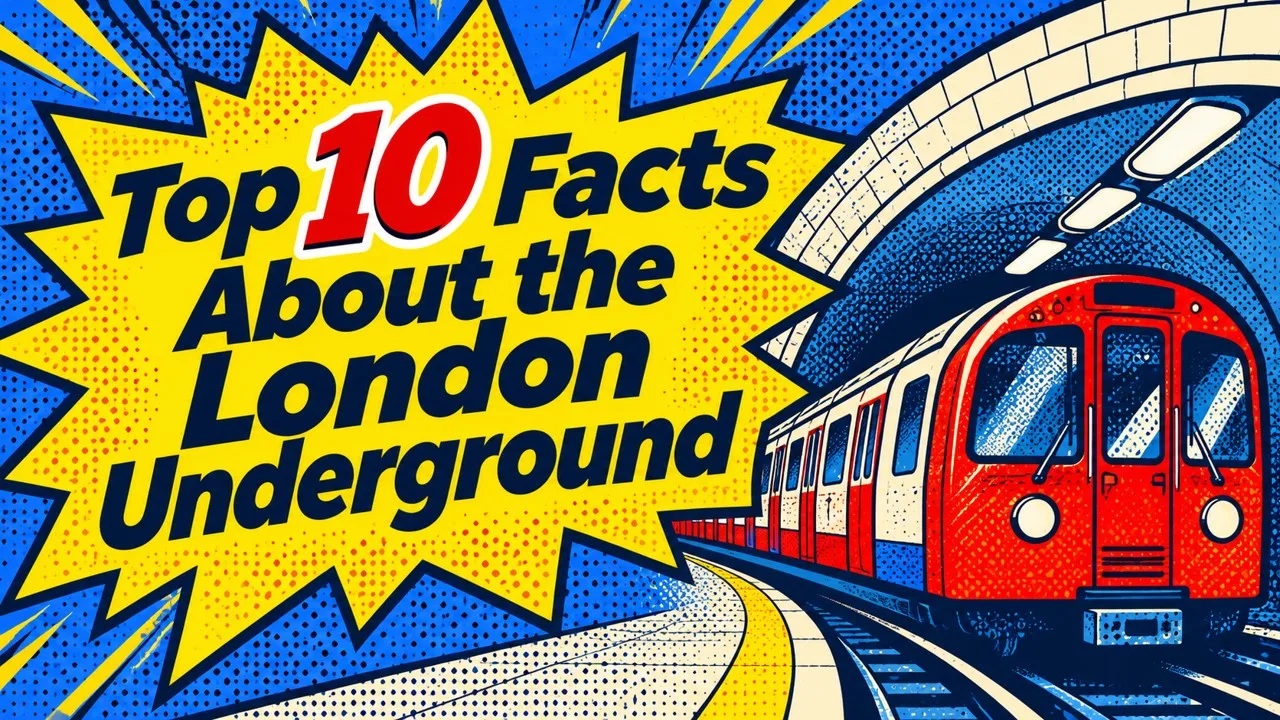
The London Underground began with steam trains in shallow trenches in 1863, and its map, typeface and tunnels still shape how cities think about transit. The London Underground is the oldest underground railway system in the world, and much of what people now expect from a metro, from a simple diagram to a recognizable typeface, was developed or popularized there. It is also a working railway that carries millions of journeys a day, with all the compromises that a network built over more than 160 years implies.
The ten facts below cover the first line of 1863, the first deep electric tube, the network's size, Harry Beck's map, the Johnston typeface, wartime shelters, the voice behind mind the gap, closed stations, the first escalators and the heat that builds up in the deep tunnels. Figures such as station counts change as the network changes, so they are given as approximate.
Key Facts
| # | Fact | Key detail | Why it matters |
|---|---|---|---|
| 1 | The first line, 1863 | The Metropolitan Railway opened between Paddington and Farringdon | World's first underground railway |
| 2 | The deep tube, 1890 | The City and South London Railway used electric trains | Created the true tube |
| 3 | Size and reach | Eleven lines, about 270 stations | Much of the network is above ground |
| 4 | Harry Beck's map, 1933 | A draftsman simplified the network into a diagram | A model copied worldwide |
| 5 | The Johnston typeface | Edward Johnston designed a sans-serif alphabet for the Underground | A pioneering corporate identity |
| 6 | Wartime shelters | Londoners slept in stations during air raids | Authorities first resisted, then organized it |
| 7 | Mind the gap | Recorded warnings were introduced from the late 1960s | One recording was restored at a single station |
| 8 | Closed stations | Dozens of stations have closed or been relocated | Some found wartime and film uses |
| 9 | Escalators | The first escalators opened at Earl's Court in 1911 | A rider was hired, so the story goes, to reassure |
| 10 | Heat in the tunnels | The deep lines can be far warmer than the streets above | Heat built up over a century |
1. Steam Trains in a Trench
On 10 January 1863, the Metropolitan Railway opened to the public between Paddington and Farringdon Street. It was the world's first underground railway, built mostly by the cut-and-cover method, in which a trench was dug along the line of a street, lined, roofed over and then covered again [1].
The trains were hauled by steam locomotives. To reduce smoke in the tunnels, the engines were designed to condense their steam, but the atmosphere in stations was still notoriously smoky. Despite that, the line was popular from the start and carried tens of thousands of passengers on its opening day [1].
The Metropolitan's success encouraged further lines, including the District Railway, and the two companies eventually completed the Circle line. The cut-and-cover lines are relatively shallow, and they still form part of today's Metropolitan, District, Circle and Hammersmith and City lines. The system's oldest sections are therefore older than the electric light bulb.
2. The First Deep Electric Tube
The word tube refers to the deep-level lines bored through London clay in circular tunnels. The first was the City and South London Railway, which opened in 1890 between King William Street in the City and Stockwell. It was also the first major railway in the world to use electric traction [2].
Its early carriages had very small windows, because the designers thought there was nothing to see in a tunnel, and they were nicknamed padded cells. Tunneling used a shield method developed from the work of engineers such as James Henry Greathead, which allowed boring through the clay without disturbing the streets above [2].
Deep-level tubes soon followed, including the Central London Railway of 1900, which charged a flat fare of twopence and was nicknamed the Twopenny Tube. Electric traction and deep tunnels made it possible to build lines beneath existing buildings, and they gave the system the name most Londoners use for it.
3. More Overground Than Its Name
The Underground today has eleven lines, around 270 stations and roughly 400 kilometers of route. It carries well over a billion passenger journeys in a typical year, although numbers fell sharply during the COVID-19 pandemic and have been recovering since [3].
Related: Top 10 Largest Metro Networks in the World
Despite its name, a large share of the network is not underground at all. Estimates commonly put the proportion of track in tunnels at under half, with long sections running on the surface or on embankments in outer London. The Metropolitan line, for example, runs far out into the countryside of Hertfordshire and Buckinghamshire [3].
The system is only part of London's rail network. The Elizabeth line, opened in 2022, the Overground and other services are run under the same Transport for London umbrella but are not counted as Underground lines. That distinction can confuse visitors, but it reflects the way London's railways were built by many companies over many decades.
4. A Diagram, Not a Map
Early Underground maps tried to show lines in their true geographical positions, which made the dense center crowded and the outer ends spread out. In 1931, Harry Beck, an engineering draftsman who had worked for the Underground, drew a different kind of map in his spare time [4].
Beck's design used straight lines, angles of 45 and 90 degrees and evenly spaced stations, and it enlarged the central area. The Underground's publicity department was initially doubtful, but a trial printing in 1933 proved popular with the public. The diagram treated the network more like an electrical circuit than a street plan [4].
Beck's approach became the model for transit diagrams around the world. It also introduced a well-known trade-off. Because distances are distorted, some journeys look longer or shorter than they are, and walking between some central stations can be faster than taking a train. Transport for London still publishes walking guidance partly for that reason.
5. A Typeface Commissioned in 1916
In 1913, Frank Pick, a manager at the Underground Electric Railways of London, commissioned the calligrapher Edward Johnston to design a clear, modern typeface for signs and posters. Johnston's alphabet, introduced in 1916, was a sans-serif design with simple, geometric forms [5].
The typeface became part of one of the earliest consistent corporate identities. Pick also commissioned posters from leading artists and modern station designs from the architect Charles Holden. Together, signs, posters and buildings gave the Underground a recognizable style [5].
Related: Top 10 Famous Tram Networks Worth the Ride
Johnston's lettering influenced later sans-serif typefaces, including Gill Sans, designed by Eric Gill, who had worked with Johnston. The typeface was revised in the late 1970s as New Johnston and again in 2016 for its centenary. It remains in use across Transport for London, which makes it one of the longest-serving corporate typefaces in the world.
6. Shelters During the Blitz
When German bombing of London began in September 1940, many Londoners took shelter in Underground stations. The government had initially discouraged this, fearing that people would refuse to leave and that the railway would be disrupted, but crowds bought tickets and stayed on the platforms [6].
Officials soon accepted the practice and began to organize it, providing bunks, sanitation, first aid and refreshment trains. At the peak, around 177,000 people sheltered in the Underground on a single night. Some unopened sections and closed stations were used for other purposes, including government offices and factories [6].
The stations were not always safe. Direct hits caused deaths at several stations, and in March 1943 a crowd crush on the stairs at Bethnal Green station, then still under construction, killed 173 people. These events are commemorated today, and the wartime role of the Underground remains an important part of London's memory of the Blitz.
7. A Voice Kept for a Widow
The phrase mind the gap warns passengers about the space between the train and the platform, which can be large on curved platforms. Recorded announcements were introduced on the Northern line around 1968 and 1969, replacing or supplementing staff calls [7].
Several voices have recorded the message over the years. One of them, the actor Oswald Laurence, recorded an announcement used on the Northern line. In 2012, after it had been replaced, his widow told staff that she used to visit Embankment station to hear his voice. Transport for London restored the recording at that station [7].
Related: Top 10 Most Bizarre Phobias: Strange Fears That Exist
The phrase has become a symbol of London itself, printed on souvenirs and copied on metro systems elsewhere. The story of the restored recording is widely reported and confirmed by the operator, and it shows how a technical safety message can become part of personal and civic memory.
8. Stations Left Behind
Over the network's history, dozens of stations have closed, often because they were too close to neighboring stations, had low use or were replaced by new stations. Some are now buildings above ground with nothing visible below, while others still have platforms that trains pass through [8].
Down Street, between Hyde Park Corner and Green Park on the Piccadilly line, closed in 1932. During the Second World War, it was converted into a protected headquarters, and Winston Churchill used it at times before the Cabinet War Rooms were completed. Aldwych, at the end of a short Piccadilly line branch, closed in 1994 and is now used for filming and occasional tours [8].
Closed stations are sometimes called ghost stations, a name that reflects how they appear from passing trains. London Transport Museum runs occasional tours of some of them. Their history shows how the network was revised over time rather than designed all at once.
9. The First Moving Stairs
The Underground's first escalators were installed at Earl's Court station in 1911. They replaced or supplemented lifts, which had been used at deep stations, and made it possible to move large crowds quickly between the platforms and the street [9].
A well-known story says that a man named William Harris, who had a wooden leg, was employed to ride the escalators to show passengers how easy they were to use. Some passengers supposedly joked about how he had lost his leg. The tale is repeated in many histories, but it is hard to verify fully, and it should be treated as an attractive anecdote rather than a documented fact [9].
Related: Top 10 Oldest Buildings in the World
What is certain is that escalators transformed deep stations. The Underground now has hundreds of them, and the longest, at Angel station, is around 60 meters. Standing on the right and walking on the left became a strong London custom.
10. Clay That Holds the Heat
The deep-level lines run through London clay, and the clay around them has absorbed heat from trains, braking, passengers and equipment for more than a century. As a result, temperatures in some tunnels and trains can be far higher than on the surface, particularly in summer [10].
Unlike the shallower cut-and-cover lines, the deep tubes have little room for air conditioning, because there is limited space in the tunnels to dump the heat. Newer trains on the subsurface lines have air conditioning, but cooling the deep tubes remains an engineering challenge. Projects have tested ways to use waste heat from the Underground to warm homes [10].
Some stations are very deep. Hampstead, on the Northern line, has the deepest platforms below ground level, at about 58 meters, because the station sits under a hill. The combination of depth, age and heat is a reminder that the Underground is not just a transport system, but also a long-lived piece of engineering embedded in the city.
Conclusion
The ten facts above trace the Underground from steam trains in trenches to a network of tunnels, signs and diagrams that much of the world has copied. Its first line, its first electric tube, Harry Beck's map and Edward Johnston's typeface all set patterns that other cities followed.
The system also carries a long history of improvisation, from Blitz shelters to closed stations and an old voice restored for a widow. Like many old infrastructures, it works because generations kept adapting it, and its oddities are the visible marks of that long process.
- ^ [1] Histories of the Metropolitan Railway and its 1863 opening. Wikipedia: Metropolitan Railway Wikipedia: history of the London Underground
- ^ [2] Accounts of the City and South London Railway and the Central London Railway. Wikipedia: City and South London Railway Wikipedia: Central London Railway
- ^ [3] Network size and the relationship to other TfL services. Wikipedia: London Underground Wikipedia: Transport for London
- ^ [4] Harry Beck and the history of the Tube map. Wikipedia: Tube map Wikipedia: Harry Beck
- ^ [5] Edward Johnston, Frank Pick and the Johnston typeface. Wikipedia: Johnston typeface Wikipedia: Frank Pick
- ^ [6] Wartime sheltering and the Bethnal Green disaster. Wikipedia: Bethnal Green disaster Wikipedia: the Blitz
- ^ [7] Mind the gap announcements and the Oswald Laurence recording. Wikipedia: mind the gap Wikipedia: Embankment station
- ^ [8] Down Street and Aldwych closed stations. Wikipedia: Down Street station Wikipedia: Aldwych station
- ^ [9] The first escalators at Earl's Court and the Angel escalators. Wikipedia: Earl's Court station Wikipedia: Angel station
- ^ [10] Heat in the deep tubes and Hampstead's depth. Wikipedia: Hampstead station Wikipedia: London Clay



















Discussion
Log in with