





 By
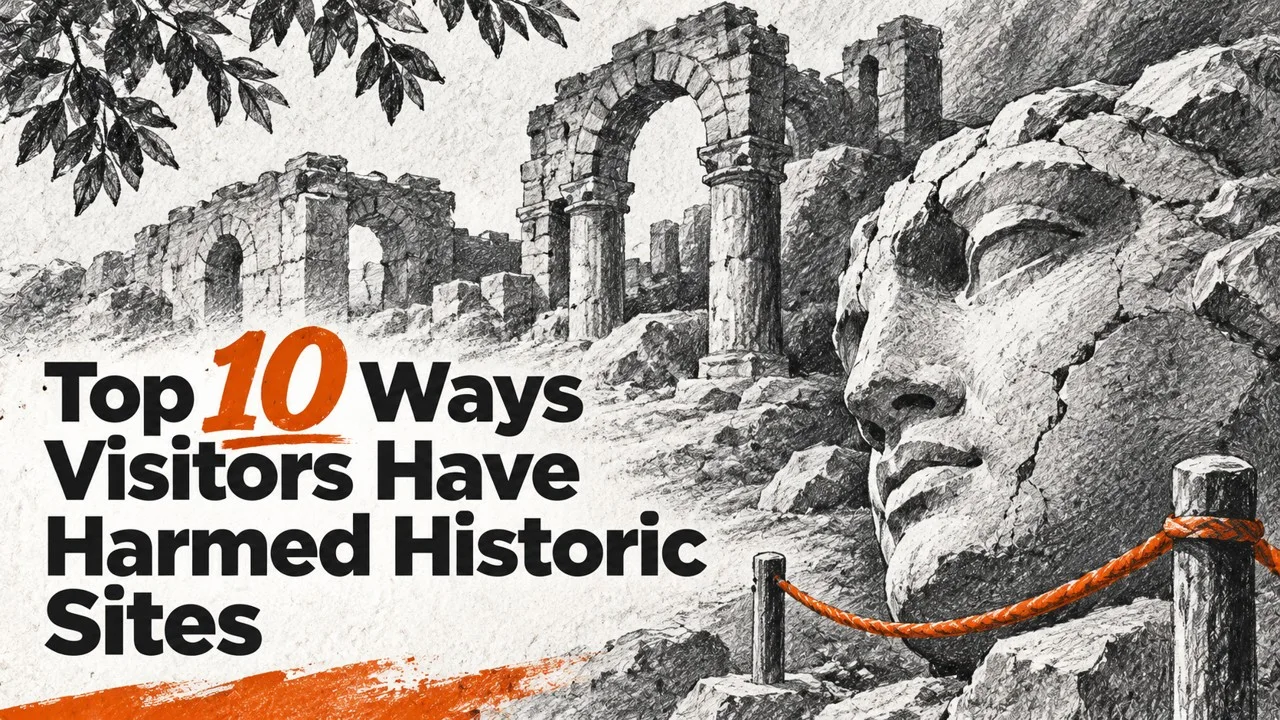
Visitors have harmed historic sites in ordinary ways, from coins hammered into stone to the breath that forced a famous cave to close.
The ten problems below are coins forced into columnar basalt, graffiti at the Colosseum, cobbles taken from Bruges, bricks taken from the Great Wall, petrified wood removed from protected ground, climbing on the Kukulkan pyramid, hands wearing a bronze statue in Verona, love locks loading historic bridges, footfall and touching at Pompeii and Herculaneum, and the air of visitors in painted caves such as Lascaux. This is a conservation history. It is not a guide, not a dare, and not a shame gallery of named private people. This article will not reproduce damaged famous art, and it will not explain how to defeat a barrier.
Key Facts
| Practice | The documented harm | A limit |
|---|---|---|
| 1 | Coins hammered into joints at the Giant's Causeway and similar sites stain and wedge the stone | A wish is not an excuse; removals are a conservation task |
| 2 | The Colosseum carries historic marks and also later scratching that abrades the fabric | Older graffiti can be evidence; new carving is damage |
| 3 | Souvenir hunting has taken cobbles from historic streets in Bruges and in other paved towns | A stone in a suitcase is a hole in a street |
| 4 | Loose or pried bricks have been taken from sections of the Great Wall | Official repair cannot keep up with casual removal if it is tolerated |
| 5 | Petrified wood has been stolen from parks, including the Petrified Forest, for decades | "It was already on the ground" does not make it private property |
| 6 | Climbing the Castillo at Chichen Itza wore treads and is now prohibited | The later rope is a conservation decision, not a lack of welcome |
| 7 | Touching a twentieth-century bronze in Verona has worn the metal at favorite spots | The statue is a later monument; the wear is still real |
| 8 | Love locks have overloaded historic railings and bridges, sometimes to the point of removal campaigns | A padlock is a small weight until there are thousands |
| 9 | Walking, touching, and crowding have worn and risked frescoes and fabric at Pompeii and Herculaneum | Access is a public good that has to be managed |
| 10 | Breath, moisture, and microbes from visitors helped force the closure of Lascaux and similar caves | Replicas exist because the original paint could not bear the traffic |
1. A Coin in the Joint, and a Stain in the Stone
At the Giant's Causeway, and at other columnar or jointed sites, visitors have hammered coins into cracks as a wish or a marker [1]. The metal weathers, stains the basalt, and acts as a wedge. Conservation teams have had to spend time removing the coins, which is the opposite of a victimless ritual. The site is famous because of the stone, not because of a mint. A similar habit at other monuments has produced the same dull, expensive result. This article will not suggest a better hiding place [1].
The unexpected fact is that a small denomination can become a masonry problem [1]. The careful fact is documented insertion, documented staining, and documented removal work. Superstition is the motive. Iron and copper are the agents.
A wish can be cheap in the pocket and still have been, in the joint, a slow tool.
2. Marks That Are Evidence, and Marks That Are Damage
The Colosseum has been written on for centuries [2]. Some historic inscriptions and later travelers' names are now treated as part of the building's long use, and they are studied rather than casually erased. That scholarly patience does not extend to new carving, paint, or scratches made by recent visitors, which abrade already weathered stone and add nothing of record. The difference is date, context, and intent, not a special fondness for vandalism in one century. Management has to protect a ruin that is also one of the most visited structures on Earth [2].
The unexpected fact is that a wall can be an archive and still not be a blank page [2]. This article will not show a damaged surface as a spectacle and will not name private carvers. The careful fact is documented historic marks, documented later damage, and documented conservation policy. History leaves traces. A later key is not an inscription.
A building can be allowed to keep old names and still need, in this century, a rule against new ones.
3. A Street That Goes Home in a Bag
Historic cities with distinctive paving, including Bruges, have had cobbles and setts lifted as souvenirs [3]. Each stone is small. A street is a pattern of many small stones, and the gaps are trip hazards, drainage problems, and a slow erasure of the surface that made the place recognizable. Officials have had to warn visitors and to replace missing pieces, which is a cost shifted from a suitcase to a public budget. The habit is not unique to one Belgian city; it is a type of taking that follows photogenic ground [3].
Related: Top 10 Remarkable Monasteries Around the World
The unexpected fact is that a pavement can be collected, a piece at a time, until it is a repair list [3]. This article will not identify easy stones. The careful fact is documented souvenir removal and documented replacement work. Memory wants an object. The street needed to stay a street.
A keepsake can fit in a bag and still have been, the day before, part of a public way.
4. A Wall That Loses Bricks to Pockets
Sections of the Great Wall, especially where fabric is already loose or unrestored, have lost bricks and rubble to people who wanted a private piece of a public monument [4]. The Wall is long, and that length can make a single brick seem negligible. Conservation and rebuilding programs have the opposite view: the structure is a continuous fabric, and casual removal is a leak. Official rules against taking materials exist because the practice had become ordinary, not because a sign was invented for its own sake. A brick on a shelf is a gap in a rampart [4].
The unexpected fact is that a world-famous wall can be, in places, unbuilt by hand, in small units [4]. This article will not map soft spots. The careful fact is documented removal and documented official prohibition and repair. Awe is the usual excuse. Masonry is the loss.
A souvenir can be older than a house and still not have been, except by theft, a household object.
5. Wood That Turned to Stone, and Then to a Souvenir
Petrified wood in parks such as Petrified Forest National Park in Arizona has been taken by visitors for more than a century, despite rules and despite later amnesty programs in which some people mailed pieces back [5]. The logs are a public scientific and scenic resource. "It was already on the ground" is a common justification and a legal and conservation error: protected objects on the surface are still part of the site. The losses are visible as disappearing scatter and as later guilt in letters. Other fossil and mineral sites have the same problem in miniature [5].
The unexpected fact is that a park can receive, years later, a package of regret [5]. This article will not give a collecting hint. The careful fact is documented, long-running removal and documented official efforts to stop it and sometimes to reverse it. Geology is slow. A pocket is fast.
Related: Top 10 Oldest Buildings in the World
A fossil can look free because it is lying down and still have been, in the statute, not for taking.
6. A Stair That Was Climbed Until It Could Not Be
The Castillo, the pyramid at Chichen Itza associated with the deity Kukulkan, was for years climbed by visitors [6]. The treads wore, the risk of falls was real, and the site's managers closed the ascent. What looks, in an older photograph, like an ordinary tourist stair is a pre-Columbian monument that was not built as a modern viewing platform. Similar closures at other pyramids and mounds follow the same reasoning: fabric and safety come before a private summit. The rope is a conservation decision, not a refusal of interest in the culture [6].
The unexpected fact is that a famous climb can end, officially, because the climb itself was the harm [6]. This article will not suggest another route. The careful fact is documented wear, documented prohibition, and documented later ground-level visiting. Wonder can happen from the plaza. The steps needed to rest.
A pyramid can be open as a site and still not be, any longer, a staircase for a crowd.
7. A Bronze Worn by Hands, in a Later Plaza
In Verona, a bronze figure associated with the later Juliet tradition stands in a courtyard and has been touched so often that the metal is worn bright, and thinner, at favorite spots [7]. The statue is a twentieth-century monument, not a medieval relic, which makes the literary romance even more clearly a modern habit. The wear is still a conservation problem: bronze does not have an infinite surface, and oils and abrasion change it. Officials have had to consider barriers, replacements, or repairs. Love, in this form, is a polishing cloth [7].
The unexpected fact is that a comparatively new statue can already need protection from devotion [7]. This article will not sexualize the wear or name private visitors. The careful fact is documented touching, documented metal loss, and a documented later story rather than a medieval original. Fiction can move a hand. The alloy still has a thickness.
Related: Top 10 Magnificent Libraries of the World
A monument can be loved in a plaza and still have been, in the foundry's terms, an object with a finite skin.
8. A Padlock, Multiplied Until a Railing Fails
Couples have clipped padlocks to historic bridges and railings as a sign of attachment, a habit that spread from a few famous spans to many others [8]. One lock is a few hundred grams. Thousands are a load, a corrosion problem, and, in some cases, a reason officials have cut the locks away and changed the furniture of a bridge, as in widely reported campaigns at Paris and elsewhere. The sentiment is private. The structure is public. Conservation here looks unromantic, and it is still a duty to the crossing [8].
The unexpected fact is that a small lock can become, in a year of fashion, an engineering complaint [8]. This article will not recommend a substitute ritual at a weaker rail. The careful fact is documented overloading and documented removal campaigns. Feeling is light. Steel, after a while, is not.
A promise can be clipped in place and still have been, for the bridge, only extra weight.
9. A Floor That Was Not Built for a Modern Queue
Pompeii and Herculaneum are towns that survive because they were buried, and they are fragile for the same reason [9]. Modern visitor numbers, walking in the same lanes, touching walls, and pressing into decorated rooms, have worn edges, risked frescoes, and forced a rotation of access, roofs, and closures. Neglect and weather have also done their work; tourism is not the only enemy. It is a major, documented one. Management has to keep the sites both public and intact, which means that some doors are shut so that the plaster can last [9].
The unexpected fact is that a city saved by ash can be threatened, later, by affection [9]. This article will not linger on crude anecdotes or name private misbehavior. The careful fact is documented wear, documented conservation limits, and documented efforts to control flow. Curiosity is the point of opening the gates. Capacity is the point of the ropes.
Related: Top 10 Countries with Most Natural World Heritage Sites
A street can be two thousand years old and still not have been designed, in any useful sense, for a daily modern crowd.
10. Breath, and a Cave That Had to Close
The painted cave at Lascaux, and similar decorated caves, could not bear the moisture, carbon dioxide, and microbes that arrived with modern visitors [10]. Algae and other films appeared, paintings were put at risk, and authorities closed or tightly limited the originals, later opening replicas so that the images could still be taught. The harm was not a dramatic attack. It was the ordinary fact of human presence in a sealed, painted chamber. Other painted caves have been managed with the same lesson in mind. Looking, here, had a chemistry [10].
The unexpected fact is that a careful visitor can still be, as a breathing body, too much for a wall [10]. This article will not reproduce the paintings. The careful fact is documented biological and climatic damage, documented closure, and documented replica programs. Education was the aim of opening. Survival was the aim of closing.
A prehistoric image can survive ice and time and still not have been, once the ticket office arrived, safe from a warm lung.
Conclusion
The ten harms above include coins in basalt, new marks on a Roman amphitheater, stolen cobbles, missing bricks, pocketed fossils, a climbed pyramid, a worn bronze, overloaded padlocks, worn streets in buried towns, and breath in a painted cave. None of these required a spectacular intention. Most required only a hand, a foot, or a wish.
A site can be open because the public owns it, and still need, if it is to remain itself, rules that feel smaller than the monument.
- ^ [1] Conservation accounts of coins and other objects forced into joints at the Giant's Causeway and similar sites, and of later removal work, presented as history rather than as a visiting tip. https://www.nationaltrust.org.uk/visit/northern-ireland/giants-causeway https://www.britannica.com/place/Giants-Causeway
- ^ [2] Conservation and archaeological accounts of historic inscriptions and of later damaging graffiti at the Colosseum, without a display of damaged surfaces used as spectacle. https://www.britannica.com/topic/Colosseum official site materials
- ^ [3] Municipal and heritage accounts of souvenir removal of cobbles and setts in Bruges and in other historic paved streets, and of later replacement. https://www.britannica.com/place/Bruges related heritage materials
- ^ [4] Conservation accounts of brick and rubble removal from sections of the Great Wall, and of official rules and repair programs. https://www.britannica.com/topic/Great-Wall-of-China https://whc.unesco.org/en/list/438
- ^ [5] National Park Service and related accounts of petrified-wood theft, including long-running losses and later return efforts, at Petrified Forest and similar sites. Petrified Forest National Park https://www.britannica.com/place/Petrified-Forest-National-Park
- ^ [6] Site-management accounts of visitor climbing at the Castillo of Chichen Itza, of wear and risk, and of the later prohibition, without an alternative route. https://www.britannica.com/place/Chichen-Itza https://whc.unesco.org/en/list/483
- ^ [7] Conservation accounts of touching wear on the later Juliet bronze in Verona, treated as metal loss on a twentieth-century monument rather than as a spectacle. https://www.britannica.com/place/Verona-Italy https://www.britannica.com/art/bronze-sculpture
- ^ [8] Engineering and municipal accounts of love-lock overloads on historic bridges and railings, including later removal campaigns, without a suggested substitute fixture. https://www.britannica.com/technology/bridge-engineering related municipal heritage materials
- ^ [9] Conservation accounts of visitor wear, touching, and crowding at Pompeii and Herculaneum, and of later access management, without crude anecdotes or named private persons. https://www.britannica.com/place/Pompeii https://www.britannica.com/place/Herculaneum
- ^ [10] Conservation accounts of visitor-related climatic and biological damage at Lascaux and similar painted caves, of later closure, and of replica programs, without reproduction of the paintings. https://www.britannica.com/place/Lascaux https://whc.unesco.org/en/list/85



















Discussion
Log in with