



Top 10 Roaring Twenties Slang Terms and Where They Came From
 By Dhiraj Sharma · Published
Share Post
Loading…
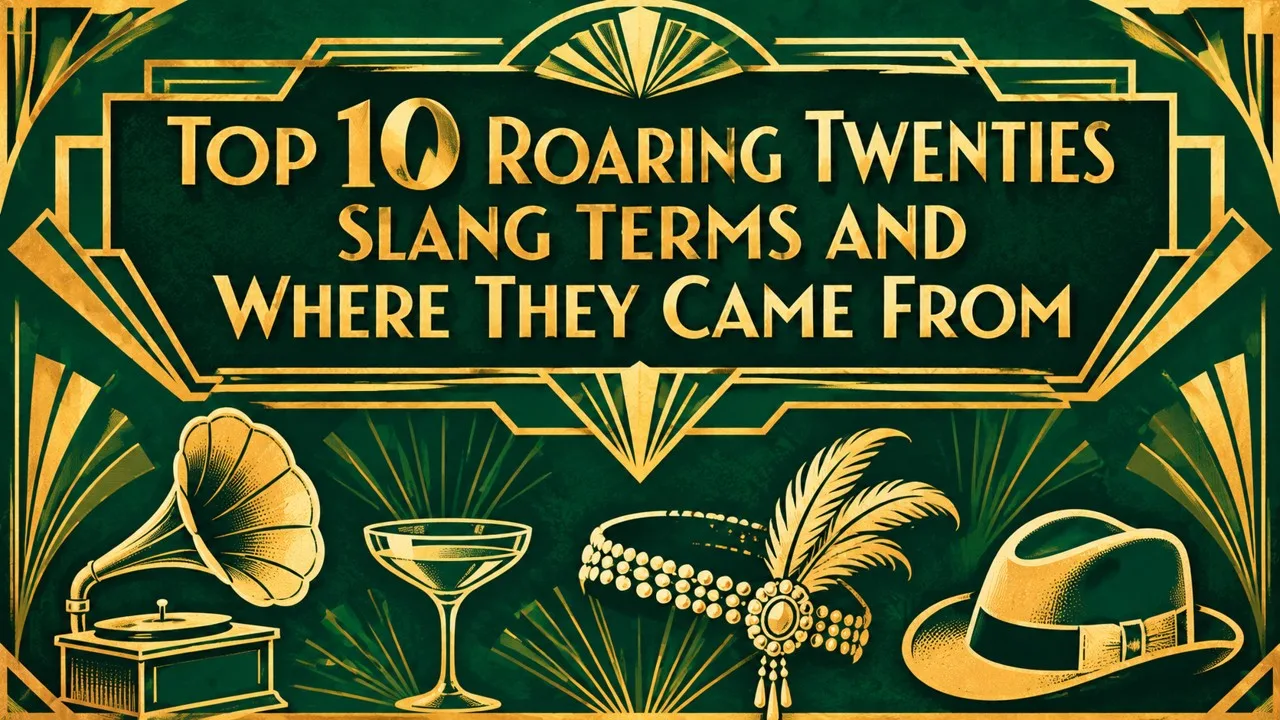
Roaring Twenties slang mixed jazz, Prohibition and newspaper cartoons, and many of its famous words are older or stranger than the decade suggests. The 1920s in the United States produced a burst of new talk. Prohibition created a market for words about illegal drink, jazz clubs and dance halls spread fashions in speech, and syndicated comic strips and sports columns sent catchphrases across the country within weeks. Some of that slang vanished with the decade. Some of it still sounds faintly modern.
The ten terms below are the bee's knees, the cat's pajamas, speakeasy, bootlegger, flapper, heebie-jeebies, ritzy, applesauce, hooch and jazz. A recurring surprise is that several of them were not invented in the 1920s at all. They were older words that the decade picked up, polished and made famous. Slang origins are often uncertain, so this list separates what the dictionaries can document from the tidy stories that grew around the words later.
Key Facts
| # | Term | What it meant in the 1920s | Where it seems to come from |
|---|---|---|---|
| 1 | The bee's knees | Something excellent | An older phrase for something small, reused in a fad for animal-body expressions |
| 2 | The cat's pajamas | Something or someone wonderful | New Western sleepwear plus the period's taste for silly animal compliments |
| 3 | Speakeasy | A bar selling alcohol during Prohibition | Attested before Prohibition; tied to keeping one's voice down |
| 4 | Bootlegger | A person who made, moved or sold illegal alcohol | Nineteenth-century practice of hiding flasks in tall boots |
| 5 | Flapper | A young woman of the new, independent style | Earlier British slang for a teenage girl |
| 6 | Heebie-jeebies | Nervousness, jitters | Coined in the comic strip Barney Google in 1923 |
| 7 | Ritzy | Fancy, expensive, showy | From the Ritz hotels founded by the hotelier César Ritz |
| 8 | Applesauce | Nonsense, rubbish | A 1920s American use of the ordinary word for stewed apples |
| 9 | Hooch | Liquor, especially illicit or homemade | From Hoochinoo, a name for a Tlingit community and the liquor made there |
| 10 | Jazz | A style of music, and energy or excitement | Early printed uses in West Coast baseball writing, around 1912 |
1. A Tiny Thing That Became the Best Thing
The bee's knees is the phrase most people reach for when they imitate the 1920s, and it did mean "excellent" in that decade. The odd part is that the phrase is older. Earlier uses, going back to the late eighteenth century, treated a bee's knee as an example of something very small or insignificant. The 1920s flipped that sense into praise [1].
The flip happened inside a broader fashion. American slang of the period produced a family of nonsense compliments built from animal anatomy: the cat's whiskers, the flea's eyebrows, the elephant's instep and others. Most of them did not last. The bee's knees did, perhaps because of its neat rhyme, and it survived well enough to become shorthand for the whole era [1].
Popular explanations sometimes claim the phrase refers to pollen carried on a bee's legs, or to a particular person with the initials B. K. Neither story has good documentary support. The safer account is simpler: an old phrase for something tiny was recycled by a decade that liked absurd compliments.
2. Pajamas as a Fashion, and Praise as a Joke
The cat's pajamas belongs to the same fad as the bee's knees. It meant something splendid, and it worked partly because pajamas themselves were still a little fashionable and exotic in the West. The word comes from Hindi and Urdu, and loose trousers of that kind were adopted in Britain and America in the late nineteenth and early twentieth centuries [2].
Putting a cat into new nightwear was the kind of deliberate absurdity the period enjoyed. The phrase is often linked with the newspaper cartoonist Tad Dorgan, who is credited with popularizing a long list of slang terms in his sports cartoons. Attribution of slang to a single person is notoriously hard to prove, and lexicographers usually treat such credit as popularization rather than invention [2].
The cat's meow, which meant much the same thing, came from the same playful habit. These terms faded quickly, which is part of why they now sound so firmly dated. They were jokes that depended on novelty, and once the novelty wore off they became period costume.
3. A Quiet Word for an Illegal Bar
A speakeasy was an illegal drinking place during national Prohibition, which began under the Eighteenth Amendment in January 1920 and ended with the Twenty-first Amendment in December 1933. The word suggests that customers had to speak quietly, or say a password softly, to avoid attracting the police or the neighbors [3].
Related: Top 10 Most Bizarre Phobias: Strange Fears That Exist
The term is older than Prohibition. American newspapers used speakeasy in the 1880s and 1890s for unlicensed saloons, especially in places with high license fees or local bans on alcohol. Earlier British expressions about a "speak softly shop" for smuggled goods point in the same direction, although the exact line of descent is not certain [3].
What the 1920s did was multiply the places the word described. Large cities had thousands of illegal bars, and the speakeasy became a recognizable social setting, mixing classes, admitting women more readily than many old saloons had, and shaping nightlife. The name was old. The scale was new.
4. Bottles in Boot Tops
A bootlegger was a smuggler or seller of illegal liquor, and the word is usually traced to the practice of hiding a flask in the leg of a tall boot. That image belongs to the nineteenth century, when the term was used for illegal sales of alcohol, including sales to Native American communities where liquor was banned [4].
Prohibition turned bootlegging from a small trade into a national industry. Liquor came across the Canadian border, by sea from offshore ships, and from domestic stills and diverted industrial alcohol. Organized crime grew rich on the trade, and the word took on a wider sense of large-scale illegal supply rather than one man with a flask [4].
Bootleg later spread far beyond alcohol. By the late twentieth century it described unauthorized recordings, copied software and other unlicensed goods. The original boot has long disappeared from the meaning, but the idea of something hidden and sold outside the law has stayed intact for well over a century.
5. A Word for Girls That Became a Style
A flapper, in the American 1920s, was a young woman who wore shorter skirts, bobbed her hair, danced to jazz and ignored older rules about behavior in public. The figure became so familiar that it was used in advertising, fiction and film, including the 1920 silent comedy The Flapper [5].
The word itself was older and British. Before the First World War, flapper was used in Britain for a teenage girl, and one common explanation links it to a young bird flapping its wings before it can fly. Other explanations exist, and dictionaries treat the exact origin with caution [5].
Related: Top 10 Oldest Buildings in the World
The 1920s meaning carried an argument about modern life. To admirers, the flapper stood for freedom, work outside the home and new voting rights, since the Nineteenth Amendment had been ratified in 1920. To critics, she was a sign of moral decline. The word held both views at once, which helps explain why it became the defining label of the decade.
6. A Cartoonist's Nonsense Word
The heebie-jeebies is one of the few pieces of 1920s slang with a fairly clear birth certificate. The phrase is credited to the cartoonist Billy DeBeck, who used it in his comic strip Barney Google in 1923. It meant a fit of nerves or a creeping sense of unease [6].
Comic strips were a powerful channel for slang in the period because they were syndicated to hundreds of newspapers. A phrase that appeared on a Sunday page could be repeated in many cities by Monday. DeBeck's strip also popularized other expressions, and Barney Google itself became the subject of a popular song [6].
The phrase got another lift in 1926, when Louis Armstrong and his Hot Five recorded Heebie Jeebies, a recording often remembered for its early scat singing. Unlike most of the decade's slang, the heebie-jeebies never quite left everyday English. People still use it today, usually without knowing it began as a cartoonist's invented rhyme.
7. A Hotel Name Turned Into an Adjective
Ritzy meant stylish, expensive or showily elegant, and it came from the name of the Swiss hotelier César Ritz. His hotels, including the Ritz in Paris, which opened in 1898, and the Ritz in London, which opened in 1906, became bywords for luxury [7].
By the early twentieth century, "putting on the Ritz" and similar phrases were used for dressing up or behaving grandly. The adjective ritzy appears around 1920, which makes it a genuinely new 1920s word built from an older name. Irving Berlin's song Puttin' On the Ritz, written in the late 1920s, helped keep the expression in circulation [7].
Related: 10 Sikh Gurus: The Pillars of Sikhism Who Shaped Faith, Equality, Courage, and Humanity
The word could carry a note of mockery as well as admiration. Calling a party ritzy might mean it was impressive, or that it was trying too hard. That double edge is common in slang about wealth, and it helps explain why ritzy remains in use while many of the decade's compliments have disappeared.
8. A Breakfast Food as an Insult
Applesauce, in 1920s slang, meant nonsense, much as baloney or hooey did. Someone who said "applesauce!" was dismissing a claim as foolish or untrue. The usage is well recorded in American writing of the period, though no single inventor is known [8].
One explanation offered by etymologists is that applesauce was a cheap filler, served to stretch a meal, and so became a word for something padded or worthless. That reasoning is plausible but hard to prove, and it should be treated as a likely story rather than an established fact [8].
The word is a reminder that much slang of the decade was gentle. Alongside the language of gangsters and smugglers, ordinary people needed polite ways to say "you are talking rubbish" in mixed company. Applesauce did that job for a few years and then retreated to the kitchen, where it had always had a more secure place.
9. A Village Name in Alaska
Hooch, meaning liquor, especially cheap or illegal liquor, was common Prohibition slang, but its origin is in nineteenth-century Alaska. The word is usually traced to Hoochinoo, an English rendering of the name of a Tlingit community on Admiralty Island, associated with the present-day village of Angoon [9].
In the period after the United States bought Alaska in 1867, a distilled drink made from molasses or other ingredients became associated with that community, and soldiers and miners called it hoochinoo. The longer word was soon shortened to hooch and traveled south, especially during the Klondike gold rush of the late 1890s [9].
Related: Top 10 Tallest Buildings in the World
By the 1920s, hooch was a general word for bootleg alcohol, with no memory of its Alaskan origin in most mouths. It is one of several American slang words with roots in Indigenous place names or languages, and its journey from a specific community to a national joke is a good example of how slang can erase its own history.
10. From a Baseball Word to a Musical Era
The decade itself is often called the Jazz Age, a phrase associated with F. Scott Fitzgerald. Yet jazz, as a word, began somewhere unexpected. Its earliest known printed uses come from West Coast baseball writing around 1912 and 1913, where it meant something like pep, energy or a lively pitch [10].
Within a few years, the word was attached to the new music coming out of New Orleans and other cities. The Original Dixieland Jass Band made recordings in 1917, using an older spelling, and the music and its name spread quickly through recordings, dance halls and radio in the 1920s [10].
The deeper origin of the word is still debated. Suggestions include older American slang related to energy and vitality, but none has been proven to the satisfaction of most lexicographers. What is clear is that the word moved from the sports page to the bandstand, and from there to the name of an entire decade.
Conclusion
The ten words above show how slang works in a period of fast change. Some, like heebie-jeebies and ritzy, can be traced to a particular moment and source. Others, like speakeasy, bootlegger and flapper, were older words that the 1920s adopted and amplified. A few, such as the bee's knees and applesauce, carry origin stories that are more confident than the evidence allows.
The useful lesson is to treat a famous slang word as a record of where people were talking, not just what they were saying. Prohibition, syndicated cartoons, jazz recordings and a new kind of young woman all left marks on American English, and some of those marks are still audible a century later.
- ^ [1] Dictionary and reference accounts of the phrase and the 1920s fad for animal-anatomy compliments. Wikipedia: bee's knees Wiktionary: bee's knees
- ^ [2] Background on pajamas as a borrowed word and on Tad Dorgan's role in popularizing slang. Wikipedia: pajamas Wikipedia: Tad Dorgan
- ^ [3] Histories of the speakeasy and of national Prohibition in the United States. Wikipedia: speakeasy Britannica: Prohibition
- ^ [4] Accounts of bootlegging, rum-running and the origin of the term. Wikipedia: rum-running Wikipedia: bootleg
- ^ [5] Histories of the flapper, the 1920 film The Flapper and the Nineteenth Amendment. Wikipedia: flapper Britannica: flapper
- ^ [6] Accounts of Billy DeBeck, Barney Google and the 1926 Hot Five recording. Wikipedia: Billy DeBeck Wikipedia: Barney Google and Snuffy Smith
- ^ [7] Background on César Ritz, his hotels and the song Puttin' On the Ritz. Wikipedia: César Ritz Wikipedia: Puttin' On the Ritz
- ^ [8] Dictionary notes on applesauce and related 1920s words for nonsense. Merriam-Webster: applesauce Wikipedia: 1920s slang
- ^ [9] Etymological accounts tracing hooch to Hoochinoo and the Tlingit community of Angoon. Wikipedia: Angoon, Alaska Merriam-Webster: hooch
- ^ [10] Accounts of the word jazz, its early baseball uses and the Original Dixieland Jass Band. Wikipedia: jazz (word) Wikipedia: Original Dixieland Jass Band




















Discussion
Log in with