


 By
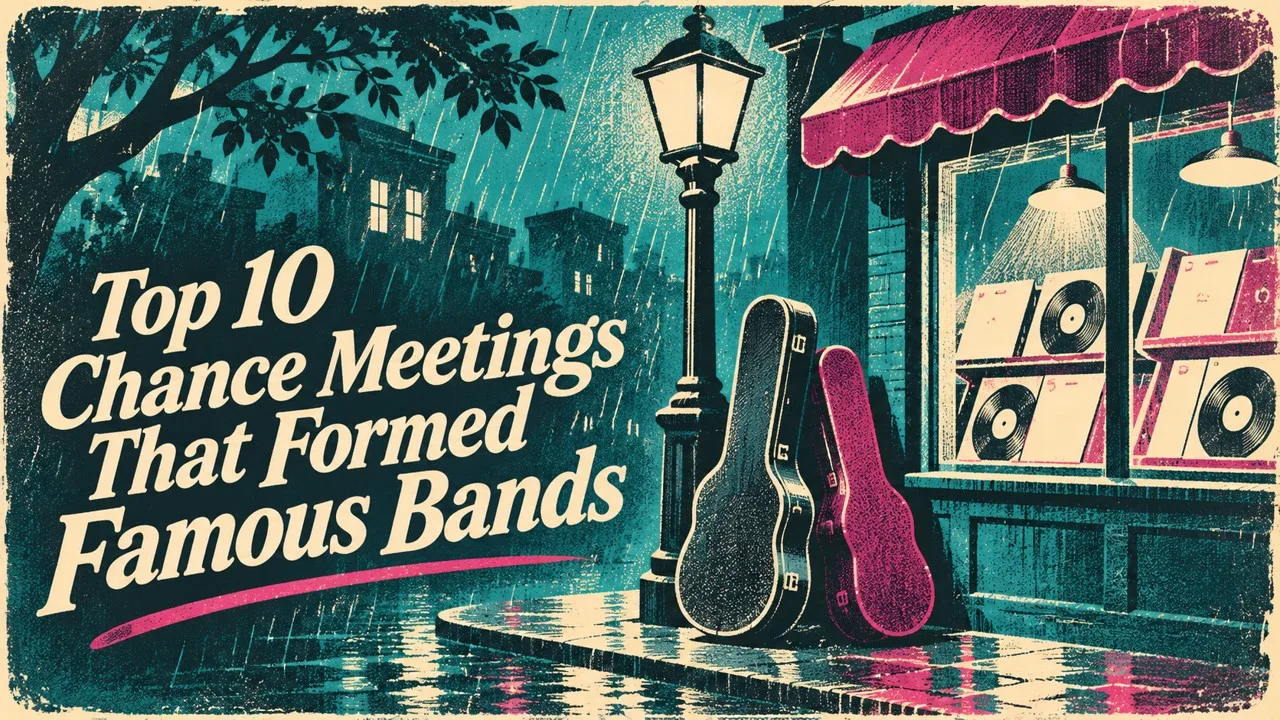
A church fete, a railway platform, a shop jukebox and a freight elevator: ten chance meetings that led to some of the most famous bands in music history. Many famous bands began with a moment that could easily have gone differently. Two musicians happen to attend the same event, catch the same train or answer the same advertisement, and a partnership begins that changes popular music.
Musicians often tell these origin stories in interviews and memoirs, and some have become part of rock legend. Like most legends, the details can vary from one telling to another, and memories of events decades ago are not always precise.
Even so, the broad outlines of these meetings are well documented. They show how luck, timing and a shared love of particular records or artists brought together people who went on to sell millions of albums.
Some of the meetings were between strangers. Others involved people who had known each other as children but lost touch until a chance encounter reconnected them years later.
In several cases, the meeting itself depended on a third person, such as a friend who made an introduction, a studio engineer who played a demo tape or a manager who spotted a striking T-shirt.
The stories also show how often music fandom brought people together. A shared enthusiasm for Chuck Berry, Muddy Waters or an obscure album was enough to start a conversation that led to a band.
The ten meetings below span from the 1950s to the 1980s and include bands from Britain and the United States. They are arranged roughly in chronological order.
Each one is a reminder that some of the most influential music in history might never have existed without an unlikely coincidence.
Many of these accounts come from the musicians themselves, recorded in interviews, documentaries and autobiographies, and they have been repeated by biographers and music historians over the years.
Key Facts
| # | Band | Meeting | Year |
|---|---|---|---|
| 1 | The Beatles | John Lennon meets Paul McCartney at a church garden fete | 1957 |
| 2 | The Rolling Stones | Mick Jagger and Keith Richards reunite at Dartford station | 1961 |
| 3 | Simon and Garfunkel | Paul Simon and Art Garfunkel meet in a school production | Early 1950s |
| 4 | Sex Pistols | John Lydon auditions by singing along to a jukebox | 1975 |
| 5 | Fleetwood Mac | Mick Fleetwood hears Lindsey Buckingham at Sound City | 1974 |
| 6 | Queen | Freddie Mercury joins the band Smile | 1970 |
| 7 | The Police | Stewart Copeland sees Sting perform | 1976 |
| 8 | Hall and Oates | Daryl Hall and John Oates meet while fleeing a disturbance | 1967 |
| 9 | The Smiths | Johnny Marr visits Morrissey's home | 1982 |
| 10 | Pixies | Kim Deal answers a newspaper advertisement | 1986 |
1. A Church Fete in Woolton
On July 6, 1957, John Lennon's skiffle group, the Quarrymen, played at a garden fete at St Peter's Church in Woolton, Liverpool. A mutual friend, Ivan Vaughan, brought along a fifteen-year-old named Paul McCartney to see them [1].
After the performance, McCartney met Lennon and impressed him by playing Eddie Cochran's song Twenty Flight Rock and showing that he knew how to tune a guitar and remember song lyrics. Lennon soon invited McCartney to join the group [1].
Related: Top 10 Famous Bands That Began with Worse Names
McCartney later brought in his school friend George Harrison, and with drummer Ringo Starr joining in 1962, the group became the Beatles. The church hall where the two first met has since become a place of pilgrimage for fans.
2. A Conversation on a Railway Platform
Mick Jagger and Keith Richards had attended the same primary school in Dartford, Kent, but drifted apart as children. In October 1961, they ran into each other on a platform at Dartford railway station [2].
Jagger was carrying records by American artists including Chuck Berry and Muddy Waters. Richards, a fan of the same music, struck up a conversation, and the two discovered a shared passion for rhythm and blues [2].
They began playing music together and soon joined forces with guitarist Brian Jones. The Rolling Stones played their first gig in 1962 and became one of the most successful bands in history, with Jagger and Richards as its main songwriting partnership.
3. A School Play in Queens
Paul Simon and Art Garfunkel grew up near each other in Queens, New York. They became friends in elementary school, where they both took part in a school production of Alice in Wonderland, with Simon reportedly playing the White Rabbit and Garfunkel the Cheshire Cat [3].
As teenagers, they formed a duo called Tom and Jerry, inspired by the Everly Brothers. Their song Hey Schoolgirl became a minor hit in 1957, but they soon went their separate ways for a time [3].
They reunited in the 1960s as Simon and Garfunkel. Songs such as The Sound of Silence, Mrs. Robinson and Bridge over Troubled Water made them one of the best-selling duos of all time.
4. An Audition at a Shop Jukebox
In 1975, members of the band that became the Sex Pistols were looking for a singer. A young man named John Lydon was spotted around the King's Road in London, reportedly wearing a Pink Floyd T-shirt with the words I Hate written above the band's name [4].
He was invited to an informal audition at Malcolm McLaren's shop, where he sang along to Alice Cooper's song I'm Eighteen on the jukebox. The band was impressed by his attitude and stage presence, and he joined, becoming known as Johnny Rotten [4].
Related: Top 10 Best-Selling Albums of All Time
The Sex Pistols released only one studio album, Never Mind the Bollocks, Here's the Sex Pistols, in 1977, but they became one of the most influential bands of the punk movement in Britain.
5. A Demo Tape at a Recording Studio
In late 1974, Mick Fleetwood was visiting Sound City Studios in Van Nuys, California, to look at the facilities. To demonstrate the studio's sound, engineer Keith Olsen played a track called Frozen Love from an album by the duo Buckingham Nicks [5].
Fleetwood was impressed by the guitar playing of Lindsey Buckingham. When guitarist Bob Welch left Fleetwood Mac shortly afterward, Fleetwood invited Buckingham to join. Buckingham agreed on the condition that his partner, Stevie Nicks, could join as well [5].
The new lineup released the album Fleetwood Mac in 1975, followed by Rumours in 1977, which became one of the best-selling albums of all time.
6. A Friend From Art College
Guitarist Brian May and drummer Roger Taylor played in a band called Smile, whose singer and bassist was Tim Staffell. Staffell was a friend of Farrokh Bulsara, who would later become known as Freddie Mercury, and Mercury became a regular supporter of the band [6].
When Staffell left Smile in 1970, Mercury joined May and Taylor and suggested a new name, Queen. Bassist John Deacon joined in 1971, completing the classic lineup [6].
Queen went on to produce hits such as Bohemian Rhapsody, We Will Rock You and Another One Bites the Dust. Their performance at Live Aid in 1985 is often described as one of the greatest live performances in rock history.
7. A Visit to a Newcastle Jazz Club
Drummer Stewart Copeland, an American who had grown up partly in the Middle East, saw a bassist and singer named Sting performing with a jazz group called Last Exit in Newcastle upon Tyne in 1976. Impressed, he took Sting's phone number [7].
Sting later moved to London, and in 1977 he and Copeland formed the Police with guitarist Henry Padovani. Guitarist Andy Summers soon joined, and Padovani left, creating the trio that became famous [7].
Related: Top 10 Songs and Products That Became Hits the Second Time
The Police achieved huge success with songs such as Roxanne, Message in a Bottle and Every Breath You Take. They became one of the best-selling bands of the late 1970s and early 1980s.
8. Escaping a Fight in a Freight Elevator
Daryl Hall and John Oates were both students at Temple University in Philadelphia, but they reportedly met in 1967 at the Adelphi Ballroom, where each was performing with a different group at a music event [8].
According to their own accounts, a fight broke out between rival groups in the audience, and the two musicians escaped into the same freight elevator. They began talking and discovered a shared love of soul and rhythm and blues music [8].
They later became roommates and began performing together. Hall and Oates became one of the most successful duos in pop history, with hits such as Rich Girl, Kiss on My List and Maneater.
9. A Knock on a Door in Stretford
In 1982, the young guitarist Johnny Marr went to the home of Steven Morrissey in Stretford, near Manchester, accompanied by a friend. Marr had reportedly been inspired by the story of how songwriters Jerry Leiber and Mike Stoller had begun their partnership by knocking on a door [9].
Morrissey was a music fan and writer who had not yet found success. The two shared interests in music and literature and soon began writing songs together [9].
They formed the Smiths, adding bassist Andy Rourke and drummer Mike Joyce. The band released four studio albums before breaking up in 1987 and became one of the most influential British bands of the 1980s.
10. A Classified Advertisement in Boston
Charles Thompson, who later performed as Black Francis, and guitarist Joey Santiago had been roommates at the University of Massachusetts Amherst. In 1986, they placed an advertisement seeking a bassist who liked both the punk band Hüsker Dü and the folk group Peter, Paul and Mary [10].
Related: Top 10 Common Misconceptions About Music History
Kim Deal answered the advertisement and joined the band, even though she reportedly did not own a bass at the time. Drummer David Lovering completed the lineup [10].
The Pixies released albums such as Surfer Rosa and Doolittle. Their mix of quiet verses and loud choruses influenced many later bands, including Nirvana.
Conclusion
These stories show how much luck can shape the history of music. A missed train, a different studio tour or an unanswered advertisement might have meant some of the world's most famous songs were never written.
They also reveal the importance of shared enthusiasm. Again and again, musicians connected because they loved the same records and recognized that passion in someone else.
Some of the details have grown over time through repeated retelling, and band members sometimes remember events differently. Still, the basic facts of these meetings are well established.
For aspiring musicians, the stories offer a hopeful message. Great partnerships can start in ordinary places, from church fetes and railway platforms to shops and campus advertisements.
The next time two people strike up a conversation about music, it is worth remembering that a famous band might be just one chance meeting away.
Music history is full of such moments, and for every famous band there are countless others whose chance meetings led to friendships, local gigs and songs heard only by a few, which are part of the story too.
- ^ [1] Accounts of the Quarrymen. Wikipedia: The Quarrymen Wikipedia: The Beatles
- ^ [2] Accounts of the Rolling Stones' formation. Wikipedia: The Rolling Stones Wikipedia: Dartford railway station
- ^ [3] Accounts of Simon and Garfunkel. Wikipedia: Simon and Garfunkel Wikipedia: Paul Simon
- ^ [4] Accounts of the Sex Pistols. Wikipedia: Sex Pistols Wikipedia: John Lydon
- ^ [5] Accounts of Fleetwood Mac's lineup change. Wikipedia: Fleetwood Mac Wikipedia: Sound City Studios
- ^ [6] Accounts of Queen's formation. Wikipedia: Queen (band) Wikipedia: Freddie Mercury
- ^ [7] Accounts of the Police. Wikipedia: The Police Wikipedia: Sting
- ^ [8] Accounts of Hall and Oates. Wikipedia: Hall and Oates Wikipedia: Daryl Hall
- ^ [9] Accounts of the Smiths. Wikipedia: The Smiths Wikipedia: Johnny Marr
- ^ [10] Accounts of the Pixies. Wikipedia: Pixies Wikipedia: Kim Deal


















Discussion
Log in with