





Top 10 Overlooked People Who Changed the World by Accident
 By Dhiraj Sharma · Published
Share Post
Loading…
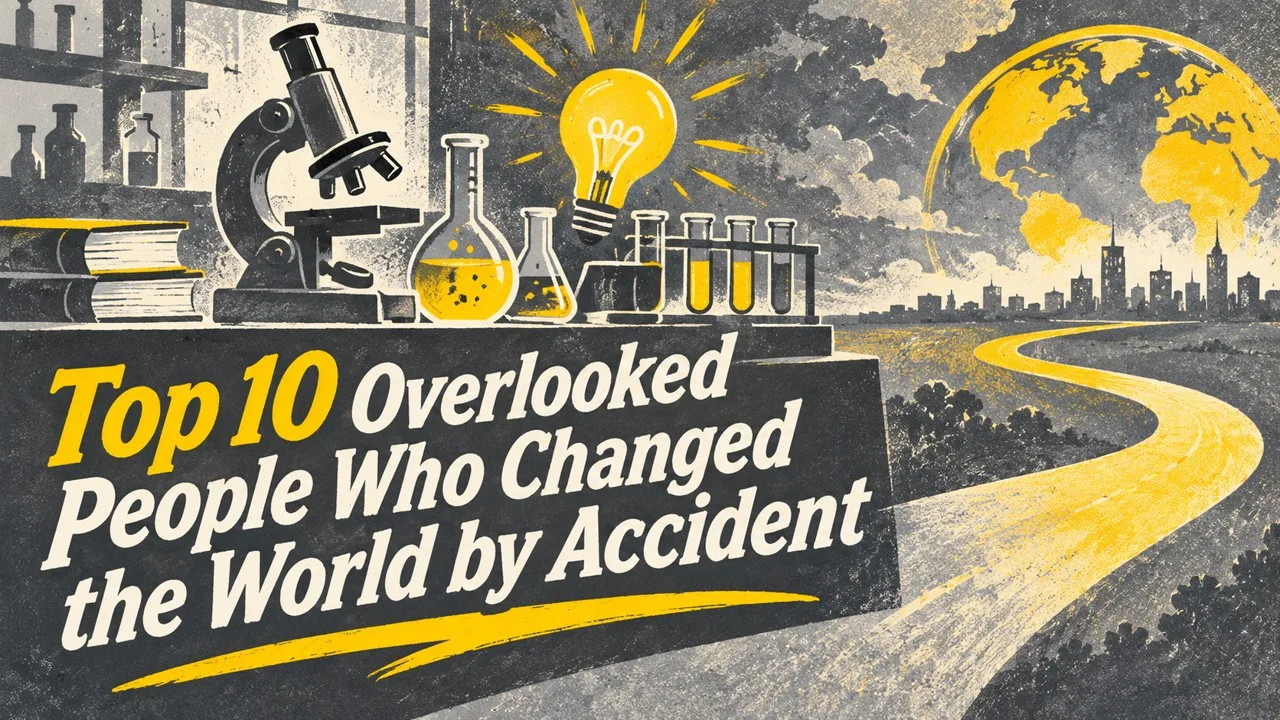
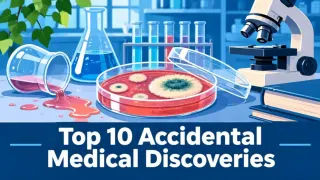
A scraped stick, a sweet dinner roll, a dropped flask and a melted candy bar: ten overlooked people whose accidental discoveries changed the world. Some of the most important discoveries in history were not planned. They happened when someone noticed something unexpected and had the curiosity to investigate it further.
Accidents alone do not produce great discoveries. The people in this list were often trained scientists or skilled workers who recognized that an odd result might be valuable. Many others had probably seen similar things before and dismissed them.
While some accidental discoverers, such as Alexander Fleming, became famous, many others remain largely unknown to the public. Their names are rarely mentioned, even though their discoveries are used by millions of people every day.
The discoveries below include products found in nearly every home, such as matches, nonstick pans and microwave ovens, as well as life-saving medical devices and a scientific finding that changed our understanding of the universe.
Several of these stories have been simplified or embellished in popular retellings. Where the details are uncertain, that is noted, but the basic facts of each discovery are well documented.
Many of these discoverers did not become wealthy from their work. Some failed to patent their inventions, while others worked for companies that owned the rights to their discoveries.
Each entry names the person, the accidental discovery and the year it took place, followed by an account of what happened and how the discovery changed the world.
The entries are arranged in chronological order, from the early nineteenth century to the 1960s.
Together, they show the importance of curiosity, observation and persistence in scientific progress, and the role that chance can play in shaping history.
They also suggest that the next world-changing discovery could come from an unexpected result that someone, somewhere, decides not to ignore.
Historians of science have long debated how much credit chance deserves. Some argue that accidental discoveries are really the product of years of training and experience, since only someone with the right knowledge would recognize the importance of an unexpected result. Others point out that many breakthroughs depended on a lucky combination of circumstances that could easily never have happened. Both views contain truth, and the stories below illustrate how preparation and luck often work together. In nearly every case, the discoverer had to persuade others that the accident was worth pursuing, a task that sometimes took years.
Patents, company records and laboratory notebooks preserve many of these stories, allowing historians to check popular accounts against the evidence.
Related: Top 10 Accidental Inventions That Changed Everyday Life
Key Facts
| # | Person | Accidental discovery | Year |
|---|---|---|---|
| 1 | John Walker | The friction match | 1826 |
| 2 | William Henry Perkin | The first synthetic dye | 1856 |
| 3 | Constantin Fahlberg | Saccharin | 1879 |
| 4 | Jacques Brandenberger | Cellophane | 1908 |
| 5 | Édouard Bénédictus | Laminated safety glass | 1903 |
| 6 | Roy Plunkett | Teflon | 1938 |
| 7 | Percy Spencer | The microwave oven | 1945 |
| 8 | Harry Coover | Super glue | 1942 and 1951 |
| 9 | Wilson Greatbatch | The implantable pacemaker | 1956 |
| 10 | Arno Penzias and Robert Wilson | The cosmic microwave background | 1964 |
1. A Stick That Burst Into Flame
John Walker was a chemist and pharmacist in Stockton-on-Tees in northern England. In 1826, according to accounts of his work, he was mixing chemicals when he noticed that a stick coated with the mixture burst into flame when it was scraped across his hearth [1].
Walker realized the potential of this discovery and began selling friction matches, which he called friction lights, in 1827. They could be lit by drawing them through a fold of sandpaper [1].
Walker never patented his invention, and others soon copied it. Matches transformed daily life, making fire easy to create for the first time in history. Yet Walker himself remains little known outside his hometown.
2. A Failed Medicine Becomes a Color
In 1856, an eighteen-year-old chemistry student named William Henry Perkin was trying to synthesize quinine, a drug used to treat malaria, in a makeshift laboratory at his home in London. His experiment failed, producing a dark sludge [2].
When Perkin cleaned his equipment with alcohol, he noticed a brilliant purple color. He had created the first synthetic dye, which became known as mauveine, or mauve [2].
Perkin patented the dye and opened a factory to produce it. Mauve became fashionable across Europe, and his discovery launched the synthetic dye industry, which in turn contributed to the development of modern chemistry and pharmaceuticals.
3. A Sweet Taste at Dinner
Constantin Fahlberg was a chemist working in the laboratory of Ira Remsen at Johns Hopkins University. In 1879, after a day of work, he noticed that the bread he was eating at dinner tasted unusually sweet [3].
He realized that a chemical from his experiments must have been on his hands. Returning to the laboratory, he tasted various substances until he identified the source, a compound later named saccharin [3].
Saccharin became the first commercially successful artificial sweetener. Fahlberg patented it without crediting Remsen, which led to a lasting dispute between the two men.
4. A Stain on a Tablecloth
The Swiss chemist Jacques Brandenberger reportedly saw a customer spill wine on a restaurant tablecloth around 1900. He wondered if he could create a waterproof coating that would protect fabrics from stains [4].
His experiments with coating fabric did not work as planned, but he noticed that the coating peeled away as a clear, thin film. He developed this film into a new material he called cellophane [4].
Related: Top 10 Inventions That Changed the World
Cellophane became widely used for packaging food and other products, especially after the American company DuPont developed a moisture-proof version in the 1920s. It was one of the first transparent packaging materials.
5. A Dropped Flask That Did Not Shatter
The French chemist and artist Édouard Bénédictus accidentally knocked a glass flask off a shelf in his laboratory in 1903. To his surprise, the flask cracked but did not shatter into pieces [5].
He discovered that the flask had once contained a solution of cellulose nitrate, a type of plastic, which had evaporated and left a thin coating that held the broken glass together [5].
Bénédictus developed the idea into laminated safety glass, which he patented. It was first used in gas mask lenses during the First World War and later became standard in car windshields, saving countless lives.
6. A Gas Cylinder That Seemed Empty
Roy Plunkett was a chemist working for the DuPont company. In April 1938, he was experimenting with gases used in refrigeration when he found that a cylinder of gas seemed to have stopped working [6].
When he and his assistant cut open the cylinder, they discovered a white, waxy powder inside. The gas had turned into a solid material that was extremely slippery and resistant to heat and chemicals [6].
The material, polytetrafluoroethylene, was later sold under the name Teflon. It was first used in industrial and military applications before becoming famous as a coating for nonstick frying pans.
7. A Melted Candy Bar
Percy Spencer was an engineer at the Raytheon company who worked on radar equipment during the Second World War. According to the popular story, he noticed that a candy bar in his pocket had melted while he was standing near a working magnetron [7].
Spencer experimented by placing popcorn kernels near the magnetron, and they popped. He realized that microwaves could be used to cook food quickly [7].
Related: Top 10 Women Who Changed History
Raytheon patented the idea, and the first commercial microwave ovens appeared in 1947. They were large and expensive, but smaller versions later became common in homes around the world.
8. A Glue That Stuck to Everything
In 1942, Harry Coover was working for Eastman Kodak on clear plastics for gun sights. One of the substances he tested, a type of cyanoacrylate, stuck to everything it touched, so it was rejected [8].
In 1951, Coover and a colleague encountered the substance again while working on heat-resistant materials for aircraft. This time, Coover realized its potential as a strong, fast-acting adhesive [8].
The glue was sold beginning in 1958 and later became known as Super Glue. Versions of it have also been used in medicine to close wounds.
9. The Wrong Resistor
Wilson Greatbatch was an engineer building a device to record heart sounds in 1956. He accidentally installed a resistor with the wrong value into the circuit [9].
Instead of recording, the circuit produced regular electrical pulses. Greatbatch realized the pulses resembled a heartbeat and could be used to stimulate a heart [9].
He worked with surgeons to develop a small pacemaker that could be implanted in the body. The first implants took place around 1960, and pacemakers have since helped millions of people with heart problems.
10. Noise That Would Not Go Away
In 1964, Arno Penzias and Robert Wilson were working with a large antenna at Bell Laboratories in New Jersey. They detected a faint background noise that they could not eliminate [10].
They checked every possible source, even removing pigeon droppings from the antenna. The noise remained, coming from every direction in the sky [10].
They had discovered the cosmic microwave background, faint radiation left over from the early universe. It provided strong evidence for the Big Bang theory, and the two men shared the Nobel Prize in Physics in 1978.
Related: Top 10 Famous Historical Events That Did Not Happen
Conclusion
These discoveries show that chance can play an important role in scientific progress. Yet in each case, it took a curious and observant person to recognize the significance of an unexpected result.
Many of these discoverers remain largely unknown to the public, even though their discoveries are part of everyday life. Matches, nonstick pans, microwave ovens and safety glass are used by millions of people.
Some of the discoveries also transformed medicine and science, from pacemakers to our understanding of the origins of the universe.
These stories remind us that failures and mistakes can lead to important breakthroughs, if someone takes the time to investigate.
Scientists sometimes use the word serendipity to describe such fortunate accidents, a term coined by the English writer Horace Walpole in the eighteenth century.
The French scientist Louis Pasteur famously observed that chance favors the prepared mind, a principle that each of these discoverers illustrates.
The next time you strike a match or use a microwave, it may be worth remembering the people whose accidental discoveries made these things possible.
Laboratories, workshops and kitchens around the world continue to produce unexpected results every day. Most are dismissed as mistakes, but a few may turn out to be the beginning of something important. Encouraging curiosity, keeping careful notes and taking the time to ask why something happened are habits that have served discoverers well throughout history, and they remain valuable for scientists and inventors today.
Their stories are a reminder that progress often depends on people whose names never become famous.
- ^ [1] Accounts of John Walker. Wikipedia: John Walker (inventor) Wikipedia: Match
- ^ [2] Accounts of William Henry Perkin. Wikipedia: William Henry Perkin Wikipedia: Mauveine
- ^ [3] Accounts of Constantin Fahlberg. Wikipedia: Constantin Fahlberg Wikipedia: Saccharin
- ^ [4] Accounts of Jacques Brandenberger. Wikipedia: Jacques E. Brandenberger Wikipedia: Cellophane
- ^ [5] Accounts of Édouard Bénédictus. Wikipedia: Safety glass Wikipedia: Laminated glass
- ^ [6] Accounts of Roy Plunkett. Wikipedia: Roy J. Plunkett Wikipedia: Polytetrafluoroethylene
- ^ [7] Accounts of Percy Spencer. Wikipedia: Percy Spencer Wikipedia: Microwave oven
- ^ [8] Accounts of Harry Coover. Wikipedia: Harry Coover Wikipedia: Cyanoacrylate
- ^ [9] Accounts of Wilson Greatbatch. Wikipedia: Wilson Greatbatch Wikipedia: Artificial cardiac pacemaker
- ^ [10] Accounts of the cosmic microwave background. Wikipedia: Cosmic microwave background Wikipedia: Arno Allan Penzias

















Discussion
Log in with