





 By
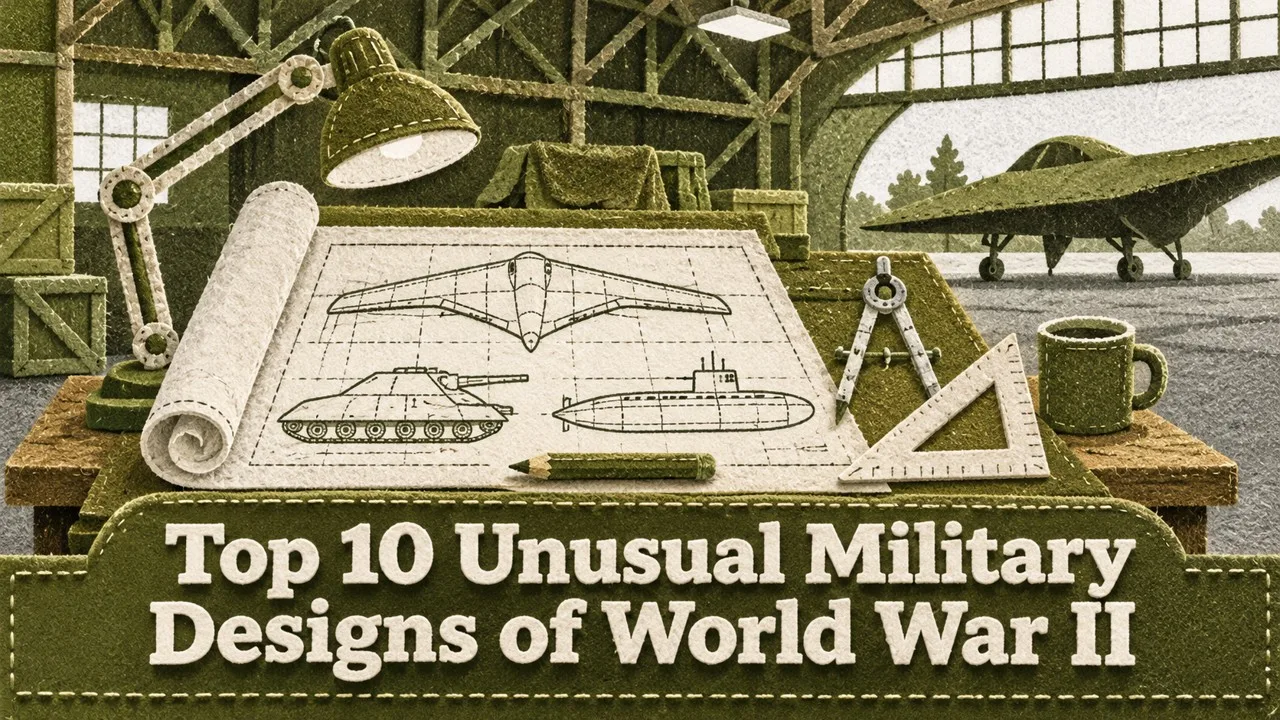
An aircraft carrier made of ice, bombs carried by bats, pigeon-guided missiles and a flying tank: ten of the strangest military designs of World War II. The Second World War was a period of extraordinary technological innovation. Facing a struggle for national survival, governments poured money into research and encouraged engineers and scientists to explore almost any idea that might give them an advantage.
Many of these efforts produced weapons and technologies that changed warfare forever, including radar, jet aircraft, rockets and the atomic bomb. But the same willingness to experiment also led to some truly bizarre designs.
Some of these unusual ideas were serious attempts to solve real military problems, such as the shortage of steel, the difficulty of guiding bombs accurately or the challenge of landing troops on heavily defended beaches.
Others were wildly ambitious projects that pushed the limits of engineering and common sense. A few were tested and abandoned, while others never progressed beyond drawings and models.
Several involved animals, reflecting a time when scientists were exploring every possible way to deliver weapons. Others involved materials that seem unlikely for military equipment, such as ice and wood pulp.
The designs below come from Britain, the United States, Germany, Japan and the Soviet Union. They range from giant guns and tanks to small, clever devices.
Some succeeded in their limited aims, while many failed or were overtaken by events. Their stories reveal the creativity, desperation and occasional absurdity of wartime research.
Each entry names the design, the country that developed it and what became of it, followed by an account of how it was meant to work.
The entries are arranged roughly by theme, beginning with projects at sea and in the air and ending with weapons designed for use on land.
Together, they offer a fascinating glimpse into a period when engineers were willing to try almost anything that might help win the war.
Wartime research was organized on a scale never seen before. In Britain, a department informally known as the Ministry of Ungentlemanly Warfare encouraged unconventional thinking, while in the United States, the National Defense Research Committee and later the Office of Scientific Research and Development coordinated thousands of scientists and engineers. Germany had numerous competing research programs, often encouraged by leaders who hoped that so-called wonder weapons could reverse the course of the war. In this atmosphere, inventors with unusual ideas sometimes found a receptive audience at the highest levels of government, and a single persuasive letter or demonstration could launch an entire project.
Key Facts
| # | Design | Country | Outcome |
|---|---|---|---|
| 1 | Project Habakkuk | United Kingdom and Canada | Tested with a prototype, then abandoned |
| 2 | The bat bomb | United States | Tested, then cancelled |
| 3 | Project Pigeon | United States | Developed but never used in combat |
| 4 | The Great Panjandrum | United Kingdom | Tested and abandoned |
| 5 | Hobart's Funnies | United Kingdom | Successfully used in the Normandy landings |
| 6 | Landkreuzer P. 1000 Ratte | Germany | Never built |
| 7 | Horten Ho 229 | Germany | Prototypes built, never entered service |
| 8 | Fire balloons | Japan | Launched against North America |
| 9 | Schwerer Gustav | Germany | Used in combat |
| 10 | Antonov A-40 | Soviet Union | Tested once, then abandoned |
1. An Aircraft Carrier Made of Ice
During the Second World War, German submarines were sinking large numbers of Allied ships in the Atlantic, partly because aircraft could not cover the middle of the ocean. The British inventor Geoffrey Pyke proposed building an enormous aircraft carrier out of ice to provide a floating air base [1].
Related: Bletchley Park Turned Codebreaking into Intelligence
Pyke's plan used a material later called pykrete, a mixture of ice and wood pulp that was much stronger and slower to melt than ordinary ice. According to popular accounts, a demonstration of its strength impressed senior Allied leaders at a conference in Quebec in 1943 [1].
A small prototype was built on a lake in Canada and survived through the summer. However, the project was abandoned because of its enormous cost and because longer-range aircraft and escort carriers had closed the gap in the Atlantic, removing the need for an ice ship.
2. Bombs Carried by Bats
An American dentist named Lytle Adams proposed attaching small incendiary bombs to bats and releasing them over Japanese cities. The bats would roost in buildings, many of which were made of wood and paper, before the bombs ignited [2].
The US military took the idea seriously, and tests were carried out using Mexican free-tailed bats. In one accident, escaped bats set fire to buildings at a test site in New Mexico [2].
The project was eventually cancelled, partly because it was moving too slowly. By then, work on the atomic bomb was advancing, and military leaders decided to focus on other weapons.
3. Missiles Guided by Pigeons
The American psychologist B. F. Skinner proposed using trained pigeons to guide missiles. The birds would be placed in the nose of a missile and trained to peck at an image of the target on a screen [3].
Skinner trained pigeons using his methods of conditioning, and they proved surprisingly accurate in tests. Their pecking would adjust the missile's controls to keep it on course [3].
Despite its success in testing, the military considered the project too unconventional and cancelled it in 1944. It was briefly revived after the war under a different name before being abandoned as electronic guidance systems improved.
4. A Rocket-Powered Wheel
The Great Panjandrum was a giant drum-like device with large wheels, propelled by rockets attached to its rims. It was designed to roll up a beach and explode against coastal defenses, blasting a hole large enough for tanks to pass through [4].
Tests in 1943 on beaches in England were chaotic. The rockets often came loose, causing the wheel to veer off course unpredictably and sending spectators running for safety [4].
Related: Top 20 World War II Facts: Little-Known Details and Essential History
The device was never used in combat. It is remembered as one of the most spectacular failures of wartime engineering, and a replica was built for a commemorative event in 2009.
5. Specialized Tanks for D-Day
Major General Percy Hobart led a British unit that developed specialized armored vehicles to help troops overcome beach defenses. These vehicles became known as Hobart's Funnies [5].
They included tanks fitted with flails to clear mines, tanks that could lay bridges, tanks that carried rolls of matting to cross soft sand and tanks equipped with flamethrowers. Some tanks were made amphibious with canvas screens [5].
The vehicles were used on the British and Canadian beaches during the Normandy landings in June 1944. They are credited with helping reduce casualties and remain one of the most successful unusual designs of the war.
6. A Tank the Size of a Ship
The Landkreuzer P. 1000 Ratte was a proposed German tank that would have weighed around a thousand tons, far heavier than any tank ever built. It was to be armed with naval guns taken from battleships [6].
The design faced enormous practical problems. It would have been too heavy for most bridges and roads, and it would have made an easy target for aircraft [6].
The project was cancelled in 1943 by Albert Speer, the German minister of armaments, before construction began. It remains a symbol of the extreme ambitions of some wartime projects.
7. A Flying Wing Jet
The Horten brothers, Reimar and Walter, designed a jet-powered flying wing aircraft in the later years of the war. It had no conventional tail or fuselage [7].
A prototype flew in early 1945 but was destroyed in a crash. Another prototype was captured by American forces at the end of the war [7].
Related: Women Served in Armed Forces and Wartime Industries
The aircraft's shape has led to speculation that it may have been difficult to detect by radar. A captured example is held by the Smithsonian Institution in the United States.
8. Balloons That Crossed the Pacific
Between 1944 and 1945, Japan launched thousands of balloons carrying incendiary and explosive devices. The balloons were designed to ride the jet stream across the Pacific Ocean to North America [8].
Hundreds of balloons reached the United States and Canada. They caused little damage, but one tragically killed a woman and five children in Oregon in 1945 when they found a balloon during a picnic [8].
The American government kept news of the balloons quiet to avoid causing panic and to prevent Japan from learning whether they were reaching their targets.
9. The Largest Gun Ever Used in Combat
Schwerer Gustav was a giant railway gun built by the German company Krupp. It is widely regarded as the largest-caliber rifled weapon ever used in combat [9].
The gun was so large that it had to be transported in pieces and assembled on specially built railway tracks, requiring a large crew [9].
It was used during the siege of Sevastopol in 1942, firing enormous shells. However, the gun was impractical, and it saw little further use before being destroyed near the end of the war.
10. A Tank That Could Fly
The Soviet aircraft designer Oleg Antonov developed a design that attached glider wings and a tail to a light tank. The idea was that the tank could be towed into the air and released to glide to the battlefield [10].
In a test flight in 1942, the tank had to be stripped of weapons and equipment to reduce its weight. Even so, the towing aircraft struggled to keep it airborne [10].
Related: Top 10 Overlooked Events of World War II
The project was abandoned because there were no aircraft powerful enough to tow it effectively. The Antonov A-40 remains one of the most unusual vehicles ever tested.
Conclusion
These unusual designs show the remarkable creativity and willingness to experiment that characterized military research during the Second World War. Engineers and scientists explored ideas that seem bizarre today.
Some designs succeeded, such as Hobart's Funnies, while many others failed or were abandoned. Even the failures contributed to knowledge that influenced later technology.
The stories also reflect the desperation of the time. With so much at stake, governments were willing to try almost anything.
Several of these ideas foreshadowed later developments. Flying wing aircraft, guided missiles and specialized armored vehicles all became important parts of modern military technology.
Some of these designs survive in museums, allowing visitors to see the strange machines that wartime engineers created.
Others exist only in documents and photographs, reminders of ideas that never left the drawing board but still capture the imagination.
Together, they offer a fascinating reminder of the extraordinary and sometimes strange ingenuity of wartime innovation.
Historians caution that hindsight can make these projects seem more foolish than they appeared at the time. Engineers were working under great pressure, with incomplete information and little time to test their ideas. What looks absurd today may have seemed a reasonable gamble when the outcome of the war was uncertain and conventional solutions were failing.
- ^ [1] Accounts of Project Habakkuk. Wikipedia: Project Habakkuk Wikipedia: Pykrete
- ^ [2] Accounts of the bat bomb. Wikipedia: Bat bomb Wikipedia: Mexican free-tailed bat
- ^ [3] Accounts of Project Pigeon. Wikipedia: Project Pigeon Wikipedia: B. F. Skinner
- ^ [4] Accounts of the Great Panjandrum. Wikipedia: Great Panjandrum Wikipedia: Atlantic Wall
- ^ [5] Accounts of Hobart's Funnies. Wikipedia: Hobart's Funnies Wikipedia: Percy Hobart
- ^ [6] Accounts of the Landkreuzer P. 1000 Ratte. Wikipedia: Landkreuzer P. 1000 Ratte Wikipedia: Albert Speer
- ^ [7] Accounts of the Horten Ho 229. Wikipedia: Horten H.IX Wikipedia: Flying wing
- ^ [8] Accounts of fire balloons. Wikipedia: Fire balloon Wikipedia: Jet stream
- ^ [9] Accounts of Schwerer Gustav. Wikipedia: Schwerer Gustav Wikipedia: Railway gun
- ^ [10] Accounts of the Antonov A-40. Wikipedia: Antonov A-40 Wikipedia: Oleg Antonov























Discussion
Log in with