






 By
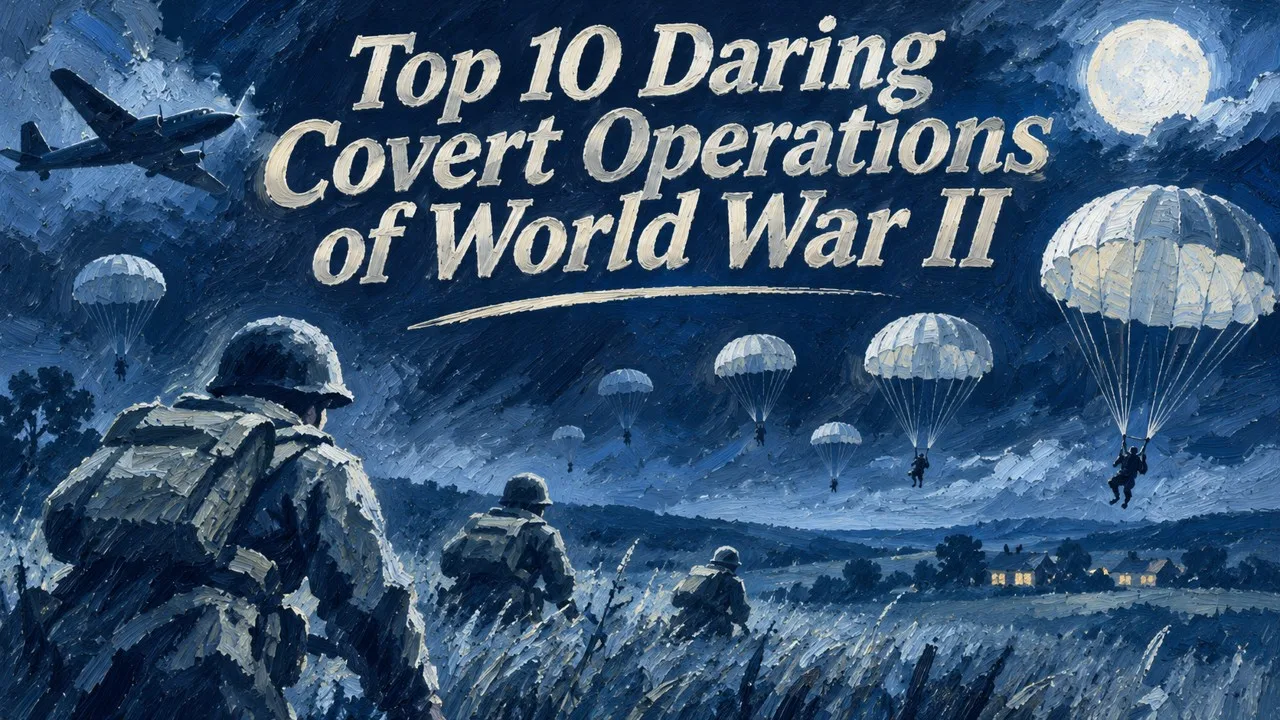
Canoes on a French river, skiers on a frozen plateau and saboteurs landed by submarine: ten of the most daring covert operations of World War II. The Second World War was fought not only by huge armies on the battlefield but also by small groups of agents, commandos and saboteurs working in secret. Their missions often took them deep behind enemy lines, where capture could mean death.
Covert operations took many forms. Some aimed to destroy key industrial sites or ships, while others targeted enemy leaders, spread confusion or disrupted the enemy's economy. Many relied on intelligence gathered through spies and codebreakers.
These missions required extraordinary courage. Participants often knew that their chances of survival were slim, and many did not return. Some operations succeeded brilliantly, while others ended in failure or tragedy.
Several special organizations were created during the war to carry out such work. Britain established the Special Operations Executive and new commando units, while the United States created the Office of Strategic Services. Germany, Australia, Norway and other countries also had their own special forces.
The operations below were carried out by forces from Britain, Czechoslovakia, Norway, Australia, the United States and Germany. They took place in Europe, the Pacific and even on the coast of the United States.
Some of these missions had a significant impact on the course of the war, while others were more symbolic. All of them reveal the ingenuity and bravery of those involved.
The operations described here are well documented by historians. Where details remain disputed, that is noted.
Each entry names the operation, the forces that carried it out and the year it took place, followed by an account of what happened.
The entries are arranged in roughly chronological order, from 1942 to the final winter of the war in Europe.
Together, they show how small groups of determined people could sometimes achieve results far beyond their numbers, and the high price that such missions often demanded.
Much of what we know about these operations was kept secret for years after the war. Official records were gradually released over the following decades, and survivors often waited a long time before speaking publicly about their experiences. Historians have used these records, along with memoirs and interviews, to piece together detailed accounts of missions that were once known only to a handful of people.
Key Facts
| # | Operation | Carried out by | Year |
|---|---|---|---|
| 1 | Operation Anthropoid | Czechoslovak soldiers trained in Britain | 1942 |
| 2 | The St Nazaire Raid | British commandos and the Royal Navy | 1942 |
| 3 | Operation Pastorius | German agents sent to the United States | 1942 |
| 4 | Operation Frankton | British Royal Marines | 1942 |
| 5 | Operation Gunnerside | Norwegian commandos trained by the British | 1943 |
| 6 | Operation Jaywick | Australian and British commandos | 1943 |
| 7 | Operation Vengeance | United States Army Air Forces | 1943 |
| 8 | The Gran Sasso raid | German paratroopers and special forces | 1943 |
| 9 | Operation Bernhard | Nazi Germany | 1942 to 1945 |
| 10 | Operation Greif | German special forces | 1944 |
1. Assassinating a Nazi Leader
Reinhard Heydrich was one of the most powerful and feared officials in Nazi Germany, a principal architect of the Holocaust and acting ruler of the occupied Czech lands. The Czechoslovak government in exile in London, working with British special operations, planned to assassinate him [1].
Related: Top 20 World War II Facts: Little-Known Details and Essential History
Two Czechoslovak soldiers, Jozef Gabčík and Jan Kubiš, were parachuted into the occupied territory. On May 27, 1942, they attacked Heydrich's car in Prague. Gabčík's gun jammed, but Kubiš threw a bomb that wounded Heydrich, who died about a week later [1].
The Nazis responded with brutal reprisals, including the destruction of the villages of Lidice and Ležáky. The assassins and other resistance fighters were trapped in a church in Prague, where they died after a fierce battle. The operation remains one of the most significant acts of resistance of the war.
2. Ramming a Dock With a Warship
The port of St Nazaire in France contained the only dry dock on the Atlantic coast large enough to repair the German battleship Tirpitz. Destroying it would make it much harder for the battleship to operate in the Atlantic [2].
In March 1942, British forces sailed an old destroyer, HMS Campbeltown, packed with explosives, into the port. The ship rammed the gates of the dock while commandos landed to destroy other facilities [2].
The explosives detonated the following day, putting the dock out of action for the rest of the war. However, many of the raiders were killed or captured. Five Victoria Crosses were awarded for the raid, which has been called the greatest raid of all.
3. Saboteurs Landed by Submarine
In June 1942, German submarines landed eight agents on the coasts of New York and Florida. They carried explosives and money and planned to sabotage American industrial targets, including aluminum plants and railway lines [3].
The operation failed almost immediately. One of the agents, George Dasch, decided to betray the mission and contacted the FBI, providing information that led to the arrest of all eight men [3].
The men were tried by a military tribunal. Six were executed, while Dasch and another agent who cooperated received prison sentences and were later deported. The case led to a significant Supreme Court decision on military tribunals.
4. Canoes on a French River
In December 1942, a small group of British Royal Marines set out in canoes from a submarine off the coast of France. Their mission was to paddle up the Gironde estuary and attach mines to German ships in the port of Bordeaux [4].
The raiders traveled at night and hid during the day. Of the original team, only two canoes reached Bordeaux, where the men attached mines to several ships, damaging them [4].
Related: Women Served in Armed Forces and Wartime Industries
Of the ten men who set out, only two survived, escaping through France and Spain. The others drowned or were captured and executed. The raid inspired the 1955 film The Cockleshell Heroes.
5. Sabotaging Nazi Germany's Heavy Water
The Vemork hydroelectric plant in Norway produced heavy water, which the Allies feared Germany could use in developing nuclear weapons. An earlier British attempt to attack the plant had ended in disaster [5].
In February 1943, a team of Norwegian commandos parachuted onto a frozen mountain plateau and skied to the plant. They climbed down a steep gorge and crossed a river to reach it, then slipped inside and set explosives that destroyed the heavy water production equipment [5].
All of the commandos escaped without a shot being fired. Later, Norwegian resistance fighters sank a ferry carrying heavy water to Germany. The operations are considered among the most successful acts of sabotage of the war.
6. Fishing Boat Raiders
In 1943, a small team of Allied commandos sailed from Australia to Japanese-occupied Singapore aboard a captured Japanese fishing boat renamed the Krait. The commandos disguised themselves by dyeing their skin and flying a Japanese flag [6].
Near Singapore, they launched canoes and paddled into the harbor at night, attaching limpet mines to Japanese ships. Several ships were sunk or damaged [6].
All of the team members returned safely to Australia. A later attempt to repeat the raid, Operation Rimau, ended in tragedy, with all of its participants killed or executed.
7. Targeting an Admiral
American codebreakers learned that Admiral Isoroku Yamamoto, commander of the Japanese Combined Fleet and planner of the attack on Pearl Harbor, would be flying to inspect bases in the Solomon Islands [7].
On April 18, 1943, American P-38 Lightning fighters flew a long, low-level route to intercept Yamamoto's aircraft near Bougainville. They shot down his plane, killing him [7].
Related: Top 10 Overlooked Events of World War II
The operation was a major blow to Japanese morale. The Americans took care to disguise the role of codebreaking, so that Japan would not realize its codes had been broken.
8. Rescuing a Dictator From a Mountaintop
After Benito Mussolini was overthrown and arrested in July 1943, he was held at a hotel on the Gran Sasso mountain in central Italy. Adolf Hitler ordered a mission to rescue him [8].
In September 1943, German forces landed gliders on the mountain and took control of the hotel without a fight. Mussolini was flown away in a small aircraft that took off from a short, rocky slope [8].
The raid was celebrated in Nazi propaganda, and the SS officer Otto Skorzeny became famous for his role. Historians note that paratroop officers played a major part in planning and carrying out the mission.
9. Forging Enemy Currency
Nazi Germany planned to damage the British economy by flooding it with forged banknotes. In a scheme known as Operation Bernhard, forgers were forced to produce large quantities of counterfeit British pound notes [9].
The work was carried out by prisoners, many of them Jewish, at the Sachsenhausen concentration camp. Their skill meant that the forgeries were of very high quality [9].
The original plan to drop notes over Britain was never carried out, but the forged money was used to finance German intelligence operations. Near the end of the war, crates of notes were dumped into a lake in Austria, where some were later recovered.
10. Soldiers in Enemy Uniforms
During the Battle of the Bulge in December 1944, German special forces led by Otto Skorzeny sent English-speaking soldiers behind American lines dressed in American uniforms. Their goal was to spread confusion and seize bridges [10].
The operation had limited military success, but it caused widespread suspicion among American troops. Soldiers began questioning one another about American trivia to identify impostors [10].
Related: Midway Turned the Tide in the Pacific
Several of the German soldiers captured in American uniforms were executed as spies. The operation showed how deception could create confusion far beyond its actual impact.
Conclusion
These covert operations show the extraordinary courage and ingenuity of those who carried them out. Small groups of soldiers and agents took enormous risks, often with little chance of survival.
Some missions achieved significant results, such as the destruction of heavy water facilities in Norway and the St Nazaire dry dock. Others failed or led to tragic consequences, including brutal reprisals against civilians.
The operations also highlight the importance of intelligence, from the codebreakers who tracked Yamamoto to the planners who identified key targets.
Many of these missions inspired films, books and memorials, ensuring that the bravery of those involved is remembered.
Special forces units created during the war became the foundation of many modern military organizations, influencing how countries train and use elite troops today.
At the same time, historians continue to examine the moral questions raised by covert warfare, including the costs borne by civilians in occupied territories.
They remind us that the Second World War was fought not only by great armies but also by small groups of determined individuals.
Memorials in Prague, Norway, Bordeaux and elsewhere now honor the people who took part in these missions and the civilians who paid the price.
- ^ [1] Accounts of Operation Anthropoid. Wikipedia: Operation Anthropoid Wikipedia: Reinhard Heydrich
- ^ [2] Accounts of the St Nazaire Raid. Wikipedia: St Nazaire Raid Wikipedia: HMS Campbeltown
- ^ [3] Accounts of Operation Pastorius. Wikipedia: Operation Pastorius Wikipedia: Ex parte Quirin
- ^ [4] Accounts of Operation Frankton. Wikipedia: Operation Frankton Wikipedia: Royal Marines
- ^ [5] Accounts of Operation Gunnerside. Wikipedia: Norwegian heavy water sabotage Wikipedia: Vemork
- ^ [6] Accounts of Operation Jaywick. Wikipedia: Operation Jaywick Wikipedia: Z Special Unit
- ^ [7] Accounts of Operation Vengeance. Wikipedia: Operation Vengeance Wikipedia: Isoroku Yamamoto
- ^ [8] Accounts of the Gran Sasso raid. Wikipedia: Gran Sasso raid Wikipedia: Otto Skorzeny
- ^ [9] Accounts of Operation Bernhard. Wikipedia: Operation Bernhard Wikipedia: Sachsenhausen concentration camp
- ^ [10] Accounts of Operation Greif. Wikipedia: Operation Greif Wikipedia: Battle of the Bulge



















Discussion
Log in with