





Top 10 Places Where Folklore Is Still Part of Daily Life
 By Dhiraj Sharma · Published
Share Post
Loading…
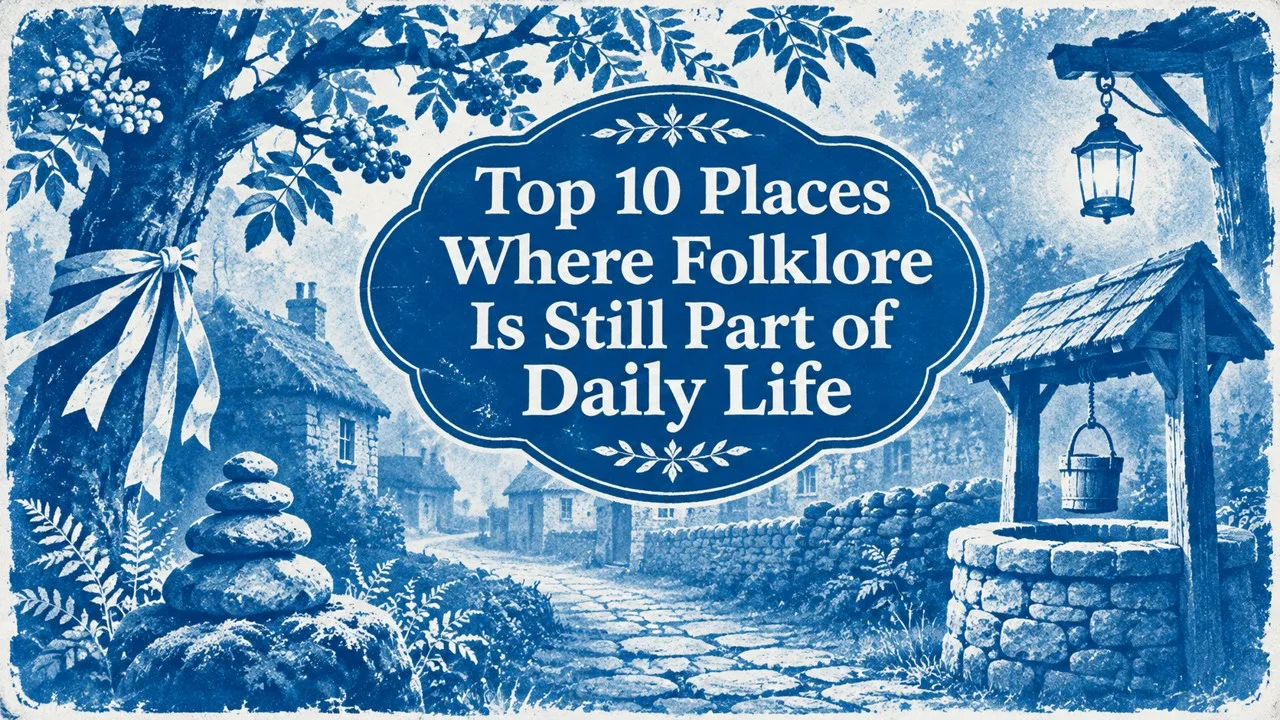
Spirit houses in Thailand, fairy forts in Ireland, offerings in Bali and empty seats for ghosts in Singapore: ten places where folklore shapes daily life. In much of the modern world, folklore is associated with storybooks and museums. But in many places, old beliefs about spirits, luck and the dead still influence how people build houses, plan roads, decorate cars and spend their holidays.
For some people, these practices are matters of sincere faith. For others, they are customs followed out of respect, habit or a sense of identity, or simply because it seems wise not to take chances.
Folklore often blends with organized religion, commerce and tourism. Many traditions have changed over time and continue to evolve, and some have been recognized by UNESCO as intangible cultural heritage.
The ten examples below come from Asia, Europe and the Americas. They show how traditional beliefs remain woven into everyday life in the twenty-first century.
Key Facts
| # | Place | Tradition | When it is seen |
|---|---|---|---|
| 1 | Thailand | Spirit houses | Every day |
| 2 | Ireland | Fairy forts and fairy trees | Building and road projects |
| 3 | Japan | Setsubun | Early February |
| 4 | Turkey and the eastern Mediterranean | Nazar amulets | Homes, cars and babies |
| 5 | Bali, Indonesia | Canang sari | Every day |
| 6 | Mexico | Day of the Dead | November 1 and 2 |
| 7 | Philippines | Tabi tabi po | Outdoors, especially in rural areas |
| 8 | Romania and Moldova | Martisor | March 1 |
| 9 | Derbyshire, England | Well dressing | Late spring and summer |
| 10 | Singapore, Malaysia, Hong Kong and beyond | Ghost Festival | Seventh lunar month |
1. Homes for the Guardian Spirits
Across Thailand, many homes, offices, shops and hotels have a small shrine called a spirit house, usually mounted on a pillar near the property. It is meant to provide a home for the guardian spirits of the land, so that they do not cause trouble for the people living there [1].
Owners leave daily offerings such as food, drinks, flowers, incense and small figurines. The location and installation date are often chosen with the help of a Brahmin priest or another specialist [1].
One of Bangkok's best-known shrines, the Erawan Shrine, was built in the 1950s after a series of mishaps during the construction of a hotel. It is now visited by large numbers of worshippers and tourists. The shrine houses a statue of the Hindu god Brahma, known in Thai as Phra Phrom. Worshippers sometimes hire traditional dancers to perform at the shrine in thanks when their prayers are answered. When an old spirit house is replaced, the old one is often taken to a temple or a special site rather than thrown away.
2. Roads Bent for Fairies
Ireland's landscape is dotted with tens of thousands of ancient circular earthworks known as ringforts. Folk tradition often calls them fairy forts and holds that disturbing them can bring misfortune [2].
Many farmers and builders have traditionally avoided damaging fairy forts and lone hawthorn trees, also linked with fairies. In 1999, the storyteller Eddie Lenihan led a campaign to protect a fairy bush at Latoon in County Clare that stood in the path of a new road [2].
The road was eventually built without destroying the bush, and the case attracted international media attention. Many Irish people treat such beliefs with humor, but respect for fairy sites remains widespread in rural areas. Ringforts were mostly farmsteads enclosed by earth banks, built mainly in the early medieval period. Their survival in such large numbers is partly credited to the folk belief that discouraged people from destroying them. Lenihan is also known for collecting and recording traditional Irish stories from older storytellers.
Related: Top 10 Saint Patrick's Day Traditions with More Complicated Origins
3. Beans Thrown at Demons
Setsubun, celebrated in Japan around February 3, marks the day before the traditional start of spring. Families throw roasted soybeans out of their doors or at a family member wearing a demon mask, shouting demons out, good luck in [3].
People also eat a number of beans equal to their age, for good health in the coming year. Temples and shrines hold public bean-throwing ceremonies, sometimes featuring celebrities and sumo wrestlers [3].
In recent decades, a custom from western Japan has spread nationwide: eating a thick sushi roll, called ehomaki, while facing the year's lucky direction. Convenience store chains helped popularize the custom across the country. Setsubun originally referred to the day before the start of each of the four seasons, but the spring one became the most important. In some places, people hang sardine heads and holly branches at their doors to keep demons away.
4. The Blue Eye Against Envy
In Turkey, a blue glass amulet shaped like an eye, known as a nazar, is a common sight. It is hung in homes, offices and cars, pinned to babies' clothing and attached to jewelry [4].
The amulet is meant to protect against the evil eye, a harmful force believed to be caused by envy or admiring looks. Similar beliefs and amulets are found in Greece, the Middle East, the Balkans and North Africa [4].
Belief in the evil eye is ancient and appears in many cultures. In Turkey, villages near Izmir have long been known for producing handmade glass nazar beads. If a nazar cracks or breaks, it is often believed to have absorbed the evil eye and should be replaced. Many people in Turkey also say the expression masallah, meaning what God has willed, when admiring a child or a new possession, to avoid attracting envy.
5. Offerings on the Pavement
In Bali, the majority Hindu island of Indonesia, people make small offerings called canang sari every day. Each consists of a palm-leaf tray holding flowers, food and incense [5].
The offerings are placed at family temples, shrines, doorways, shops and even on sidewalks and car dashboards. Those placed on the ground are often intended to appease lower spirits [5].
Related: Top 10 Personifications of Death in Myth and Folklore
Making and placing the offerings is part of daily routine for many Balinese families, often taking time each morning. Visitors are asked to avoid stepping on them. Canang sari reflect a Balinese Hindu idea of balance between good and evil forces. During the Balinese day of silence, Nyepi, the whole island shuts down, including its airport, as part of a ritual to deceive evil spirits into thinking the island is deserted.
6. A Festival for the Dead
In Mexico, families celebrate the Day of the Dead at the start of November by welcoming the spirits of deceased relatives. They build altars, or ofrendas, decorated with marigolds, candles, photographs, sugar skulls and the favorite foods of the dead [6].
Many families visit cemeteries to clean and decorate graves, sometimes spending the night there. The tradition blends Indigenous beliefs with Catholic observances of All Saints' and All Souls' Days [6].
UNESCO recognized the Indigenous festivity dedicated to the dead as intangible cultural heritage. Mexico City's large Day of the Dead parade began in 2016, inspired partly by a scene in the James Bond film Spectre. The marigold, called cempasuchil in Mexico, is believed to guide the spirits with its bright color and scent. The festival also features the elegant skeleton figure La Catrina, created as a satirical print by the artist Jose Guadalupe Posada in the early twentieth century.
7. Asking Spirits for Permission
In the Philippines, people sometimes say tabi tabi po, roughly meaning please excuse me, when passing through fields, forests or other places believed to be inhabited by spirits [7].
The phrase is a polite request to unseen beings, such as the nuno sa punso, a spirit said to live in anthills or mounds, not to be offended. Folk beliefs hold that offending them could cause illness or misfortune [7].
Many Filipinos follow the custom out of habit or respect for tradition, even if they are not sure they believe in the spirits. It is often taught to children by older relatives. Philippine folklore includes many other spirits and creatures, such as the duwende, a small household spirit, and the tikbalang, a horse-headed being said to lead travelers astray. Some people leave a little food or drink outdoors as a gesture of respect.
Related: Top 10 Mythical Creatures in World Mythology - That Inspired Myths Across Civilizations (unchanged)
8. Red and White for Spring
On March 1, people in Romania and Moldova give one another small tokens called martisor, made with intertwined red and white strings. They are worn throughout March for good luck and health [8].
In Bulgaria, a similar tradition called martenitsa is linked to the folklore figure Baba Marta, Grandmother March. At the end of the period, the strings are often tied to a blossoming tree [8].
In 2017, UNESCO added the cultural practices associated with March 1 in Bulgaria, Moldova, North Macedonia and Romania to its list of intangible cultural heritage. The tradition is associated with the arrival of spring and the renewal of nature. In the past, the red and white strings were often tied around children's wrists or necks, and coins were sometimes attached for prosperity.
9. Pictures Made of Petals
In villages in Derbyshire and Staffordshire, people decorate wells and springs with large pictures made from flower petals, seeds, leaves and other natural materials pressed into wet clay on wooden boards [9].
The custom is thought to have pagan roots but was adopted by the church and often includes religious scenes. In the village of Tissington, the tradition is said to date back centuries, possibly to the aftermath of the Black Death or a drought [9].
Today, dozens of villages hold well dressings each year, often accompanied by blessings, processions and fairs. They draw many visitors. Designs are planned weeks in advance, and the petals must be placed carefully so the picture lasts for several days. Volunteers soak the boards in water beforehand so that the clay stays moist.
10. A Month for Hungry Ghosts
In Chinese folk tradition, the gates of the underworld open during the seventh month of the lunar calendar, allowing spirits to roam the world of the living. The Ghost Festival is held on the fifteenth day of the month [10].
Related: Top 10 Most Colorful Cities in the World
People burn joss paper and offer food to the spirits. In Singapore and Malaysia, live stage performances known as getai are held, and the front row of seats is often left empty for the ghosts [10].
Some people avoid swimming, moving house or starting new businesses during the month. The festival is observed in many Chinese communities, including in mainland China, Taiwan and Hong Kong. In Hong Kong, the Yu Lan festival of the Chiu Chow community, held during the ghost month, has been recognized as part of China's national intangible cultural heritage. At the end of the month, lanterns are sometimes floated on water to guide the spirits back.
Conclusion
These traditions show that folklore remains a living part of many societies. Beliefs about spirits, luck and the dead continue to shape everyday decisions and celebrations.
For many people, following these customs is less about literal belief than about maintaining connections with family, community and heritage.
Some traditions have adapted to modern life, appearing in convenience stores, parades or tourism. Others continue in much the same way as they have for generations.
Respecting these customs is an important part of visiting the places where they are practiced.
- ^ [1] Accounts of spirit houses. Wikipedia: Spirit house Wikipedia: Erawan Shrine
- ^ [2] Accounts of fairy forts. Wikipedia: Fairy fort Wikipedia: Eddie Lenihan
- ^ [3] Accounts of Setsubun. Wikipedia: Setsubun Wikipedia: Oni
- ^ [4] Accounts of the nazar. Wikipedia: Nazar (amulet) Wikipedia: Evil eye
- ^ [5] Accounts of canang sari. Wikipedia: Canang sari Wikipedia: Balinese Hinduism
- ^ [6] Accounts of the Day of the Dead. Wikipedia: Day of the Dead Wikipedia: Spectre
- ^ [7] Accounts of tabi tabi po. Wikipedia: Tabi tabi po Wikipedia: Philippine mythology
- ^ [8] Accounts of martisor. Wikipedia: Martisor Wikipedia: Martenitsa
- ^ [9] Accounts of well dressing. Wikipedia: Well dressing Wikipedia: Tissington
- ^ [10] Accounts of the Ghost Festival. Wikipedia: Ghost Festival Wikipedia: Getai





















Discussion
Log in with