






 By
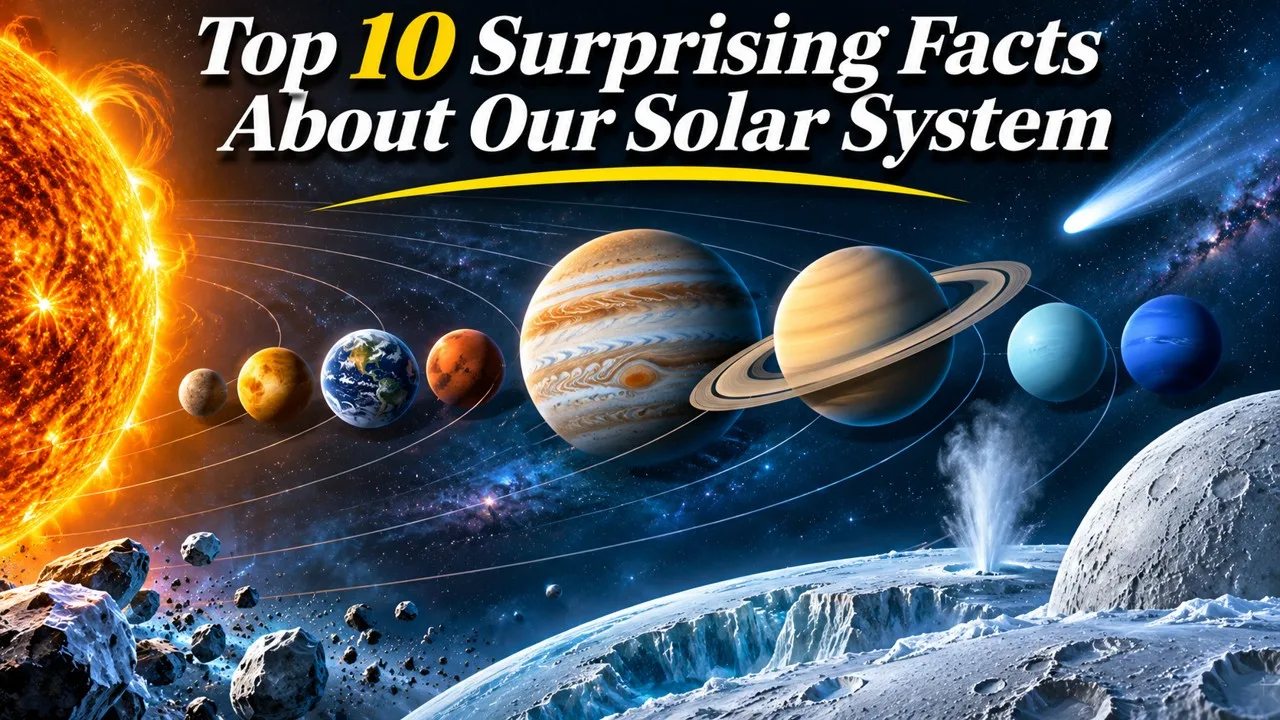
Bennu holds a watery past, Ceres may be a leftover ocean world, and a claim that Mercury was once Earth-sized is a model, not a measurement. The solar system is close enough to visit and still strange enough to keep rewriting textbooks [1][6]. Sample-return from an asteroid, a dwarf planet with leftover brines, auroras on an ice giant, and a rusty planet that was not always red are documented results [1][6][8][9]. A larger, stripped Mercury is a serious impact hypothesis, not a surveyed fact, and it is treated that way below [10]. This list stays inside our own system. It does not lean on a contested exoplanet biosignature, and it does not need one.
The ten entries are recent or recently sharpened findings, with the limits that belong to each.
Key Facts
A surprising fact about a neighbor can still be a model, a partial sample, or a single spacecraft season.
Ten Findings at a Glance
| Rank | Subject | What is reasonably shown | What is not |
|---|---|---|---|
| 1 | Asteroid Bennu | OSIRIS-REx samples are rich in hydrated minerals and organics, consistent with a water-altered parent body | The asteroid is not a droplet of a living ocean |
| 2 | Uranus and internal heat | Voyager 2 found a surprisingly low heat flow compared with Neptune; the mismatch is still discussed | The mystery is not a finished theory |
| 3 | Neptune in infrared | JWST has imaged auroras and has tracked atmospheric temperature change | One season is not the whole climate history |
| 4 | Icy bodies in step with Neptune | Trojans and resonant objects share or lock to the planet's orbit | "Synced" is a resonance or a shared path, not a tow rope |
| 5 | Ceres | Dawn found salts, bright deposits, and hints of a leftover brine or muddy ocean | It is not a proven subsurface sea you could sail |
| 6 | Jupiter's moons | The Galilean satellites and a large irregular retinue are a system, not a single type of world | Every small moon is not a second Europa |
| 7 | The inner "big four" | Metis, Adrastea, Amalthea, and Thebe are tiny, close-in companions inside Io's orbit | They are not a second Galilean set |
| 8 | Venus | A dense atmosphere, a slow retrograde spin, and growing evidence of a geologically restless surface | A contested atmospheric gas is not a detection of life |
| 9 | Early Mars | The rust is later; older crust and minerals record a wetter, less uniformly red world | Gray is a geological chapter, not a postcard of today's dust |
| 10 | Mercury's possible larger past | Some impact models start with a much bigger silicate body and strip it down | Earth-sized is a hypothesis, not a measurement |
1. Bennu, and a Wet Parent World
NASA's OSIRIS-REx mission returned material from the near-Earth asteroid Bennu, and the early laboratory results have been rich in clay minerals, hydrated phases, and organic compounds [1]. The picture is of a fragment from a larger parent body that once had liquid water circulating through rock, not of a dry, inert stone [1]. That is already a surprising fact about a small, dark, rubble-pile asteroid that crosses Earth's neighborhood. It is not a claim that Bennu is a preserved ocean, or that the sample is a biological residue.
A watery past, in this sense, is a geochemical past. The bottles in the clean room hold minerals and molecules, not a shore.
2. A Giant That Keeps Its Heat to Itself
When Voyager 2 flew past Uranus in 1986, it found a world that radiates little extra heat from the interior, in contrast to Neptune, which has a substantial internal flux [2]. The mismatch is still a live problem: the two ice giants are similar in mass and composition, yet they do not seem to have aged thermally in the same way [2]. Suggestions include a giant impact that mixed or depleted Uranus's heat, a layered interior that traps warmth, or a measurement that later missions will refine. JWST and ground-based work have added atmosphere and season, but they have not closed the energy budget.
"Diving into the heat mystery" is fair as a research program. It is not a solved dive.
Related: Top 25 Interesting Facts About the Solar System
3. Neptune, Lit and Sometimes Chilled
The James Webb Space Telescope has given Neptune a mid-infrared and near-infrared clarity that earlier portraits lacked, including auroral emission and a detailed look at clouds, rings, and temperature structure [3]. Reports associated with that work have also described a marked cooling in parts of the atmosphere relative to earlier decades, a change that belongs to seasonal and circulation studies, not to a cartoon of a planet catching a cold [3]. Auroras on an ice giant are a useful surprise: they show a magnetosphere at work far from the Sun, in a geometry unlike Jupiter's or Earth's.
A spectacular image is a starting point. The temperature drop, if it holds across later seasons, is a climate fact, not a one-night curiosity.
4. Icy Companions in Step
Neptune does not travel alone in the dynamical sense. It has Trojan asteroids that share its orbit, leading or trailing by about sixty degrees, and it holds a large family of trans-Neptunian objects in mean-motion resonances, of which Pluto's 3:2 lock is only the most famous [4]. A "weird little icy thing synced with Neptune" is, in the honest catalog, one of those trojans or resonant bodies: a small, cold object whose year is tied to the giant's [4]. The sync is gravity, a repeating orbital rhythm, not a physical tether.
The surprising fact is how much of the outer system is still choreographed by a single planet that, to the eye, looks isolated.
5. A Dwarf Planet with a Wet Memory
Ceres, the largest object in the asteroid belt, was mapped by the Dawn spacecraft and found to be more than a dry, cratered lump [5]. Bright salt deposits, the lonely mountain Ahuna Mons, and models of a muddy or briny interior have led many researchers to describe it as a leftover, or dried-down, ocean world: a body that once held a significant amount of liquid water and may still have residual brines at depth [5]. That is a strong, still-discussed interpretation, not a confirmed sea with a shoreline. It is already enough to make our nearest dwarf planet a cousin of the icy moons, not only of the stony asteroids.
Related: The Eight Planets Compared: Size, Gravity, Days and Moons
A dried ocean world is a geological sentence. It should not be sold as a cruise.
6. A Menagerie, Not a Set of Copies
Jupiter's Galilean moons are four different answers to the same gravitational question: a sulfur-and-lava world, an ice shell over a likely ocean, a giant, magnetized ice-and-rock body, and a heavily cratered, perhaps more inert, outer ice [6]. Beyond them, dozens of smaller irregular satellites, many of them likely captured, make the system look less like a tidy family and more like a menagerie [6]. The surprise, if a reader still carries a schoolbook picture of "the four moons," is the diversity, and the crowd. Europa's ocean hypothesis is a research program of its own; it does not automatically extend to every irregular rock.
A giant planet is a system. The moons are why that sentence is not a cliché.
7. Four Tiny Worlds inside the Famous Four
Inside Io's orbit, Jupiter has a compact set of small inner moons, often listed as Metis, Adrastea, Amalthea, and Thebe, which share the region of the faint rings and are, in a local sense, a "big four" of the inner system [7]. They are tiny, irregular, and close-in, a completely different class from the Galilean worlds, which is why a nickname that sounds like a sequel is slightly comic and still useful [7]. Amalthea, the largest of them, is itself a dark, potato-shaped body, not a miniature Ganymede. The inner four matter because they help trace the rings and the inner environment of a giant planet, not because they are adorable in any official sense.
A complete Jovian census has more than four names. These four are the ones a casual list most often skips.
Related: Top 10 Famous Astronomical Observatories
8. Venus, Still Not Settled
Venus is Earth's near twin in size and, at the same time, a slow, retrograde rotator under a crushing, hot, carbon-dioxide atmosphere [8]. In the last few years, evidence from surface changes, thermal anomalies, and geology has strengthened the case that the planet is still volcanically or tectonically restless in some regions, a change from the older cartoon of a dead, sealed world [8]. Claims of unusual gases in the atmosphere, including a contested phosphine report, have not met the standard of a biosignature and should not be told as a detection of life. The surprising facts that survive that caution are already large: the spin, the weather, and a surface that may not be finished.
"What's up with Venus" is a fair heading only if the answer is allowed to be several things at once, and none of them a headline about organisms.
9. Mars, before the Rust
The Mars we photograph is a rust-colored desert, stained by iron oxides in the dust and in weathered rinds [9]. Older crust, drilled and orbited, records a different early mood: basaltic, often greener or grayer minerals, clay and other water-altered phases, and a climate that, at least in places and times, could support liquid water at or near the surface [9]. "Mars used to be gray" is a fair popular sentence for that chapter, if it is not taken as a single, planet-wide paint job on a known date. The rust is a later, oxidizing story. The earlier rock is the reason the planet is more than a red postcard.
A color change, in geology, can be a climate change. That is the fact, and it is already enough.
Related: Quasars: Distant Beacons or Local Oddballs?
10. A Possible Larger Mercury
Mercury is a dense, metal-rich world with a thin silicate shell, a combination that has long suggested a violent past [10]. In some giant-impact models, an earlier, more Earth-sized or otherwise much larger body loses most of its rock in a collision, leaving a raw, oversized core and a thin mantle, the Mercury we have [10]. Other models start with a world that formed already metal-rich, or that lost silicates by other means. The surprising headline, "Mercury may have been Earth-sized," is therefore a possible initial condition in some calculations, not a measurement of a lost radius. It belongs on the list as a live scientific idea, labeled as such.
A model can be the most interesting true sentence we have about a planet, as long as no one files it as a survey.
Conclusion
Our own system is still producing surprises that do not require a leap to another star. A sampled asteroid remembers water. An ice giant will not share its heat budget with its neighbor. A telescope has made Neptune's auroras and temperature into data. A dwarf planet in the belt looks like a leftover ocean world. Mars was not always a rust bowl, and Mercury may, in some histories, have been a larger thing that was stripped.
The discipline in the list is the same as in any neighboring-planet story. A resonance is not a rope. A brine is not a sea-lane. A contested gas is not life. An impact model is not a measured diameter. With those clauses in place, the solar system is already odd enough to keep a careful list busy.
- ^ [1] NASA and laboratory reports on OSIRIS-REx samples from Bennu, including hydrated minerals and organics. NASA: OSIRIS-REx
- ^ [2] Voyager 2 results on Uranus's low internal heat flux, and later discussions of the contrast with Neptune. NASA: Uranus
- ^ [3] JWST observations of Neptune, including auroral emission and atmospheric temperature studies. NASA: James Webb Space Telescope
- ^ [4] Descriptions of Neptune trojans and of trans-Neptunian objects in mean-motion resonance, including the 3:2 Pluto resonance. NASA: Neptune
- ^ [5] Dawn mission results on Ceres, including salt deposits, Ahuna Mons, and models of a residual brine or muddy ocean. NASA: Ceres
- ^ [6] Overviews of the Galilean moons and of Jupiter's irregular satellite population. NASA: Jupiter's moons
- ^ [7] The inner Jovian moons Metis, Adrastea, Amalthea, and Thebe, and their relation to the rings. NASA: Jupiter's moons
- ^ [8] Reviews of Venus's rotation, atmosphere, and recent evidence for a geologically restless surface; contested gas detections are not treated here as biosignatures. NASA: Venus
- ^ [9] Mineralogical and geological evidence for a wetter, less uniformly oxidized early Mars. NASA: Mars
- ^ [10] Giant-impact and related models of Mercury's origin, including scenarios that begin with a larger silicate body, labeled as models. NASA: Mercury



















Discussion
Log in with