











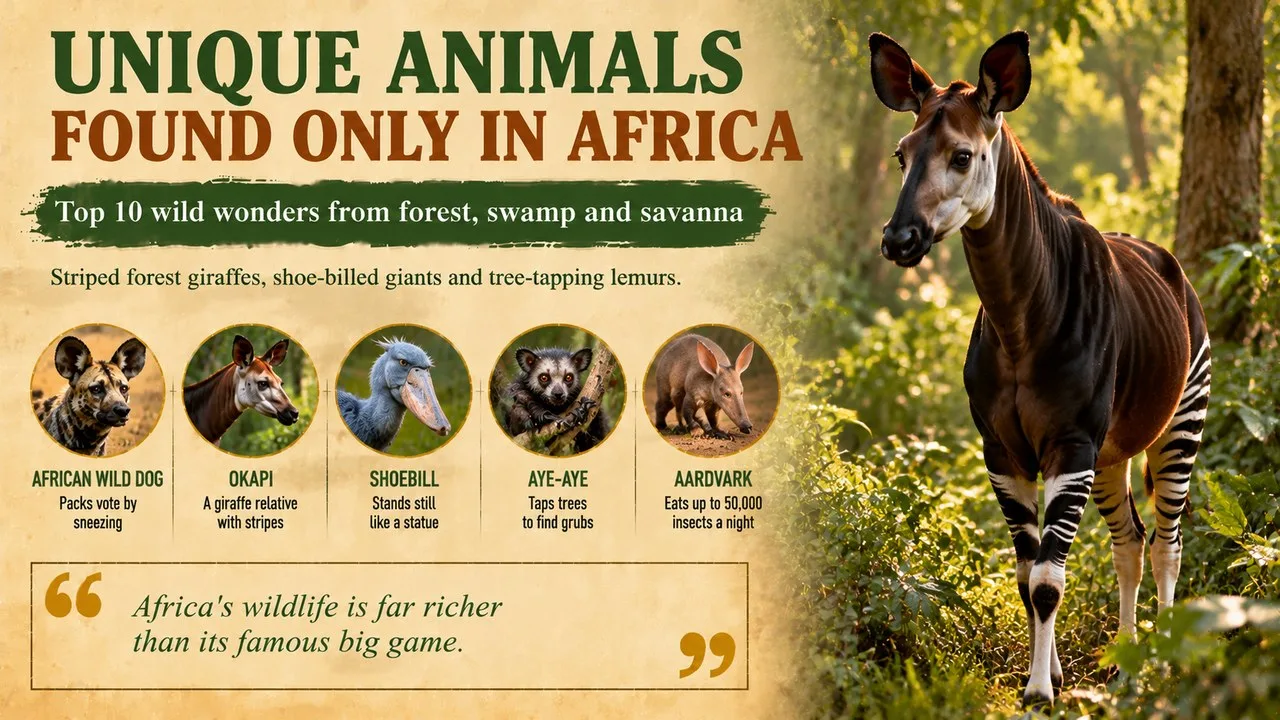
Unique animals found only in Africa include a giraffe relative with zebra stripes, a giant bird with a shoe-shaped bill and a lemur that taps on trees.
This Finepedia guide, written in October 2026, introduces 10 unusual animals that live naturally only in Africa, from rainforest hermits to savanna hunters and a strange primate from Madagascar. We left out the famous big five, such as lions and elephants, to focus on animals that get less attention. Facts were checked against conservation groups, scientific studies and reference works, and IUCN Red List status is given where it helps. For more remarkable wildlife, see the Finepedia guides Extraordinary Lizards of the World: Top 10 and Fascinating Spiders of the World: Top 10.
How We Chose These
Every animal on this list is endemic to Africa, meaning it is found in the wild nowhere else, although some live in zoos worldwide. We counted Madagascar as part of Africa. We chose a mix of mammals and birds from forests, swamps, deserts and grasslands, and avoided chameleons and agamas, which feature in our lizards guide. Each entry has a short profile, four key facts and a further note on why it matters or a surprising detail.
The 10 African Animals at a Glance
| No. | Animal | Group | Where it lives | Standout fact |
|---|---|---|---|---|
| 1 | African wild dog | mammal | sub-Saharan Africa | packs vote by sneezing |
| 2 | Okapi | mammal | DR Congo rainforest | a giraffe relative with stripes |
| 3 | Shoebill | bird | East African swamps | stands still like a statue |
| 4 | Aye-aye | mammal | Madagascar | taps trees to find grubs |
| 5 | Aardvark | mammal | much of Africa | eats up to 50,000 insects a night |
| 6 | Gerenuk | mammal | East Africa | feeds standing on its back legs |
| 7 | Grey crowned crane | bird | East and southern Africa | on Uganda's flag |
| 8 | Mantled guereza | mammal | central and East Africa | a monkey with no thumbs |
| 9 | Galago | mammal | sub-Saharan Africa | leaps over 2 m |
| 10 | Sengi | mammal | mostly southern and East Africa | related to elephants |
1. The African Wild Dog Hunts as a Team
The African wild dog, also called the painted dog, is Africa's largest wild canine. Each one has a unique coat of black, brown, yellow and white patches, and big round ears. It lives in tight-knit packs that hunt antelopes together, running them down over long distances at speeds of up to 66 km/h until they tire.
Key Facts
- Species: Lycaon pictus
- Population: about 6,600 adults in 39 groups
- Status: endangered, according to the IUCN
- Hunting: an average chase covers about 2 km
Why It Matters
Wild dog packs seem to decide when to go hunting by sneezing. Before a hunt, the dogs gather in a lively rally, and the more dogs that give short, sharp sneezes, the more likely the pack is to set off, especially if the leading pair sneeze first. Pack members also share food by bringing up meat for the pups and even for other adults.
2. The Okapi Is a Forest Giraffe
The okapi lives only in the rainforests of north-east DR Congo. Its legs carry white stripes like a zebra's, but its closest living relative is the giraffe. It has a long neck, large ears and a long, dark tongue that it uses to strip leaves from branches and even to clean its ears.
Key Facts
- Species: Okapia johnstoni
- Height: about 1.5 m at the shoulder
- Weight: about 200 to 350 kg
- Status: endangered, according to the IUCN
Did You Know?
The okapi was unknown to Western science until the early 1900s. The British official Sir Harry Johnston heard reports of a striped forest animal and sent pieces of skin and a skull to Europe, and the species was formally named in 1901 in his honour. Today the Okapi Wildlife Reserve in Congo protects a key population.
3. The Shoebill Looks Like a Living Dinosaur
The shoebill is a huge grey wading bird that lives in the papyrus swamps of East and Central Africa, from South Sudan to Zambia. It takes its name from its enormous bill, which is shaped like a wooden shoe. It can stand perfectly still for long periods, waiting for a fish to come close.
Key Facts
- Species: Balaeniceps rex
- Height: about 110 to 140 cm
- Diet: mainly lungfish, catfish and other swamp fish
- Status: vulnerable, according to BirdLife International
Why It Matters
When a shoebill spots prey, it strikes with a sudden forward lunge, often grabbing the fish along with mud and plants. Though it was long grouped with storks, DNA studies show its closest relatives are the pelicans and the hamerkop. Shoebills are usually silent but make loud clattering sounds with their bills at the nest.
4. The Aye-Aye Is Madagascar's Strangest Lemur
The aye-aye is a night-active lemur found only on the island of Madagascar. It has large ears, ever-growing front teeth like a rodent's and an extremely thin, bony middle finger. No other night-active primate on Earth is larger.
Key Facts
- Species: Daubentonia madagascariensis
- Home: forests of Madagascar
- Status: endangered, according to the IUCN
- Feeding: grubs, seeds, fruit and nectar
Did You Know?
The aye-aye finds food by tapping on tree bark with its long middle finger and listening for hollow spaces where insect larvae hide. It then gnaws a small hole and hooks the grubs out. Sadly, in some parts of Madagascar it is seen as a bad omen and may be killed on sight, which adds to the threat from forest loss.
5. The Aardvark Is an Earth Pig
The aardvark is a burrowing, night-active mammal that lives across most of Africa south of the Sahara. Its name comes from Afrikaans words meaning earth pig, but it is not related to pigs. It is the sole surviving species in its own order of mammals, and its closest relatives include elephants and manatees.
Key Facts
- Species: Orycteropus afer
- Diet: ants and termites
- Appetite: up to about 50,000 insects in one night
- Home: burrows dug with powerful claws
Why It Matters
The aardvark's burrows are important to many other animals. When it moves on, warthogs, porcupines, hyenas, snakes and birds move into its old tunnels for shelter. It uses its long, sticky tongue to lap up insects and can close its nostrils to keep out dust while it digs into hard termite mounds.
6. The Gerenuk Eats Standing on Two Legs
The gerenuk is a slender antelope with a very long neck that lives in the dry bush of East Africa, mainly in Somalia, Ethiopia, Kenya and Tanzania. Its name comes from the Somali language. Only the males have horns, which are shaped like a lyre.
Key Facts
- Species: Litocranius walleri
- Height: about 80 to 105 cm at the shoulder
- Weight: about 18 to 52 kg
- Water: rarely needs to drink
Did You Know?
To reach leaves that other antelopes cannot, the gerenuk stands upright on its back legs, sometimes resting its front legs on a branch, and stretches its long neck into thorny bushes. It gets most of the water it needs from the leaves it eats, which lets it live in very dry country far from rivers.
7. The Grey Crowned Crane Wears a Golden Crown
The grey crowned crane is a tall, elegant bird of the savannas and wetlands of East and southern Africa. It has a grey body, white cheeks, a red throat pouch and a stiff crest of golden feathers on its head. Uganda has made it the national bird and shows it on the national flag.
Key Facts
- Species: Balearica regulorum
- Diet: seeds, grain, insects, frogs and small fish
- Status: endangered, according to the IUCN
- Groups: flocks of 30 to 150 birds are common
Why It Matters
Crowned cranes are known for their dances, with bows, jumps and wing-spreading, used in courtship but also at other times of year. Along with their close cousin, the black crowned crane, they are the only cranes able to perch in trees, thanks to a long back toe that grips branches. Wetland loss has caused their numbers to fall sharply.
8. The Mantled Guereza Is a Monkey Without Thumbs
The mantled guereza is a black and white monkey of the forests of central and East Africa, from Cameroon and Nigeria to Ethiopia, Kenya and Tanzania. Its black body is draped with long white fringes of hair, called a mantle, and it has a bushy white tail tip.
Key Facts
- Species: Colobus guereza
- Groups: about 3 to 15 animals
- Diet: mainly leaves, plus seeds and fruit
- Name: colobus comes from a Greek word meaning cut short
Did You Know?
Like other colobus monkeys, the guereza has only a tiny stub where a thumb would be, which gives the group its name. It has a special stomach with several chambers that helps it digest tough leaves. The guereza spends nearly all its time in trees and can leap between branches with its mantle streaming out behind it.
9. The Galago Is a Bush Baby With a Big Leap
Galagos, also called bush babies, are small, big-eyed primates that live in forests and woodlands across sub-Saharan Africa. They are active at night and can be heard calling loudly in the dark, which may be how they got their nickname. Scientists group the many species into six genera.
Key Facts
- Family: Galagidae
- Activity: nocturnal
- Jump: up to about 2.25 m straight up
- Tail: longer than the head and body together
Why It Matters
For their size, galagos are among the best jumpers of all animals, using powerful back legs to spring between trees. They mark their routes with urine, which lets them follow scent trails and land on the same branches night after night. Their huge eyes help them spot insects in the dark.
10. The Sengi Is a Tiny Relative of Elephants
Sengis, also called elephant shrews, are small, insect-eating mammals with long, bendy snouts. They live in many habitats across Africa, from the Namib Desert to thick forest. Despite their old name, DNA studies show they are not true shrews but belong to a group that includes elephants, aardvarks and manatees.
Key Facts
- Family: Macroscelididae
- Size: about 10 to 30 cm long
- Speed: recorded at up to 28.8 km/h
- Name: sengi comes from Bantu languages
Did You Know?
Sengis keep a network of cleared paths through their territory, which gives them a quick escape route when a predator appears. The Somali sengi was not recorded by scientists for more than 50 years, from 1968 until 2020, when a team rediscovered it in Djibouti.
Frequently Asked Questions
Why does Africa have so many unique animals?
Africa is a huge continent with deserts, rainforests, mountains and grasslands, which gives animals many different places to live. Some groups, such as sengis and aardvarks, belong to an ancient family of mammals that evolved in Africa. Madagascar split from mainland Africa so long ago that most of its wildlife is found nowhere else.
Which of these animals are endangered?
The African wild dog, okapi, aye-aye and grey crowned crane are all rated endangered by the IUCN, while the shoebill is listed as vulnerable. Habitat loss, hunting and disease are the main threats.
Conclusion
From the sneezing wild dog to the tree-tapping aye-aye, these ten animals show that Africa's wildlife is far richer than its famous big game. Protecting forests, swamps and grasslands is key to their survival. For more remarkable wildlife, read the Finepedia guides Extraordinary Lizards of the World: Top 10 and Fascinating Spiders of the World: Top 10.
- IUCN Red List of Threatened Species, assessments for the African wild dog, okapi, aye-aye and grey crowned crane.
- BirdLife International, Shoebill species factsheet.
- Walker, R. and others, Sneeze to leave: African wild dogs use variable quorum thresholds facilitated by sneezes in collective decisions, Proceedings of the Royal Society B, 2017.
- Wikipedia (accessed October 2026), articles on the African wild dog, Okapi, Shoebill, Aye-aye, Aardvark, Gerenuk, Grey crowned crane, Mantled guereza, Galago and Elephant shrew.
- 10 Most Today, 10 Most Incredible Animals Only Found in Africa, 10mosttoday.com (topic reference).
















Log in with