











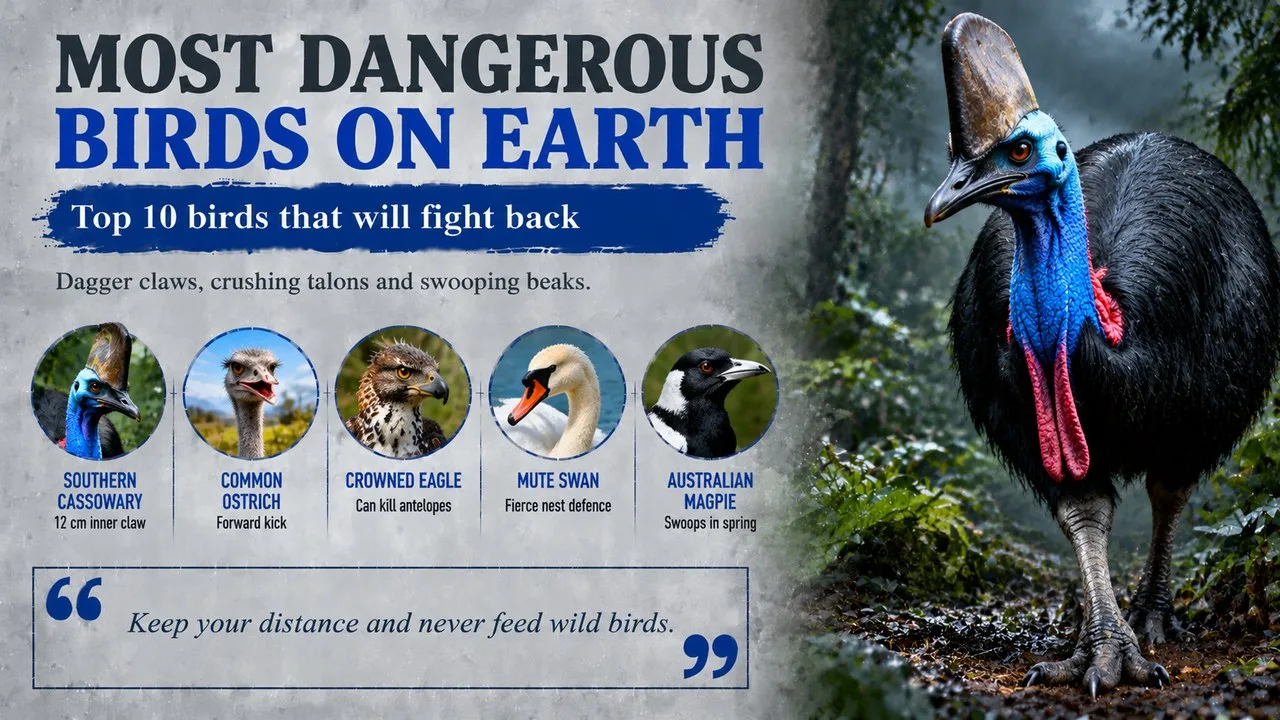
Most dangerous birds on Earth are led by the southern cassowary and its dagger claw, but swans, owls, eagles and even magpies strike if you get too close.
This Finepedia guide, written in October 2026, ranks 10 birds that can injure people or pets, from flightless giants with killer kicks to garden birds that swoop at walkers in spring. Most of these birds are not looking for trouble: they attack to defend nests, chicks or food, often after people feed or corner them. Facts were checked against wildlife agencies, bird conservation groups, scientific studies and reference works. For more colourful birds and risky wildlife, see the Finepedia guides Colourful Parrots of the World: Top 10 and Most Dangerous Sea Creatures: Top 10.
How We Chose These
We ranked birds by how much harm they can do to a person and how often they come into contact with people. Flightless giants come first because they have caused deaths, followed by powerful birds of prey and then common birds that cause many minor injuries each year. We left out the harpy eagle, which appears in our Amazon guide. Each entry gives a short profile, four key facts and a note on why it matters or a surprising detail.
The 10 Dangerous Birds at a Glance
| No. | Bird | Where it lives | Main weapon | Why it attacks |
|---|---|---|---|---|
| 1 | Southern cassowary | New Guinea and north-east Australia | 12 cm inner claw | feeding, cornering, chicks |
| 2 | Common ostrich | Africa | forward kick | cornered or stressed |
| 3 | Emu | Australia | clawed feet | cornered or fed |
| 4 | Crowned eagle | sub-Saharan Africa | huge talons | hunting, nest defence |
| 5 | Great horned owl | the Americas | crushing grip | nest defence |
| 6 | Mute swan | Europe, Asia, introduced elsewhere | wings and bill | nest defence |
| 7 | Australian magpie | Australia | bill | spring nest defence |
| 8 | Snowy owl | the Arctic | talons | nest defence |
| 9 | European herring gull | European coasts and towns | dive attacks | chicks and food |
| 10 | Barred owl | North America | talons | nest defence |
1. The Southern Cassowary Has a Dagger Claw
The southern cassowary is a huge, flightless bird of the rainforests of New Guinea, nearby Indonesian islands and north-east Australia. It has glossy black feathers, a blue neck, red wattles and a tall helmet called a casque. Its thick, three-toed feet carry an inner claw up to 12 cm long, shaped like a blade.
Key Facts
- Species: Casuarius casuarius
- Speed: up to about 50 km/h
- Jump: nearly 2 m straight up
- Status: endangered in Australia under national and Queensland law
Why It Matters
A 2003 study of 221 cassowary attacks found that 150 involved people, and about three quarters of those birds had been fed by humans, which teaches them to expect food. Deaths are rare: one was recorded in Queensland in 1926 and another in Florida in 2019, when a man was clawed by a bird he kept. Feeding wild cassowaries is illegal in Queensland.
2. The Ostrich Kicks With Huge Force
The common ostrich of Africa is the world's tallest and heaviest bird. Males can stand well over 2 m tall and weigh up to about 130 kg. It cannot fly, but it is the fastest runner on two legs of any animal alive today.
Key Facts
- Species: Struthio camelus
- Top speed: about 70 km/h in short bursts
- Stride: up to 5 m
- Eggs: the largest laid by any living bird
Did You Know?
Ostriches usually run from danger, but a cornered bird can lash out with forward kicks from its powerful legs, armed with a long claw on the larger toe. The force of a kick has been measured at more than 2,000 newtons, enough to cause serious injury or death. Most attacks on people happen on farms or near captive birds.
3. The Emu Is a Strong Runner With Sharp Claws
The emu is the tallest bird native to Australia and the tallest on Earth after the two ostrich species. It can grow to about 1.9 m tall and sprint at around 48 km/h. Each of its three-toed feet ends in sharp claws, and a toe and claw together can measure about 15 cm.
Key Facts
- Species: Dromaius novaehollandiae
- Range: most of mainland Australia
- Defence: kicks with clawed feet
- Diet: plants and insects
Why It Matters
Emus are usually shy, but birds that are cornered, or that have learned to expect food from people, can kick and scratch. In 1932, emus became famous when thousands moved into farmland in Western Australia during a dry spell and wrecked crops. Soldiers with machine guns were sent in, but the so-called Emu War largely failed to stop them.
4. The Crowned Eagle Can Kill Antelopes
The crowned eagle is a big raptor of the forests and wooded valleys of sub-Saharan Africa. It has a crest of feathers, barred underparts and enormous talons. It is often called Africa's most powerful eagle when the size of its prey is compared with its own weight.
Key Facts
- Species: Stephanoaetus coronatus
- Length: as much as 90 cm, counting its long tail
- Prey: monkeys, small antelopes, hyraxes and rodents
- Largest prey: antelopes such as bushbuck up to about 30 kg
Did You Know?
The famous Taung Child, a fossil skull of an early human relative found in South Africa in 1924, has marks that scientists link to an eagle attack. Studies suggest a bird like the crowned eagle killed the child nearly 3 million years ago. In modern times there is also a credible report of a crowned eagle attacking a young child.
5. The Great Horned Owl Hunts Like a Winged Tiger
The great horned owl is a large owl with ear tufts and bright yellow eyes, found from Alaska to South America. Early naturalists called it the winged tiger because of its fierce hunting. It has a grip of great power, and big females may squeeze with a force close to that of the much larger golden eagle.
Key Facts
- Species: Bubo virginianus
- Wingspan: about 91 to 153 cm
- Diet: rabbits, hares, rodents, birds and more
- Range: the most widespread true owl in the Americas
Why It Matters
With its weak sense of smell, this owl is one of the few hunters that regularly takes skunks. Near the nest, it warns intruders with hissing, bill-clapping and spread wings, and may strike with its feet if they come closer. People climbing to nests and pets left outside at night are most at risk.
6. The Mute Swan Defends Its Nest Fiercely
The mute swan is a large white swan with an orange bill and a black knob. It is native to Europe and some of Asia and has been introduced to North America and other regions. It is among the heaviest flying birds, with males often weighing more than 10 kg and a wingspan of up to about 2.4 m.
Key Facts
- Species: Cygnus olor
- Length: about 140 to 160 cm
- Warning sign: a loud hiss with wings raised
- Name: it is less noisy than other swans
Did You Know?
Nesting mute swans can turn highly aggressive and will chase off other swans, geese and ducks, sometimes holding them under water. Males may even attack canoes and kayaks that come too near. In England, unmarked mute swans on open water have long been treated as property of the Crown.
7. The Australian Magpie Swoops in Spring
The Australian magpie is a black and white songbird found in parks, gardens and farmland across Australia. It is loved for its rich, musical calls, but in spring a small number of breeding males swoop at people who come near their nests, sometimes pecking or scratching at the head.
Key Facts
- Species: Gymnorhina tibicen
- Length: about 37 to 43 cm
- Season: mainly spring, during nesting
- Memory: knows the faces of 100 or more people
Why It Matters
Swooping season is a regular part of Australian life, and councils put up warning signs near known nests. Wearing a wide-brimmed hat or carrying an umbrella helps, but cyclists' helmets are of little use, because magpies tend to target the sides and back of the head. Magpies that people have befriended are less likely to swoop on them.
8. The Snowy Owl Guards Its Nest on the Tundra
The snowy owl is a big, pale owl that breeds on the Arctic tundra of North America, Europe and Asia. No other owl is mostly white, and it hunts by day as well as by night, often feeding on lemmings. It is the bird symbol of Quebec and is famous as Hedwig in the Harry Potter books and films.
Key Facts
- Species: Bubo scandiacus
- Nest: a scrape on raised ground
- Clutch: often 5 to 11 eggs
- Prey: lemmings, other small mammals and water birds
Did You Know?
Because it nests on open ground, the snowy owl defends its chicks boldly against Arctic foxes, wolves and people. Encounters with angry parents have been described as genuinely risky, and some experts rank its nest defence towards humans as the most formidable of any bird. Walkers on the tundra are advised to keep well away from nests.
9. The Herring Gull Dive-Bombs and Steals Food
The European herring gull is a large grey and white gull, up to 66 cm long, found along the coasts of northern and western Europe and, more and more, in towns. It eats fish, shellfish and waste, and has learned to grab food from people.
Key Facts
- Species: Larus argentatus
- Diet: fish, crabs, carrion and human food
- Habits: snatches chips and ice cream from people
- Status: on the UK Red List of birds of high concern since 2009
Why It Matters
During the breeding season, gulls nesting on rooftops dive at people they see as a threat to their chicks, striking with feet and wings and sometimes spraying droppings or vomit. Some gulls have even learned to walk into shops and steal food. Not feeding gulls is the best way to reduce these clashes.
10. The Barred Owl Strikes Near Its Nest
This large, brown and grey owl lives in North American forests, with dark eyes and a round head without ear tufts. Its famous hooting call is often put into words as who cooks for you. It has spread from the east into the Pacific Northwest, where it competes with the threatened spotted owl.
Key Facts
- Species: Strix varia
- Habitat: mature forests and wooded suburbs
- Diet: small mammals, birds, frogs and insects
- Nickname: eight hooter, from its call
Did You Know?
Some barred owls attack people who climb to their nests or approach young owls on the ground, swooping silently and raking with their talons. There are even accounts of barred owls knocking people out of trees while defending a nest. Wearing a hat and avoiding nest areas in spring lowers the risk.
Frequently Asked Questions
Which bird is the most dangerous to humans?
The southern cassowary is usually named the most dangerous bird, because its blade-like claw and powerful kick have caused serious injuries and at least two recorded deaths. Ostriches are also capable of killing a person with a kick.
How can I avoid being attacked by a bird?
Never feed wild birds such as cassowaries, emus or gulls, keep well away from nests, and back away slowly if a bird hisses, raises its wings or swoops. In magpie season, use a wide-brimmed hat or umbrella, and walk rather than run past nesting areas.
Conclusion
From the cassowary's dagger claw to the swooping magpie, these ten birds remind us that even familiar animals will fight to protect their young. Most attacks can be avoided by keeping a respectful distance and never offering food. For more colourful birds and risky wildlife, read the Finepedia guides Colourful Parrots of the World: Top 10 and Most Dangerous Sea Creatures: Top 10.
- Kofron, C. P., Attacks to humans and domestic animals by the southern cassowary in Queensland, Australia, Journal of Zoology, 2003.
- Queensland Government, Department of Environment, cassowary safety advice.
- RSPB, Herring gull species page and UK Birds of Conservation Concern.
- Wikipedia (accessed October 2026), articles on the Southern cassowary, Common ostrich, Emu, Crowned eagle, Great horned owl, Mute swan, Australian magpie, Snowy owl, European herring gull and Barred owl.
- 10 Most Today, 10 Most Dangerous Birds, 10mosttoday.com (topic reference).

















Log in with