


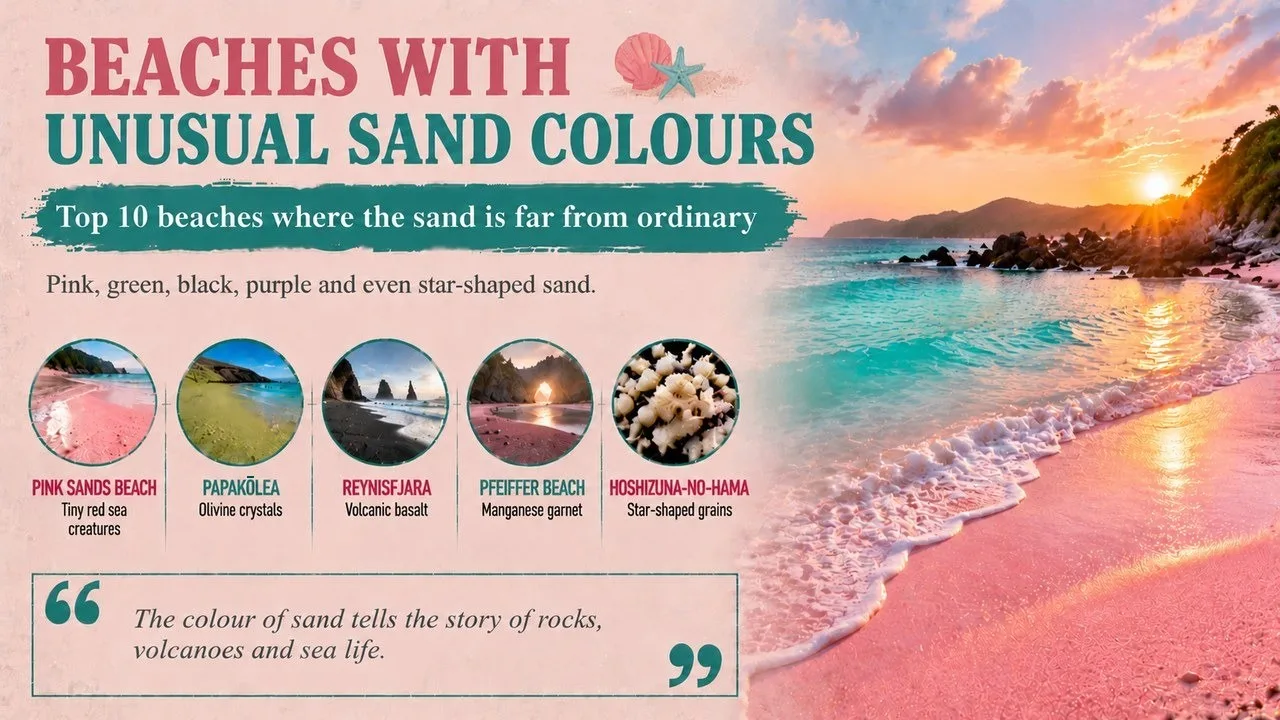
Beaches with unusual sand colours range from the pink shores of the Bahamas to green crystals in Hawaii and purple patches on California's Big Sur coast.
This Finepedia guide, written in October 2026, looks at 10 beaches where the sand is far from ordinary, from brilliant white silica to star-shaped grains in Japan. The facts come from national parks, geology bodies, tourism authorities and encyclopaedias. Beaches change with storms and seasons, so we note conditions as of October 2026 and point out where the colour is only seen at certain times. If you enjoy the coast, you may also like the Finepedia guides Most Popular Beaches in the World: 10 Icons to Visit and Most Stunning Volcanoes in the World: Top 10.
How We Chose These
Most beach sand is pale because it is made mainly of quartz, but minerals, volcanic rock, tiny sea creatures and even old rubbish can give it other colours. We chose ten beaches, each with a different colour or kind of sand and a clear scientific explanation. We left out beaches already featured in other Finepedia guides, such as Crete's pink-sand Elafonissi. Each entry has a short profile, four key facts and one more note on why it matters or a surprising detail.
The 10 Beaches at a Glance
| No. | Beach | Country | Sand colour | What makes the colour |
|---|---|---|---|---|
| 1 | Whitehaven Beach | Australia | bright white | almost pure silica |
| 2 | Pink Sands Beach | Bahamas | pink | tiny red sea creatures |
| 3 | Papakōlea Beach | United States (Hawaii) | green | olivine crystals |
| 4 | Reynisfjara | Iceland | black | volcanic basalt |
| 5 | Piha and the west coast ironsands | New Zealand | black and magnetic | titanomagnetite |
| 6 | Pfeiffer Beach | United States (California) | purple patches | manganese garnet |
| 7 | Ramla Bay | Malta | reddish | its name means red sands |
| 8 | Alum Bay | United Kingdom | many colours | iron compounds in the cliffs |
| 9 | Glass Beach | United States (California) | sea glass | an old town dump |
| 10 | Hoshizuna-no-hama | Japan | star-shaped grains | foraminifera skeletons |
1. Whitehaven Beach Has Some of the Whitest Sand on Earth
Whitehaven Beach runs for about 7 km along Whitsunday Island, off the coast of Queensland in Australia. It is famous for its dazzling white sand and clear turquoise water, and it can only be reached by boat, seaplane or helicopter. A British naval surveyor gave it its name in 1879, borrowing it from the English town of Whitehaven.
Key Facts
- Location: Whitsunday Island, Queensland
- Length: about 7 km
- Sand: around 98% pure silica
- Access: by boat, seaplane or helicopter
Did You Know?
The white silica is not found in the island's own rocks, so scientists think ocean currents brought it here over millions of years. Because the sand reflects so much sunlight, it stays cooler underfoot than most beach sand on a hot day. It is so fine that it can damage phones and cameras, but people also use it to polish silver jewellery.
2. Pink Sands Beach Gets Its Colour From Tiny Sea Creatures
Pink Sands Beach runs along the east side of Harbour Island in the Bahamas, off the coast of Eleuthera. Its soft sand has a pale pink glow, and Bermuda's beaches have the same pink tint for the same reason.
Key Facts
- Location: Harbour Island, Bahamas
- Colour source: a red single-celled sea creature called Homotrema rubrum
- Also seen: on beaches in Bermuda
- Getting there: by air to North Eleuthera, then a short water taxi
Why It Matters
Homotrema rubrum is a tiny foraminifer, a single-celled creature with a bright red skeleton, that grows on coral rubble on the reef. When it dies, the waves grind its skeleton into fine pieces, which mix with pale coral sand to give the beach its pink colour. A healthy reef is needed to keep the pink sand coming.
3. Papakōlea Beach Sparkles With Green Crystals
Papakōlea Beach, also called Green Sand Beach, lies close to South Point on Hawaiʻi Island, the largest island of the state. It sits in a bay partly enclosed by Puʻu Mahana, the worn-down remains of a volcanic cone formed more than 49,000 years ago. Very few beaches anywhere have green sand like this.
Key Facts
- Location: near South Point, island of Hawaiʻi
- Colour source: olivine, a green volcanic mineral
- Gem form: olivine of gem quality is called peridot
- Access: a walk of several kilometres along a rough coastal track
Why It Matters
Olivine crystallises early as molten rock cools. At Papakōlea, waves wear away the soft volcanic ash of the old cone and free the olivine crystals. Because olivine is heavier than ash, it stays on the beach while the lighter material is washed out to sea. Visitors are asked not to take any sand, because the green crystals are slowly being worn away.
4. Reynisfjara Is Iceland's Famous Black Beach
Reynisfjara is a black sand beach on the south coast of Iceland, near the village of Vík. Its sand is made of dark volcanic rock, and it is framed by tall columns of basalt, a sea cave and the jagged Reynisdrangar sea stacks. It lies within the Katla UNESCO Global Geopark.
Key Facts
- Location: near Vík í Mýrdal, south Iceland
- Colour source: volcanic basalt
- Landmarks: basalt columns, Hálsanefshellir cave and the Reynisdrangar stacks
- Recent change: part of the basalt columns collapsed in February 2026 after storms
Why It Matters
Reynisfjara is beautiful but dangerous. Powerful sneaker waves can rush far up the beach without warning, and there have been several deaths, including one in August 2025. A colour-coded warning setup now shows safe zones depending on conditions, and visitors are told never to turn their backs on the sea.
5. New Zealand's Ironsand Beaches Stick to Magnets
On the North Island's western shore in New Zealand, beaches such as Piha near Auckland have black sand that sticks to a magnet. It is rich in titanomagnetite, a heavy iron mineral that forms in volcanic rock. These ironsands stretch for about 480 km, from Kaipara Harbour to Whanganui.
Key Facts
- Location: North Island beaches facing the Tasman Sea, including Piha
- Colour source: titanomagnetite, an iron and titanium mineral
- Origin: mainly the Taranaki volcanoes
- Use: mined since 1969 to make steel
Did You Know?
The black grains are worn from volcanic rock, carried to the sea by rivers and then pushed along the coast by currents and waves. James Cook noted a black sandy sea bed near Raglan in 1769–1770. New Zealand's ironsands are among the largest such deposits in the world. In summer, the dark sand soaks up so much sunlight that it can burn bare feet.
6. Pfeiffer Beach Hides Purple Sand
Pfeiffer Beach is on the rugged Big Sur coast of California, within Los Padres National Forest. It is famous for Keyhole Rock, an arch that frames the setting sun on certain winter evenings. Look closely at the sand, and you may see swirls of purple, especially along the northern part of the beach.
Key Facts
- Location: Big Sur, California
- Colour source: garnet rich in manganese, washed down from the hills
- Best time to see it: after rain
- Length: about 1.6 km
Why It Matters
The purple grains are garnet, a hard mineral that forms in the metamorphic rocks of the Big Sur cliffs. Garnet is heavier than ordinary quartz sand, so waves that sweep the lighter grains away often leave the purple ones behind in patches. Swimming here is risky because of cold water, rocks and strong currents.
7. Ramla Bay Is Malta's Red Beach
Ramla Bay faces north-east on Gozo, the second-largest island of Malta, with Marsalforn to one side and San Blas Bay to the other. Its sand has a warm reddish-orange colour, and its Maltese name, Ir-Ramla l-Ħamra, means "the red sands". The nearest village is Xagħra.
Key Facts
- Location: north-east Gozo, Malta
- Name: Ir-Ramla l-Ħamra, meaning the red sands
- Nearest village: Xagħra
- Nearby: Calypso Cave, on the hillside above
Did You Know?
Calypso Cave, above the bay, is linked by local tradition with the nymph Calypso in Homer's Odyssey, who was said to have kept the hero Odysseus on her island for seven years. In 2007, plans to build villas near the cave sparked strong protests from heritage and environmental groups.
8. Alum Bay Has Cliffs of Many Coloured Sands
Alum Bay lies near the western tip of the Isle of Wight in England, close to the famous Needles rocks. Its cliffs are made of soft layers of sand and clay in a striking range of shades. The layers were tipped almost upright by the same Earth movements that raised the Alps.
Key Facts
- Location: western Isle of Wight, England
- Colour source: oxidised iron compounds in each layer
- Age of the layers: laid down in the Paleocene and Eocene, tens of millions of years ago
- Name: from the alum dug out of the bay in the 1500s
Why It Matters
In Victorian times, visitors made pictures and ornaments from the coloured sands, layering them in glass jars, and souvenirs like these are still sold at the clifftop park. Digging sand from the cliffs is now banned, because the site is protected as a Site of Special Scientific Interest. A chairlift takes visitors down to the pebble beach below.
9. Glass Beach Is Covered in Old Sea Glass
Glass Beach in Fort Bragg, California, began as a rubbish dump. Between 1906 and 1967, people threw bottles, cars and other waste into the sea at three sites along the coast. Over the years, the waves smashed and tumbled the glass into smooth, colourful pebbles that now cover parts of the shore.
Key Facts
- Location: Fort Bragg, California
- Dumping: from 1906 to 1967 at three sites
- Protection: part of MacKerricher State Park since 2002
- Visitors: tens of thousands each year
Did You Know?
After the dump closed, metal and other rubbish was cleared away, leaving the glass and pottery behind. So many visitors have taken pieces home that the glass is slowly disappearing, and park rangers ask people to leave the remaining glass for future visitors. Waves are also grinding the glass down over time.
10. Hoshizuna-no-hama Is Made of Tiny Stars
Hoshizuna-no-hama, which means Star Sand Beach, is on the north-west coast of Iriomote Island in Okinawa, Japan. Mixed into its sand are tiny star-shaped grains, each only about a millimetre across. Kaiji Beach on nearby Taketomi Island is also famous for them.
Key Facts
- Location: Iriomote Island, Okinawa
- Grain source: skeletons of foraminifera such as Baculogypsina sphaerulata
- Size: about 1 mm across
- Rule: taking star sand from the beaches is not allowed
Why It Matters
Each star is the empty skeleton of a single-celled creature that lives on the reef. When it dies, waves carry its skeleton to the shore, so star sand can make beaches slowly grow. A local legend says the stars are the bones of the children of stars, eaten by a great sea serpent. Japan has even grown star sand to help build up a tiny remote islet.
Frequently Asked Questions
Why is most beach sand white or golden?
Most sand is made mainly of quartz, a pale mineral that resists weathering, often mixed with crushed coral and seashell fragments. Iron staining can turn it golden, while volcanic minerals or tiny creatures can give it other colours.
Can you take coloured sand home?
Usually not. Many of these beaches are protected, and removing sand, glass or star-shaped grains is banned or discouraged, because it would slowly destroy what makes them special.
Conclusion
From white silica to purple garnet and stars on a Japanese shore, these ten beaches show how much the colour of sand can tell us about rocks, volcanoes and sea life. Many of them are fragile, so leaving them as we find them matters. For more on the coast and the forces that shape it, read the Finepedia guides Most Popular Beaches in the World: 10 Icons to Visit and Most Stunning Volcanoes in the World: Top 10.
- US Forest Service, Pfeiffer Beach Day Use, fs.usda.gov.
- Te Ara, the Encyclopedia of New Zealand, Iron and steel: Iron, an abundant resource, teara.govt.nz.
- NIWA, The science of sand, niwa.co.nz.
- National Geographic, Okinawa's star sand, nationalgeographic.com.
- Japan Tourism Agency, Kaiji Hama (Kaiji Beach): Star Sand and Subtropical Foliage, mlit.go.jp.
- Wikipedia (accessed October 2026), articles on Sand, Whitehaven Beach, Harbour Island (Bahamas), Homotrema rubrum, Papakōlea Beach, Reynisfjara, Ironsand, Pfeiffer Beach, Ramla Bay, Alum Bay, Glass Beach (Fort Bragg, California) and Star sand.
- 10 Most Today, 10 Awesome Colors of Beach Sand and Where to Find Them, 10mosttoday.com (topic reference).















Log in with