









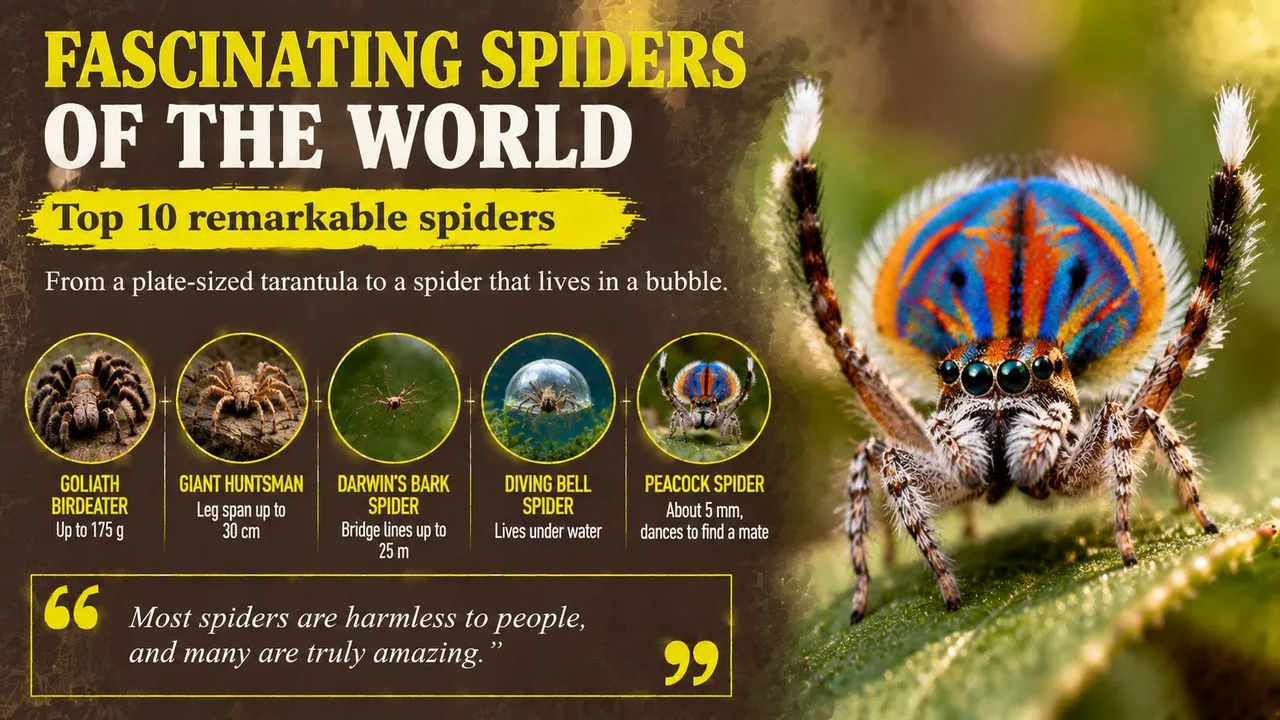
Fascinating spiders of the world include a plate-sized tarantula from South America, a tiny Australian dancer and a spider that spends its life underwater.
This Finepedia guide, written in October 2026, looks at 10 remarkable spiders, from giants with legs as wide as a dinner plate to tiny jumpers just a few millimetres long. The facts come from museums, scientific studies and encyclopaedias. Scientists keep finding new species, so we give counts as of October 2026 and say when a figure is a typical value rather than a record. If you enjoy unusual creatures, you may also like the Finepedia guides Remarkable Spiny Animals of the World: Top 10 and Slowest Animals on Earth: Top 10.
How We Chose These
More than 53,000 kinds of spider have been described, living on every continent except Antarctica. Our ten were chosen for record size, bright colours, amazing silk, strong venom or odd habits, with species from several continents. We left out spiders already covered in other Finepedia guides, such as the spiny orb-weavers, and we left out camel spiders, which are arachnids but not true spiders. Each entry has a short profile, four key facts and one more note on why it matters or a surprising detail.
The 10 Spiders at a Glance
| No. | Spider | Home | Size | Standout fact |
|---|---|---|---|---|
| 1 | Goliath birdeater | northern South America | up to 175 g | heaviest spider |
| 2 | Giant huntsman spider | Laos | leg span up to 30 cm | widest leg span |
| 3 | Darwin's bark spider | Madagascar | females about 2 cm long | biggest webs, toughest silk |
| 4 | Diving bell spider | Europe and Asia | about 0.8 to 1.5 cm | lives under water |
| 5 | Peacock spider | Australia | about 5 mm | colourful courtship dance |
| 6 | Golden wheel spider | Namib Desert | about 2 cm | cartwheels down dunes |
| 7 | Brazilian wandering spider | South and Central America | leg span 13 to 18 cm | strong venom |
| 8 | Black widow | worldwide genus | females 25 to 38 mm with legs | red hourglass mark |
| 9 | King baboon spider | East Africa | leg span up to 20 cm | hisses when threatened |
| 10 | Bagheera kiplingi | Central America | a few millimetres | a mostly vegetarian spider |
1. The Goliath Birdeater Outweighs Every Other Spider
The Goliath birdeater is a huge, hairy tarantula found in the rainforest of the northern part of South America. By weight and body length it is the biggest spider known, and its legs can stretch about 30 cm across. It lives in deep burrows, often in marshy or swampy ground, and drags its prey back underground to eat.
Key Facts
- Species: Theraphosa blondi
- Weight: up to about 175 g
- Body length: up to about 13 cm
- Lifespan: females often live 15 to 25 years
Did You Know?
Birds are in fact a rare meal for this spider. It mostly feeds on large insects, worms, frogs and other small animals. The name goes back to an engraving from the early 1700s by the artist Maria Sibylla Merian showing a tarantula eating a hummingbird. When threatened, it makes a hissing sound by rubbing bristles on its legs and flicks irritating hairs at attackers. Its bite hurts, but the venom is weak, and its effect is often compared to a wasp sting.
2. The Giant Huntsman Spider Has the Widest Legs
The giant huntsman spider was only described by scientists in 2001, after it was found in a cave in Laos. Its body is just a few centimetres long, but its long, crab-like legs can span about 30 cm, wider than those of any other known spider. It is pale yellowish brown with dark spots and bands.
Key Facts
- Species: Heteropoda maxima
- Leg span: up to about 30 cm
- Body length: about 4.6 cm
- Home: caves in Laos
Why It Matters
The giant huntsman is a reminder of how much is still unknown, even about large animals. More than a thousand new species of plants and animals were described from the Greater Mekong region between 1997 and 2007, and a WWF spokesman said some of them had no business being so newly discovered. Like other huntsman spiders, it does not build a web to catch food but hunts by speed.
3. Darwin's Bark Spider Spins the Biggest Webs
Darwin's bark spider lives in Madagascar and was discovered in 2009 in Andasibe-Mantadia National Park. It builds the largest known orb webs, hung over rivers and lakes, with bridge lines that can stretch up to 25 m from bank to bank. Females are much larger than males.
Key Facts
- Species: Caerostris darwini
- Web size: up to about 2.8 square metres
- Bridge lines: up to 25 m long
- Named: in November 2009, 150 years after Charles Darwin's On the Origin of Species
Why It Matters
When scientists tested it in 2010, this spider's silk proved tougher than any other biological material they had measured, soaking up more energy before snapping than any known silk. Scientists study it to learn how to make strong, light materials. By hanging its web right above a river or lake, the spider can catch insects flying over the water, a spot where no other known spider builds.
4. The Diving Bell Spider Lives Under Water
The diving bell spider, also called the water spider, is the only spider known to spend nearly its whole life under water. It lives in clean ponds, lakes, marshes and slow streams across much of Europe and northern Asia. Out of water it looks dark brown, but under water it shines like silver because of the air trapped on its body.
Key Facts
- Species: Argyroneta aquatica, the only member of its genus
- Home: freshwater in Europe and northern Asia
- Lifestyle: rests, hunts, mates and lays eggs under water
- Status: protected as endangered in South Korea
Did You Know?
The spider weaves a dome of silk among water plants and fills it with air carried down from the surface on the hairs of its body. Research published in 2011 showed that this bubble, the diving bell, works partly like a gill: oxygen from the water seeps into it, so the spider only needs to go up for fresh air now and then. It catches small water creatures and brings them back to its bell to eat.
5. The Peacock Spider Dances to Find a Mate
Peacock spiders are tiny jumping spiders from Australia, and Maratus volans is among the most famous. Both males and females are only about 5 mm long. The females are brown, but the males have a brilliant red, blue and black flap on their abdomen that they can raise like a fan.
Key Facts
- Species: Maratus volans
- Size: about 5 mm long
- Home: parts of Australia
- Vision: can see ultraviolet light as well as normal colours
Did You Know?
To win a female, the male lifts his colourful fan, raises his third pair of legs and shuffles to the left and right, while also sending vibrations through the ground. The whole show lasts about 24 minutes on average, though it can run from 6 to 50 minutes. Females seem to care most about the visual part of the dance. If they are not impressed, they may attack or even eat the male.
6. The Golden Wheel Spider Cartwheels to Safety
The golden wheel spider lives among the sand dunes of the Namib Desert in southern Africa. It is a kind of huntsman spider that hunts insects at night and hides by day in a silk-lined burrow dug deep into the sand. It is only about 2 cm across and is harmless to people.
Key Facts
- Species: Carparachne aureoflava
- Home: the Namib Desert
- Burrow: 40 to 50 cm deep
- Escape speed: up to 44 turns a second
Why It Matters
The spider's main enemy is a parasitic wasp that stings it and lays an egg on its body. When attacked on a slope, the spider tucks in its legs, flips onto its side and rolls down the dune like a wheel, at about 1 m per second. It is one of very few animals that move by rolling. While it digs a burrow, this spider can move as much as 10 litres of sand, about 80,000 times its own weight.
7. The Brazilian Wandering Spider Packs Powerful Venom
Brazilian wandering spiders are large, fast hunters found mostly in tropical South America, though one species reaches Central America. They do not build webs but roam the forest floor at night. They are also called banana spiders, because they sometimes hide in bunches of bananas and turn up far from home in shipments of fruit.
Key Facts
- Genus: Phoneutria
- Leg span: about 13 to 18 cm
- Body length: about 1.7 to 4.8 cm
- Warning pose: rears up with its front legs held high
Did You Know?
These spiders are among the few that are truly dangerous to people, and Guinness World Records has named one of them the most venomous spider on Earth. Yet most bites are mild, and one study found that only about 2.3% of bites needed antivenom, and most of those serious cases involved children. Deaths are rare.
8. The Black Widow Is Famous for Its Red Hourglass
Widow spiders belong to the genus Latrodectus and are found in warm and temperate regions across much of the globe. The females are glossy black or dark brown, usually with a red mark shaped like an hourglass on the underside. The black widow is the best known, but there are also brown, red and other widow species.
Key Facts
- Genus: Latrodectus
- Female size: about 25 to 38 mm including legs
- Venom: contains a nerve toxin called latrotoxin
- Name: from females that sometimes eat males after mating
Why It Matters
Black widow venom is strong, and a bite can cause severe pain and muscle cramps. But black widows are not aggressive and usually bite only when pressed or trapped. A 2012 review by US poison control centres found no deaths from black widow bites in the United States since 1983, and most people recover with simple treatment for pain.
9. The King Baboon Spider Is an African Giant
The king baboon spider is a large tarantula from the grasslands and scrub of East Africa, including Kenya and Tanzania. It is rusty orange to brown and has thick back legs for digging deep burrows. It feeds on beetles, cockroaches and other spiders, sensing prey through silk threads at the burrow entrance.
Key Facts
- Species: Pelinobius muticus
- Leg span: up to about 20 cm
- Home: East Africa
- First described: in 1885 by Ferdinand Karsch
Did You Know?
When threatened, the king baboon spider rears up and makes a loud hissing noise by rubbing its legs together. Unlike many tarantulas, it does not flick irritating hairs. Its bite is very painful but is not known to be deadly, so it is popular with experienced keepers but not suitable for beginners.
10. Bagheera kiplingi Is a Mostly Vegetarian Spider
Almost all spiders are hunters, but Bagheera kiplingi, a small jumping spider from Central America, lives mostly on plants. It lives on acacia trees guarded by ants and feeds on small, fatty tips on the leaves called Beltian bodies. Its name honours Bagheera, the black panther of The Jungle Book, and the book's author, Rudyard Kipling.
Key Facts
- Family: jumping spiders, the largest spider family with about 7,000 species
- Home: Mexico, Guatemala, Costa Rica and nearby countries
- Diet: Beltian bodies make up over 90% of its food
- Named: in 1896, with the female first described 100 years later
Why It Matters
The acacia's Beltian bodies are meant to feed the ants that protect the tree, so the spider has to dodge the ants to steal them. It also takes nectar and sometimes ant larvae. Like other jumping spiders, it has excellent eyesight, with two large front eyes among its eight, which helps it plan quick leaps to escape the ants.
Frequently Asked Questions
Which spider is the biggest?
It depends on how you measure. The Goliath birdeater of South America is the heaviest spider and has the longest body, while the giant huntsman spider of Laos has the widest leg span, at about 30 cm.
Are most spiders dangerous to people?
No. Almost all spiders have venom to catch their prey, but only a few, such as widow spiders and Brazilian wandering spiders, can seriously harm people, and deaths from spider bites are rare.
Conclusion
From a plate-sized tarantula to a tiny dancer and a spider that lives in a bubble, these ten spiders show how varied and surprising these animals are. Most are harmless to people, and many help keep insect numbers in check. For more unusual creatures, read the Finepedia guides Remarkable Spiny Animals of the World: Top 10 and Slowest Animals on Earth: Top 10.
- World Spider Catalog, Natural History Museum Bern, wsc.nmbe.ch (species counts and names).
- Agnarsson, I., Kuntner, M. and Blackledge, T. A., Bioprospecting finds the toughest biological material: extraordinary silk from a giant riverine orb spider, PLoS ONE, 2010.
- Henschel, J. R., Spiders wheel to escape, South African Journal of Science, 1990.
- Seymour, R. S. and Hetz, S. K., The diving bell and the spider: the physical gill of Argyroneta aquatica, Journal of Experimental Biology, 2011.
- Wikipedia (accessed October 2026), articles on Spider, Goliath birdeater, Heteropoda maxima, Darwin's bark spider, Diving bell spider, Maratus volans, Carparachne aureoflava, Phoneutria, Latrodectus, Pelinobius, Jumping spider and Bagheera kiplingi.
- 10 Most Today, 10 Coolest Spiders in the World, 10mosttoday.com (topic reference).
















Log in with