







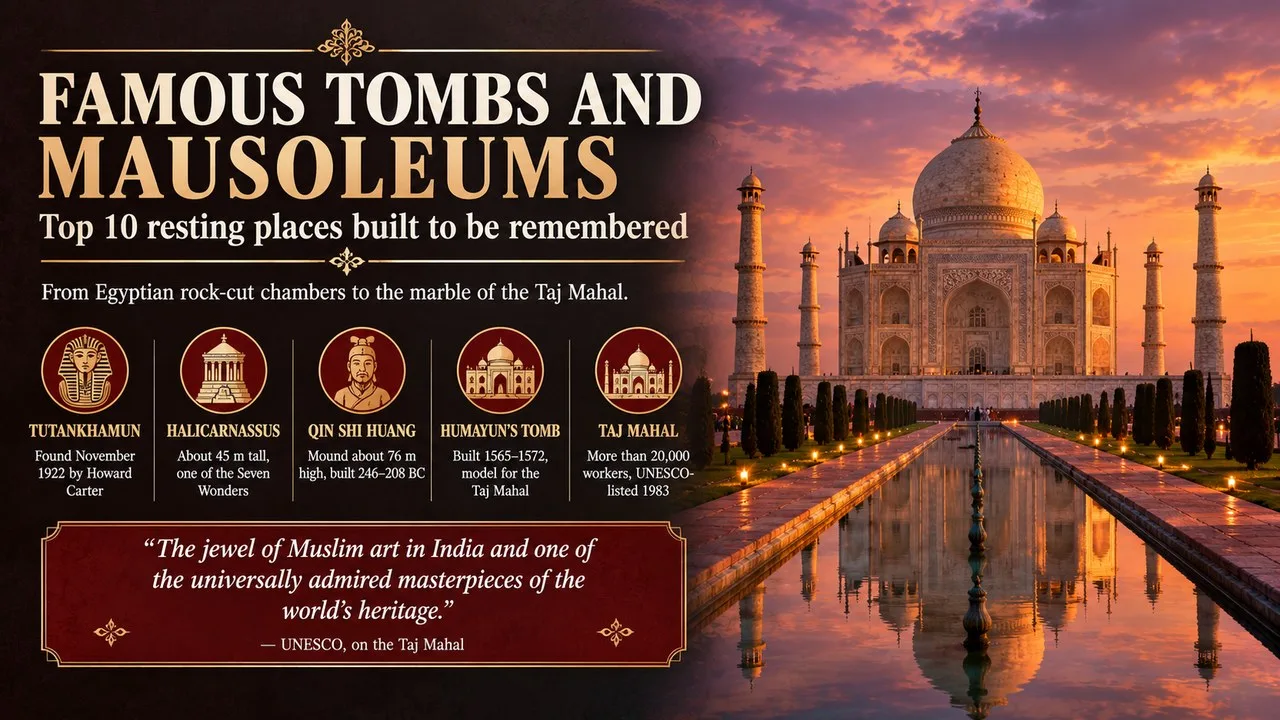
Famous tombs and mausoleums show how rulers and their families wanted to be remembered, from Egyptian rock-cut chambers to the marble of the Taj Mahal.
This Finepedia guide, written in October 2026, brings together 10 of the world's most celebrated tombs, spread across more than 3,000 years and four continents' worth of influence. The facts come from encyclopaedias, UNESCO and museum records, and ancient historians where they are the only source; where dates or numbers are estimates, we say so. If you enjoy ancient wonders, you may also like Finepedia's guides to the legendary tomb of Cleopatra, the entire history of Egypt and the oldest surviving buildings on Earth.
How We Chose These
We picked tombs that are famous for at least one of three reasons: their architecture, the treasures found inside, or the influence they had on later buildings. To avoid repeating our guide to the oldest buildings, we left out prehistoric passage tombs and the early pyramids. The list runs in chronological order, from Tutankhamun's burial around 1323 BC to the completion of the Taj Mahal in 1653.
The 10 Famous Tombs at a Glance
| No. | Tomb | Location | Built or used | Famous for |
|---|---|---|---|---|
| 1 | Tomb of Tutankhamun | Valley of the Kings, Egypt | c. 1323 BC | Treasures found almost intact |
| 2 | Tomb of Cyrus the Great | Pasargadae, Iran | c. 530 BC | Simple stone tomb of an empire's founder |
| 3 | Mausoleum at Halicarnassus | Bodrum, Turkey | 353 to 351 BC | Gave us the word mausoleum |
| 4 | Mausoleum of Qin Shi Huang | Xi'an, China | 246 to 208 BC | Terracotta Army |
| 5 | Al-Khazneh | Petra, Jordan | early 1st century AD | Carved from a cliff face |
| 6 | Mausoleum of Hadrian | Rome, Italy | AD 134 to 139 | Later a papal fortress |
| 7 | Sutton Hoo Mound 1 | Suffolk, England | early 7th century | Anglo-Saxon ship burial |
| 8 | Gur-e-Amir | Samarkand, Uzbekistan | from 1403 | Tomb of Timur |
| 9 | Humayun's Tomb | Delhi, India | 1565 to 1572 | First great Mughal garden tomb |
| 10 | Taj Mahal | Agra, India | 1631 to 1653 | Marble tomb of Mumtaz Mahal |
1. Tutankhamun's Tomb Was Found Almost Untouched
Tutankhamun ruled Egypt for about ten years and died young around 1323 BC. His tomb, numbered KV62 in the Valley of the Kings, is small and plain compared with other royal tombs, and it may first have been meant for someone of lower rank. Robbers broke in twice soon after the burial, but most of the goods survived, partly because flood debris and later building work hid the entrance for more than 3,000 years. On 4 November 1922 Howard Carter's team uncovered the first step of its staircase.
Key Facts
- Tomb number: KV62
- Burial: about 1323 BC
- Found: November 1922, by Howard Carter
- Sponsor: Lord Carnarvon
Why It Matters
The tomb's four rooms were packed with coffins, furniture, chariots, clothing and jewellery, and the golden funerary mask has become one of the best-known objects from the ancient world. The find caused a worldwide media sensation in the 1920s. Damage from visitors and flooding led Egypt to build a full-size replica of the burial chamber nearby.
2. Cyrus the Great's Tomb Was Built to Ride Out Earthquakes
Cyrus the Great founded the Achaemenid Persian Empire and died around 530 BC. His tomb stands alone on the plain at Pasargadae, his first capital, in Iran's Fars province: a small gabled stone chamber on six stepped tiers. Its simplicity is striking for a man who ruled one of the largest empires of his day. For centuries local people called it the tomb of the mother of Solomon, until the British diplomat James Morier linked it to Cyrus in 1812.
Key Facts
- Location: Pasargadae, Fars province, Iran
- Built: around the time of Cyrus's death, c. 530 BC
- Identified: 1812, by James Justinian Morier
- UNESCO: part of the Pasargadae World Heritage Site
Did You Know?
Greek historians record that Alexander the Great visited the tomb after conquering Persia and found it robbed of everything but the coffin and couch. Engineers today point to its wide, layered stone base as an early example of design that helps a building survive earthquakes.
3. The Mausoleum at Halicarnassus Gave Us a New Word
Between 353 and 351 BC a huge tomb was raised at Halicarnassus, today's Bodrum in Turkey, for Mausolus, a regional ruler under the Persian Empire, and his wife and sister Artemisia II. Planned by two Greek architects, Satyros and Pythius, it stood about 45 metres tall and carried around 400 statues, with each side decorated by a different famous sculptor. Ancient writers ranked it among the Seven Wonders of the Ancient World.
Key Facts
- Built for: Mausolus and Artemisia II
- Built: 353 to 351 BC
- Height: about 45 m
- Status: one of the Seven Wonders of the Ancient World
What Happened to It
Earthquakes between the 12th and 15th centuries brought it down, and it was the last of the six lost wonders to fall. In 1494 the Knights of St John reused its stones to strengthen their castle at Bodrum. Surviving sculptures are now in the British Museum, and the name of Mausolus lives on in the word mausoleum.
4. Qin Shi Huang's Tomb Is Guarded by a Clay Army
Work on the tomb of China's first emperor, Qin Shi Huang, began in 246 BC, when he became king of Qin at about 13, and continued until 208 BC. The burial mound near Xi'an rises about 76 metres, and the wider complex was laid out like the Qin capital, with inner and outer walls. The emperor's own burial chamber has never been opened, but pits to the east hold the Terracotta Army, found by farmers digging a well in 1974.
Key Facts
- Location: Lintong District, Xi'an, Shaanxi
- Built: 246 to 208 BC
- Mound height: about 76 m
- UNESCO: listed 1987
The Terracotta Army
Estimates from 2007 suggested the three main pits hold over 8,000 clay warriors, about 130 chariots pulled by 520 horses, and another 150 horses for cavalry, most of them still buried. The Han historian Sima Qian wrote that the tomb contained rivers of mercury, and soil tests around the mound have found unusually high mercury levels, one reason archaeologists are in no hurry to dig.
5. Al-Khazneh Was Carved Out of a Cliff in Petra
Al-Khazneh, meaning "the Treasury", is the best-known monument of Petra, the rock-cut capital of the Nabataean kingdom in southern Jordan. It was carved into a sandstone cliff, probably as a royal tomb, in the early decades of the 1st century AD, when Aretas IV was king. Its two-storey facade of columns and sculpted figures is the first thing visitors see as they leave the narrow gorge called the Siq.
Key Facts
- Location: Petra, Jordan
- Carved: early 1st century AD
- Probable patron: Aretas IV of the Nabataeans
- Rediscovered for Europe: 1812, by Johann Ludwig Burckhardt
Did You Know?
The name comes from a Bedouin legend that a pharaoh hid treasure in the stone urn at the top of the facade. The urn is solid rock, but it still carries bullet marks from people who tried to shoot it open. Film fans know the facade as the hiding place of the Holy Grail in Indiana Jones and the Last Crusade (1989).
6. Hadrian's Mausoleum Became a Papal Castle
The Roman emperor Hadrian built a great cylindrical tomb for himself and his family on the bank of the Tiber between AD 134 and 139. His ashes were placed there after his death in 138, and later emperors followed, the last recorded being Caracalla in 217. In 401 it was turned into a fortress and joined to Rome's walls, and for centuries it was the tallest building in the city. Today it is known as Castel Sant'Angelo.
Key Facts
- Built: AD 134 to 139
- Last imperial burial: Caracalla, 217
- Became a fortress: 401
- Today: a museum, Castel Sant'Angelo
The Angel on the Roof
According to legend, the Archangel Michael appeared above the building in 590, sheathing his sword to mark the end of a plague, which gave it its present name. Popes later used it as a fortress and refuge. The bridge Hadrian built in front of it, now lined with Baroque angel statues, still leads visitors to the entrance.
7. Sutton Hoo Hid an Anglo-Saxon King's Ship
In 1939, on the estate of landowner Edith Pretty near Woodbridge in Suffolk, the self-taught archaeologist Basil Brown dug into a large mound and found the outline of a buried ship about 27 metres long. The wood had rotted away, but almost all of its iron rivets were still in place. In the burial chamber lay gold and garnet fittings, a sword, a shield, a lyre, silver from the Eastern Roman Empire and a famous ceremonial helmet.
Key Facts
- Location: near Woodbridge, Suffolk, England
- Date: early 7th century AD
- Excavated: 1939, by Basil Brown, then national experts
- Finds: held mostly by the British Museum
Who Was Buried There?
No body survived in the acidic soil, but most scholars think the grave belonged to Rædwald, ruler of the East Angles, who died around 624. The find transformed the picture of early Anglo-Saxon England, once seen as a poor "Dark Age", and invited comparisons with the Old English poem Beowulf.
8. Gur-e-Amir Is the Tomb of Timur
The Gur-e-Amir in Samarkand, Uzbekistan, holds the remains of Timur, the Turco-Mongol conqueror better known in English as Tamerlane, along with his sons and grandsons. Work began in 1403 after the death of Timur's favourite grandson, Muhammad Sultan, for whom it was planned. When Timur himself died on campaign in 1405, snow blocked the route to the tomb he had prepared in Shahrisabz, so his body was laid here instead. His grandson Ulugh Beg, the astronomer-ruler, completed it.
Key Facts
- Location: Samarkand, Uzbekistan
- Begun: 1403
- Buried here: Timur, Shah Rukh, Ulugh Beg and others
- Dome: ribbed and azure blue, about 15 m across
Why It Matters
Gur-e-Amir is the ancestor of the great Mughal tombs of India. Timur's descendants founded the Mughal Empire and carried the idea of a domed family mausoleum to Kabul, Delhi and Agra, leading directly to Humayun's Tomb and the Taj Mahal.
9. Humayun's Tomb Was the Model for the Taj Mahal
Humayun's Tomb in Delhi was commissioned by the emperor's widow, Bega Begum, and planned by Mirak Mirza Ghiyas, an architect from Persia, whose son finished the work after his death. Built between 1565 and 1572, it was the earliest garden tomb in the Indian subcontinent and the first building in the region to use red sandstone on such a scale. It sits in a formal charbagh, a Persian-style garden divided into four parts by water channels and paths.
Key Facts
- Location: Nizamuddin East, Delhi
- Built: 1565 to 1572
- Patron: Bega Begum, Humayun's widow
- UNESCO: listed 1993
Did You Know?
The complex holds so many members of the Mughal dynasty, including Dara Shikoh, the son of Shah Jahan, that it is sometimes called the dormitory of the Mughals. A long restoration, completed in recent years, brought its gardens and water channels back to life.
10. The Taj Mahal Is the World's Most Famous Tomb
The Mughal emperor Shah Jahan ordered the Taj Mahal in 1631 for his wife Mumtaz Mahal, who had died that year, and he was later buried beside her. Standing on the bank of the Yamuna in Agra, the white marble mausoleum is inlaid with semi-precious stones and framed by four minarets, each more than 40 metres tall. The main tomb was finished in 1648 and the whole 17-hectare complex in about 1653, built by a workforce of over 20,000 labourers and craftsmen under the court architect Ustad Ahmad Lahori.
Key Facts
- Location: Agra, Uttar Pradesh, India
- Built: 1631 to about 1653
- Workforce: more than 20,000
- UNESCO: listed 1983
Why It Matters
UNESCO's official description calls it the jewel of Muslim art in India, and today it welcomes over five million visitors annually. Its design brings together Persian, Timurid and Indian traditions, completing a line of ideas that runs back through Humayun's Tomb to Timur's resting place in Samarkand.
Frequently Asked Questions
What is the difference between a tomb and a mausoleum?
A tomb is any place where the dead are laid to rest, above or below ground. A mausoleum is a large, free-standing building above ground that contains one or more tombs. The word comes from Mausolus, whose monument at Halicarnassus was one of the ancient wonders.
Has Qin Shi Huang's tomb ever been opened?
No. Archaeologists have excavated the pits around it, including the Terracotta Army, but the central burial chamber is still sealed. Concerns about preserving its contents, and the high mercury levels in the mound, are among the reasons.
Conclusion
These ten tombs span from a hidden Egyptian burial to a marble masterpiece seen by millions, but they share one purpose: to keep a name alive. Some, like Tutankhamun's and the Sutton Hoo ship, became famous because they were forgotten and found again almost intact, while others, like Hadrian's Mausoleum, survived by becoming something else entirely. For more on the ancient world, read Finepedia's legendary tomb of Cleopatra and the oldest surviving buildings on Earth.
- UNESCO World Heritage Centre (accessed October 2026), Taj Mahal; Humayun's Tomb, Delhi; Mausoleum of the First Qin Emperor; Pasargadae; Petra; Historic Centre of Rome, whc.unesco.org.
- Reeves, Nicholas (1990), The Complete Tutankhamun, Thames and Hudson, London.
- Carter, Howard and A. C. Mace (1923), The Tomb of Tut-Ankh-Amen, vol. 1, Cassell, London.
- Arrian, The Anabasis of Alexander, book 6, chapter 29 (2nd century AD).
- Sima Qian, Records of the Grand Historian (c. 94 BC).
- British Museum, collection notes on the Mausoleum at Halicarnassus and the Sutton Hoo ship burial.
- Carver, Martin (1998), Sutton Hoo: Burial Ground of Kings?, British Museum Press, London.
- Koch, Ebba (2006), The Complete Taj Mahal and the Riverfront Gardens of Agra, Thames and Hudson, London.
- Encyclopaedia Britannica, entries on Cyrus the Great, Petra, Hadrian and Timur.
- Wikipedia (accessed October 2026), articles on KV62, Tomb of Cyrus, Mausoleum at Halicarnassus, Mausoleum of the First Qin Emperor, Terracotta Army, Al-Khazneh, Castel Sant'Angelo, Sutton Hoo, Gur-e-Amir, Humayun's tomb and Taj Mahal.
- 10 Most Today, 10 Most Famous Tombs In The World, 10mosttoday.com (topic reference).
















Log in with