










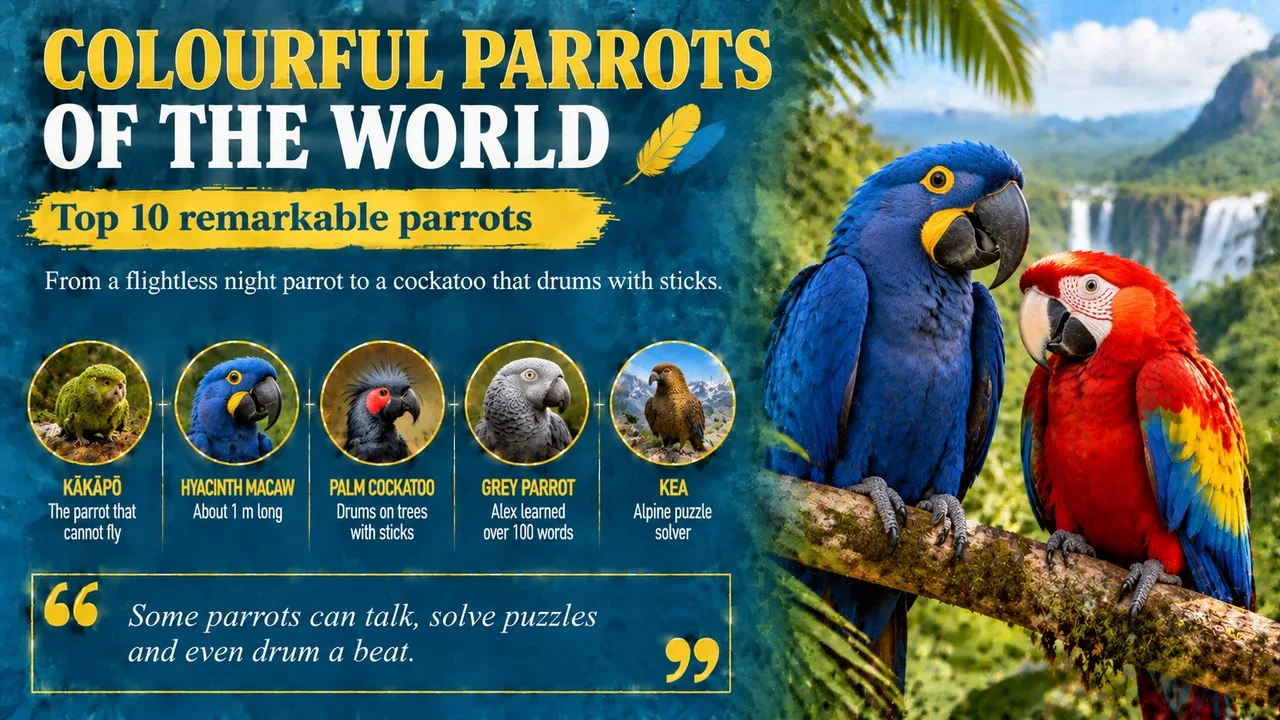
Colourful parrots of the world include New Zealand's flightless kākāpō, the metre-long hyacinth macaw and a grey parrot that learned over 100 words.
This Finepedia guide, written in October 2026, looks at 10 remarkable parrots, from giant macaws of South America to tiny lovebirds from Africa and popular pet cockatiels from Australia. The facts come from conservation bodies, scientific studies and encyclopaedias. Bird numbers and conservation ratings change over time, so we give figures as of October 2026 and say when a number is an estimate. If you enjoy animal records, you may also like the Finepedia guides Longest-Living Animals on Earth and Shortest-Lived Animals on Earth.
How We Chose These
There are around 400 kinds of parrot, so we picked ten that stand out for their size, colour, intelligence or unusual way of life, and that come from different parts of the world. Several are threatened in the wild, and we note their status where it matters. The list runs roughly from the largest and heaviest parrots to the smallest. Each entry has a short profile, four key facts and one more note on why it matters or a surprising detail.
The 10 Parrots at a Glance
| No. | Parrot | Home | Size | Standout fact |
|---|---|---|---|---|
| 1 | Kākāpō | New Zealand | males about 1.5 to 3 kg | cannot fly at all |
| 2 | Hyacinth macaw | central and eastern South America | about 1 m long | biggest parrot that flies |
| 3 | Scarlet macaw | Mexico to the Amazon | about 1 kg | national bird of Honduras |
| 4 | Palm cockatoo | New Guinea and northern Australia | 55 to 60 cm | drums with sticks |
| 5 | Grey parrot | West and Central Africa | about 420 to 530 g | famous talker and thinker |
| 6 | Kea | New Zealand's South Island | roughly 48 cm | alpine puzzle solver |
| 7 | Golden parakeet | Amazon Basin of Brazil | medium-sized | helpers raise the chicks |
| 8 | Rainbow lorikeet | eastern Australia | 25 to 30 cm | brush-tipped tongue |
| 9 | Cockatiel | Australia | smallest cockatoo | one of the most popular pet birds |
| 10 | Fischer's lovebird | Tanzania | about 14 cm | named after an explorer |
1. The Kākāpō Is a Parrot That Cannot Fly
The kākāpō is a large, moss-green parrot from New Zealand that cannot fly. It is active at night, has an owl-like face and waddles through the undergrowth, climbing trees with its strong feet and beak. It is also the heaviest parrot on Earth, and one of the rarest, with each known bird given its own name.
Key Facts
- Weight: adult males about 1.5 to 3 kg
- Population: 325 birds alive, according to New Zealand's Department of Conservation
- Status: critically endangered
- Lifespan: may reach 60 to 90 years
Why It Matters
Kākāpō once lived across New Zealand, but hunting and introduced predators such as stoats, rats and cats drove them close to extinction. Today they survive on predator-free islands and in a fenced sanctuary, cared for by the Kākāpō Recovery programme. In the breeding season, males gather and make deep booming calls that can carry a long way at night. The kākāpō is the only parrot known to breed this way, in a display ground called a lek.
2. The Hyacinth Macaw Is the Biggest Parrot in the Air
The hyacinth macaw is a deep cobalt-blue parrot from the centre and east of South America. It has bright yellow rings around its eyes and at the base of its beak. At roughly 1 m from head to tail tip, no other parrot beats it for length. It lives in palm-rich areas such as the Pantanal wetlands of Brazil.
Key Facts
- Length: about 1 m, including its long tail
- Weight: about 1.2 to 1.7 kg
- Diet: mostly the very hard nuts of certain palms
- Status: vulnerable, according to the IUCN
Did You Know?
The hyacinth macaw's huge beak can crack palm nuts that most animals cannot open. One kind of nut, from the acuri palm, is so hard that the macaws often eat it only after it has passed through cattle, which soften the tough outer husk. The species has suffered as its habitat shrank and as birds were caught for the pet trade, and international trade in wild birds is banned.
3. The Scarlet Macaw Is a Flying Rainbow
The scarlet macaw is a large, mostly red parrot with yellow and blue on its wings, found in humid forests from south-eastern Mexico to Peru, Bolivia and Brazil. It usually stays high in the treetops, where it feeds on fruits, nuts and seeds. It keeps in touch with its flock through loud, raucous honking calls.
Key Facts
- Range: south-eastern Mexico to the Amazon and Trinidad
- Weight: about 1 kg
- Lifespan: typically 40 to 50 years, longer in captivity
- National bird: of Honduras
Did You Know?
Scarlet macaws, like many South American parrots, often gather in large numbers at clay licks, riverbanks where they eat mouthfuls of soil. The clay seems to help digestion and supply nutrients such as sodium and calcium. The bird is popular in captivity, but stricter laws have made it rarer and more expensive to keep.
4. The Palm Cockatoo Drums on Trees With Sticks
The palm cockatoo is a large, smoky black cockatoo from New Guinea, the nearby Aru Islands and Queensland's Cape York in the far north of Australia. It has a tall crest, red cheek patches and one of the biggest beaks of any parrot. At 55 to 60 cm long, it could well be the biggest cockatoo of all.
Key Facts
- Range: New Guinea, Aru and Queensland's Cape York
- Size: 55 to 60 cm long, weighing about 0.9 to 1.2 kg
- Look: grey-black feathers with bare red cheeks
- Behaviour: males drum on trees to attract mates
Why It Matters
The male palm cockatoo snaps off a thick stick or seed pod, grips it in his foot and beats it against a dead branch or hollow tree. The drumming, first described in 1984, can be heard up to about 100 m away, and each bird seems to have its own rhythm. This is one of very few known cases of an animal other than humans making and using a tool to produce sound.
5. The Grey Parrot Is a Champion Talker
The grey parrot, often called the African grey, is found in the lowland forests of western and central Africa. It is mainly grey with a bright red tail, and it is famous for its ability to copy human speech. Scientists rank it among the most intelligent of all birds.
Key Facts
- Species: Psittacus erithacus
- Weight: about 420 to 530 g
- Lifespan: 40 to 60 years in captivity, about 23 years in the wild on average
- Status: endangered since 2016, because of trapping and habitat loss
Did You Know?
The most famous grey parrot was Alex, studied for about 30 years by the scientist Irene Pepperberg until his death in 2007. Alex learned more than 100 words and seemed to understand many of them. He could name about 50 objects, tell apart seven colours and five shapes, and count small numbers of things up to six. His work helped change the idea that only animals with large brains, such as apes, could handle such tasks.
6. The Kea Is the Clever Parrot of the Mountains
The kea is a large, olive-green parrot that lives only in the high country and beech forests of the South Island in New Zealand. No other parrot in the world lives above the treeline like this, at home in snow and cold. When it spreads its wings, it flashes bright orange feathers underneath. Kea are famously curious, and they often investigate tents, cars and hikers' bags.
Key Facts
- Home: alpine areas and forests in the South Island
- Length: about 48 cm
- Population: estimated at 1,000 to 5,000 birds
- Status: nationally endangered in New Zealand
Why It Matters
Kea are among the smartest birds in the world. In tests, they can solve puzzles that require several steps done in the right order, work together to reach food and even prepare and use simple tools. Farmers once paid bounties for kea because the birds sometimes attacked sheep, and many thousands were killed before they gained full legal protection in 1986. New Zealanders voted the kea Bird of the Year in 2017.
7. The Golden Parakeet Raises Its Young With Helpers
The golden parakeet is a brilliant yellow parrot with green wing feathers, found only in the Amazon Basin of northern Brazil. No other species shares its genus, and its old name, the Queen of Bavaria conure, reflects how prized it was by collectors. Its name in the Tupi language means yellow bird.
Key Facts
- Species: Guaruba guarouba
- Home: drier upland rainforest in Amazonian Brazil
- Look: almost entirely golden yellow, with green flight feathers
- Protection: listed on CITES Appendix I, which bans international trade in wild birds
Did You Know?
The golden parakeet has one of the most unusual family lives of any parrot. Breeding pairs are helped by other adults, which assist in feeding and guarding the chicks. The species is threatened by forest clearing, flooding from dams and illegal trapping for the pet trade.
8. The Rainbow Lorikeet Licks Up Nectar With a Brush
The rainbow lorikeet is one of Australia's most colourful birds, with a blue head, green back, orange-red chest and a red beak. It lives in rainforest, coastal bush and woodland along the eastern side of the country and is a common sight in towns and gardens, often in noisy, fast-flying flocks.
Key Facts
- Range: eastern Australia, from far north Queensland down to South Australia
- Length: about 25 to 30 cm
- Weight: about 75 to 157 g
- Diet: mainly nectar, pollen and fruit
Why It Matters
Unlike most parrots, which crack seeds, the rainbow lorikeet feeds mainly on nectar and pollen. The tip of its tongue carries tiny brush-like bristles that soak up nectar from flowers, especially those of eucalyptus trees, so it plays a part in pollinating plants. Lorikeets have also spread to places where people released them, including Perth, Auckland and Hong Kong.
9. The Cockatiel Is the Smallest Cockatoo
The cockatiel is a slim grey parrot from Australia with a yellow face, orange cheek patches and a tall, expressive crest. Although it looks like a parakeet, it belongs to the cockatoo family and is its smallest member. In the wild it lives in dry scrub, bushland and wetlands across inland Australia.
Key Facts
- Species: Nymphicus hollandicus, the only member of its genus
- Family: cockatoos, as their tiniest member
- Home: inland Australia
- Popularity: found in roughly 4.8 million homes in the US
Did You Know?
Around the world the cockatiel ranks among the very top pet birds, loved for its friendly nature and its whistling. It raises and lowers its crest to show its mood. As a social bird, it does best with company, a varied diet and daily time out of its cage.
10. Fischer's Lovebird Is a Small Parrot From Tanzania
Fischer's lovebird is a small green parrot with a golden-orange face, a red beak and a white ring around each eye. It is only about 14 cm long. In the wild it occupies a small patch of northern Tanzania, south and south-east of Lake Victoria, where it gathers in small flocks among scattered trees.
Key Facts
- Species: Agapornis fischeri
- Size: about 14 cm long, weighing 43 to 58 g
- Home: northern Tanzania
- Named after: Gustav Fischer, a German explorer of East Africa
Why It Matters
Lovebirds get their name from the close bond between mated pairs, which often sit side by side and preen each other. Fischer's lovebird was heavily trapped for the pet trade, and Tanzania suspended export licences in 1992 to stop the wild population falling further. Escaped pets now live wild in a few places, including the Algarve region of Portugal.
Frequently Asked Questions
What is the largest parrot in the world?
It depends how you measure. The hyacinth macaw is the longest parrot, at about 1 m from head to tail, while the flightless kākāpō of New Zealand is the heaviest.
Which parrot is the best talker?
The grey parrot is widely seen as the best mimic of human speech, and studies of birds such as Alex suggest that some can link words to meanings. Many other parrots, including macaws and amazons, can also learn to talk.
Conclusion
From a flightless night parrot in New Zealand to a drumming cockatoo in Australia, these ten birds show why parrots are among the most remarkable animals on Earth. Many are now threatened in the wild, which makes protecting their forests more important than ever. For more animal records, read the Finepedia guides Longest-Living Animals on Earth and Shortest-Lived Animals on Earth.
- New Zealand Department of Conservation, Kākāpō, doc.govt.nz.
- New Zealand Department of Conservation, Kea, doc.govt.nz.
- Pepperberg, I. M., Alex and Me, Harper, 2008.
- IUCN Red List of Threatened Species, assessments for the grey parrot and hyacinth macaw.
- Wikipedia (accessed October 2026), articles on Parrot, Kākāpō, Hyacinth macaw, Scarlet macaw, Palm cockatoo, Grey parrot, Alex (parrot), Kea, Golden parakeet, Rainbow lorikeet, Cockatiel and Fischer's lovebird.
- 10 Most Today, 10 Coolest Parrots in the World, 10mosttoday.com (topic reference).
















Log in with