



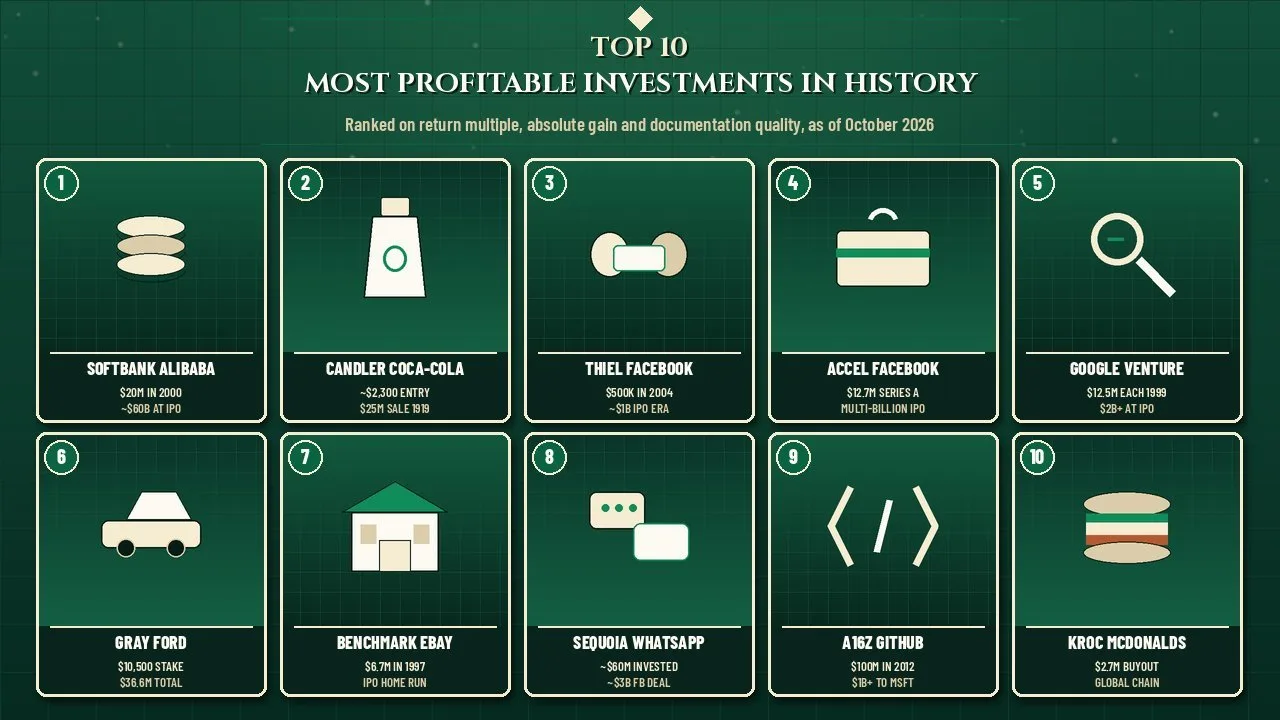
These most profitable investments in history show how small early stakes grew into fortunes, ranked by multiples, absolute gains and clear records.
A profitable investment is not the same as a famous brand. Many household names grew slowly for founders who worked for decades; the deals on this list turned a defined cash stake into a much larger, well-documented outcome. Some were venture rounds of a few million dollars. Others were nineteenth-century formula purchases or early automobile stock. What they share is an auditable starting price, a measurable exit or peak stake value, and a story that still teaches how capital, timing and business model interact.
This Finepedia ranking, written as of October 2026, scores ten single investments by return multiple, absolute dollar gain and how clearly the figures are documented in company histories, regulatory filings and major news archives. It is educational history, not financial advice. Past returns do not predict future results, and none of these outcomes was guaranteed when the cheque was written.
How We Ranked the Most Profitable Investments in History
Each deal was scored from 1 to 5 on three equally weighted criteria, for a total out of 15. Scores are Finepedia's editorial judgement, applied with the same definitions to every entry and checked against at least two reputable sources per core figure (company histories, SEC or stock-exchange disclosures, Reuters, Bloomberg, the Wall Street Journal, the New York Times, Forbes, CNBC, Britannica-level encyclopedic summaries and authorised corporate timelines). Approximate and inflation-adjusted figures are labelled as such. Invented or single-source headlines were left out.
- Return multiple (1 to 5): how many times the original cash stake grew by a clear exit, IPO mark or buyout valuation of that stake. A rough 10x scores low; several-thousand-fold scores high.
- Absolute gain (1 to 5): the scale of wealth created in dollars at the measurement point, so a large modern venture win can outrank a tiny historic cheque that only produced a few million.
- Documentation quality (1 to 5): how firmly the entry price, date, stake size and outcome can be pinned down from independent records. Vague folklore scores lower even if the brand is famous.
When totals tie, the higher Return multiple ranks first, then Absolute gain. Honourable Mentions cover strong deals that missed the cut or sit outside a single defined stake.
The Scorecard
| Rank | Investment | Multiple | Absolute | Docs | Total |
|---|---|---|---|---|---|
| 1 | SoftBank in Alibaba (2000) | 5 | 5 | 5 | 15 |
| 2 | Asa Candler and Coca-Cola (c. 1888 to 1891) | 5 | 4 | 5 | 14 |
| 3 | Peter Thiel in Facebook (2004) | 5 | 4 | 5 | 14 |
| 4 | Accel Partners in Facebook (2005) | 4 | 5 | 5 | 14 |
| 5 | Sequoia and Kleiner Perkins in Google (1999) | 4 | 5 | 5 | 14 |
| 6 | John S. Gray in Ford Motor Co. (1903) | 5 | 3 | 5 | 13 |
| 7 | Benchmark Capital in eBay (1997) | 5 | 4 | 4 | 13 |
| 8 | Sequoia Capital in WhatsApp (2011 to 2013) | 3 | 5 | 5 | 13 |
| 9 | Andreessen Horowitz in GitHub (2012) | 3 | 4 | 5 | 12 |
| 10 | Ray Kroc buying McDonald's (1961) | 3 | 4 | 4 | 11 |
Xiaomi's Morningside stake, Creandum's Spotify Series A and Alibaba's late investment in Ele.me appear in many older round-ups but score lower here on documentation, multiple or clarity of a single original cheque, so they sit in Honourable Mentions rather than the top ten.
Most Profitable Investments at a Glance
| Rank | Deal | Year | Stake (approx.) | Snapshot outcome |
|---|---|---|---|---|
| 1 | SoftBank / Alibaba | 2000 | US$20 million lead | Stake ~US$58 to 75 billion around 2014 IPO |
| 2 | Candler / Coca-Cola | 1888 to 1891 | ~US$2,300 | Company sold for US$25 million in 1919 |
| 3 | Thiel / Facebook | 2004 | US$500,000 | Roughly US$1 billion from IPO-era sales and holdings |
| 4 | Accel / Facebook | 2005 | US$12.7 million | Stake valued in the multi-billion range at 2012 IPO |
| 5 | Sequoia and KP / Google | 1999 | US$12.5 million each | ~US$2 billion-plus each at 2004 IPO price |
| 6 | Gray / Ford | 1903 | US$10,500 | ~US$36.6 million total with 1919 sale |
| 7 | Benchmark / eBay | 1997 | US$6.7 million | Hundreds of millions at IPO; multi-billion peak paper value |
| 8 | Sequoia / WhatsApp | 2011 to 2013 | ~US$60 million total | ~US$3 billion in 2014 Facebook deal |
| 9 | a16z / GitHub | 2012 | US$100 million | Over US$1 billion in 2018 Microsoft deal |
| 10 | Kroc / McDonald's | 1961 | US$2.7 million buyout | Built a global chain; family fortune reported ~US$500 million-plus by 1984 |
1. SoftBank in Alibaba
| Attribute | Details |
|---|---|
| Investor | SoftBank Corp., led by Masayoshi Son |
| Year | 2000 (lead of a US$20 million syndicate into Alibaba.com) |
| Original stake | About US$20 million (later topped up; early cheque is the classic figure) |
| Snapshot outcome | SoftBank stake valued around US$58 billion ahead of the 2014 IPO; near US$75 billion on first-day close marks in contemporary reports |
| Why it ranks first | Extreme absolute gain plus multi-thousand-fold paper multiple on a well-reported cheque |
SoftBank's early bet on Jack Ma's Hangzhou-based marketplace is the clearest modern example of a mid-size cheque that became a corporate fortune. Contemporary Wall Street Journal coverage recorded SoftBank leading a US$20 million investment in Alibaba.com in January 2000. Bloomberg and Reuters later framed that relationship as one of the great internet investments when Alibaba filed to list in the United States in 2014.
Origins and History
Alibaba began as a business-to-business portal linking Chinese manufacturers with overseas buyers. Son has said he backed Ma after a short meeting, comparing the instinct to SoftBank's earlier Yahoo investment. SoftBank kept adding capital and influence as Alibaba expanded into consumer marketplaces, payments and cloud services. Unlike Yahoo, which sold large blocks of Alibaba stock over time, SoftBank held a major stake through the IPO window, which is why press accounts often quote stake values in the tens of billions of dollars rather than a single fully cashed exit.
Key Features
- Clear early cheque size (about US$20 million lead) reported by major business newspapers in 2000
- Long holding period through China's e-commerce boom of the 2000s and early 2010s
- Outcome measured at IPO-era stake value rather than a single overnight sale
- Absolute gain large enough to move SoftBank's own enterprise value
- Lesson often cited in venture history: conviction plus patience on a platform market
Significance
On Absolute gain this deal sits alone at the top of the list. Even if later top-ups blur a pure "US$20 million in, US$60 billion out" ratio, independent 2014 reporting consistently described SoftBank's holding as worth roughly US$50 to 75 billion around the IPO. That scale dwarfs almost every classic venture win and still leaves room for Candler's Coca-Cola multiple and Gray's Ford multiple on the Return score.
Interesting Facts
- Son has repeatedly told the "animal smell" story of trusting Ma after a brief first meeting rather than a full financial model.
- SoftBank did not sell Alibaba shares in the IPO itself, according to contemporary DealBook coverage, so the famous figures are mark-to-market, not realised cash on day one.
- Yahoo's parallel Alibaba stake is a related but separate story and is not scored as SoftBank's deal here.
- Inflation-adjusted comparisons of 2000 dollars to 2014 dollars change the multiple only modestly next to a three-thousand-fold move.
2. Asa Candler and Coca-Cola
| Attribute | Details |
|---|---|
| Investor | Asa Griggs Candler, Atlanta pharmacist and businessman |
| Years | Acquired control in stages from 1888; sole proprietorship by 1891 for about US$2,300 plus interest |
| Original stake | Roughly US$2,300 for the formula, trademarks and manufacturing rights |
| Snapshot outcome | Candler interests sold The Coca-Cola Company to an Ernest Woodruff-led syndicate for US$25 million in 1919 |
| Correction note | Older web lists sometimes say Candler "sold the recipe in 1923 for US$25 million"; company and press records put the US$25 million sale in 1919 |
Coca-Cola's leap from a pharmacy syrup to a global brand is often told as a marketing tale. On this ranking it is a capital tale: a few thousand dollars of late-nineteenth-century purchase price became a US$25 million corporate sale three decades later.
Origins and History
John Stith Pemberton created the early Coca-Cola syrup in Atlanta in the 1880s. Candler bought pieces of the business from Pemberton and other holders between 1888 and 1891. The Coca-Cola Company's own historical materials and archival company stories put total cash outlay for sole control at about US$2,300 plus interest. Candler incorporated The Coca-Cola Company in Georgia, pushed national advertising and bottling, and built syrup sales far beyond Pemberton's pharmacy counter.
In September 1919 a consortium led by Ernest Woodruff bought the company for US$25 million and took it public. Robert W. Woodruff later became the long-running executive face of the firm. That 1919 price, not a 1923 figure, is the documented corporate exit used here.
Key Features
- Extremely small entry price relative to the 1919 sale
- Value created through branding, bottling franchises and national distribution, not a stock-market flip
- Outcome confirmed by company timelines and 1919 press coverage of the US$25 million deal
- Multiple high enough to top almost every modern venture anecdote on a pure ratio basis
- Absolute gain smaller in today's dollars than SoftBank or Accel, which is why it ranks second rather than first
Significance
If the only score were Return multiple, Candler's Coca-Cola purchase would argue for the number-one slot. Roughly US$2,300 into a US$25 million sale is on the order of ten thousand times before counting intervening profits. Absolute gain and the fact that Candler also operated the business for decades keep SoftBank ahead on the combined scorecard, but the educational lesson is the same: owning a scalable consumer formula early can beat almost any later financial engineering.
Interesting Facts
- Candler had been a wholesale druggist; he liquidated much of that business to focus on soft-drink syrup.
- Early Coca-Cola advertising stressed refreshment; later food-and-drug rules changed how ingredients could be described.
- The 1919 buyers listed the company on the New York market; public Coca-Cola shares then became a multi-generation wealth vehicle of their own.
- Warren Buffett's later Berkshire Hathaway Coca-Cola stake (from 1988) is a separate, well-documented public-market investment listed under Honourable Mentions.
3. Peter Thiel in Facebook
| Attribute | Details |
|---|---|
| Investor | Peter Thiel (PayPal co-founder), via an early convertible investment |
| Year | 2004 (commonly dated June 2004 in Reuters timelines) |
| Original stake | US$500,000, later described as converting into about a 10 percent stake at a low single-digit-million valuation |
| Snapshot outcome | Sold roughly 20 million shares after the 2012 IPO lock-up for about US$400 million in that wave; Guardian and other outlets put total IPO-era proceeds near US$1 billion including earlier sales, with a residual holding |
| Correction note | Some 2019 listicles say Thiel invested in 2005 and sold all 25 million shares for US$400 million; filings and reporting put the seed in 2004 and the August 2012 Form 4 sales near 20 million shares, not a clean 25 million share wipe-out |
Thiel's Facebook cheque is the prototype angel outcome of the social-network era: half a million dollars into a Harvard-born startup that became a public giant.
Origins and History
Facebook launched in 2004. Thiel's US$500,000 investment that year is repeatedly described in Reuters timelines and later profiles as an early loan that converted into equity, giving him a large minority stake when the company was still tiny. He joined the board and remained associated with the company through the IPO. After the May 2012 listing and the end of the first lock-up, SEC Form 4 filings showed large Rule 10b5-1 sales in mid-August 2012 at prices near US$19 to US$21 per share.
Key Features
- Very small absolute cheque with board-level access
- Conversion from loan-like instrument into a large early percentage
- Partial, documented public sales rather than a single private buyout
- Multiple still measured in the thousands even using only the ~US$400 million August 2012 sale wave against US$500,000
- Residual shares after those sales mean "sold everything for US$400 million" is an oversimplification
Significance
On Return multiple, Thiel matches Candler's tier even though Absolute gain is far below SoftBank or Accel. The deal also shows why documentation matters: correcting the year and the share-count myth does not shrink the achievement, but it stops readers from memorising a false neat story.
Interesting Facts
- TechCrunch and Reuters coverage in 2012 emphasised that the August sales followed a pre-arranged 10b5-1 plan filed before the IPO.
- Thiel still held on the order of five to six million shares after the main 2012 sales, according to contemporary reports.
- Accel's later, larger cheque (next on this list) produced more absolute dollars for the firm even though Thiel's personal multiple was higher.
- The episode is often taught alongside the earlier PayPal "mafia" network that funnelled talent and capital into consumer internet startups.
4. Accel Partners in Facebook
| Attribute | Details |
|---|---|
| Investor | Accel Partners (lead: Jim Breyer in contemporary accounts) |
| Year | May 2005 Series A |
| Original stake | About US$12.7 million at roughly a US$100 million valuation |
| Snapshot outcome | Stake valued in the multi-billion-dollar range at the 2012 IPO (CNBC, Reuters and Bloomberg cited figures from about US$6 billion upward depending on price assumptions) |
| Role | Often described as Facebook's largest outside institutional shareholder heading into the IPO |
Accel’s 2005 round is the institutional twin of Thiel’s angel cheque: more capital at a higher entry price, still an enormous paper and realised outcome by IPO day.
Origins and History
By 2005 Facebook had left the dorm-room phase and needed institutional capital to scale servers, hiring and international growth. Accel’s roughly US$12.7 million investment for around an 11 percent stake (figures vary slightly by outlet) is one of the most cited Series A wins in venture history. Bloomberg previewed it before the IPO as a candidate for the largest venture profit of its era; Reuters and CNBC later published stake valuations in the multi-billion range at IPO pricing.
Key Features
- Classic Series A size with board influence
- Entry valuation still tiny next to the 2012 public market capitalisation
- Absolute gain larger than Thiel’s personal outcome even at a lower multiple
- Strong documentation through IPO prospectuses and major financial press
- Shows how a "late" early round can still be historic if the market expands enough
Significance
Accel ranks above Google’s venture backers on Absolute gain at the IPO snapshot used here and sits just behind Thiel on Return multiple. Together, items 3 and 4 show that Facebook created more than one hall-of-fame investment inside two years.
Interesting Facts
- Accel planned to sell a portion of its stake in the IPO itself; reported secondary proceeds still left a huge retained holding.
- Jim Breyer’s association with the deal became a recruiting story for later Accel funds.
- The US$100 million post-money figure often quoted for 2005 looks almost quaint next to later private rounds that valued Facebook in the tens of billions before listing.
- This entry replaces weaker-documented Asia consumer deals from older lists that could not clear the documentation bar.
5. Sequoia Capital and Kleiner Perkins in Google
| Attribute | Details |
|---|---|
| Investors | Sequoia Capital (Michael Moritz) and Kleiner Perkins Caufield & Byers (John Doerr) |
| Year | June 1999 Series B |
| Original stake | About US$12.5 million each (US$25 million combined) |
| Snapshot outcome | Each firm’s stake worth roughly US$2 billion-plus at Google’s August 2004 IPO price of US$85; later distributions added more as the share price rose |
| Combined ownership | Contemporary reports put the pair near a quarter of the company (figures vary; some early stories said up to about 40 percent combined) |
Google’s 1999 venture round is the search-era counterpart to SoftBank’s Alibaba bet: two blue-chip Silicon Valley firms splitting a US$25 million cheque that became several billion dollars each by the IPO.
Origins and History
Larry Page and Sergey Brin’s search engine had already left Stanford when Sequoia and Kleiner Perkins invested in June 1999 and joined the board. The New York Times and other outlets later described the US$25 million round as buying on the order of 25 percent of the company. Google delayed a public offering while advertising revenue compounded. When the company listed in August 2004, Washington Post and specialist venture coverage put Kleiner’s and Sequoia’s holdings above US$2 billion each at the US$85 IPO price, with both firms initially planning then pulling back from selling a slice in the offering itself.
Key Features
- Twin US$12.5 million cheques with equal narrative weight
- Multi-year hold through the post-bubble winter of 2000 to 2003
- IPO mark already ~160x on invested capital before later upside
- Unusually strong press and filing trail for a private round
- Board seats that tied capital to governance
Significance
Google scores level with Accel on Absolute gain and just behind on Multiple at the IPO snapshot. If later secondary sales at higher prices were fully aggregated, both firms’ lifetime multiples would look even larger; this ranking sticks to the well-published IPO marks to avoid speculative totals.
Interesting Facts
- Google’s unconventional Dutch-auction IPO design was itself a governance signal from founders who had negotiated hard with their venture backers.
- Sequoia and Kleiner had many failed late-1990s internet bets; Google rescued fund returns for that vintage.
- Alphabet’s later market value makes any 2004 mark look small, but the investment thesis must be judged from the 1999 information set.
- Internal Finepedia reading pairs this story with platform-scale consumer internet history rather than with pure stock-picking.
6. John S. Gray in Ford Motor Co.
| Attribute | Details |
|---|---|
| Investor | John S. Gray, Detroit banker and candymaker; uncle of Alexander Y. Malcomson |
| Year | 1903 (Ford Motor Company incorporation 16 June 1903) |
| Original stake | US$10,500 for 105 shares (10.5 percent) |
| Snapshot outcome | Heirs received about US$10.36 million in dividends over 16 years and sold the stock to Henry Ford in 1919 for US$26.25 million, for about US$36.6 million total return |
| Role | First president of Ford Motor Company until his death in 1906 |
Gray’s Ford stake is the industrial-age anchor of this list: a five-figure cheque into an automobile startup that paid both life-changing dividends and a nine-figure (for its day) buyout.
Origins and History
Henry Ford and coal dealer Alexander Malcomson needed fresh capital after parts suppliers pressed for payment. Malcomson recruited his uncle Gray, whose bank presidency helped attract other Detroit investors. Ford Motor Company launched with 1,000 shares and US$100,000 of capitalised value; Gray’s US$10,500 bought 105 shares and the presidency. The firm paid large dividends within months. Gray died in 1906; his estate kept the shares until Henry Ford bought out minority holders in 1919 while consolidating control. Allan Benson’s early biography of Ford and later summaries based on it record the dividend and sale totals cited above; The Henry Ford’s research guides confirm Gray’s share count and estate timeline.
Key Features
- Exact share count and cash entry price
- Dual return path: dividends plus final sale
- Multiple above 3,000x including dividends on the original US$10,500
- Absolute gain modest by SoftBank standards but enormous for 1919
- Governance role (president) unusual for a passive modern LP
Significance
Gray ranks sixth because Absolute gain lags the internet mega-deals even though Return multiple and Documentation are elite. The story still matters: without patient minority capital, Ford’s early production surge would have looked different, and the 1919 buyouts show how founder control battles crystallise investor exits.
Interesting Facts
- James Couzens, another original investor, separately realised tens of millions in the same 1919 wave; his sister’s tiny loan into his stake is a famous side anecdote.
- Only a fraction of the advertised US$100,000 capital was cash in the bank on day one, according to The Henry Ford’s checkbook research.
- Gray had sold his candy firm to National Candy Company around the same period he entered Ford.
- Inflation comparisons sometimes push the US$36.6 million total toward modern billions; this article treats such conversions as approximate only.
7. Benchmark Capital in eBay
| Attribute | Details |
|---|---|
| Investor | Benchmark Capital |
| Year | June 1997 Series B |
| Original stake | About US$6.7 million |
| Snapshot outcome | Stake worth hundreds of millions after the September 1998 IPO; spring 1999 paper value often cited near US$5 billion in retrospective venture profiles |
| Context | Pierre Omidyar’s auction marketplace scaled as consumer internet adoption exploded |
Benchmark’s eBay investment is the late-1990s consumer marketplace legend: a single-digit-million cheque into a company that listed within roughly a year and then rode a valuation spike.
Origins and History
eBay began as AuctionWeb. Benchmark’s June 1997 financing is documented in investor-rights materials and later firm histories at about US$6.7 million. The company went public in September 1998. Venture retrospectives (including TechCrunch profiles of Benchmark) describe the stake reaching about US$400 million around IPO and climbing toward multi-billion paper value by 1999 as the stock ran. Exact peak realisation depends on distribution timing, which is why Documentation scores a 4 rather than a 5 even though the entry price is solid.
Key Features
- Fast path from Series B to IPO
- Marketplace network effects as the core underwriting thesis
- Multiple measured in the hundreds at IPO and higher at the 1999 peak marks
- Absolute gain large for a 1997 fund cheque
- Brand still operating decades later, unlike many bubble peers
Significance
eBay stays in the top ten because the entry cheque and IPO outcome are repeatedly attested, even if "US$5 billion" is a peak mark rather than a single audited exit. It outranks later food-delivery or smartphone deals that lack a comparably clean public trail.
Interesting Facts
- Meg Whitman joined as CEO in 1998 and became the public face of the scaling years.
- Benchmark’s eBay win helped define the firm’s reputation for concentrated, high-conviction consumer bets.
- Amazon later competed fiercely with eBay in different e-commerce lanes; the two investments are not interchangeable.
- Secondary sales and fund distributions mean limited partners, not only the GP brand, captured much of the gain.
8. Sequoia Capital in WhatsApp
| Attribute | Details |
|---|---|
| Investor | Sequoia Capital (partner Jim Goetz in contemporary accounts) |
| Years | Roughly 2011 seed through later rounds; about US$60 million total capital commonly cited |
| Stake | On the order of 15 to 20 percent by the exit |
| Snapshot outcome | Facebook’s 2014 acquisition valued WhatsApp around US$19 billion; Sequoia’s stake worth about US$3 billion in contemporaneous TechCrunch and Reuters reports |
| Multiple | Roughly 50x on total capital in those accounts |
Sequoia’s WhatsApp holding is a clean twenty-first-century acquisition outcome: tens of millions invested, billions returned when a strategic buyer paid a headline price.
Origins and History
WhatsApp, founded by Jan Koum and Brian Acton, chased reliable mobile messaging with a tiny team and a clear anti-advertising stance in its early years. Sequoia was the primary institutional backer across rounds. When Facebook agreed in February 2014 to buy WhatsApp for about US$19 billion in cash and stock (final accounting varied with Facebook’s share price), Reuters and TechCrunch put Sequoia’s stake near US$3 billion.
Key Features
- Concentrated ownership by one firm
- Product-market fit in mobile messaging before mass advertising models dominated
- Exit via strategic acquisition rather than IPO
- Absolute gain in the same league as classic venture home runs despite a "only" ~50x multiple
- Strong contemporary deal reporting
Significance
WhatsApp ranks eighth because the multiple is lower than Gray, Candler or Thiel, yet Absolute gain and Documentation remain excellent. It also illustrates that a later-stage total of US$60 million can still produce a hall-of-fame absolute outcome when the buyer is a platform paying for users and engagement.
Interesting Facts
- Sequoia’s own essays later highlighted user growth and engagement metrics that justified the Facebook price.
- Acton and Koum’s employee and founder proceeds created additional Silicon Valley fortunes outside the VC stake scored here.
- The deal closed into a period of intense mobile platform consolidation.
- This entry displaces Ele.me-style late corporate investments that read more like strategic M&A than classic early-stake compounding.
9. Andreessen Horowitz in GitHub
| Attribute | Details |
|---|---|
| Investor | Andreessen Horowitz (a16z) |
| Year | 2012 Series A (US$100 million at about a US$750 million valuation in contemporaneous reports) |
| Follow-on | Participated in later rounds; stake often cited near mid-teens percent by exit |
| Snapshot outcome | Microsoft bought GitHub in 2018 for US$7.5 billion; a16z’s stake reported above US$1 billion |
| Early scepticism | Some commentators called a US$100 million developer-tools round frothy in 2012 |
GitHub is the developer-infrastructure proof that tools businesses can produce venture-scale exits when they become default industry workflow.
Origins and History
GitHub hosted Git repositories and social coding workflows that spread through open-source and corporate engineering teams. Andreessen Horowitz’s 2012 investment of US$100 million was unusually large for a developer tool at the time. When Microsoft announced the US$7.5 billion acquisition in June 2018, Vox, Forbes and other outlets described a16z’s holding as worth more than US$1 billion, turning early scepticism into a case study.
Key Features
- Large early cheque relative to category norms
- Network effects among developers rather than mass consumers
- Exit to a strategic buyer integrating cloud and enterprise sales
- Roughly order-of-magnitude multiple on the original US$100 million, amplified by follow-ons
- Clean public deal price (US$7.5 billion)
Significance
GitHub ranks ninth: Absolute gain is strong, Multiple is solid but not Candler-like, and Documentation is excellent. It earns a place over flashier consumer names whose investor maths never appeared in primary filings or tier-one deal reports.
Interesting Facts
- Microsoft’s purchase was one of the largest U.S. venture-backed software acquisitions of its decade.
- GitHub continued as a relatively distinct brand inside Microsoft’s developer cloud strategy.
- The deal minted new wealth for founders and early employees beyond the a16z stake.
- Developer tools have since attracted many large rounds; few have matched this exit clarity.
10. Ray Kroc Buying McDonald's
| Attribute | Details |
|---|---|
| Buyer | Ray Kroc, milkshake-machine salesman turned franchising chief |
| Year | 1961 |
| Price | US$2.7 million cash for the McDonald brothers’ interest in the name and system (widely cited by PBS, Chicago encyclopedias and business histories) |
| Snapshot outcome | Kroc scaled McDonald’s into a global franchise chain; contemporary obituaries in 1984 described a family fortune on the order of US$500 million or more |
| Caveat | This is a full buyout of the brand rights, not a minority venture stake; the "return" is entrepreneurial equity in the company he built, not a simple 1961-to-1984 share multiple |
Kroc’s purchase closes the list because it is famous, reasonably documented and economically enormous, yet it is a different animal from a Sequoia-style minority cheque.
Origins and History
Richard and Maurice McDonald had already refined a fast hamburger system in San Bernardino when Kroc joined as a franchising partner in the 1950s. In 1961 he bought them out for US$2.7 million after raising cash with help from advisers such as Harry Sonneborn. Kroc emphasised real-estate structure, operational uniformity and national expansion. By his death on 14 January 1984, McDonald’s had thousands of restaurants worldwide; the New York Times obituary discussed a family fortune of about US$500 million or more.
Key Features
- Clear headline purchase price (US$2.7 million)
- Value created mostly after the buyout through systems and franchising
- Outcome measured as entrepreneurial net worth, not a fund distribution
- Cultural permanence of the brand
- Lower Documentation score than Ford or Google because personal net-worth figures are estimates
Significance
Kroc ranks tenth rather than higher because Absolute gain is partly inseparable from decades of operating work, and because net-worth estimates are softer than IPO filings. Older articles that claim a neat "US$500 million return in 1984" as if it were a stock sale overstate what obituaries actually said. The durable lesson remains: buying and industrialising a proven operating system can rival financial-market home runs.
Interesting Facts
- The brothers reportedly preferred cash to stock, a choice that became a famous counterfactual in business folklore.
- Sonneborn’s franchise-real-estate insight is often credited as the financial engine beneath the brand.
- McDonald’s Thanksgiving parade association and global store count made the company a cultural symbol beyond its financials.
- This ranking deliberately does not invent an exact ROI multiple for Kroc’s personal estate.
Honourable Mentions
| Deal | Why it is notable | Why it missed the top ten |
|---|---|---|
| Berkshire Hathaway in Coca-Cola (from 1988) | Roughly US$1.3 billion cost basis into a stake worth tens of billions plus huge cumulative dividends | Public-market averaging over years rather than a single early private cheque |
| Berkshire Hathaway in Apple (2016 onward) | Cost basis and market value disclosed in Berkshire annual reports; enormous absolute profit even after partial sales | Same public-averaging issue; multiple far below Candler or SoftBank |
| Creandum in Spotify (2008 Series A) | About US$4.5 million for roughly 6 percent; ~US$370 million mark at 2018 listing (~80x) in Bloomberg-linked accounts | Strong but smaller absolute gain than WhatsApp or Accel |
| Morningside in Xiaomi | Often described as a large winner into the 2018 IPO | Entry size and exact multiple less consistently reported in tier-one English sources consulted for this piece |
| Alibaba in Ele.me (2016 era) | Strategic food-delivery bet later folded into Alibaba’s local services | Late corporate primary investment; order-volume anecdotes are not the same as a cleared stake multiple |
| James Couzens in Ford | Another original 1903 investor with a vast 1919 outcome | Overlaps Gray’s story; Gray’s presidency and fully tallied estate figures were used as the Ford exemplar |
Frequently Asked Questions
What counts as one of the most profitable investments in history on this list?
A single, identifiable capital stake with a documented entry price and a documented exit, IPO mark or buyout value for that stake. Founder sweat equity without a cash basis, vague brand folklore and broad index returns are excluded. Scores combine return multiple, absolute gain and documentation quality.
Are these results typical for venture capital or angel investing?
No. These are extreme outliers. Most early-stage investments fail or return little. The examples are teaching cases in selection bias: history remembers SoftBank and Thiel, not the silent losses in the same funds and angel networks.
Why were Xiaomi, Spotify and Ele.me moved out of the top ten?
They remain interesting, but Accel’s Facebook round, SoftBank’s Alibaba stake and Sequoia’s WhatsApp exit cleared higher combined scores on absolute dollars, multiples or source clarity. Honourable Mentions keeps them visible without forcing weak maths into the main ranking.
Did Asa Candler really sell Coca-Cola in 1923 for US$25 million?
No. Company timelines and 1919 press put the Woodruff syndicate purchase at US$25 million in 1919. Candler’s earlier acquisition cost of about US$2,300 remains the right entry figure; only the sale year in some 2019 web lists is wrong.
Is this article financial advice?
No. It is historical education. Past returns do not predict future results. Nothing here is a recommendation to buy any security, join any fund or copy any investor’s strategy.
How were inflation adjustments handled?
Sparingly. Where older articles quote modern inflation-adjusted billions for Ford or Candler, this piece treats them as approximate illustrations only and prefers nominal figures from primary reporting. Absolute-gain scores already favour large modern dollar outcomes where appropriate.
Where can readers learn related Finepedia context?
See Finepedia’s biography of Warren Buffett for value-investing context, the Top 10 social media apps list for platform-scale consumer internet background, and the business-owner lessons list for practical operating themes that sit beside these capital stories.
Conclusion
The most profitable investments in history on this scorecard stretch from a US$2,300 soft-drink formula purchase to SoftBank’s Alibaba fortune and the Facebook cheques that defined social-network venture returns. Multiples favour Candler, Gray and Thiel; absolute dollars favour SoftBank, Accel and Sequoia’s modern exits. Documentation separates durable lessons from recycled listicle errors such as the wrong Coca-Cola sale year or a tidied Facebook share count.
None of these deals was safe when the capital went in. Each combined a scalable business model with timing, governance and, often, sheer luck. For readers building companies rather than trading folklore, the useful pattern is simpler than the rankings: write down the entry price, track the stake honestly, and remember that history’s highlight reel is not a base rate. For more Finepedia context on long-term capital allocators and platform businesses, see Warren Buffett: The Sage of Omaha and Value Investing Pioneer, Most Popular Social Media Apps and Sites: Top 10 and Things to Know as a Business Owner: 10 Essential Lessons.
- SoftBank / Alibaba: Wall Street Journal, 18 Jan 2000, Softbank to invest US$20 million in Alibaba.com; Bloomberg, May 2014, SoftBank Alibaba stake valued around US$58 billion; New York Times DealBook, 22 Sept 2014, SoftBank stake near US$75 billion on first-day marks; Reuters, Aug 2014, SoftBank–Ma background
- Coca-Cola / Candler: The Coca-Cola Company historical pages on the Asa Candler era and 1919 Woodruff purchase; company archive story on Candler’s ~US$2,300 acquisition; contemporary 1919 press on the US$25 million sale
- Facebook / Thiel: Reuters Facebook timeline (US$500,000 in June 2004); Guardian and TechCrunch, Aug 2012, sales of ~20 million shares / ~US$400 million wave; SEC Form 4 filings mid-Aug 2012
- Facebook / Accel: Reuters and CNBC IPO investor explainers, May 2012; Bloomberg preview of Accel’s potential venture profit, Jan 2012
- Google / Sequoia and Kleiner Perkins: New York Times, 26 Apr 2004; Washington Post, 20 Aug 2004; contemporaneous IPO ownership reporting (~US$12.5 million each in 1999)
- Ford / Gray: Wikipedia summary citing Allan L. Benson, The New Henry Ford (1923); The Henry Ford research guide on early stockholders; Harry Barnard, Independent Man (Couzens biography)
- eBay / Benchmark: Benchmark firm histories and TechCrunch retrospective coverage of the 1997 US$6.7 million investment and IPO-era stake values
- WhatsApp / Sequoia: Reuters, 21 Feb 2014; TechCrunch, Feb 2014, Sequoia stake ~US$3 billion in ~US$19 billion Facebook acquisition
- GitHub / Andreessen Horowitz: Vox and Forbes, June 2018, Microsoft US$7.5 billion acquisition and a16z stake above US$1 billion; a16z announcements
- McDonald’s / Kroc: PBS They Made America; Encyclopedia of Chicago; New York Times obituary, 15 Jan 1984
- Reference awareness: https://10mosttoday.com/most-profitable-investments-in-history/ (Sept 2019; factual errors corrected above)
- Internal Finepedia links verified 200 on 2026-10-15: https://finepedia.com/post/warren-buffett-the-sage-of-omaha-and-value-investing-pioneer ; https://finepedia.com/post/most-popular-social-media-apps-and-sites-top-10 ; https://finepedia.com/post/things-to-know-as-a-business-owner-10-essential-lessons
















Log in with